
Suppose your maths teacher bans calculators for a day but leaves one chart on the classroom wall: the powers of 2. Row 0 holds 1, and every row below holds double the one above it: 1, 2, 4, 8, 16, and on down to row 20, which holds 1,048,576. Then the teacher writes a sum on the board: 4,096 × 256.
You could multiply it out on paper. Or you could notice something about the chart that lets you find the answer by adding two small numbers in your head. For about 350 years, from 1614 until pocket calculators arrived in the 1970s, scientists, engineers and navigators multiplied that way, with a much bigger book of numbers or a sliding ruler made from one.
Guess first. 4,096 is in row 12 and 256 is in row 8. In which row will you find 4,096 × 256?
Pick an answer to see why.
Multiplying by adding
The row number of a number in the chart counts how many 2s are multiplied to make it. Row 5 holds 32, because 2 × 2 × 2 × 2 × 2 = 32. In the language of Grade 9’s indices, row n holds , and the row number is the index (or exponent). The law you already know, , says that multiplying two numbers of the chart means adding their rows.
The other laws of indices give the chart more tricks. Dividing takes 2s away, so it subtracts rows: . A square root is the number that, times itself, gives the number back, so it is half the row: , since . A cube root is a third of the row. Long multiplication becomes addition, division becomes subtraction, and the dreaded square and cube roots become halving and dividing by 3.
The German mathematician Michael Stifel printed a table like this in 1544, the numbers in one row and the counts n above them, and pointed out that multiplying numbers in the bottom row is adding the counts above them. It was his word, exponent, that we still use. But his table had a fatal snag.
Which of these can the powers-of-2 chart do, by adding or subtracting rows?
Pick an answer to see why.
Filling the gaps
The chart’s rows are too far apart because each one is double the last. What if each row were only a little bigger than the last? Start at 1 and multiply by 1.1 each time: 1, 1.1, 1.21, 1.331, 1.4641, … The rows creep up instead of leaping, so every number has a row close to it. The rule still holds, because row n is still and .
Here is what 3 × 7 = 21 gives in each book. The second column says how many rows the book needs just to climb from 1 to 10.
| Each row times | Rows from 1 to 10 | Rows of 3 and 7 | Answer read | Off by |
|---|---|---|---|---|
| 2 | about 3.3 | 2 + 3 = 5 | 32 | 52 % |
| 1.1 | about 24 | 12 + 20 = 32 | 21.11 | 0.5 % |
| 1.01 | about 231 | 110 + 196 = 306 | 21.006 | 0.03 % |
| 1.0001 | about 23,027 | 10,987 + 19,460 = 30,447 | 21.0005 | 0.003 % |
The closer the ratio is to 1, the closer every answer comes, and the thicker the book. A book with ratio 1.0001 needs 23,027 rows to get from 1 to 10, but no answer read from it can be off by more than about 0.01 %: each number is within half a step of its row, so the row numbers’ sum is out by at most one step, and one step is 1.0001 times, a change of 0.01 %.
Logarithms: rows counted in powers of 10
Bürgi’s book works, but its row numbers are awkward: 10 is in row 23,027.0022 and 100 in row 46,054.0044. The idea that made the book easy to use came from the English professor Henry Briggs after reading John Napier’s book of 1614 (the story is below): number the rows so that 10 sits in row 1 exactly, 100 in row 2, 1,000 in row 3, and fill in every row in between.
Then the row number of any positive number x is the power you must raise 10 to, to get x. That number is the logarithm of x (to the base 10, the common logarithm), written :
So , and . Napier made up the word from Greek logos, ratio, and arithmos, number: a “ratio-number”, counting how many equal ratios (steps of the same times-size) it takes to get from 1 to x.
The logarithm and the power undo each other, the way squaring and square-rooting do: for every positive x, and for every n. Each is the inverse of the other. That is all a book of logarithms is: a table of read backwards.
What a row like 0.30103 means
The rows between 1 and 10 have fractional numbers. What could mean, “10 multiplied by itself half a time”? Grade 10’s indices answer it: two half steps make one step, so , and . So . In the same way , and : the row of 2 is 0.30103. A fractional index is exactly the tool that fills the gaps between the whole powers.
Why the book only needs the numbers from 1 to 10
Every positive number can be written as a number from 1 to 10 times a power of 10 (Grade 8’s scientific notation): . Multiplying adds rows, so
The whole-number part, 3, is the characteristic: it only says where the decimal point goes, and you can read it from the number of digits. The part after the point, 0.4971, is the mantissa, and it is the same for 3.141, 31.41 and 3,141,000. A number below 1 works the same way with a negative characteristic: , so , which is −1.5029. The old tables kept the mantissa positive and wrote it (“bar two point 4971”), the bar meaning that only the 2 is negative.
So a book of logarithms only lists the mantissas of the numbers from 1 to 10, and that one book serves every number there is. The common school book was a four-figure table (mantissas to 4 decimal places, for numbers of 3 or 4 figures), with a second table, of antilogarithms, for going back from a logarithm to its number.
Given , what is ?
Pick an answer to see why.
Using the book
Here are the few lines of a four-figure table we need (each mantissa rounded to 4 places, as the tables printed them):
| Number | 1.08 | 1.25 | 2.86 | 3.68 | 3.69 | 4.37 | 5.00 |
|---|---|---|---|---|---|---|---|
| Logarithm | 0.0334 | 0.0969 | 0.4564 | 0.5658 | 0.5670 | 0.6405 | 0.6990 |
Why adding the rows always works
Here is the proof, using nothing but the laws of indices. Take any two positive numbers a and b, and call their logarithms p and q. That means and . Then
In the same way and , which give the other two laws of logarithms:
The last one holds for fractional n too, which is why a square root halves the logarithm () and a cube root thirds it.
Any base will do
Nothing above needed 10 in particular. The chart on the wall is a table of logarithms to the base 2: the row of x is , the power you raise 2 to, to get x. Bürgi’s rows are logarithms to the base 1.0001. All these books are the same book with the rows renumbered. If , take common logarithms of both sides: , so
This is the change of base rule, . Bürgi’s row numbers are the common logarithms multiplied by , about 23,027: his row for 2 is 23{,}027.0022 × 0.30103, about 6,931.8.
The same step solves any equation with the unknown in the index. Grade 10 solves by making the bases match. Logarithms solve it when they can’t: how many times must Rs 1 double to pass 1 crore?
How do you write the book?
A book of logarithms is easy to use and terribly hard to make. Where does 0.30103 come from, with no calculator? Try it before reading on: you can find to two places in your head.
The trick is a power of 2 that is almost a power of 10: , very nearly . So , and . The true value is 0.30103. Then the laws give more for free: , , and .
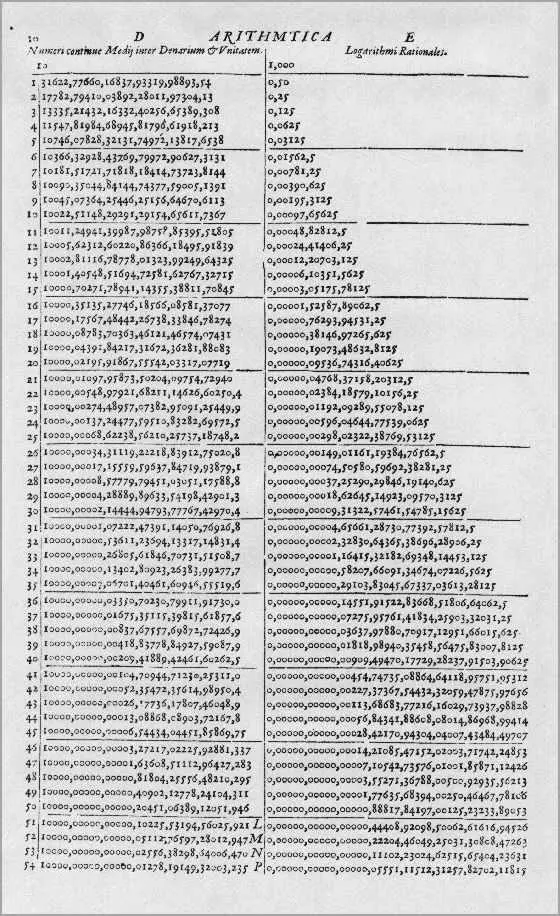
Briggs used the same trick (he started from ), and another one. Since a square root halves the logarithm, , , and so on. Briggs took the square root of 10, then the square root of that, 54 times in a row, the last ones to more than 30 decimal places, by hand. The 54th root is 1.000 000 000 000 000 127 8…, and its logarithm is . Near 1, he noticed, the logarithm is simply proportional to how much the number exceeds 1, and from there he could work out the logarithm of any number. In 1624 his Arithmetica Logarithmica gave the logarithms of 1 to 20,000 and 90,000 to 100,000, to 14 decimal places.
The ruler that multiplies
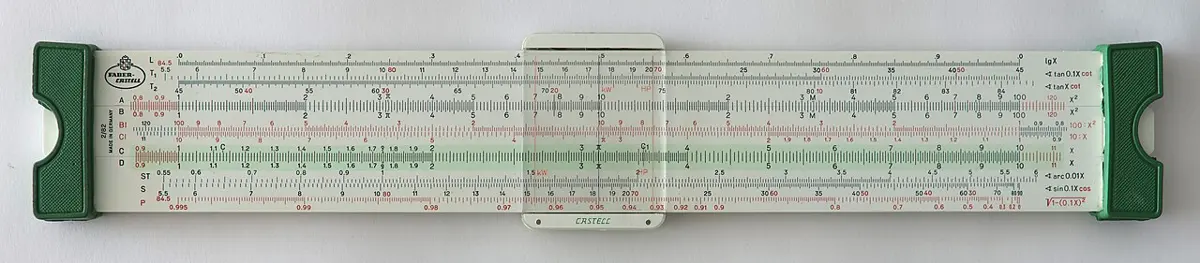
A table needs looking up. In 1620 Edmund Gunter, professor of astronomy at Gresham College in London, put the logarithms on a ruler instead: he marked each number 1, 2, 3, … 10 at a distance from the end equal to its logarithm (on a 25 cm scale, 2 sits 0.30103 × 25 ≈ 7.5 cm along, 3 at 11.9 cm). Distances on that ruler are logarithms, so adding two distances adds two logarithms. Around 1622 the English clergyman William Oughtred slid two such rulers against each other, and the slide rule was born.
The two rulers do exactly what the book does, without the looking up. Sliding puts the length on D before the length on C, so the cursor stands at the length , and D is marked 6 there. A scale like this is the graph of laid flat along a line: each number at the height its logarithm would have.
That last question shows how people used slide rules: the rule gives about three figures, and the user places the decimal point by a rough estimate. For an engineer designing a bridge or a navigator plotting a course, three figures were usually enough, and a slide rule was far quicker than a book.
Where this is used
Logarithms as a tool for calculating disappeared within a decade. Logarithms themselves did not:
- Every computer stores numbers the way the book did. A computer keeps a decimal number like 0.000123 as a significand times a power (of 2, inside the machine): the power plays the role of the characteristic, and the old word mantissa is still used for the significand, though it means something slightly different there.
- Solving equations with the unknown in the power: how long a loan takes to double, how long until a population or a sum of money passes a target, how old a fossil is from the carbon left in it. Every one of them is solved by taking logarithms, as with the crore above.
- Scales that go up by multiplying: the earthquake magnitude, sound in decibels and acidity as pH all count powers of 10. That is a topic of its own (below).
Questions
What is ?
Pick an answer to see why.
Use the powers of 2 to find 8,192 × 128 and 1,048,576 ÷ 8,192, adding or subtracting rows only.
Hint
Answer
Given and , find , , , , and .
Hint
Answer
A number’s count of digits is its characteristic plus 1. How many digits do and have? Use and .
Hint
Answer
At 8 % a year, compounded yearly, how many years does it take money to double? Bankers use the “rule of 72”: divide 72 by the rate. How well does it do here?
Hint
Answer
On a slide rule, someone works out 3.15 × 4.25 and the cursor reads 1.34 on D. What is the answer?
Pick an answer to see why.
Prove that for positive x and b (b ≠ 1). Why must b not be 1?
Hint
Answer
The largest prime number known (as of 2026), found in 2024, is . How many digits does it have? First use , then . What do you notice?
Hint
Answer
Where to go next
- Why Is a Magnitude 8 Earthquake Not Just a Bit Bigger Than a 7? Logarithms as a scale for measuring things that range over many powers of 10.
- What Is e, and Why Does Growth Keep Finding It? The other famous base, and how Napier’s logarithms are tied to it.
- What Is the Biggest Number Anyone Has Used? Numbers so big that even their logarithms are too big to write.
- How Did People Multiply Before Calculators? (Grades 6–8) Doubling and halving, the lattice and Napier’s bones: the ways before logarithms.
- How Much Rice Is on the Chessboard? (Grades 6–8) The powers of 2, and how fast they grow.
- How Does a Calculator Find a Square Root? (Computing, Going Further 9–12) What a machine does in place of Briggs’s 54 square roots.
- How Did a Rounding Error Stop a Missile Defense? (Computing, Going Further 9–12) Numbers stored as a significand and a power, and what their rounding can cost.
- Grade 10, Indices: the laws of indices and fractional indices that this page builds on, and Compound Interest.
Where these facts come from
- Napier’s Descriptio of 1614, Wright’s English translation of 1616 and the quotations from its preface, Napier’s years at Gartness and his use of sines, Briggs’s journey of at least four days to Edinburgh, logarithms in Kepler’s work: MacTutor, “John Napier”, read October 2026.
- Briggs’s dates, his letter of 10 March 1615 (“saw a book which pleased me better or made me more wonder”), the visits of 1615 and 1616, as Napier’s proposal (“by far the most convenient”), the Arithmetica Logarithmica of 1624 (1 to 20,000 and 90,000 to 100,000, 14 places), Vlacq’s edition of 1628: MacTutor, “Henry Briggs”, read October 2026.
- Briggs’s first table of 1617 (1 to 1,000, 14 places), his 54 successive square roots of 10 and their logarithms , the 54th root’s digits, his start from 1.024, his proportionality near 1: Denis Roegel, “A reconstruction of the tables of Briggs’ Arithmetica logarithmica (1624)”, LOCOMAT, 2011 (revised 2014), read October 2026.
- Bürgi’s table of for n from 0 to 23,027 to 9 digits, made about 1600, printed in Prague in 1620, 58 pages, red and black numbers, the “whole red number” 23,027.0022, the error count (91.5 % exact, 7.3 % rounded the wrong way, the rest mostly typesetting slips); Stifel’s table of 1544 and the word exponent: Jörg Waldvogel, “Jost Bürgi and the discovery of the logarithms”, Elemente der Mathematik 69 (2014), 89–117, read October 2026.
- Bürgi’s dates and Kepler’s urging him to publish: MacTutor, “Jost Bürgi” and Wikipedia, “Jost Bürgi”, read October 2026.
- Napier’s 20 years of computation, Kepler’s words on Bürgi in the Rudolphine Tables (1627) and his Ephemeris dedicated to Napier, the end of the tables with the calculators of the 1970s: Wikipedia, “History of logarithms”, read October 2026.
- The word logarithm from logos and arithmos, characteristic and mantissa, tables of mantissas, the slide rule as sliding scales that add logarithms: Wikipedia, “Logarithm”, read October 2026.
- Laplace’s words as quoted in H. Eves, In Mathematical Circles (1969): MacTutor, “Quotations by Pierre-Simon Laplace”, read October 2026. We could not find the place in Laplace’s own works.
- Gunter at Gresham College from 1619, his logarithmic rule: MacTutor, “Edmund Gunter”; Oughtred a clergyman, rector of Albury: Wikipedia, “William Oughtred”, read October 2026.
- Gunter’s scale of 1620, Oughtred’s slide rule of about 1622, about three significant figures and the user placing the decimal point, Pickett slide rules on Apollo, the HP-35 of 1972 at US$395, slide rules obsolete by about 1974, the E6-B still in daily use: Wikipedia, “Slide rule”, read October 2026.
- The E6-B as a circular slide rule for fuel burn, wind correction and time en route, still taught by many flight schools: Wikipedia, “E6-B flight computer”, read October 2026.
- The significand, also called the mantissa, and the difference from a logarithm’s mantissa: Wikipedia, “Significand”, read October 2026.
- The largest known prime, , 41,024,320 digits, found on 12 October 2024: Wikipedia, “Largest known prime number”, read October 2026.
- Photos from Wikimedia Commons: Napier’s page, public domain; Briggs’s roots of 10 by Phidus, CC BY-SA 4.0; the Faber-Castell 2/82 by Slashme, CC0.
- Every number on this page (the chart’s sums, the four books’ answers for 3 × 7 and their rows to 10, the table entries and the three examples, the near-miss logarithms, Briggs’s 54th root, the doublings to a crore, the digit counts and the questions’ answers) was computed in a script.