
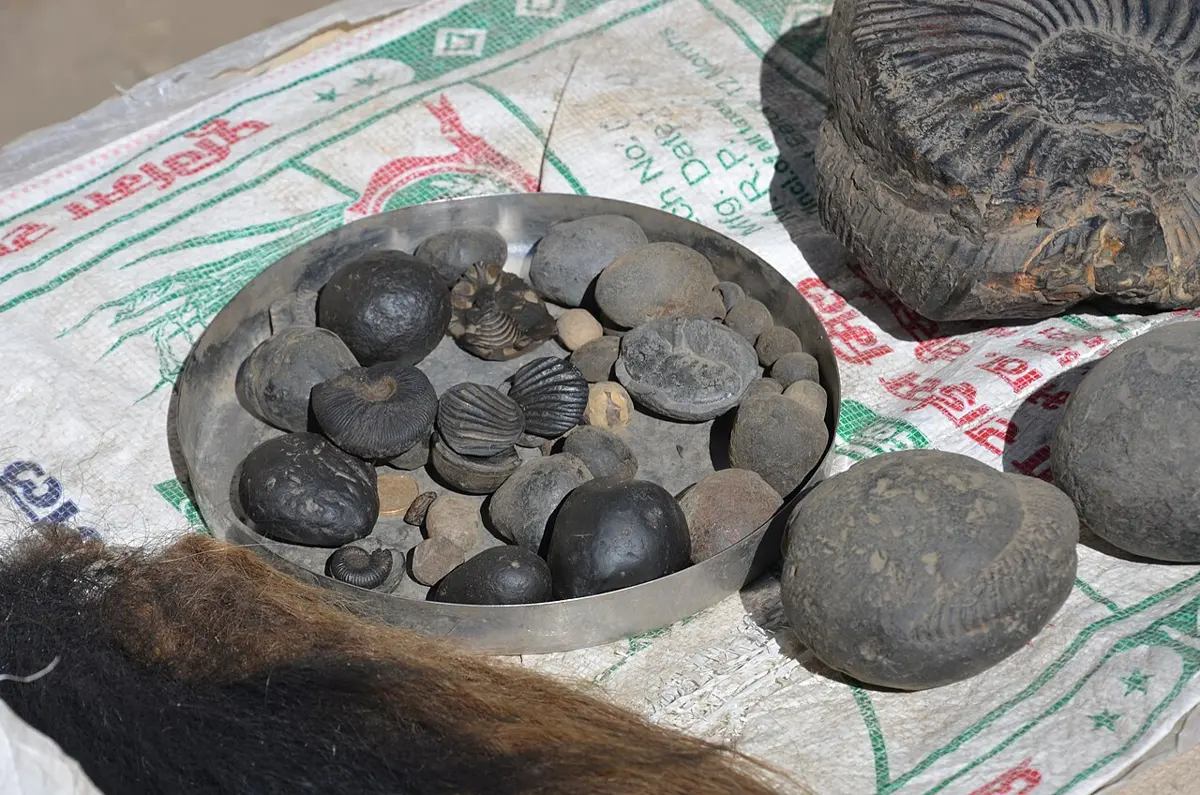
High on the banks of the Kali Gandaki, pilgrims pick up smooth black stones from the river. Crack one open, and inside there may be a perfect spiral shell: a shaligram, worshipped in homes all over Nepal. But how did the shell of a sea animal get into the Himalaya, thousands of kilometers from the nearest sea? The answer is part of one of the biggest ideas in science: the story of how living things, and the Earth itself, have changed over an unimaginably long time.
Scientists today understand that the many kinds of organisms on Earth, from bacteria and Amoeba to mammals and flowering plants, came from simpler ancestors, changing slowly as their environment changed. Every organism differs from every other. Humans and elephants are both land-living mammals with backbones, yet they are very different; people living in different parts of the world differ in skin color and height; thousands of flowering plants of the same group differ from each other. These differences built up over a very long time, as living things adapted to the land, the weather and the other living things around them.
4.1 Introduction to evolution
We learn about ancient organisms mainly from their fossils. By comparing the fossils, and the features of living things that are alike and different, scientists have worked out that very simple organisms appeared on Earth first.
Evolution is the slow change in living things over many generations, by which new species arise from earlier ones. Over the history of life, it has generally led from simple forms to more complex ones.
The story of life, in short
- The Earth formed about 4,600 million years ago. At first it was far too hot, and its air poisonous, for anything to live.
- Slowly the Earth cooled. Water vapor condensed and fell as rain for a very long time, making the oceans.
- In the water, simple substances reacted together, powered by lightning, volcanic heat and sunlight, and made organic molecules, the building blocks of living things.
- Out of these, the first simple cells arose, more than 3,500 million years ago: prokaryotes, like bacteria.
- Much later, around 2,000 million years ago, the more complex eukaryotic cells, with a nucleus, appeared. Single-celled plant-like and animal-like organisms followed.
- Then multicellular organisms evolved, as the environment kept changing.
Among animals, simpler invertebrates came first: animals like Hydra, flatworms, earthworms, snails, insects and starfish. Fish were the first vertebrates (the seahorse is a fish too). Some fish gave rise to amphibians, which could live on land as well as in water; amphibians gave rise to reptiles, and reptiles to birds and mammals, among them horses, elephants and humans.
Among plants, multicellular algae came from single-celled algae; then came bryophytes (mosses), the first land plants; then pteridophytes (ferns); then the seed plants: the gymnosperms, like pine, which have seeds but no flowers, and finally the flowering plants, the angiosperms.
All these changes together are what we call evolution.
Which group of plants evolved last?
Pick an answer to see why.
4.2 Evidences of organic evolution
How do we know that living things evolved? Many different kinds of evidence point the same way. The main ones are:
A. Evidence from fossils
The remains, parts or traces of animals and plants that lived long ago, preserved in rocks, are called fossils: a bone, a tooth, a shell, a leaf print, a footprint. The study of fossils is paleontology (and of plant fossils, paleobotany). Fossils show us organisms that lived millions of years ago, so they are the strongest evidence of evolution.
Fossils are found in sedimentary rocks, the rocks made of layers of mud and sand. This is how a fossil forms:
- A plant or animal dies, and rivers carry its body, with soil, sand and gravel, into a lake or the sea, where it settles on the bottom.
- It is quickly buried in mud and sand. The soft parts (flesh, muscles) rot away; the hard parts (bones, teeth, shells, wood) remain.
- More and more layers pile up on top over millions of years. Their weight presses the lower layers into sedimentary rock.
- Water seeping through the rock slowly replaces the bone or shell with minerals, copying its shape in stone. Or the body rots away and leaves its shape as a hollow, a mold, which may fill with minerals.
- Much later, movements of the Earth can lift the rock up, and rain and rivers wear it away until the fossil is found.
The layers of sedimentary rock are laid down one on top of the other, so the deeper a layer, the older it is. And the order of the fossils in them matches evolution: the lowest (oldest) layers have only fossils of simple organisms like algae and bacteria; higher up come invertebrates, then fish, then amphibians and reptiles; and only the upper (youngest) layers have mammals. That is why fossils are given so much importance as evidence of evolution.
The age of a rock or fossil can be measured with radioactive dating. Carbon dating works for remains up to about 50,000 years old; for older rocks, millions or billions of years old, scientists use uranium dating (and other elements) instead.
In undisturbed layers of sedimentary rock, where would you expect to find the oldest fossils?
Pick an answer to see why.
B. Evidence from comparative morphology and anatomy
Compare the bodies of different organisms (their outer form, morphology, and inner structure, anatomy), and you find that, under their differences, many have the same basic plan. That suggests that they came from the same ancestors.
1. Homologous and analogous organs
The skeletons of vertebrates are made of bones arranged in the same pattern. Look at a human arm, a horse’s front leg, a bat’s wing and a whale’s flipper. They do very different jobs (grasping, running, flying, swimming) and look very different. Yet each has the same bones, in the same order: one upper-arm bone (humerus), two forearm bones (radius and ulna), wrist bones (carpals), palm bones (metacarpals) and finger bones (phalanges).
Organs that have the same basic structure and origin in the embryo, but do different jobs, are called homologous organs. The simplest explanation is that these animals evolved from a common ancestor, and its limb changed in different ways in each line. (Strictly, organs with the same origin are homologous whatever their job: our ear and a rabbit’s are too. But organs doing different jobs are the clearest evidence, so they are the examples to give.)
Bones: BodyParts3D, DBCLS (CC BY 4.0), reshaped for each animal
Now compare the wings of a butterfly, a bird and a bat. All three are used for flying, but the wings are built in different ways: an insect’s wing is a thin sheet with veins and no bones; a bird’s wing is feathers on arm bones; a bat’s wing is skin stretched between very long finger bones. Organs that do the same job but have a different structure and origin are called analogous organs. They show that different groups of animals, with different ancestors, can evolve similar solutions to the same problem.
Dragonfly: Pearson Scott Foresman; bird: L. Shyamal after Blanche Stillson (both public domain)
Bat’s bones: BodyParts3D, DBCLS (CC BY 4.0), reshaped for a bat
A bird’s wing and a bat’s wing are analogous as wings. But as forelimbs, they are:
Pick an answer to see why.
2. Vestigial organs
Some organs in our body are small and do little or nothing now, while in other animals the same organs are large and useful. They are left over from our ancestors, in whom they worked. Such organs are called vestigial organs.
Vestigial organs in humans include:
| Vestigial organ in humans | Where it is useful |
|---|---|
| tail bones (coccyx), at the end of the backbone | the tails of monkeys and most other mammals |
| ear muscles, which can move the outer ear | dogs, horses and cows swivel their ears towards a sound |
| vermiform appendix, a small tube on the gut | a long one helps plant-eaters like rabbits digest grass |
| plica semilunaris, a small pink fold in the inner corner of the eye | the nictitating membrane, a see-through third eyelid that sweeps across the eye in birds, reptiles and cats |
| wisdom teeth (third molars) | big jaws for chewing tough raw food |
| body hair and goosebumps | fur that fluffs up for warmth, or to look bigger |
Body and intestines: BodyParts3D (CC BY 4.0); ear and teeth: Gray’s Anatomy (public domain)
Skin: D. J. Wong and H. Y. Chang, StemBook (CC BY 3.0)
Eye: traced from a photo by Exordium (CC BY-SA 3.0); this tracing is CC BY-SA 3.0 too
From such organs we can guess what our ancestors were like: they had tails and ears they could move, they ate much more tough plant food (in bigger jaws with more teeth), and they had more hair. Vestigial organs make sense only if we evolved from ancestors in whom these organs worked. They show that humans and apes evolved from common ancestors.
C. Evidence from connecting links
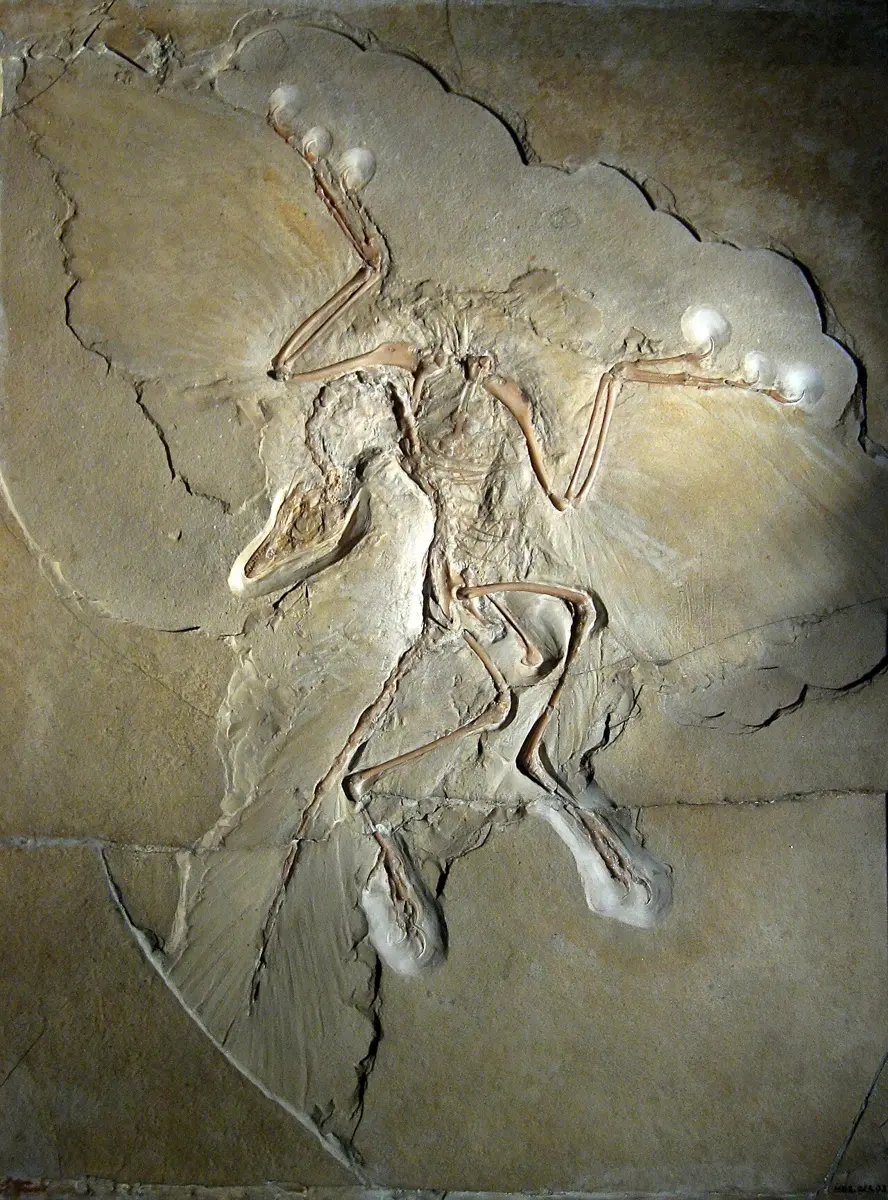
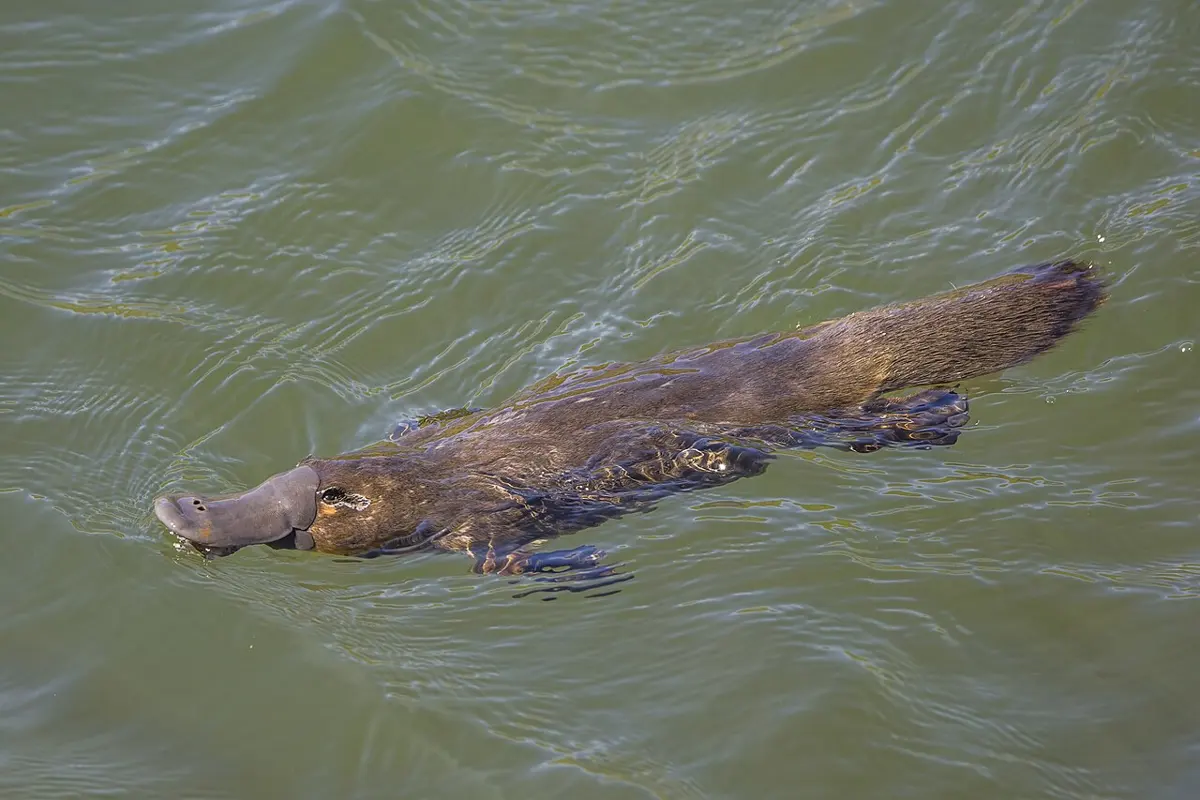
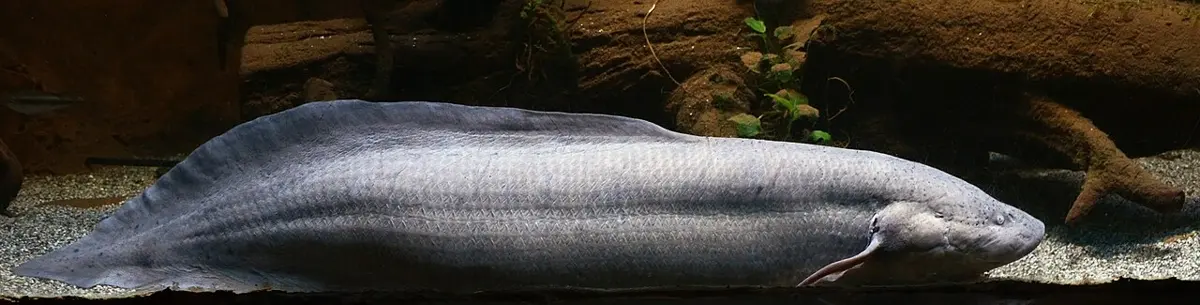
Some animals have features of two different groups, as if they stand on a bridge between them. Such bridge animals are called connecting links. When they are known only as fossils, they are often called missing links.
- Platypus (Australia): it is covered in hair and feeds its young on milk, like a mammal; but it lays eggs, like a reptile, and has a beak like a duck’s. It links reptiles and mammals: mammals evolved from reptile-like ancestors.
- Archaeopteryx (a fossil from Germany, about 150 million years old): it had feathers and wings, like a bird; but also teeth in its jaws, claws on its wings and a long bony tail, like a reptile. It links reptiles and birds: birds evolved from reptiles (in fact, from dinosaurs).
- Protopterus, the African lungfish: a fish with gills, but it also has lungs and can breathe air when its pond dries up, like an amphibian. It links fish and amphibians: amphibians evolved from fish.
D. Evidence from embryos
If you look at the early embryos of vertebrates (fish, salamanders, tortoises, chickens and humans), they look remarkably alike. All have a tail, and a row of pharyngeal pouches in the neck, the “gill slits”. Later, in fish these become gills; in humans they become parts of the ear, throat and glands, and the tail disappears. The similar early stages suggest that all vertebrates evolved from one common ancestor.
Early: zebrafish DBCLS (CC BY 4.0); the others public domain (Eycleshymer and Wilson; H. J. Clark for Agassiz; Keibel; Keibel and Elze)
Later: zebrafish fry DBCLS (CC BY 4.0); turtle Parexocoetus (CC BY-SA 4.0, our tracing CC BY-SA too)
Later still: tortoise traced from Berthold Werner's photo; the others too, all public domain or CC0
4.3 Theory of evolution
Many scientists have explained how evolution happens. Among them were Jean-Baptiste de Lamarck (France), Charles Darwin and Alfred Russel Wallace (Britain), and Hugo de Vries (the Netherlands). Here we look at the theories of Lamarck, Darwin and de Vries.
Lamarckism
The French naturalist Jean-Baptiste de Lamarck (1744–1829) was the first to put forward a full theory of evolution, in his book Philosophie Zoologique (1809). His theory, Lamarckism, has three main points:
- Direct effect of the environment. When the environment changes, living things need new features to live in it, so their bodies change.
- Use and disuse of organs. An organ that is used a lot grows stronger and bigger; an organ that is not used gets weaker and smaller, and at last disappears.
- Inheritance of acquired characters. Features an organism gains in its lifetime (acquired characters) are passed on to its young. Over many generations, the changes add up to a new species.
Lamarck explained the giraffe’s long neck this way. Long ago, giraffes had short necks and ate grass. When the grass ran short, they began stretching up to eat the leaves of trees. Their necks grew a little longer from the stretching, and their young were born with those slightly longer necks. Generation after generation, stretching made the necks longer and longer, until they became the long necks of today.
Criticism of Lamarckism
Lamarck’s theory was the first to say that species change, which was a brave idea. But its main idea doesn’t hold:
- Can organisms grow new organs just because they need them? No. A need does not create an organ.
- Are acquired characters inherited? No. A wrestler’s big muscles, a scar, or pierced ears are not passed on to children. Acquired characters change the body, not the genes in the egg and sperm, and only genes are inherited.
Darwinism
The English naturalist Charles Darwin (1809–1882) spent five years (1831–1836) sailing round the world on the ship HMS Beagle, collecting animals, plants and fossils. He then spent more than twenty years thinking about them. In 1859 he published his book On the Origin of Species. His theory is called Darwinism, or the theory of natural selection. (Another British naturalist, Alfred Russel Wallace, reached the same idea on his own, and the two announced it together in 1858.) Its main points are:
1. Enormous fertility
Every organism can produce many more young than are needed to replace it. If all of them survived, the numbers would grow geometrically (2, 4, 8, 16, …) and soon fill the world. Darwin chose the elephant, one of the slowest-breeding animals: suppose an elephant breeds from the age of 30 to 90 and has six young. Then, he worked out, one pair would leave nearly 19 million elephants after about 750 years. Yet in nature the number of each species stays roughly the same.
2. Struggle for existence
So most of the young must die. There is not enough food, space and shelter for all, so living things must compete for them, and to escape enemies and diseases and to find mates. This is the struggle for existence. It happens between members of the same species (two deer for the same grass), between different species (a deer escaping a tiger), and against the environment (cold, drought, floods). Those that succeed survive; the rest die.
3. Variation and heredity
No two members of a species are exactly alike: you differ from your parents, brothers and sisters. These differences are variations. Some come from the genes and are inherited (passed to the young); some come from the environment. Some variations help an organism in its environment; some are harmful; many make no difference.
4. Natural selection
In the struggle for existence, the organisms whose variations suit their environment best are more likely to survive and reproduce, and they pass these useful variations to their young; those with unsuitable variations die out. Nature itself, not a person, “chooses” which survive, so Darwin called this natural selection. It is also called the survival of the fittest (“fittest” meaning the best suited, not the strongest).
5. Origin of new species
Generation after generation, the useful variations are passed on and add up. Over a very long time, the offspring come to be so different from their ancestors that they are a new species. Two or more groups of the same ancestor, living in different places, can become two or more new species.
In Darwin’s theory, why do giraffes today have long necks?
Pick an answer to see why.
Criticism of Darwinism
Darwin’s theory is the basis of our understanding of evolution, but in his time it could not answer everything:
- It doesn’t explain how variations arise and are inherited. (Darwin knew nothing of genes; Mendel’s work was ignored until 1900.)
- It can’t explain why a useful variation appears in some organisms and a harmful one in others.
- Natural selection only picks among variations; something else must make the new variations. Today we know that mutation is a main source of new variations.
- If natural selection kept only useful characters, useless and harmful characters (like vestigial organs) should not remain, yet they do.
As Hugo de Vries put it, borrowing the words of the American botanist Arthur Harris: natural selection may explain the survival of the fittest, but it cannot explain the arrival of the fittest.
Variation and mutation
Even twins are never exactly alike. Differences between the members of a species, such as in height, skin color or the shape of the nose, are called variations. They are of two kinds:
- Somatogenic variation (soma = body): variation acquired in the body during life, such as strong muscles from exercise, knowledge and skills, or a scar. It is not inherited: it doesn’t come from the parents and is not passed to the children; it ends with the organism’s death.
- Blastogenic variation (blasto = germ, the egg or sperm): variation caused by differences in the genes, such as skin color, hair color and eye color. It is inherited by the next generation.
The environment also shapes the body. Two plants grown from seeds of one parent can look very different if one grows in sun and the other in shade, or one in rich soil and the other in poor soil: they have the same genes but different appearance. Variation caused by the environment is called environmental variation, and like other somatogenic variation it is not inherited.
Variations that suit the environment help an organism survive, and if they are genetic, they are inherited. Over many generations, such favorable variations add up, and offspring appear that are quite different from their ancestors.
Mutation
A mutation is a sudden change in the genes or chromosomes that produces a new character in the offspring, one not seen in the parents. It is a sudden and discontinuous variation. Examples: extra fingers or toes (polydactyly), albinism (no color in the skin, hair and eyes), sickle-cell anemia, a cleft lip in some families, and hairless mice.
- An organism with a mutation is a mutant.
- Something that causes mutations is a mutagen: radiation (X-rays, ultraviolet rays, radioactivity) and certain chemicals. Mutations also happen by chance, as mistakes when DNA is copied.
- Most mutations are recessive (they show only when inherited from both parents) and most are harmful or make no difference; a very few are useful.
Hugo de Vries’ mutation theory
Hugo de Vries (1848–1935), a Dutch botanist, put forward the mutation theory in 1901. He had grown thousands of evening primrose plants (Oenothera lamarckiana) and seen new forms appear suddenly among them, which bred true. Some of these new forms had more chromosomes than normal: the normal plant has 14, but one new form had 15 and a giant form 28. He concluded that new species arise by sudden mutations, not by slowly adding up small variations. The main points of his theory:
- New species arise by mutation, so mutation is the main basis of evolution.
- New characters appear suddenly, in one step, and work at once.
- Mutations are inherited by the next generation.
- Organisms with favorable mutations are selected to survive; those with unfavorable ones die out.
- New species can arise from a large mutation in a single generation.
Criticism of de Vries’ theory
- Oenothera lamarckiana turned out to be a hybrid, and most of its “new forms” came from its chromosomes being reshuffled and rearranged, not from true mutations.
- Mutations happen in no fixed direction, so the theory can’t explain why evolution leads to organisms that fit their environment so well.
- If new characters appeared suddenly and at random, most mutants would be unsuited to their environment; yet the species we see are well adapted.
- It ignores the role of nature (natural selection) in shaping species.
- Most mutations are recessive, so they seldom show, and they are rarely useful.
Exercise
1. Choose the correct answer
(i) Who founded the theory of natural selection?
Pick an answer to see why.
(ii) Which of these is an example of homologous organs?
Pick an answer to see why.
(iii) In which rocks are fossils found?
Pick an answer to see why.
(iv) What is the appearance of new characters in offspring, due to a change in genetic structure, called?
Pick an answer to see why.
2. Give reasons
Fossils are taken as strong evidence of evolution.
Answer
Organisms produce a huge number of young, yet their populations do not keep increasing.
Answer
Variation alone is not the cause of the origin of species.
Answer
Humans, monkeys, horses and birds are thought to have evolved from a common ancestor.
Answer
3. Write the differences between
Variation and mutation
Answer
Darwinism and de Vries’ theory
Answer
Homologous and analogous organs
Answer
Fossils and vestigial organs
Answer
4. Answer the following questions
What is evolution?
Answer
What is a fossil? How does it give evidence of evolution?
Answer
How is a fossil formed? Explain.
Answer
What are the evidences of evolution? Describe with examples.
Answer
Describe Darwin’s theory of evolution.
Answer
What is natural selection? Describe.
Answer
According to Darwin, how does a new species arise? Explain.
Answer
Write the properties of mutation.
Answer
How does mutation help in evolution?
Answer
Mutation is not the only factor in evolution, but one additional factor. Explain.
Answer
Explain Darwin’s ideas of the struggle for existence and the survival of the fittest.
Answer
How is Darwinism criticized?
Answer
Using the study of fossils, show that today’s organisms developed from primitive unicellular and multicellular organisms.
Answer
Study the picture of the fossil in Figure 4.7 and answer:
- a.What is shown in the picture?
- b.Which classes does it connect?
- c.How does it give evidence of evolution?
Answer
Study the picture and answer:
A. What change is seen in the picture?
B. Does this character appear in all organisms?
C. What causes such characters?
D. How can such a character help in evolution?
E. Write any three merits of such changes.
Answer
Compare Lamarckism and Darwinism.
Answer
Quiz yourself: Heredity and Evolution, Grades 5–10 →
Practice every question in the book, and keep track of the ones you miss →
A companion to your textbook, not a replacement for it: study from the book your school uses, and where the two differ, follow your teacher. Found a mistake? Please tell us.