
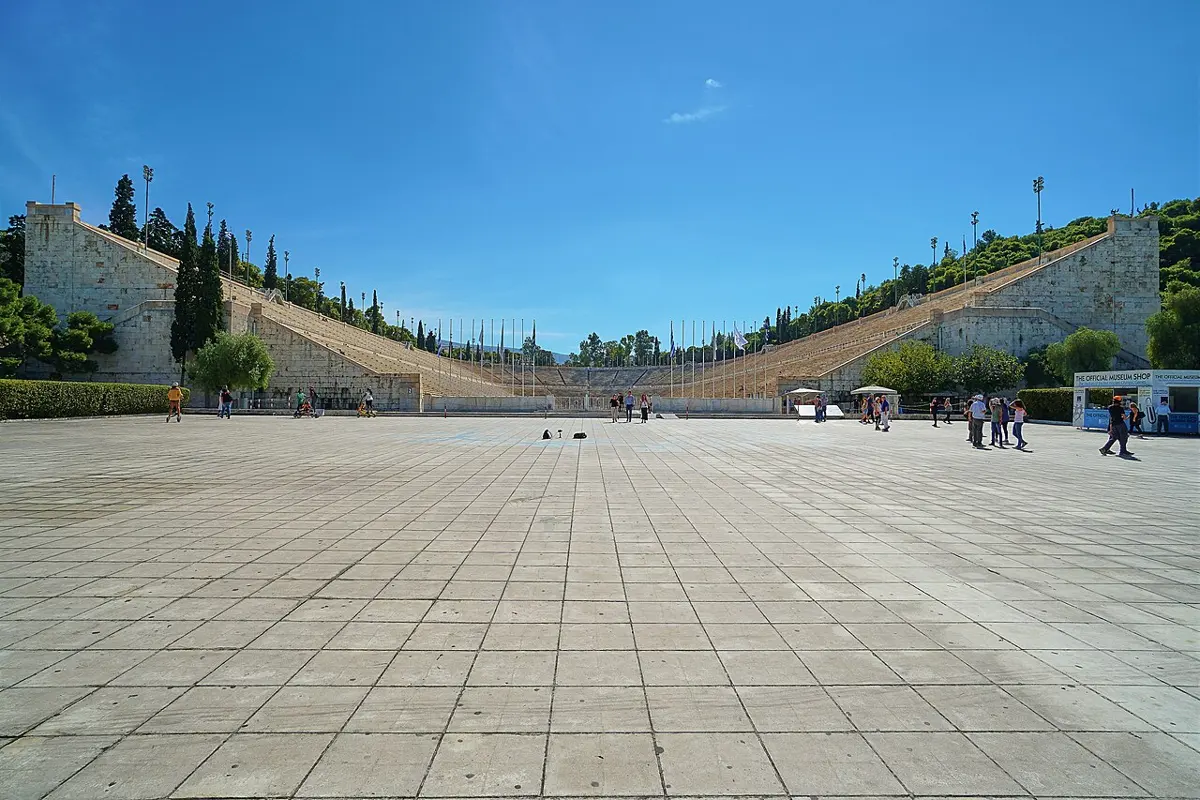
The Summer Olympics held in Paris in 2024 were officially the Games of the XXXIII Olympiad, the 33rd. The first were in Athens in 1896, and an Olympiad comes round every four years. So, without listing them all: in which year is the 40th? Brisbane in 2032 will be which one? And is there a catch, since there were no Games in 1916, 1940 or 1944?
A list of numbers made by a rule is a sequence. In this unit you will learn to find any term of a sequence without writing out the ones before it, to add up its terms in a short notation, and to tell the two most useful kinds apart: those that grow by adding the same number and those that grow by multiplying by it. Then, in Back to the Olympics, you will answer the questions above in one line each.
Sources: the Olympiad numbers are from Wikipedia’s “Olympiad” (see Sources).
8.1 Review
8.1.1 Introduction to sequence
Numbers written one after another, in an order, by a fixed rule, make a sequence. The marbles give the sequence 1, 3, 6, 10, 15, …. Each number in it is a term: 1 is the first term, 3 the second, and so on. The three dots, “…”, mean “and so on by the same rule”.
A sequence can stop or go on for ever.
- A finite sequence has a fixed number of terms; it has a last term. 1, 3, 5, 7, …, 15 is finite: it stops at 15, after 8 terms.
- An infinite sequence goes on without end; there is no last term to find. 10, 20, 30, 40, … is infinite.
So when “…” comes at the end of the list, the sequence goes on for ever; when a last term is written after the “…”, it stops there.
Which of these is a finite sequence?
Pick an answer to see why.
8.1.2 General term
A rule that gives the nth term of a sequence from n is its general term, written . The terms themselves are t₁, t₂, t₃, …: t₁ is the first term, t₂ the second, and the tenth. With the general term, any term is one calculation away: put its number in for n.
What it means: n is a position in the list (1st, 2nd, 3rd, …), so it is always a natural number; is the value in that position. In 4, 8, 12, …, the value 12 sits in position 3: t₃ = 12.
The general term of a sequence is . Which term of it is 31?
Pick an answer to see why.
In a sequence, t₄ = 13. What does that tell you?
Pick an answer to see why.
Exercise 8.1
Question 1
Find the next two terms of each sequence.
1, 2, 3, 4, …
Answer
2, 4, 6, 8, 10, …
Answer
5, 10, 15, 20, 25, …
Answer
1, 2, 4, 8, 16, …
Answer
22, 20, 18, 16, 14, …
Answer
−8, −6, −4, …
Answer
2, 5, 9, 14, 20, …
Hint
Answer
Answer
Question 2
Find the general term of each sequence.
4, 6, 8, 10, …
Answer
7, 11, 15, 19, 23, …
Answer
2, 6, 10, 14, 18, …
Answer
25, 22, 19, 16, …
Answer
Answer
Answer
40, 38, 36, 34, …
Answer
Answer
Question 3
From each general term, find the first five terms and write them as a sequence (n is a natural number).
Answer
Answer
Answer
Answer
Answer
Answer
Answer
Question 4
Look at each pattern, draw the next two figures, and find the general term .
Answer
Answer
Answer
8.2 Introduction to series
Discuss in your group:
- a.A sequence has the general term . What is the sum of its first five terms?
- b.Can the sum of those five terms be written t₁ + t₂ + t₃ + t₄ + t₅? What is that called?
The five terms are 3, 5, 7, 9, 11, and their sum is 3 + 5 + 7 + 9 + 11 = 35. Written with plus signs between them, the terms of a sequence make a series:
- the sequence 7, 11, 15, 19, 23, … is a list;
- the series 7 + 11 + 15 + 19 + 23 + … is that list added up.
The sum of the first n terms of a series is written : .
The sigma sign, Σ
Writing out a long series is slow, so mathematicians use the Greek capital letter Σ (sigma, their S, for “sum”). It reads as “add up”:
- after Σ comes the general term, 2n + 1: the rule for each term;
- under Σ, n = 1 says where n starts;
- over Σ, 5 says where n stops.
So: put n = 1, then 2, 3, 4, 5 in the general term, and add what you get. The number of terms is (top − bottom + 1): from 1 to 5 there are 5 terms, from 2 to 6 also 5, and from 0 to 4 also 5.
How many terms does have?
Pick an answer to see why.
Which of these is a series?
Pick an answer to see why.
Exercise 8.2
Question 1
Define a sequence, with an example.
Answer
What is the difference between a sequence and a series?
Answer
Question 2
Which of these are sequences and which are series?
3, 6, 9, 12, 15, …
Answer
2 + 4 + 6 + 8 + 10 + …
Answer
Answer
Answer
1 + 4 + 9 + 16 + …
Answer
Answer
Question 3
Find the value of each.
Answer
Answer
Answer
Answer
Answer
Answer
Answer
Answer
Answer
Question 4
Write each series with the Σ sign.
5 + 7 + 9 + 11 + ⋯ + 21
Answer
2 + 4 + 6 + 8 + 10 + 12
Answer
30 + 25 + 20 + ⋯ + 5
Answer
1 + 5 + 9 + 13 + 17 + 21
Answer
1 + 4 + 9 + 16
Answer
Answer
8.3 Arithmetic sequence and series
Study the pattern of dots in these figures.
- a.How can you write the numbers of dots as a sequence?
- b.How does the number of dots grow? Is there a rule?
- c.How could you find, say, the tenth figure’s dots without drawing it?
The dots are 1, 4, 7, 10, …. Each figure adds a square, and a square adds 3 new corners, so each term is 3 more than the one before: 4 − 1 = 3, 7 − 4 = 3, 10 − 7 = 3. The tenth figure has nine squares, nine lots of 3 dots after the first: 1 + 9 × 3 = 28.
Find the steps in 5, 10, 15, 20, 25 and in 50, 45, 40, 35, 30 too: the first goes up by 5 every time, the second down by 5.
A sequence in which each term is the one before plus the same fixed number is an arithmetic sequence, and that fixed number, the difference between successive (neighboring) terms, is its common difference, d. In 15, 25, 35, 45, 55 the common difference is d = 10; in 100, 90, 80, 70 it is d = −10: going down means a negative d.
If is an arithmetic sequence, then
Usually you take d = t₂ − t₁: a term minus the one before it, never the other way round. The terms added up, , make an arithmetic series.
What is the common difference of 12, 9, 6, 3, …?
Pick an answer to see why.
Which of these is an arithmetic sequence?
Pick an answer to see why.
8.3.1 General term of arithmetic sequence
Call the first term a. Each term after it adds one more d:
| Term | Value | Number of ds added |
|---|---|---|
| t₁ | a | 0, that is (1 − 1) |
| t₂ | a + d | 1, that is (2 − 1) |
| t₃ | a + 2d | 2, that is (3 − 1) |
| t₄ | a + 3d | 3, that is (4 − 1) |
| ⋮ | ⋮ | ⋮ |
| a + (n − 1)d | n − 1 |
is the general term of an arithmetic sequence. The n − 1 is no accident: to get to the nth term you start at the first and take n − 1 steps, just as the 10th figure of dots was the first dot and nine more squares.
Back to the Olympics
The 40th Olympiad begins in 2052, and Brisbane 2032 is the 35th.
The Olympiads are an arithmetic sequence of years: first term a = 1896, common difference d = 4. So the nth Olympiad begins in the year
- Check with Paris: . ✓
- The 40th: .
- Brisbane: 4n + 1892 = 2032 gives 4n = 140, n = 35.
And the catch? An Olympiad is the four-year stretch itself, not the Games held in it. The 6th (1916), 12th (1940) and 13th (1944) Olympiads came round during the two World Wars and had no Games, but they were still counted. That is why the formula still works: n counts the four-year stretches, not the Games actually held. Count only the Games held, and Paris was the 30th.
8.4 Geometric sequence and series
Study these sequences:
2, 4, 8, 16, 32, 64, …
2, 6, 18, 54, …
27, 9, 3, 1, , …
Discuss:
- a.How is each sequence made?
- b.Is the difference between neighboring terms always the same?
- c.What is the ratio of each term to the one before it?
- d.What is the rule for getting the next term from the one before it?
The differences aren’t equal (in the first, they are 2, 4, 8, 16, …), so these are not arithmetic. Divide instead:
In each, the ratio of every term to the one before it is the same. To get the next term, multiply by that number: by 2, by 3, by .
A sequence in which each term is the one before times the same fixed number is a geometric sequence, and that number is its common ratio, r:
The terms joined by plus signs, , make a geometric series, such as 2 + 4 + 8 + 16 + 32 + 64 + ….
What is the common ratio of 81, 27, 9, 3, …?
Pick an answer to see why.
8.4.1 General term of geometric sequence
Call the first term a. Each term after it multiplies by r once more:
| Term | Value | Powers of r |
|---|---|---|
| t₁ | a | |
| t₂ | ar | |
| t₃ | ||
| ⋮ | ⋮ | ⋮ |
is the general term of a geometric sequence: the same n − 1 as before, now as a power, because there are n − 1 multiplications from the first term to the nth.
How the exam asks it
Grade 9’s final exam is set to CDC’s specification grid for Compulsory Mathematics, Grades 9–10. There, Algebra is 15 marks in three questions; the grid’s model sequence question is 4 marks on an arithmetic sequence:
| Part | Level | Marks | What it asks |
|---|---|---|---|
| a. | knowledge | 1 | the formula for the general term of an arithmetic sequence |
| b. | understanding | 1 | the common difference of the sequence given |
| c. | application | 2 | which term of the sequence is a given number |
Here is one in that shape, with how it is marked.
Exercise 8.3
Question 1
Is each sequence or series arithmetic or geometric? Give a reason.
Answer
4, 10, 16, …
Answer
Answer
6 + 12 + 24 + …
Answer
30 + 27 + 24 + …
Answer
Question 2
The 3rd and 9th terms of an arithmetic series are 9 and 33. Find its 5th term.
Hint
Answer
Question 3
Find the common difference and the 10th term of the arithmetic sequence 2, 6, 10, 14, 18, ….
Answer
Question 4
The 4th and 7th terms of an arithmetic series are 20 and 35. Find its 10th term.
Answer
Question 5
The first three terms of an arithmetic sequence are x − 1, x + 2 and 3x. Find x, and then the first and fifth terms.
Hint
Answer
Question 6
The 5th and 8th terms of an arithmetic series are 17 and 26. Which term is 44?
Answer
Question 7
Find the common ratio and the 10th term of the geometric sequence 12, 6, 3, ….
Answer
Question 8
The 2nd and 5th terms of a geometric series are 6 and 162. Find its 9th term.
Answer
Question 9
The first three terms of a geometric sequence are z + 6, z and z − 3. Find z, and then the fifth term.
Hint
Answer
Practice every question in the book, and keep track of the ones you miss →
Where these facts come from
- The Olympiads (the opening, Back to the Olympics): Wikipedia, “Olympiad” (the first Olympiad began on 1 January 1896, one begins in every year divisible by four, and the count continues when Games are canceled: the 6th, 1916, 12th, 1940, and 13th, 1944; Paris 2024 the XXXIII, Los Angeles 2028 the XXXIV, Brisbane 2032 the XXXV), read November 2026.
- Counting rhythms (8.1.1, the story): Wikipedia, “Fibonacci sequence”, History (Pingala about 450–200 BC, Virahanka about AD 700, Gopala about 1135, Hemachandra about 1150, Liber Abaci 1202), read November 2026.
- The Σ sign (8.2, the fact box): Wikipedia, “Summation” (Euler, 1755; limits under and over the sign, Fourier, 1820), read November 2026.
- Taxi fares (8.3.1, the fact box): this book’s Unit 4 and its sources.
- ISO settings (8.4.1, the fact box): Wikipedia, “Film speed” (the arithmetic ISO scale, each doubling of the number a doubling of sensitivity), read November 2026.
- Folding paper (8.4, the activity): worked out here, from 0.1 mm a sheet; the Earth–Moon distance, 384,400 km on average, from Wikipedia, “Lunar distance”.
- The photo: Wikimedia Commons, credited under the picture.
- The exam’s sequence question (For the exam, How the exam asks it): CDC, Specification Grid, Compulsory Mathematics, Grades 9–10 (Algebra 15 marks in three questions), and its Grade 9 model question 8 (an arithmetic sequence: K1, U1, A2); our question is our own.
A companion to your textbook, not a replacement for it: study from the book your school uses, and where the two differ, follow your teacher. Found a mistake? Please tell us.