
An underground water tank is a closed concrete box. Say it is a cube 2 m along each outside edge, with its walls, floor and lid all 10 cm thick, so the hollow inside is a cube 1.8 m along each edge. How much concrete went into it?
The concrete is the big cube with the hollow taken out: cubic meters, a difference of two cubes. This unit shows how to break expressions like that into factors: and from a cube cut into eight pieces, then , and . In Back to the tank you will answer the question in one line, and see what the answer means.
9.0 Review
To factorize an expression is to write it as a product: things multiplied together. It is the same as writing a number as a product, 12 = 2 × 2 × 3, but with letters. Each thing multiplied is a factor.
Factorizing is expanding run backwards. Expanding turns (x + 2)(x + 3) into ; factorizing turns back into (x + 2)(x + 3). Every formula you know can be read both ways: left to right it expands, right to left it factorizes.
The area of a rectangle is a product, length × breadth, so a picture of areas shows a factorization. Here are the four you met in Grade 8.
These four will be used again and again in this unit, the third most of all: whenever you can write an expression as one square minus another, it splits into two factors.
Which of these is a factorization of ?
Pick an answer to see why.
9.1 Factorization of the expressions (a + b)³, a³ + b³, (a − b)³ and a³ − b³
A square’s area is a length times a length; a cube’s volume is a length times a length times a length. So where squares gave pictures of , cubes give pictures of .
9.1.1 Geometrical concept of (a + b)³
Try it on the screen: the cube below is cut the same way. Take it apart, and change a and b.
Group A’s conclusion: the cube’s volume is the sum of the volumes of all its pieces.
The last line takes 3ab out of the second and third terms: .
So the cube of a + b can be written in three ways:
- i., the expanded form;
- ii.;
- iii., the factorized form.
Check it with numbers: a = 3, b = 2. The cube is . The pieces are 27 + 3 × 18 + 3 × 12 + 8 = 27 + 54 + 36 + 8 = 125 ✓.
In the cube cut at a:b, how many pieces have volume ?
Pick an answer to see why.
9.1.2 Geometrical concept of (a − b)³
Group B’s conclusion: the whole cube’s volume, , is again the sum of the eight pieces.
Take the last three terms to the other side:
Again three ways to write it:
- a., the expanded form;
- b., taking 3ab out of the middle terms;
- c., the factorized form.
There is a quicker way to the same formula, with no soap. a − b is a + (−b), so put −b for b in the formula for :
The signs simply take turns, + −+ −, because an odd power of −b is negative and an even power positive.
What is the expanded form of ?
Pick an answer to see why.
Using the formulas
9.1.3 Simplified form of a³ + b³
The cube of a + b is not . But has factors of its own, and the formula for finds them.
So
- i.
- ii.
Form (ii) is the factorization: a sum of two cubes is (a + b) times a three-term factor. Multiply it back to see why it works: every term but two cancels.
9.1.4 Simplified form of a³ − b³
The same steps, starting from :
The second line takes out the common factor (a − b); the third uses the formula for .
So
- i.
- ii.
Which is the factorization of ?
Pick an answer to see why.
Factorizing sums and differences of cubes
To factorize a sum or difference of cubes, first write each term as a cube: , , . Then use the formula with those as a and b.
Two more kinds turn up in the exercise: a common factor hiding the cubes, and a bracket standing for a.
Exercise 9.1
Question 1
Find the cube of each expression using the formula.
(x + 1)
Answer
(x − 3)
Answer
(x + 4)
Answer
(2x − 1)
Answer
(3y + 2b)
Answer
Answer
Question 2
Write each expression in its expanded form.
Answer
Answer
Question 3
Write each expression in the form .
Hint
Answer
Answer
Question 4
Write each expression in the form .
Answer
Answer
Question 5
Factorize.
Answer
Answer
Answer
Answer
Answer
Hint
Answer
Question 6
Factorize.
Answer
Answer
Answer
Hint
Answer
Answer
Answer
Question 7
A cubical log of wood has edges x ft long (x > 7). A cube with edges 7 ft long is cut out of it. How many cubic feet of wood are left?
Answer
9.2 Factorization of expressions in the form a⁴ + a²b² + b⁴
is not a cube, and it is not a difference of two squares, at least not yet. The trick is to make it one.
Both ways do the same three things: make a perfect square from the two end terms, see what is left over, and if the leftover is a square taken away, finish with . The square to make can be or ; only one of them may work.
The same idea works on expressions with two letters and no fourth powers: group the terms of each letter into a perfect square, and look for a difference of two squares.
To factorize , which square do you build?
Pick an answer to see why.
Back to the tank
The tank’s concrete is the outer cube minus the hollow, m³, a difference of two cubes with a = 2 and b = 1.8:
The tank took about 2.17 m³ of concrete.
What the factors mean: a − b = 0.2 m is the thickness of two walls, one on each side of the hollow. m² is very nearly three times m², the area of one wall measured along its middle, 1.9 m each way. So the concrete is about six walls, each 1.9 m by 1.9 m and 0.1 m thick: 6 × 3.61 × 0.1 = 2.166 m³, within 0.002 m³ of the exact answer. Meanwhile the hollow holds m³ of water, 5,832 liters.
How the exam asks it
Grade 9’s final exam is set to CDC’s specification grid for Compulsory Mathematics, Grades 9–10. There, Algebra is 15 marks in three questions. Factorization comes inside them; in the grid’s Grade 9 model paper it is question 9:
| Part | Level | Marks | What it asks |
|---|---|---|---|
| a. | understanding | 3 | the HCF of a sum of cubes and an expression |
| b. | application | 3 | simplify a product of powers whose indices are and the like |
The HCF (highest common factor) of two expressions is the product of the factors they share; the next unit is about it. To find it, factorize both. Part b belongs to indices, Unit 12, but it needs only two rules you know from Grade 8, and , and this unit’s .
Here is one in that shape, with how it is marked.
Exercise 9.2
Question 1
Factorize.
Answer
Answer
Answer
Answer
Hint
Answer
Answer
Question 2
Factorize.
Answer
Answer
Answer
Answer
Answer
Answer
Question 3
Factorize.
Answer
Hint
Answer
Answer
Answer
Answer
Answer
Question 4
Factorize.
Answer
Answer
Answer
Answer
Answer
Answer
Question 5
Factorize.
Answer
Hint
Answer
Answer
Hint
Answer
Answer
Answer
Question 6
Factorize , and write all its factors.
Hint
Answer
Practice every question in the book, and keep track of the ones you miss →
Where these facts come from
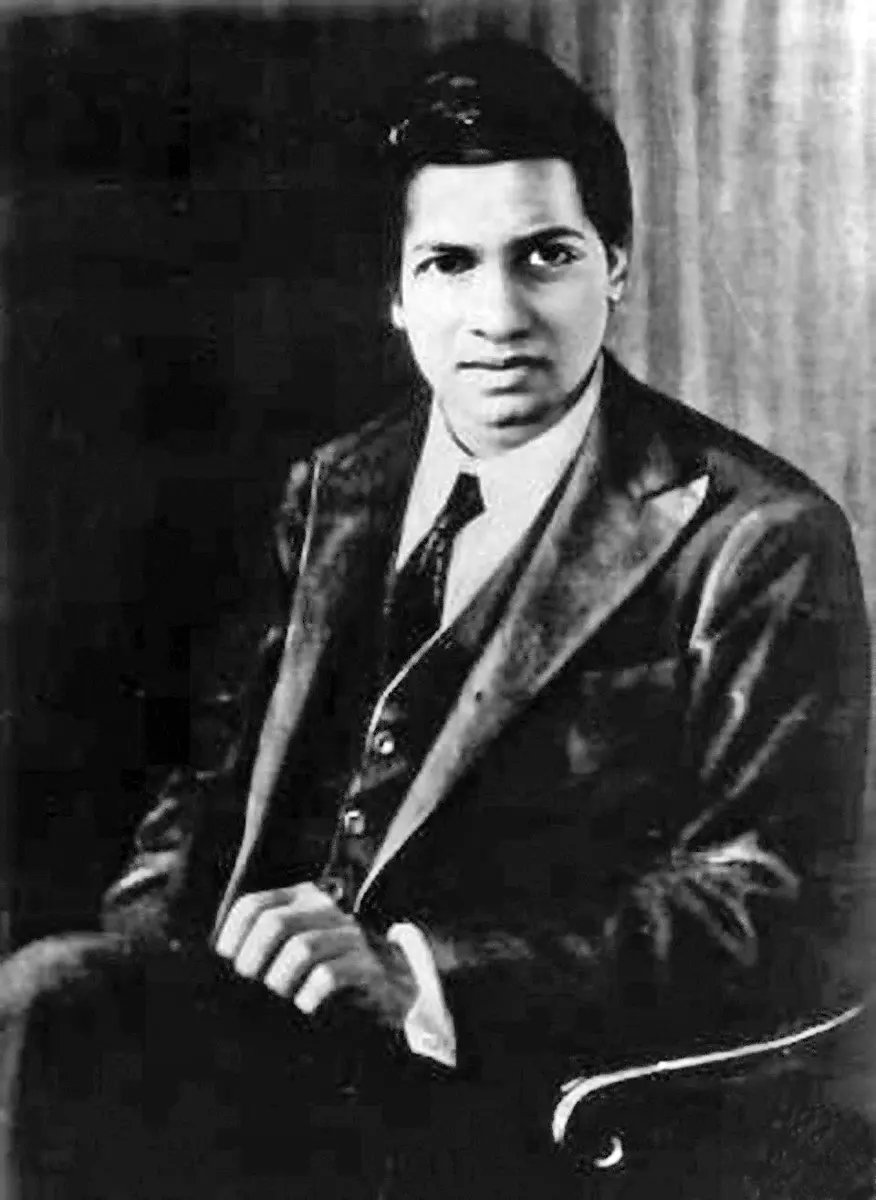
- Ramanujan and 1729 (9.1.4, the story): Wikipedia, “1729 (number)” (Hardy’s visit to Putney and the taxi, the two sums of cubes) and “Srinivasa Ramanujan”, read November 2026.
- Sophie Germain (9.2, the story): Wikipedia, “Sophie Germain” (1776–1831; barred from the École Polytechnique as a woman, its lecture notes, her work sent to Lagrange and letters to Gauss as “Monsieur LeBlanc”) and “Sophie Germain’s identity”, read November 2026.
- The photo of Ramanujan: Wikimedia Commons (public domain), credited under the picture.
- 1001 = 7 × 11 × 13 and the 10101, 101³ facts: worked out here.
- The tank (the opening, Back to the tank): our own example; the arithmetic is worked out here.
- The exam’s question (For the exam, How the exam asks it): CDC, Specification Grid, Compulsory Mathematics, Grades 9–10 (Algebra 15 marks in three questions), and its Grade 9 model question 9 (the HCF of and , 3U; a simplification of indices, 3A); our question is our own.
A companion to your textbook, not a replacement for it: study from the book your school uses, and where the two differ, follow your teacher. Found a mistake? Please tell us.