
In Chaitra 2077, Nepal Telecom announced that it would pay its owners Rs 40 for every share they held, out of the profit of the year 2076/77. Lhamu’s grandmother owns 150 Nepal Telecom shares. How much money reaches her bank account? And when a newspaper calls this a “40% dividend”, it is 40% of what?
Money is shared out by percentages like this all the time: an agent who finds a buyer for a plot of land keeps a part of the price, a company that made a profit gives its staff a part of it, and it gives its owners another part. This unit is about those three shares: commission, bonus and dividend. By the end of 3.3 you will work out the grandmother’s dividend yourself.
Sources: the Nepal Telecom dividend as Gorkhapatra Online reported it on 14 Chaitra 2077; the tax on dividends, Income Tax Act, 2058, section 88(2)(a).
3.1 Commission
A person who acts between the seller and the buyer of goods or services is an agent. The money an agent is paid for arranging a sale, worked out as a percentage of the selling price, is the commission. The agent can be paid by the seller, by the buyer, or by both, as they agree.
Commission is always expressed as a percentage, and it is worked out on the selling price:
Commission is paid in land and house sales, in buying and selling shares, by banks and insurance companies to their agents, and to salespeople in shops and showrooms, on top of their salary, for what they sell.
An agent is paid 2% commission on a house sold for Rs 80,00,000. How much commission is that?
Pick an answer to see why.
Commission in bands
Some companies pay a higher rate the more an agent sells, to reward big sales. The rates are then set in bands, as income tax is (Unit 2): each rate is paid only on the part of the sale inside its band.
Salary plus commission
A salesperson in a shop is often paid a fixed salary and, on top of it, a commission on what they sell. So the month’s income is
and working backwards, the rate is the commission as a percentage of the sales:
A salesperson earns Rs 20,000 a month plus 2% commission on her sales. In one month she earned Rs 26,000. What were her sales?
Pick an answer to see why.
Exercise 3.1
Question 1
Find the commission.
| Item sold | Selling price | Rate of commission | |
|---|---|---|---|
| a. | Land | Rs 1 crore 50 lakh | 5% |
| b. | House | Rs 2 crore | 3% |
| c. | Photocopy machine | Rs 4 lakh | 7.5% |
| d. | Shares | Rs 5 crore 25 lakh | 2% |
Land: Rs 1 crore 50 lakh at 5%
Answer
House: Rs 2 crore at 3%
Answer
Photocopy machine: Rs 4 lakh at 7.5%
Answer
Shares: Rs 5 crore 25 lakh at 2%
Answer
Question 2
An agent sells a house for Rs 1,40,00,000 and is paid 5% commission by the owner.
How much commission does the agent receive?
Answer
How much does the house owner receive?
Answer
Question 3
A motorcycle showroom has 10 employees, each paid a salary of Rs 20,000 a month. Together they are paid a commission of 0.25% of the month’s total sales, shared equally among them. In Asoj the showroom’s sales were Rs 1,35,00,000.
How much does the showroom pay its employees as commission in Asoj?
Answer
By what percentage is an employee’s income in Asoj more than the monthly salary?
Answer
Question 4
A company making plastic goods pays its sellers commission at 1% on sales up to Rs 6,00,000, 1.5% on sales above Rs 6,00,000 up to Rs 10,00,000, and 2% on sales above Rs 10,00,000. Find the commission on each of these sales.
Rs 4,45,600
Answer
Rs 7,25,000
Answer
Rs 15,75,000
Answer
Question 5
A woman working in a cosmetics shop earns a salary of Rs 17,000 a month, plus a commission of a certain percentage of her sales. In Mangsir she sold goods worth Rs 10,00,000 and earned Rs 30,000 in all, with the commission. How much was her commission, and at what rate?
Answer
Project work
3.2 Bonus
A bonus is money that an organization pays its employees once a year, on top of their regular salary, as a part of the profit it made that year: a lump sum, given as a reward. It is worked out as a percentage of the profit. In Nepal, the staff of Nepal Electricity Authority, Nepal Telecom, Nepal Oil Corporation, Nepal Water Supply Corporation, banks and many private companies get a bonus in the years their organization makes a profit, under the law.
(when it is shared equally).
3.3 Dividend
When a company makes a profit, it can keep it to grow, or share part of it with its owners. The part of the profit that a company pays to its shareholders is the dividend. A company decides what percentage of its net profit to pay, and that amount is divided equally among all its shares: the more shares you own, the more you get.
A dividend comes in two kinds:
- a.Cash dividend: money, paid into the shareholder’s bank account.
- b.Share dividend: new shares instead of money, given free to the shareholders in proportion to what they own. In Nepal these are called bonus shares: a 10% bonus share gives 10 new shares for every 100 you hold.
Bonus and dividend are both shares of a profit (in Nepali both are लाभांश): a bonus goes to the people who work there, a dividend to the people who own the company.
Play with Example 3’s company. Change how much of the profit is paid out, and see what a share dividend does.
A company with 10,00,000 shares pays a total cash dividend of Rs 15,00,000. Rabina owns 400 shares. How much dividend does she get, before tax?
Pick an answer to see why.
Back to Lhamu’s grandmother
Nepal Telecom paid Rs 40 a share, and she has 150 shares.
Dividend = 150 × 40 = 6000; tax kept back .
Rs 5,700 reaches her bank account. The “40%” is 40% of each share’s face value of Rs 100, not 40% of the company’s profit or of the price she paid for the shares.
Exercise 3.2
Question 1
Find the bonus.
| Profit | Rate of bonus | |
|---|---|---|
| a. | Rs 60 lakh | 25% |
| b. | Rs 2 crore 50 lakh | 67.5% |
| c. | Rs 80 lakh | 48% |
| d. | Rs 9 crore | 55% |
Rs 60 lakh at 25%
Answer
Rs 2 crore 50 lakh at 67.5%
Answer
Rs 80 lakh at 48%
Answer
Rs 9 crore at 55%
Answer
Question 2
A textile factory made a profit of Rs 5 lakh 60 thousand in 2076 BS. It decided to share 60% of the profit equally among its 105 employees as a bonus. How much does each employee get?
Answer
Question 3
An insurance company decided to share two thirds of its profit equally among its 150 staff as a bonus. If each gets Rs 40,000, what was the company’s profit that year?
Answer
Question 4
Find the total dividend and the dividend per share.
| Number of shares | Rate of dividend | Net profit | |
|---|---|---|---|
| a. | 4,50,000 | 40% | Rs 50,00,000 |
| b. | 1,15,62,486 | 55.5% | Rs 12,00,00,000 |
| c. | 3,28,50,000 | 23.5% | Rs 5,20,60,000 |
| d. | 21,63,25,030 | 60% | Rs 2,75,67,36,894 |
4,50,000 shares, 40% of Rs 50,00,000
Answer
1,15,62,486 shares, 55.5% of Rs 12,00,00,000
Answer
3,28,50,000 shares, 23.5% of Rs 5,20,60,000
Answer
21,63,25,030 shares, 60% of Rs 2,75,67,36,894
Answer
Question 5
Suryalaxmi Cooperative has 13,63,497 shares of Rs 100 each, and Mamata owns 350 of them. The cooperative made a profit of Rs 1 crore 20 lakh in a year and decided to pay 45% of the profit as a cash dividend. How much cash dividend does Mamata receive?
Answer
Question 6
An insurance company has 22,39,440 shares of Rs 100 each. It made a profit of Rs 1,52,05,675 in a year, and its board of directors decided to pay 65% of the profit as a cash dividend. How much does a shareholder with 280 shares receive?
Answer
Project work
Practice every question in the book, and keep track of the ones you miss →
How the exam asks it
Grade 9’s final exam is set to CDC’s specification grid for Compulsory Mathematics, Grades 9–10 (2078). There, Arithmetic is 13 marks in three questions; the commission and dividend question is usually 3 marks in three parts:
| Part | Level | Marks | What it asks |
|---|---|---|---|
| a. | knowledge | 1 | a fact: what a dividend, bonus or commission is, or where it comes from |
| b. | application | 1 | a percentage: the rate paid out, or an amount |
| c. | higher ability | 1 | a shareholder’s or employee’s amount when something changes |
Here is one in that shape, with how it is marked.
Where these facts come from
- Nepal Telecom’s cash dividend of Rs 40 a share from the profit of 2076/77 (the opening, Activity 2, Back to Lhamu’s grandmother): Gorkhapatra Online, “Telecom passes its dividend”, 14 Chaitra 2077, as quoted in CDC’s Mathematics, Grade 9.
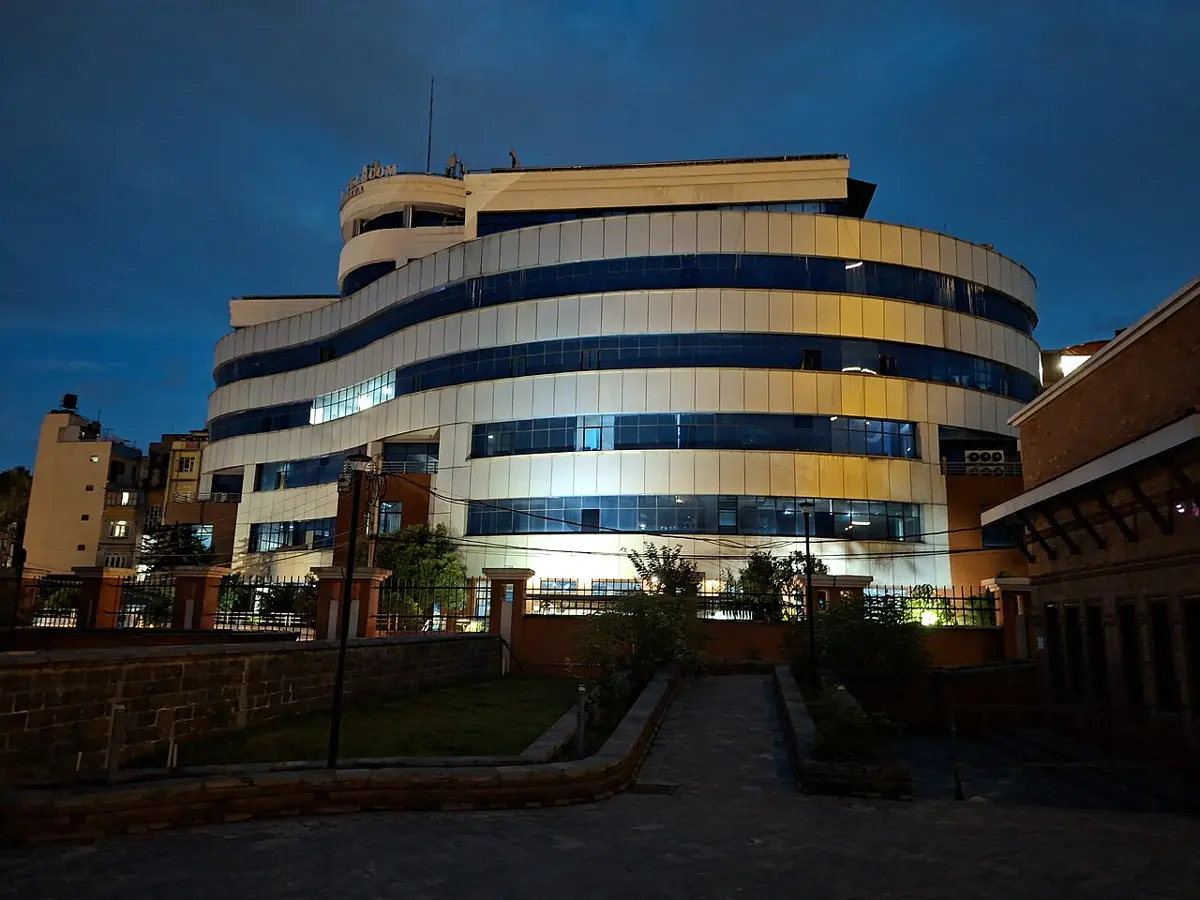
- The Government of Nepal’s 91.49% of Nepal Telecom’s shares (the photo’s caption): The Himalayan Times, “Govt to reduce stake in Nepal Telecom to 66 percent”, 29 May 2026.
- Nepal Oil Corporation’s bonus (Activity 1 of 3.2): Naya Patrika Daily, 24 Poush 2077, as quoted in CDC’s Mathematics, Grade 9.
- The 5% tax kept back on dividends (the opening, the fact in 3.3): Income Tax Act, 2058, section 88(2)(a), and that it is final, section 54(1)(a); the 15% kept back on commission (the fact in 3.1): section 88(1); consolidated text on nepallaws.com, read November 2026. Bonus shares taxed at 5% of face value: news reports (ShareSansar; ICT Frame on SEBON’s directive), not the Act’s text. The 2083/84 budget’s change to the tax on the profit from selling shares, with none reported on dividends: ShareSansar, 29 May 2026; Niti Partners, “Income Tax Changes as per Budget 2083/84”.
- Broker commission rates on NEPSE from 1 Jestha 2081 (14 May 2024) (the fact in 3.1): the Ministry of Finance’s notice amending Schedule 14 of the Securities Businessperson (Securities Broker and Securities Dealer) Regulations, 2064, as reproduced by NEPSE Trading, “Amendment of schedule to Securities Dealers Regulations 2064”, 28 May 2024, read November 2026; the same rates in ShareSansar, “SEBON to enact revised commission rates for stockbrokers”, 14 May 2024. The notice gives each rate for a trade of that size and doesn’t say whether it applies to the whole trade or band by band; we found no broker’s worked example that settles it. Neither SEBON’s site nor the Nepal Gazette copy was read.
- The Bonus Act, 2030 (the fact in 3.2): section 5 (10% of net profit; the government sets it for government-owned enterprises), section 7 (at most eight or six months’ salary), section 9 (cash, within eight months), section 13 (the left-over amount, 70 : 30, or 20 : 80 for government-owned enterprises); consolidated text on nepallaws.com, read November 2026.
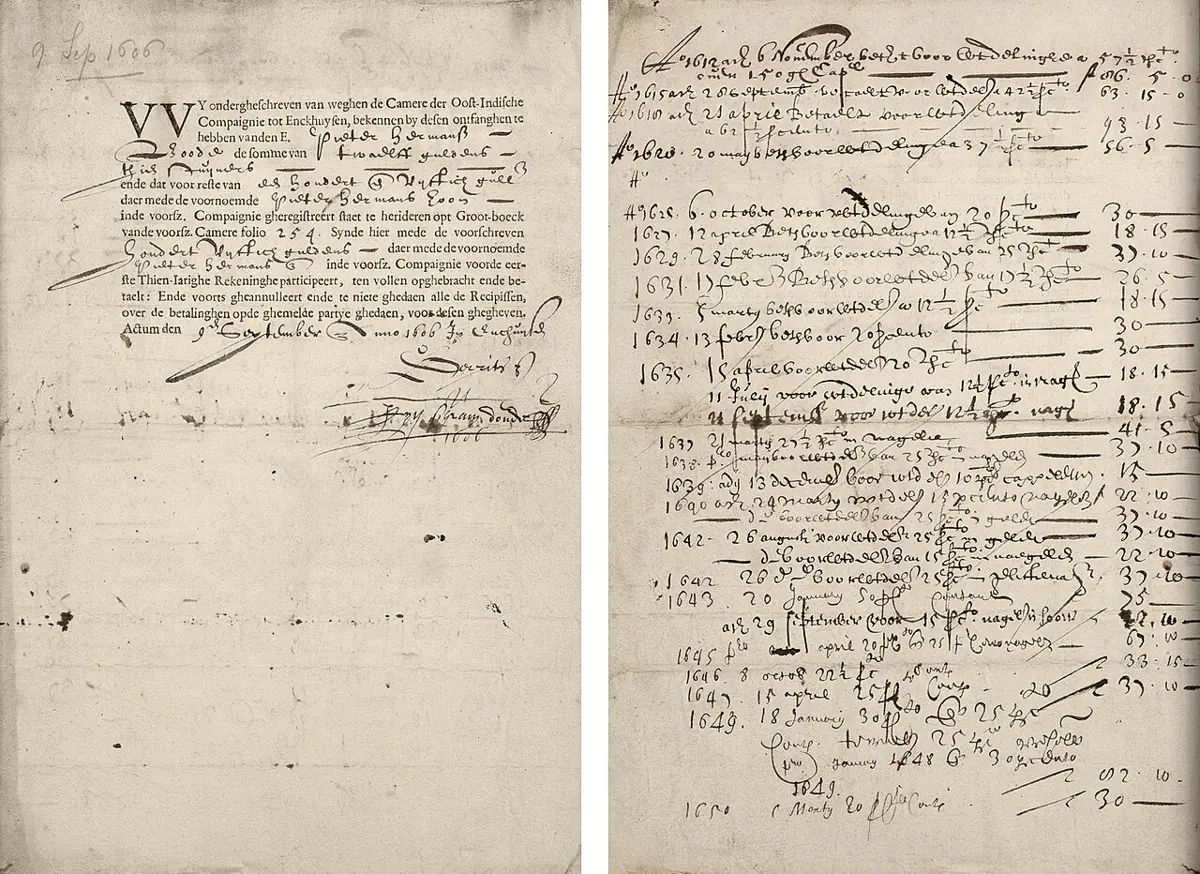
- The VOC (the story): Wikipedia, “Dutch East India Company”, read November 2026; the 1606 share and its finder: its file description on Wikimedia Commons.
- The exam’s commission and dividend question (For the exam, How the exam asks it): CDC, Specification Grid 2078, Compulsory Mathematics, Grades 9–10, and the model questions printed with it (question 3: K1, A1, H1).
A companion to your textbook, not a replacement for it: study from the book your school uses, and where the two differ, follow your teacher. Found a mistake? Please tell us.