
At a mela, a stall sells paper pinwheels on sticks. Blow on one and it spins. Stop it after a quarter of a turn, or half a turn, and it looks exactly as it did before. Now look at a playing card, the king of hearts. Turn it upside down: it is still the king of hearts, the right way up, with a crown at both ends.
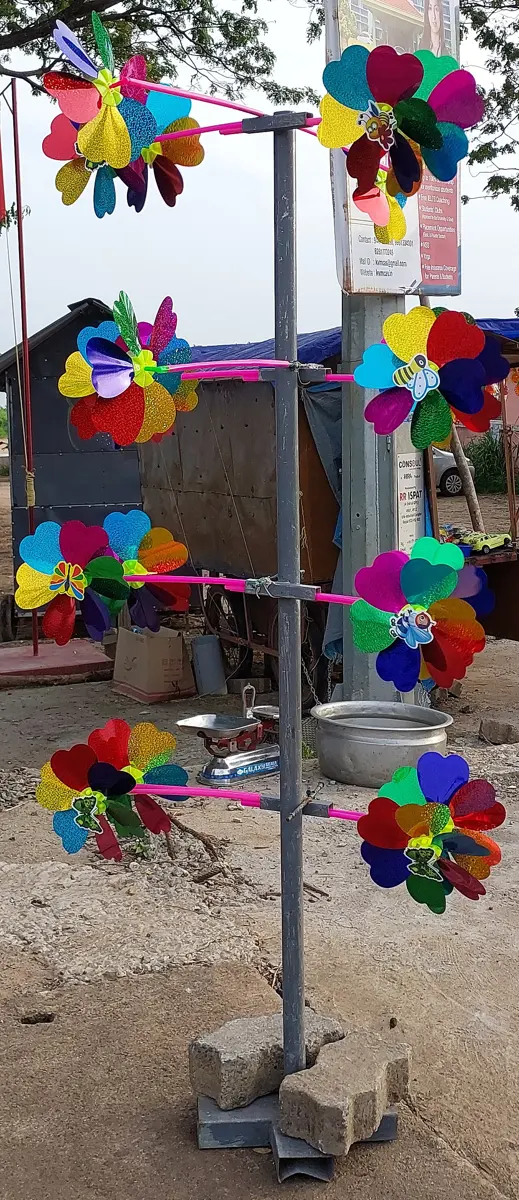
Fold either of them down the middle, though, and the two halves don’t match. They are balanced in a different way, about a point, not a line. In this unit you meet both kinds of symmetry: line symmetry, where one half is a mirror image of the other, and point symmetry, where half a turn brings the figure back onto itself. Then you cover a floor with triangles. In Back to the pinwheel you will say exactly which kind of symmetry the pinwheel and the card have.
18.0 Review
In Grade 6 you found the lines of symmetry of shapes by folding them. Look at these five things and talk about them in your group.
A figure is symmetrical if a straight line divides it into two halves that fit exactly on each other when you fold along the line. That line is its axis of symmetry, or line of symmetry. A figure can have more than one.
18.1 Line and point symmetry
18.1.1 Line symmetry
A line of symmetry is also called a mirror line. Stand a mirror upright along it, and the half in front of the mirror, with its reflection, looks exactly like the whole figure.
Find the lines of symmetry of some shapes yourself. Drag the fold line round until the red, folded outline lands on the shape.
How many lines of symmetry does a square have?
Pick an answer to see why.
18.1.2 Point symmetry
A figure has point symmetry if it looks exactly the same after half a turn (180°) about a point. That point is its center of symmetry. (Turning a figure about a point is also called rotating it, so we also say: the figure looks the same when it is rotated through 180° about its center.) Every point of the figure has a partner on the other side of the center, at the same distance from it: half a turn swaps them, as it swapped A and B.
Try it below. Drag the yellow handle to turn a copy of the shape (the red outline) about its center, and watch where the dot goes.
A shape has point symmetry. What do you see when you turn it half a turn about its center?
Pick an answer to see why.
Which of these has point symmetry but no line of symmetry?
Pick an answer to see why.
Exercise 18.1
Question 1
Complete each figure, taking the dotted line as the axis of reflection.
Complete figure (a).
Answer
Complete figure (b).
Answer
Complete figure (c).
Answer
Question 2
Half of each figure and one axis of symmetry are given. Complete the figure, and find how many axes of symmetry it has.
Figure (a).
Answer
Figure (b).
Answer
Figure (c).
Answer
Figure (d).
Answer
Question 3
Trace each figure. Draw all its lines of symmetry, and say how many there are.
The equilateral triangle.
Answer
The heart.
Answer
The bow tie.
Answer
Question 4
Trace each figure, and turn it half a turn (180°) about O. Does it look the same?
Figure (a).
Answer
Figure (b).
Answer
Figure (c).
Answer
Figure (d).
Answer
Question 5
Which of these figures have point symmetry?
Answer
Question 6
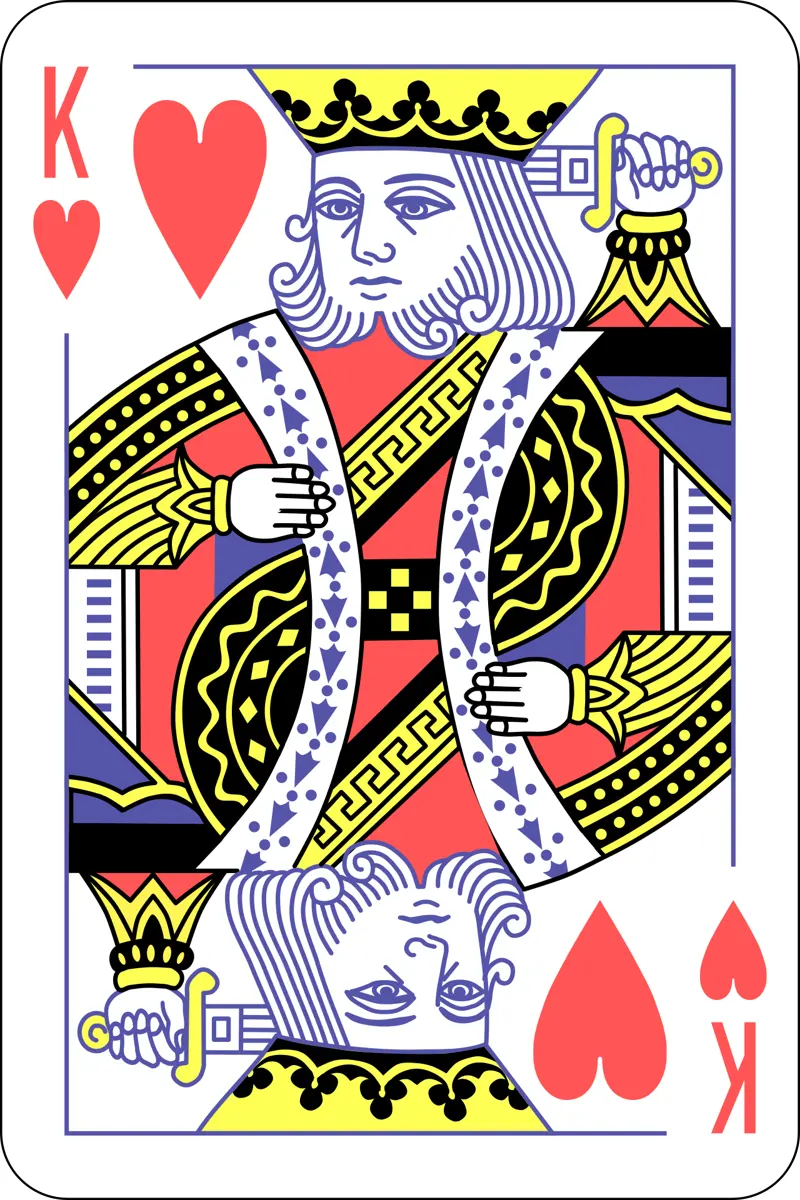
The jack, queen and king of a pack are drawn like this king of hearts. Do the pictures on these cards have point symmetry? If so, how?
Answer
18.2 Tessellation
Look at these patterns. What shapes are in each, and how many?
The first pattern is made of triangles only, all the same. The second is made of rectangles, all the same. The third has squares and triangles, each triangle half a square. In each, the shapes fit together with no gaps and no overlaps.
You see such patterns all round the house: in the weave of a nanglo and a doko, on carpets, in a wall of bricks or stone, on a tiled floor, and on a football, whose panels fit together over the whole ball. Discuss with your friends how the pieces are laid in each.
Covering a flat surface with one or more shapes, with no gaps and no overlaps, is called tessellation. The pattern is called a tessellation too. One made of triangles is a triangular tessellation.
Will any triangle tile a floor, or only special ones? Try it below: drag the corner C, and the floor of copies follows.
Exercise 18.2
Question 1
Is each of these a triangular tessellation? Give your reasons.
Figure (a).
Answer
Figure (b).
Answer
Figure (c).
Answer
Question 2
Complete the triangular tessellation, as begun in the first square.
Answer
Question 3
Join the dots to make a triangular tessellation, and color it.
Answer
Question 4
Make one tessellation from a right-angled triangle, and one from an equilateral triangle.
Answer
Printable PDFs
- Study notes 2 pages
- Harder practice questions 2 pages Answer key
Practice every question in the book, and keep track of the ones you miss →
Back to the pinwheel
A paper pinwheel with four blades has point symmetry. Half a turn about its pin brings it back onto itself, and so does a quarter turn: it fits on itself four times in a full turn. (A wheel with eight blades fits eight times; any wheel with an even number of equal blades has point symmetry.) But it has no line of symmetry: each blade curls the same way round, and a mirror would curl them the other way.
The king of hearts is the same: the bottom half of the picture is the top half turned half a turn, so the card has point symmetry and no line of symmetry. That is why it has no upside down.
Where this is used
- Playing cards. Court cards have been printed reversible, with corner marks, since the 1800s, so that a player never needs to turn a card the right way up.
- Tiles and floors. Tiles in squares, rectangles, triangles and hexagons cover floors and walls with no gaps; tilers cut the last row to fit the edge.
- Weaving. The over-and-under pattern of a nanglo, a doko or a mat repeats with no gaps, like a tessellation.
Where these facts come from
- Reversible court cards: Wikipedia, “English pattern” (“In the 19th century, corner indices and rounded corners were added and cards became reversible, relieving players from having to flip face cards right-side up”), read November 2026.
- The king of hearts: Wikimedia Commons, “English pattern king of hearts.svg” (Dmitry Fomin, CC0), read November 2026.
A companion to your textbook, not a replacement for it: study from the book your school uses, and where the two differ, follow your teacher. Found a mistake? Please tell us.