
You buy apples at a shop. The digital scale says 1.25 kg.
The shopkeeper charges for 1 kilogram and a quarter. Is that right? What does the little dot mean, and what are the 2 and the 5 after it?
The dot is a decimal point. The digits after it are parts of a whole, cut into tens and hundreds. Every price in paisa, every weight on a digital scale and every race time is written this way.
In this unit you will turn fractions into decimals and decimals into fractions. You will put decimals in a place value table. And you will add and take away decimals, lining up the points. At the end you will read the scale’s 1.25 kg in three ways.
6.0 Review
Look at the three squares.
Square A is cut into 10 equal strips, and 1 is colored. That is one tenth, . We also write it as 0.1 and read it “zero point one”.
Square B is cut into 100 equal squares, and 1 is colored. That is one hundredth, . We write it as 0.01 and read it “zero point zero one”.
Square C has 20 of its 100 squares colored: , twenty hundredths. We write it as 0.20 and read it “zero point two zero”. It is 20 times one hundredth: 20 × 0.01 = 0.20.
A number written with a decimal point is a decimal number, or just a decimal. The digits before the point are whole ones. The digits after it are parts of one:
- the first place after the point counts tenths;
- the second place counts hundredths.
6.1 Changing fractions and decimals into each other
A fraction into a decimal
- A fraction over 10: write the numerator, and put the point so that one digit is after it. , .
- A fraction over 100: put the point so that two digits are after it. . If the numerator has only one digit, put a 0 before it first: .
A decimal into a fraction
Write the digits without the point as the numerator. The denominator is 1 followed by one zero for each digit after the point.
- One digit after the point: over 10. .
- Two digits after the point: over 100. .
When the denominator isn’t 10 or 100
Here is the division 13 ÷ 5 written out. When 5 can’t go into 3 any more, put a point after 2 in the answer, and carry on with a 0 after the 3:
2.65)13.0 −10 30 −30 0Thousandths
Cut one hundredth into 10 equal parts again. Each part is one thousandth, , written 0.001. A fraction over 1000 has three digits after the point.
Quarters and twenty-fifths
5 times 2 makes 10. In the same way, 4 × 25 = 100 and 25 × 4 = 100. So fractions over 4 and over 25 can be made into hundredths.
Which decimal is ?
Pick an answer to see why.
Is the same as 0.4?
Pick an answer to see why.
6.2 Place value table of decimal numbers
In Unit 3 you put whole numbers in a place value table. Decimals go in one too. Each place to the right is ten times smaller:
- ten ones make a ten;
- ten tenths make one;
- ten hundredths make a tenth.
In 27.53, which digit is in the tenths place?
Pick an answer to see why.
6.3 Adding and subtracting decimals
The way to add decimals is the way you add whole numbers. Count the same parts together: tenths with tenths, hundredths with hundredths.
The easiest way is in columns:
- Write the numbers one under another, with the points in a line.
- Fill empty places at the end with zeros, so every number has the same number of digits after the point.
- Add or subtract as with whole numbers, carrying or borrowing as usual.
- Put the point in the answer right under the other points.
What is 0.6 + 0.08?
Pick an answer to see why.
Back to the scale
The scale said 1.25 kg. In a place value table, that is 1 one, 2 tenths and 5 hundredths of a kilogram.
As a fraction: two digits after the point, so .
And is a quarter, because . So 1.25 kg is 1 kilogram and a quarter, सवा किलो. The shopkeeper is right.
Exercise 6.1
Question 1
Write each colored part as a fraction and as a decimal.
Answer
Answer
Answer
Question 2
Change into decimals.
Answer
Answer
Answer
Answer
Answer
Answer
Answer
Answer
Question 3
Change into fractions.
0.2
Answer
0.38
Answer
13.05
Answer
19.37
Answer
0.37
Answer
6.47
Answer
0.50
Answer
3.25
Answer
Question 4
Put the decimals of Question 3 in place value tables.
Answer
Question 5
Work out.
23.12 + 71.28
Answer
14 + 71.23
Answer
42.567 + 23.1
Answer
91.8 + 0.83
Answer
1.1 + 3.5 + 4.2
Answer
174.68 − 21.32
Answer
36.5 − 23.14
Answer
312.275 − 25.68
Answer
8.5 − 9.25 + 5.07
Answer
0.08 − 3.27 + 6.347
Answer
Question 6
Write a number sentence for each problem, and work it out.
A shop has 25 cm of ribbon. It sells two pieces, of 12.91 cm and 9.28 cm. How much ribbon is left?
Answer
Subtract 31.123 from the sum of 30.41 and 20.2.
Answer
Kritika bought an exercise book for Rs 50.25 and chocolates for Rs 12.75. She gave the shopkeeper Rs 100. How much change did she get?
Answer
It is 200 km from Kathmandu to Pokhara. Suntali traveled 114.375 km by bus and then 66.305 km by taxi. How far does she still have to go?
Answer
Question 7
A worker carries 25.32 kg of sand, 27.12 kg of mud and 12.12 kg of cement in a basket.
How many kilograms is the worker carrying?
Answer
On the way, 4.43 kg of sand trickles out and is lost. How many kilograms reach home?
Answer
Question 8
A street seller has 25 packets of tea of 2.5 kg each, 15.25 kg of sugar and 11.75 kg of dalmoth.
How many kilograms of things does he have in all?
Answer
By 11 a.m. he sells 1.5 kg of dalmoth and 5.5 kg of sugar. How much is left to sell?
Answer
Printable PDFs
- Study notes 2 pages
- Harder practice questions 2 pages Answer key
Practice every question in the book, and keep track of the ones you miss →
Where this is used
- Money. Prices, bills and bank balances are in rupees and paisa: Rs 63.50 is 63 rupees and 50 paisa.
- Weighing. Digital scales in shops show kilograms to two or three decimal places.
- Heights. Mount Everest is 8,848.86 m tall, the height Nepal and China announced together in 2020.
- Sports. Races are timed in hundredths of a second. Usain Bolt’s world record for 100 meters is 9.58 seconds (2009).
- Not a decimal: in cricket, “10.3 overs” means 10 overs and 3 balls. An over has 6 balls, not 10, so 10.3 overs is not 10 and 3 tenths.
Where these facts come from
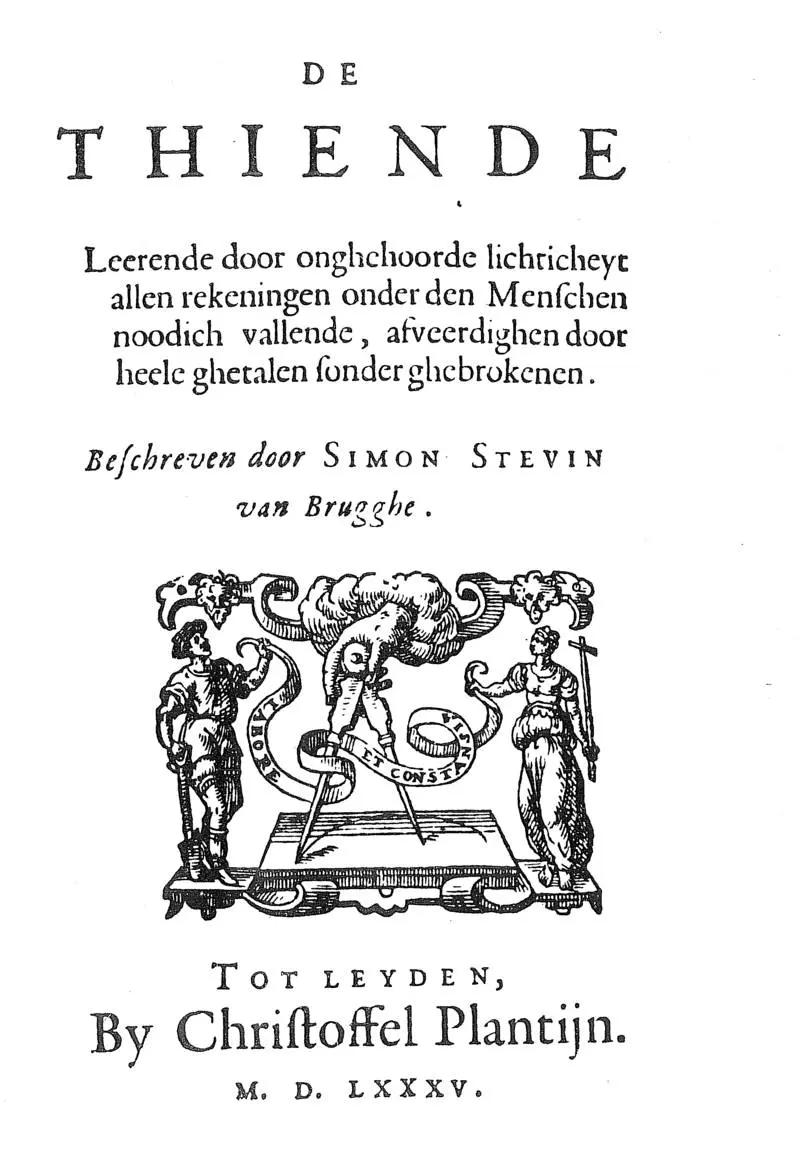
- Simon Stevin and De Thiende: Wikipedia, “Simon Stevin”; the decimal point: Wikipedia, “Decimal separator” (Napier’s use of the point), read November 2026.
- Everest’s height: Wikipedia, “Mount Everest” (8,848.86 m, announced by Nepal and China on 8 December 2020), read November 2026.
- 100 meters world record: Wikipedia, “Men’s 100 metres world record progression” (Usain Bolt, 9.58 s, Berlin, 16 August 2009), read November 2026.
- Overs: Wikipedia, “Over (cricket)” (six balls an over, written as overs.balls), read November 2026.
- Paisa: Wikipedia, “Nepalese rupee” (1 rupee = 100 paisa), read November 2026.
A companion to your textbook, not a replacement for it: study from the book your school uses, and where the two differ, follow your teacher. Found a mistake? Please tell us.