
What will you do after school today? What will you be when you grow up? Will people live on Mars one day? Every one of these questions is about the future: the time that hasn’t come yet.
This unit is about plans and the future. You will read about turning Mars into a new Earth and a poem about a flight in a dream. You will learn two ways to talk about the future, will and going to, how to say short forms like isn’t and won’t, and how to write a message to a friend.
Getting started
A. What is he planning?
The picture shows a young man with his hand on his chin. He is thinking. Around his head are five bubbles, his thoughts: a laptop, a house, a car, a mobile phone, and a shopping trolley with clothes in it.
Look at the pictures and say what he might be planning to do.
Model answers
A plan is something you have decided to do in the future. Might be planning means we are guessing: we don’t know for sure.
B. Listen and sing
The song is a list of promises. A child promises to do their best every day and never less. They will color carefully and write neatly. They won’t be happy until their work is complete. They will always do their homework and try hard in every test. And they won’t forget their promise.
Listen for two little words: will (often said ’ll: I’ll) and won’t (will not). We use them for promises about the future.
What dreams do you have, and what do you plan to do in the future? Talk to your friends.
A model answer
I won’t forget my promise. What does won’t mean?
Pick an answer to see why.
Reading I: Life on Mars
Before you read
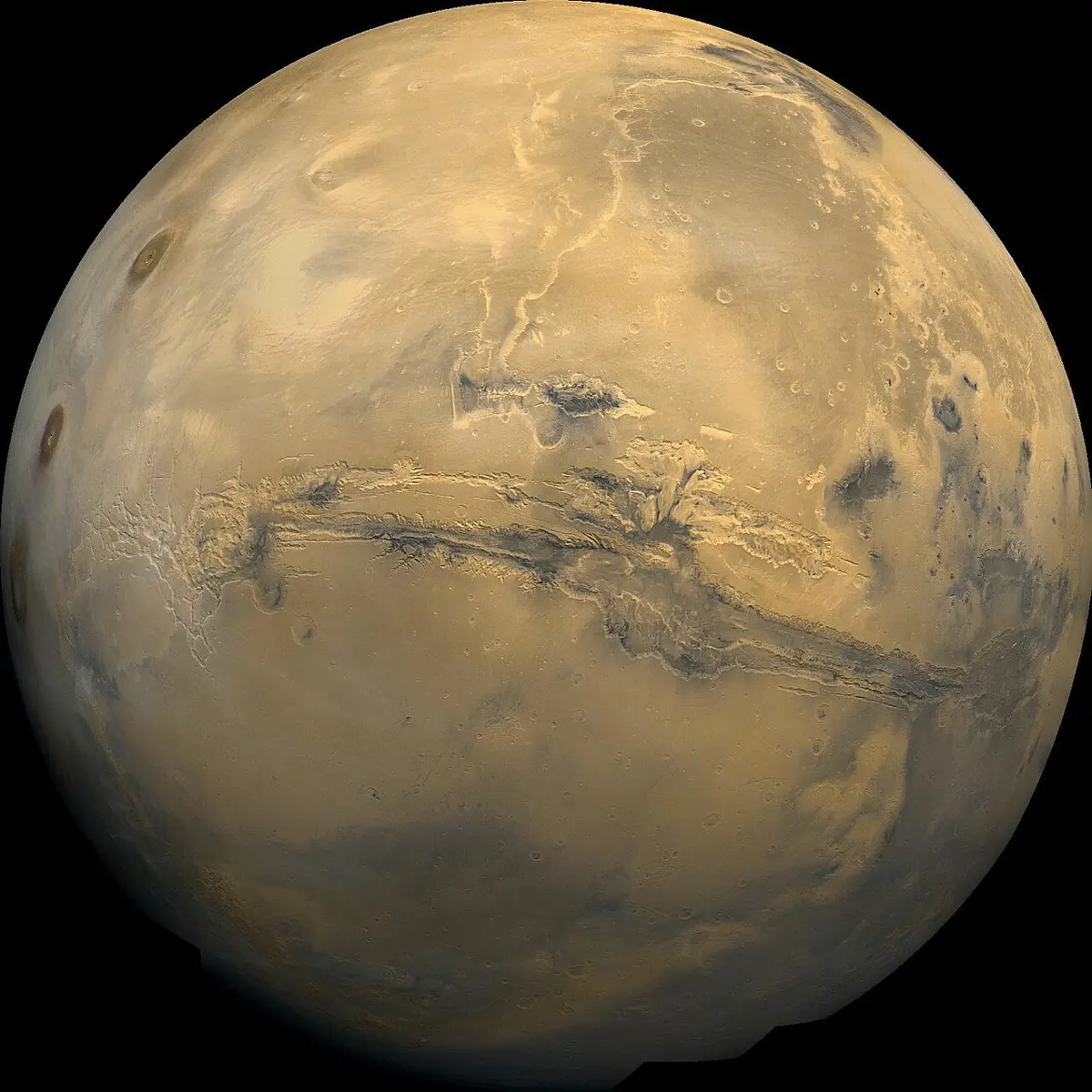
Which planet is shown in the picture?
A model answer
Do you think that people will live there in the future? Why?
A model answer
The text, part by part
The text is an information text. It explains an idea scientists talk about: making Mars more like Earth.
- The big question. Will people one day live and work on Mars? Many scientists (people who study science) hope so, and some are making plans.
- What we need. People can’t live without three things: water, air and food. Mars doesn’t give us any of these today.
- Terraforming. To make Mars habitable (a place where people can live), we would have to change it to be like Earth. This is called terraforming. Terra means “earth” in Latin, so terraforming is “earth-making”.
- Warming Mars up. Mars is freezing: about minus 60 °C on average. So the first goal (aim) would be to warm it up.
- An idea from Earth’s problem. Earth is getting warmer because of greenhouse gases in its atmosphere, the layer of air around it. These gases trap heat, like the plastic roof of a greenhouse. One idea is to build factories on Mars that release (give off) these gases on purpose. The warmer air might bring rain, and then plants could grow. Plants give off oxygen, the gas we breathe.
- The problems. It would take many centuries (hundreds of years) and cost a great deal of money.
What is terraforming?
Pick an answer to see why.
Why would scientists want to release greenhouse gases on Mars?
Pick an answer to see why.
Words from the text
| Word | Meaning |
|---|---|
| scientist | a person who studies science |
| planet | a large body in space that goes round a star, like Earth or Mars |
| habitable | good enough for people to live in |
| terraforming | changing a planet to make it like Earth |
| temperature | how hot or cold something is |
| goal | an aim, what you want to do |
| atmosphere | the layer of gases around a planet |
| release | to give off, to let out |
| century | a hundred years (plural centuries) |
| oxygen | the gas in the air that we need to breathe |
A. Words from the text
Write the words from the text for these meanings. The first letters of the words are given.
- a.the mixture of gases around the Earth: a………
- b.periods of 100 years: c………
- c.aims: g………
- d.to give off: r………
- e.how hot or cold a thing or place is: t………
- f.people who study science: s………
- g.suitable for people to live in: h………
- h.a large body in space like the Earth: p………
Answer
B. Complete the sentences
Complete the sentences using words from the text.
- a.There is no ……… on Mars, just ice.
- b.Terraforming Mars means making it similar to ……… .
- c.One way to warm up Mars is to build ……… . These will release ……… into the air.
- d.The plants will add ……… to the air.
- e.Life on Mars is possible in the ……… .
Answer
C. A month on Mars
If you were asked to travel to Mars and stay there for one month, what would you plan to take with you? Make a list of things and choose the five most important.
A model answer
Pronunciation: short forms with n’t
We often join a verb and not into one word. The apostrophe ( ’ ) shows where letters are left out: is not → isn’t. Here are thirteen of these short forms, and a fourteenth, won’t (will not), the one this unit needs most.
Three to listen for:
- In can’t, say the vowel fully and the t at the end (kahnt in British English, kant in American English), so it isn’t heard as can.
- In couldn’t, wouldn’t, shouldn’t, the l is silent: kud-nt, wud-nt, shud-nt.
- won’t rhymes with don’t. It doesn’t sound like want.
What is the short form of does not?
Pick an answer to see why.
Grammar I: will and going to
Will + verb
To talk about the future, we can put will before the plain verb:
The plants will add oxygen. It will take many years.
Will is the same for everyone: I will, you will, she will, they will. The verb after it never takes -s, -ed or -ing.
✗ She will goes. ✓ She will go.
In speaking, will is often ’ll: I’ll, she’ll, we’ll. Will not is won’t.
Going to + verb
We can also say am / is / are going to + the plain verb:
I am going to visit my aunt. She is going to buy a bike. They are going to play.
Which one?
Both talk about the future, but we choose like this:
| Use going to for | Use will for |
|---|---|
| a plan made before now: I bought the ticket. I’m going to visit Lumbini. | a choice made just now, as you speak: The phone’s ringing. I’ll get it! |
| something we can see coming: Look at those clouds! It’s going to rain. | an offer or a promise: I’ll help you. I won’t tell anyone. |
| a guess about the future: I think robots will cook our food one day. |
Your friend’s bag is heavy. You say:
Pick an answer to see why.
A. From the text
These sentences are from the last two paragraphs of the reading text. Complete them with the missing words (will + verb).
- a.The gases ……… to change the atmosphere on Mars.
- b.Rain ……… , and it may be possible to grow plants for food.
- c.The plants ……… more oxygen to the air.
- d.The cost ……… high.
Answer
B. Make sentences
Make as many sentences as possible from the table.
| I | will | eat rice | tomorrow. |
| She | won’t | go to school | |
| They | am/is/are going to | buy a book | |
| write a letter | |||
| go to the farm | |||
| sing a song | |||
| draw a picture | |||
| go to the market |
Hint
Some of the sentences
C. Rewrite with will
Rewrite the following sentences as in the example. Use will in your sentences.
Example: She (lend) me a book tomorrow. → She will lend me a book tomorrow.
- a.They (eat) some fruits.
- b.We (wear) fancy dress tonight.
- c.We (not help) you with your homework.
- d.Jamuna (not walk) home.
- e.You (cook) dal bhat?
- f.Sumina (not buy) candies for her daughter.
- g.I (not spend) my money on junk food from now on.
Answer
Listening
A. Next week
What will you do next week? Write and talk to your friends, as in the example: I will go to the farm at 7 o’clock next Sunday.
A model answer
Now listen. A girl asks Tony about his trip to New York. He is flying from LAX, the airport of Los Angeles, in the USA. Read the table in B first.
B. Tony’s plans
Listen to the audio and complete the table with the verbs.
| Time | What will Tony do? |
|---|---|
| 7 o’clock | He will ……… here. |
| 9:30 a.m. | He will ……… from LAX. |
| 4:30 p.m. | He will ……… in New York City. |
| Tomorrow night | He will ……… dinner at the hotel. |
| After dinner | He will ……… around the city. |
Answer
After you have checked B, read Tony’s day as a table, and find the answers.
C. Your friend’s plans
Listen to your friend telling you about his or her plans for tomorrow, and share them with the class.
A model answer
Reading II: Night Flight
Before you read
How do you feel when you see birds and planes flying in the sky?
A model answer
Do you wish you could fly? Why?
A model answer
The poem, verse by verse
The poem is by Ted Scheu, an American poet who writes for children. It has six short verses, and four of them start with the same three words: Close your eyes. The poet is talking to you, maybe a child going to sleep. The flight is a dream.
- Take off. With your eyes shut, the two of you rise up into the sky, past the clouds.
- To the Moon. The poet tells you to grip hard, because now you zoom (go very fast) all the way round the Moon.
- Over the sea. You swoop (dive down through the air) low over the sea at night. Its water is swirly: it turns round and round.
- Mountains and shores. Your dreams soar (fly high), from a pointy peak, a sharp mountain top, down to a wet beach where you could slip.
- Star to star. You travel between the stars, to places close by and far away.
- Home for breakfast. When you have been everywhere, the whole land from one coast to the other, you float slowly back home, and breakfast is waiting. Breakfast means the night is over: you have woken up!
The poem uses will for the journey ahead: we’ll zoom, we’ll float. Listen to its rhymes too. Each verse has one pair, at the ends of its second and fourth lines, such as coast and toast. Find the other five.
Where does the night flight really happen?
Pick an answer to see why.
Words from the poem
| Word | Meaning |
|---|---|
| hold | to keep something in your hands; hold on tight |
| zoom | to move very fast |
| swoop | to dive down through the air, as an eagle does |
| swirly | turning round and round |
| soar | to fly high up |
| peak | the pointed top of a mountain |
| slippery | wet or smooth, so you may slip |
| shore | the land at the edge of the sea or a lake |
| coast | the land next to the sea |
| float | to rest on water or drift gently in the air |
A. The crossword
Solve the crossword with words from the poem. Their meanings are given.
Across: 1. seaside, land near the sea · 4. dive · 5. stay on or above a surface
Down: 2. beach, seaside · 3. catch, grasp · 4. fly, rise up
Answer
B. Answer the questions
Why does the poet ask you to close your eyes in the first stanza?
Answer
Where will the poet take you in the second stanza?
Answer
Where do you start your journey in the fourth stanza?
Answer
Why will you need to come back home?
Answer
C. A free air ticket
If you were given a free air ticket, where would you like to fly to? Why? Talk to your friends.
A model answer
Grammar II: will in three forms
A. Yes, no and questions
| Affirmative (yes) | Negative (no) | Question |
|---|---|---|
| I will do my work. | I won’t do my work. | Will I do my work? |
| She will be fine soon. | She won’t be fine soon. | Will she be fine soon? |
| He will come to see me. | He won’t come to see me. | Will he come to see me? |
- Negative: put not after will: will not, or won’t.
- Question: put will first, before the person: Will he come?
- Short answers: Yes, he will. No, he won’t.
Which is a correct question?
Pick an answer to see why.
B. Match the sentences
Match the sentences on the left with the situations on the right.
| Sentences | Situations | ||
|---|---|---|---|
| a. | I think it will rain today. | i. | I want to borrow some story books. |
| b. | I will go to the library tomorrow. | ii. | It is unhealthy. |
| c. | She will help you with maths. | iii. | I will come to your house. |
| d. | What will you do on Sunday? | iv. | I have got no friends. |
| e. | I will not eat junk food. | v. | You need more practice. |
| f. | Will you come to play with me? | vi. | It’s a cloudy day. |
Answer
C. Put the words in order
Rearrange the words to form sensible sentences.
- a.go/now/home/will/I/not.
- b.give/the present/tomorrow/We/him/will.
- c.her/meet/next month/in/We/will/India/not.
- d.in Pokhara/spend/I/will/next year/my holiday.
- e.the library/take/I/the book/will/today/to.
- f.tomorrow/to the cinema/will/go/We.
- g.take/next week/Will/they/at school/a test?
Hint
Answer
Speaking
A. What is going to happen?
There are five pictures:
- A little girl stands in a swimsuit with a red swimming ring round her waist.
- A girl slips on a wet floor and drops her cup. A yellow sign beside her says the floor is wet.
- A father and his son stand by the water at sunset with fishing rods.
- Huge dark storm clouds hang over an empty road.
- A teacher holds up a picture book, and children sit round her on the grass.
- a.What is happening in the pictures?
- b.Match the pictures with these comments: a. It’s going to rain. b. I’m going to swim. c. I’ll slip for sure. d. They are going to listen to a story. e. The father and son will catch fish.
Answer
B. Yesh and Seema
Yesh and Seema talk about tomorrow.
Yesh:says hi, and asks what Seema is doing tomorrow.
Seema:says she is going to swim in the river.
Yesh:asks if she is going to carry a swimming tube (a float).
Seema:says no, she can swim very well. She asks, Will you join us? and says, I will teach you.
Yesh:says sorry, he is going to a party tomorrow.
Seema:asks what he is going to do before the party.
Yesh:says he is going to learn some dance steps with his sister.
Seema:says that’s an interesting day, and wishes him a nice time.
Yesh:says, You too.
Act out the conversation. Underline the verb forms that show the future.
Answer
C. Your plans
Use will or going to to talk about your future plans. Say at least five sentences.
A model answer
Writing: a message
A. The parts of a message
A message is a short note to tell someone something. The model message is from Alia to Raman: she is going to a picnic on a Saturday and asks him to join. It has five parts:
- Date: the day you write it, at the top.
- Time: the time you write it, on the right.
- Salutation: the greeting: Dear Raman,
- Message body: why you are writing, the news or the plan, a question, and Please reply soon.
- Signature: Yours, and your name.
Where does the salutation go?
Pick an answer to see why.
B. Write your message
What are you planning to do after your final exams? Write a message to your friend telling them about your plans.
Hint
A model message
Do it yourself
Exercise
Practice the whole unit. Try each one, then open the answer.
Will or going to?
- a.“I’m cold.” “I ……… close the window.”
- b.We have booked a hotel. We ……… stay in Chitwan for three days.
- c.Look at that boy on the wall! He ……… fall.
Answer
Make these negative, then make them questions.
- a.Mamata will come tomorrow.
- b.They will win the match.
Answer
Write the short forms: a. will not b. should not c. has not d. cannot
Answer
Correct the mistakes.
- a.She will goes to Pokhara.
- b.I am go to buy a pen.
- c.Will you to help me?
Answer
Why can’t people live on Mars today? Give two reasons.
Answer
Printable PDFs
- Study notes 2 pages
- Harder practice questions 2 pages Answer key
Practice every question in the book, and keep track of the ones you miss →
A companion to your textbook, not a replacement for it: study from the book your school uses, and where the two differ, follow your teacher. Found a mistake? Please tell us.