
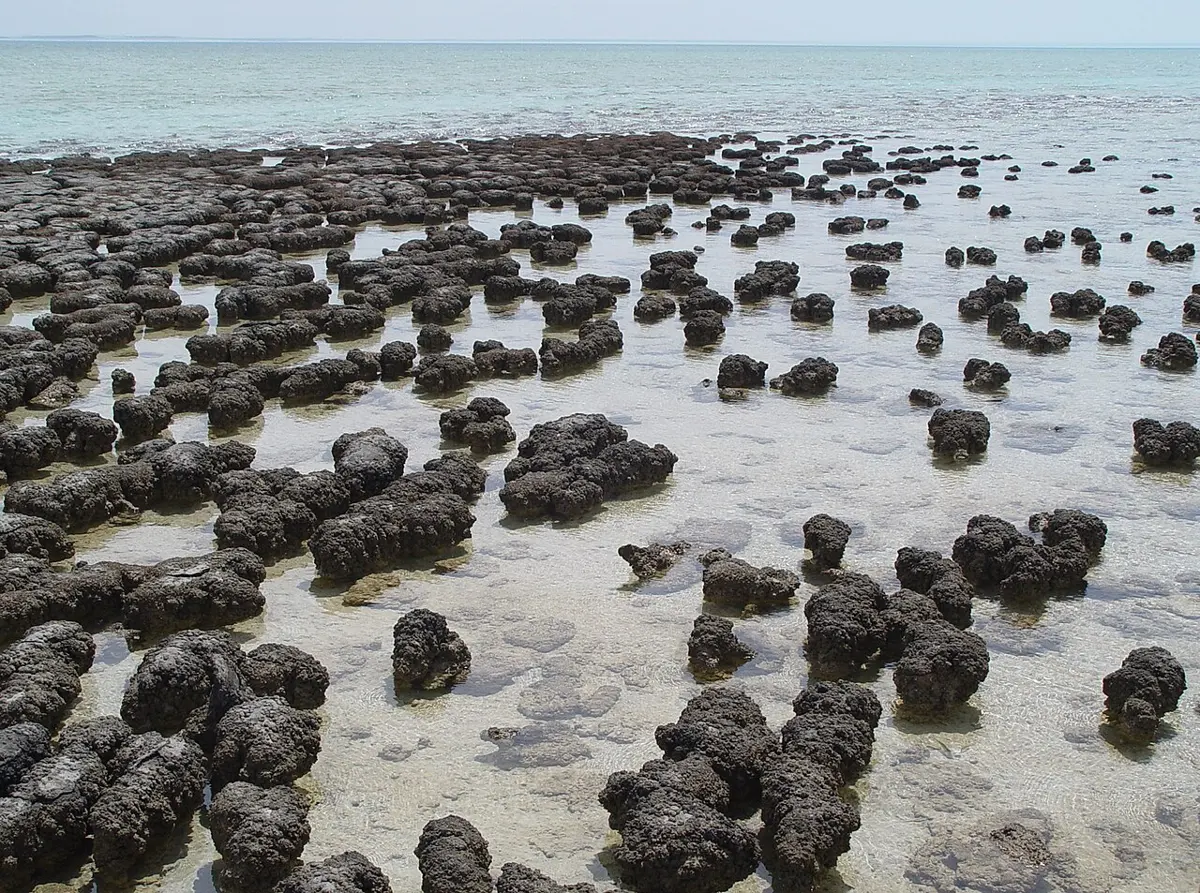
In the rocks of the Pilbara in Western Australia there are thin, wavy layers of stone, stacked like the pages of a crumpled book. They are about 3.5 billion years old, and they were built by living things: mats of microbes in a shallow sea, trapping mud grain by grain. The Earth itself is about 4.5 billion years old. So within a billion years of being a ball of molten rock, the Earth had life on it. Where did that life come from? People have answered in many ways: a creator, seeds from space, mice from dirty rags, a chemical soup. This unit follows how scientists tested those answers, one experiment at a time, and what they think happened.
The unit begins with how the Earth formed and what its first air was like, then looks at the old theories of life’s origin and the experiments of Redi, Spallanzani and Pasteur that overturned one of them. It then follows the Oparin–Haldane theory, step by step from simple gases to the first cells, and ends with the experiment of Miller and Urey, who made the building blocks of life in a flask.
7.1.1 Origin of the Earth and the primitive atmosphere
Scientists date the Earth to about 4.54 billion years (with an uncertainty of about 50 million years), from the decay of radioactive elements in meteorites and the oldest rocks. The Sun, the Earth and the other planets formed together from a vast, slowly turning cloud of gas and dust, the solar nebula (the nebular, or dust-cloud, hypothesis). The dust clumped into larger and larger bodies, which crashed together to build the planets.
The young Earth was far too hot for life. The heat of the crashes and of radioactive elements kept it molten, and the hottest material was a vapor of single atoms, since the heat broke every bond as fast as it formed. Its elements included carbon, silicon, oxygen, sulphur, chlorine, phosphorus, sodium, calcium, potassium and iron.
As the Earth cooled, its materials separated by density, forming layers:
- i.The densest, iron and nickel, sank to the center to form the core.
- ii.Lighter rock, compounds of oxygen with silicon, magnesium, aluminium, calcium, sodium and potassium, formed the mantle and the crust.
- iii.The lightest substances, gases, collected at the surface to form the atmosphere: at first some hydrogen and helium, most of which escaped to space, then the gases breathed out by volcanoes: water vapor, carbon dioxide, nitrogen, and smaller amounts of methane, ammonia, hydrogen sulphide and hydrogen.
The cooling was quick, by the Earth’s standards: zircon crystals from Jack Hills in Australia, 4.4 billion years old, carry signs that liquid water already existed on the surface. As the crust cooled further, the water vapor condensed and fell as rain for ages, filling the low places to make the first oceans.
The primitive atmosphere differed from today’s in one great way: it had no free oxygen. Its oxygen was all locked in compounds such as water and carbon dioxide. An atmosphere without oxygen, with gases that give electrons and hydrogen to other substances (hydrogen, methane, ammonia), is called reducing; today’s, rich in oxygen, is oxidizing. Without oxygen there was also no ozone layer, so the Sun’s ultraviolet light reached the surface unfiltered.
Why did the primitive atmosphere have no free oxygen?
Pick an answer to see why.
7.1.2 Origin of life
Over the centuries people have explained the origin of life in several ways. Four theories:
- Theory of special creation: all living things, plants and animals, were created by a supernatural power or God, in the forms they have now. This is a belief, found in many religions; science can neither test nor disprove it, so it is not a scientific theory.
- Cosmozoic theory (interplanetary theory, or panspermia): life reached the Earth from elsewhere in space, as spores or microbes carried on meteorites. It was proposed by the German physician Hermann Richter in 1865, and the Swedish chemist Svante Arrhenius made it famous in 1903 as panspermia (“seeds everywhere”). It doesn’t say how life began, only moves the question to another planet.
- Theory of spontaneous generation (abiogenesis): living things arise again and again from non-living matter: frogs, toads and snakes from mud, worms from rotting meat, aphids from plant juice, lice from sweat. Aristotle believed it, and so did most people for 2,000 years.
- Theory of biogenesis: life comes only from pre-existing life: every living thing is born of a parent of its own kind. Experiments by Francesco Redi, Lazzaro Spallanzani and Louis Pasteur established it.
7.1.3 The experiments that ended spontaneous generation
Spontaneous generation was not given up because someone argued against it, but because experiments, each with a control, kept failing to find it.
Francesco Redi (1626–1697), an Italian doctor, tested in 1668 the belief that maggots grow out of rotting meat. He put pieces of meat in jars: some open, some sealed, and some covered with fine gauze, which let in air but not flies. Maggots appeared only on the meat in the open jars, where flies had landed and laid their eggs; on the gauze-covered jars flies laid eggs on the gauze itself. So maggots come from flies’ eggs, not from meat.
But the microscope had just revealed a world of microbes, and surely they, so small and simple, could arise from broth by themselves? In 1745 the English priest John Needham boiled broth briefly, corked it, and found it swarming with microbes days later. Lazzaro Spallanzani (1729–1799), an Italian priest and scientist, repeated this in the 1760s more carefully: he boiled broth for an hour and sealed the flasks by melting their glass necks shut. They stayed clear. Flasks boiled only briefly, or left open, grew microbes. Needham replied that the long boiling had destroyed a “vital force” in the air that life needed, and since Spallanzani had shut out the air, the argument went on for another century.
Louis Pasteur (1822–1895) settled it, in experiments of about 1859–1862. He boiled broth in flasks whose necks he had drawn out in a flame and bent into an S, like a swan’s neck, and he left the neck open to the air. Air could reach the broth freely, so no “vital force” was shut out, but the dust and microbes in the air settled in the low bend of the neck and never reached the broth. The broth stayed clear for months. When he broke the neck off, or tilted the flask so that the broth ran into the bend and back, the broth was cloudy with microbes within days. So the microbes came from the dust of the air, not from the broth. Some of his flasks are kept at the Pasteur Institute in Paris; their broth is clear still. He told the Sorbonne in 1864: “Never will the doctrine of spontaneous generation recover from the mortal blow of this simple experiment.”
In Pasteur’s experiment, why did the broth in the unbroken swan-neck flask stay free of microbes, although its neck was open to the air?
Pick an answer to see why.
7.1.4 Theory of biochemical origin of life (Oparin–Haldane theory)
Pasteur showed that life doesn’t arise from non-living matter today. But the first life must have come from somewhere. The biochemical theory says that it did arise from non-living matter, once, slowly, over many millions of years, in conditions very unlike today’s. It is the explanation most scientists accept as the best starting point. It was proposed by the Russian biochemist Alexander Ivanovich Oparin in a booklet of 1924, The Origin of Life, and, independently, by the British scientist J. B. S. Haldane in an article of 1929. They argued that, in the young Earth’s seas, under a reducing atmosphere, simple chemicals built up into more and more complex ones until some of them could copy themselves. The oldest firm signs of life (stromatolites like those in the opening) are about 3.5 billion years old, so it happened before that.
Why couldn’t this happen today? Because free oxygen would destroy the delicate molecules, and microbes everywhere would eat them as soon as they formed.
The theory is studied in three stages (Figure 18.1):
A. Chemogeny: chemicals into the molecules of life.
B. Biogeny: those molecules into the first cells.
C. Cognogeny: the first cells into the many kinds of life.
A. Chemogeny
Chemogeny is the making of complex organic molecules from simple inorganic ones, by chemical reactions in the primitive seas and air. Its steps:
i. Formation of water, ammonia, methane and cyanamide. On the young Earth, carbon, hydrogen, nitrogen and oxygen were plentiful, mostly as gases at the high temperatures. As the surface cooled, they combined into simple molecules:
(These equations show which molecules formed; the oxygen in the water came from compounds, since there was no free oxygen gas left.)
ii. Formation of hydrocarbons. As the surface cooled to about 100 °C or below, very reactive fragments called free radicals, such as CH and CH₂, joined to make hydrocarbons such as acetylene, ethylene and methane. Meanwhile the water vapor condensed and rained down to make the oceans, where further reactions went on.
iii. Formation of oxygen and hydroxyl derivatives of hydrocarbons. Hydrocarbons reacted with hot steam to form molecules containing oxygen, such as aldehydes and ketones (and alcohols):
iv. Formation of sugars, amino acids and fatty acids. By condensation, polymerization, oxidation and reduction, these gave the simple sugars, amino acids and fatty acids of which living things are built. In outline:
v. Formation of purines, pyrimidines and nucleotides. These molecules reacted further in the warm water to form the purine and pyrimidine bases, and from them nucleotides, the units of nucleic acids.
Energy for these reactions came from the Sun’s ultraviolet light (unblocked, since there was no ozone layer), lightning, the heat of volcanoes and the hot young Earth, and radioactivity. Of these, ultraviolet light gave by far the most: Miller and Urey reckoned in 1959 that even the short-wave part of it alone (below 200 nm, strong enough to break apart molecules such as methane and ammonia) brought about twenty times as much energy as lightning and other electric discharges.
These reactions are thought to have happened in warm seawater, which slowly filled with organic compounds. Haldane called it a “hot dilute soup”; it is also called the primordial or prebiotic soup. With no free oxygen in the air to break them down, and nothing alive to eat them, the molecules could build up over millions of years.
Why could organic molecules collect in the primitive seas, when today they would not last?
Pick an answer to see why.
B. Biogeny
Biogeny is the stage in which the complex organic molecules gave rise to self-copying molecules and the first cells, in three steps:
- Formation of nucleic acids. Sugars, phosphates and purine and pyrimidine bases joined into nucleotides, and nucleotides into long chains, nucleic acids like RNA and DNA. This was the great step, because a nucleic acid can act as a pattern for making copies of itself: something that copies itself, with small mistakes, can evolve.
- Formation of coacervates. In the primitive ocean, large molecules such as proteins, nucleic acids and sugars, each holding a shell of water, clumped together into tiny droplets separate from the water round them. Oparin called them coacervates (Latin coacervare, to heap together). Oparin made coacervates in his laboratory and showed that they can take in substances from the water round them, grow, and split into smaller droplets. He thought that coacervates holding nucleic acids and enzyme-like proteins were the bridge between non-living molecules and living cells.
- Formation of the first organisms. Coacervates that took in organic matter from the soup, grew and divided were the forerunners of cells, called protobionts or eobionts (Greek ēōs, dawn, and bios, life). In time some became true cells, wrapped in a membrane, with nucleic acids that carried their instructions: the first cells. Oparin thought they were anaerobic chemoheterotrophs: living without oxygen, and feeding on the organic molecules of the soup. They were prokaryotes, like today’s bacteria.
C. Cognogeny
Cognogeny is the stage in which simple early life diversified into many kinds: single-celled protists (protozoa), and later many-celled animals (metazoa) and plants (metaphyta). As living things multiplied in the sea, food and space ran short, and they came to feed in different ways: as parasites, saprophytes (on dead matter), chemosynthetic or photosynthetic organisms.
i. Origin of autotrophs. As the first heterotrophs multiplied, they used up the organic molecules of the soup, and food ran short. Some prokaryotes evolved enzymes to make their own food from inorganic substances: they became autotrophs.
- Some got the energy by oxidizing inorganic chemicals: chemoautotrophs (as nitrifying bacteria, which oxidize ammonia, still do).
- Others captured the energy of sunlight with pigments. The first kind of photosynthesis probably used hydrogen sulphide, not water, as green and purple sulphur bacteria still do with their bacteriochlorophyll. It gives out sulphur, not oxygen:
- Bacteriochlorophyll and chlorophyll are close relatives, each a ring of the porphyrin family round an atom of magnesium. With chlorophyll, cyanobacteria (once called blue-green algae) learned to split water in photosynthesis, the kind plants still do. They were the first organisms to give out oxygen:
This is photoautotrophism, and from it came the photosynthetic autotrophs.
Nostoc: L. H. Pammel, A Manual of Poisonous Plants (1910), public domain
ii. Origin of eukaryotes. The cyanobacteria’s oxygen slowly changed the world. For hundreds of millions of years it was used up as fast as it was made, rusting the iron dissolved in the sea, but from about 2.4 billion years ago it began to collect in the air (the Great Oxidation Event), turning the reducing atmosphere into an oxidizing one. With oxygen came:
- aerobic respiration, which gets many times more energy from food than living without oxygen;
- the ozone layer, high in the air, which blocks most of the Sun’s ultraviolet;
- eukaryotes, cells with a true nucleus and membrane-bound organelles. The oldest fossils accepted as eukaryotes are about 1.6 to 1.8 billion years old. Their mitochondria and chloroplasts began as bacteria that were swallowed by a larger cell and lived on inside it (the endosymbiotic theory, championed by Lynn Margulis from 1967): they still have their own DNA and divide like bacteria.
Single-celled eukaryotes, over time, gave rise to many-celled ones of growing complexity. Shielded by the ozone layer, plants moved onto land about 470 million years ago, and animals followed them.
Which group of organisms first filled the air with oxygen?
Pick an answer to see why.
7.1.5 Miller–Urey experiment
Could the first step, chemogeny, really happen? In 1952, at the University of Chicago, Stanley L. Miller, a 22-year-old student, and his professor, Harold C. Urey, tested it. They built a model of the young Earth in glass and published the result in 1953 (Figure 18.4).
Experiment
- i.The apparatus was made of glass flasks joined by glass tubes and sealed from the outside air. It had two flasks: a small one with water, and a large one with the gases.
- ii.The water in the small flask was boiled, so that water vapor circulated through the apparatus, as water evaporates from the sea.
- iii.The large flask held a mixture of methane, ammonia and hydrogen (in the proportions 2 : 2 : 1, CH₄ : NH₃ : H₂, by pressure), with the water vapor: the reducing atmosphere Oparin had imagined. It had no oxygen.
- iv.Energy came from the heat that boiled the water, and from electric sparks between two tungsten electrodes in the large flask, standing for lightning.
- v.A condenser cooled the vapors into drops, which ran down into a U-shaped trap, where they could be sampled, and on back to the boiling flask. The apparatus ran continuously for about a week.
Observation: within a day the water turned pink, and by the end of the week deep red-brown. The products collected in the trap.
Result: the water held several amino acids: glycine, alanine and aspartic acid among them, identified by paper chromatography. Later work found simple organic acids and urea too.
Conclusion: energy from the sparks, acting on a reducing mixture of gases, made amino acids and other organic compounds from inorganic ones, without any living thing. This supports Oparin and Haldane’s idea that chemogeny could happen on the young Earth.
Exercise
A. Choose the correct option
- Which elements formed the Earth’s core, according to the dust-cloud (nebular) hypothesis?
Pick an answer to see why.
- According to the theory of biogenesis, where did life come from?
Pick an answer to see why.
- Which theory is widely accepted as the modern explanation of the origin of life on Earth?
Pick an answer to see why.
- In which stage of the origin of life were complex organic molecules formed from simpler inorganic ones?
Pick an answer to see why.
- What was the main source of energy for the chemical reactions of chemogeny?
Pick an answer to see why.
- In which stage of the origin of life did nucleic acids like DNA and RNA first form?
Pick an answer to see why.
- Which process first let simple organisms become autotrophs, making their own food from inorganic substances?
Pick an answer to see why.
- Which gases were used in the Miller–Urey experiment to model the atmosphere of the early Earth?
Pick an answer to see why.
- What was the main observation of the Miller–Urey experiment?
Pick an answer to see why.
B. Answer the following questions
How old do scientists believe the Earth is?
Answer
What were the conditions like when the Earth first formed, and why was it impossible for life to exist?
Answer
What does the theory of special creation propose about the origin of living things?
Answer
Explain the theory of biogenesis, and name at least two scientists who supported it by experiments.
Answer
Describe the theory of spontaneous generation (abiogenesis), and give an example of an experiment that disproved it.
Answer
What is the Oparin–Haldane theory of the biochemical origin of life? Explain its main ideas briefly.
Answer
Describe the main steps of the Miller–Urey experiment.
Answer
Printable PDFs
- Study notes 2 pages
- Worksheet 5 pages Answer key
Quiz yourself: Heredity and Evolution, Grades 5–12 →
Practice every question in the book, and keep track of the ones you miss →
A companion to your textbook, not a replacement for it: study from the book your school uses, and where the two differ, follow your teacher. Found a mistake? Please tell us.