
After the monsoon, the old brick walls of Bhaktapur, the stone steps of a temple and the shady side of every tree trunk turn velvet green. Press a finger on that green and it feels like a wet sponge; look closely and it is a forest in miniature, thousands of tiny plants packed side by side. These are bryophytes: mosses, liverworts and hornworts. They were among the first plants to leave the water for the land, about 470 million years ago, and they still live with one foot in the water: without a film of water, they can’t reproduce.

This unit is about what bryophytes are, the three groups they are sorted into, one liverwort, Marchantia, from its flat green body to its tiny umbrellas of sex organs, and what bryophytes do for the land and for us.
2.5.1 General introduction
Bryophytes (Greek bryon, moss; phyton, plant) are small green plants, from a few millimeters to a few centimeters tall (a few mosses grow longer, trailing in streams). They make their own food by photosynthesis, they have no vascular tissue (no xylem or phloem), and they are embryophytes: the young plant, the embryo, grows inside the female organ and is fed by the parent. That last point is what makes them land plants, not algae.
Bryophytes live in almost every ecosystem on Earth, from the tropics to Antarctica, from rainforests to deserts and the cold rocks near Everest Base Camp. Their spores are so small and light that wind carries them across oceans, they survive drying for years, and each kind can settle in its own small patch of a habitat (the north side of a rock, the base of a trunk). So many kinds of bryophyte are found over wider areas of the world than most flowering plants.
The bryophytes are of three groups: the liverworts, the hornworts and the mosses. The study of bryophytes is bryology. Johann Hedwig (1730–1799), a German botanist and doctor, is called the father of bryology: he worked out with his microscope how mosses reproduce, and his book on mosses, published in 1801 after his death, is where the scientific naming of mosses begins.
Amphibians of the plant kingdom
Bryophytes sit between the algae, which live in water, and the pteridophytes (ferns), the first plants with vascular tissue. They are called the amphibians of the plant kingdom:
- their body is adapted to life on land: it has rhizoids to hold on, a body many cells thick, and spores with tough walls that the wind carries;
- but their male gametes have to swim to the egg, so fertilization needs water, as a frog needs water to lay its eggs.
2.5.2 Characteristic features of bryophytes
- Most bryophytes grow in damp, moist and shady places: they form green mats or cushions on damp soil, rocks, walls and the bark of trees.
- The plant body has no true roots, stems or leaves. It may be a flat thallus (most liverworts and the hornworts) or a small upright leafy shoot, a stem-like axis with leaf-like scales (mosses and the leafy liverworts).
- The plant body is the gametophyte, so called because it produces the gametes. It is haploid (n), independent and autotrophic (it makes its own food).
- It is fixed to the ground by rhizoids, unicellular (liverworts, hornworts) or multicellular (mosses).
- The body is made of simple parenchyma cells. Vascular tissues (xylem and phloem) are absent; some mosses have a central strand of thin cells that conduct water a little, but these are not true xylem.
- They reproduce by vegetative and sexual methods.
- Vegetative reproduction is by fragmentation, adventitious buds, gemmae, tubers and similar parts.
- Sexual reproduction is oogamous: the female gamete (the egg) is large and does not move; the male gamete is small and swims.
- The male sex organ, the antheridium, makes many male gametes, the antherozoids, each with two flagella (biflagellate). The female sex organ, the flask-shaped archegonium, holds a single egg (oosphere).
- Antherozoids are set free into water, swim to the archegonium and one fuses with the egg, making a diploid zygote (oospore).
- The zygote grows into a many-celled sporophyte (2n). The sporophyte stays attached to the gametophyte and depends on it for water, food and support: it is said to be parasitic on the gametophyte (in most mosses and hornworts it is green and makes some of its own food, so it is partly dependent).
- Inside the sporophyte, cells divide by meiosis to make haploid spores. A spore grows into a new gametophyte.
- So the life cycle shows alternation of generations: a haploid gametophyte and a diploid sporophyte follow each other, and in bryophytes the gametophyte is the dominant, long-lived, independent generation.
In a moss you see a green leafy shoot with a thin brown stalk and a capsule growing from its tip. Which part is diploid?
Pick an answer to see why.
2.5.3 Classification
The division Bryophyta (in the wide sense used in most school courses) is divided into three classes. Today many botanists treat the three as separate divisions: Marchantiophyta (liverworts), Anthocerotophyta (hornworts) and Bryophyta in the narrow sense (mosses).
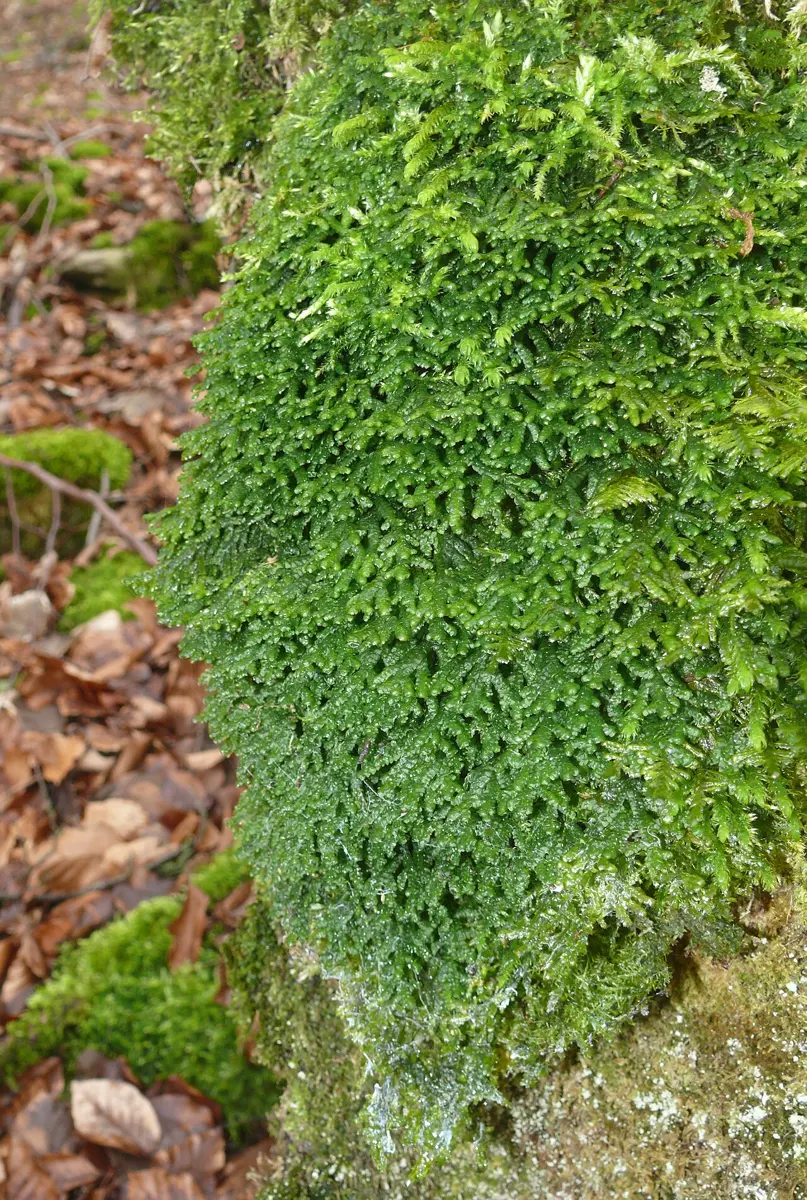
1. Hepaticopsida (liverworts)
The name comes from Latin hepaticus, of the liver: “class of liver-like plants”. The lobed thallus of some liverworts looks a little like a liver, and the old herbalists believed (wrongly) that a plant shaped like an organ would cure that organ; the English word wort just means plant. Their main features:
- i.The gametophyte is dorsoventral (it has a distinct upper and lower surface). It may be thalloid (a flat ribbon) or foliose (leafy, with a stem-like axis and two or three rows of leaves). Leaves, where present, have no midrib.
- ii.The lower (ventral) surface carries scales and rhizoids; the rhizoids are unicellular and unbranched.
- iii.The sex organs are on the upper (dorsal) side, sunk in the tissue or carried on stalks.
- iv.The sporophyte may be just a capsule (Riccia), a foot and capsule, or a foot, seta and capsule (Marchantia).
- v.The sporophyte is completely dependent on the gametophyte for its food.
- vi.The capsule has no columella (a central column of sterile tissue).
- vii.A spore grows straight into the gametophyte; there is no distinct protonema stage.
Examples: Marchantia, Riccia, Porella.
2. Anthocerotopsida (hornworts)
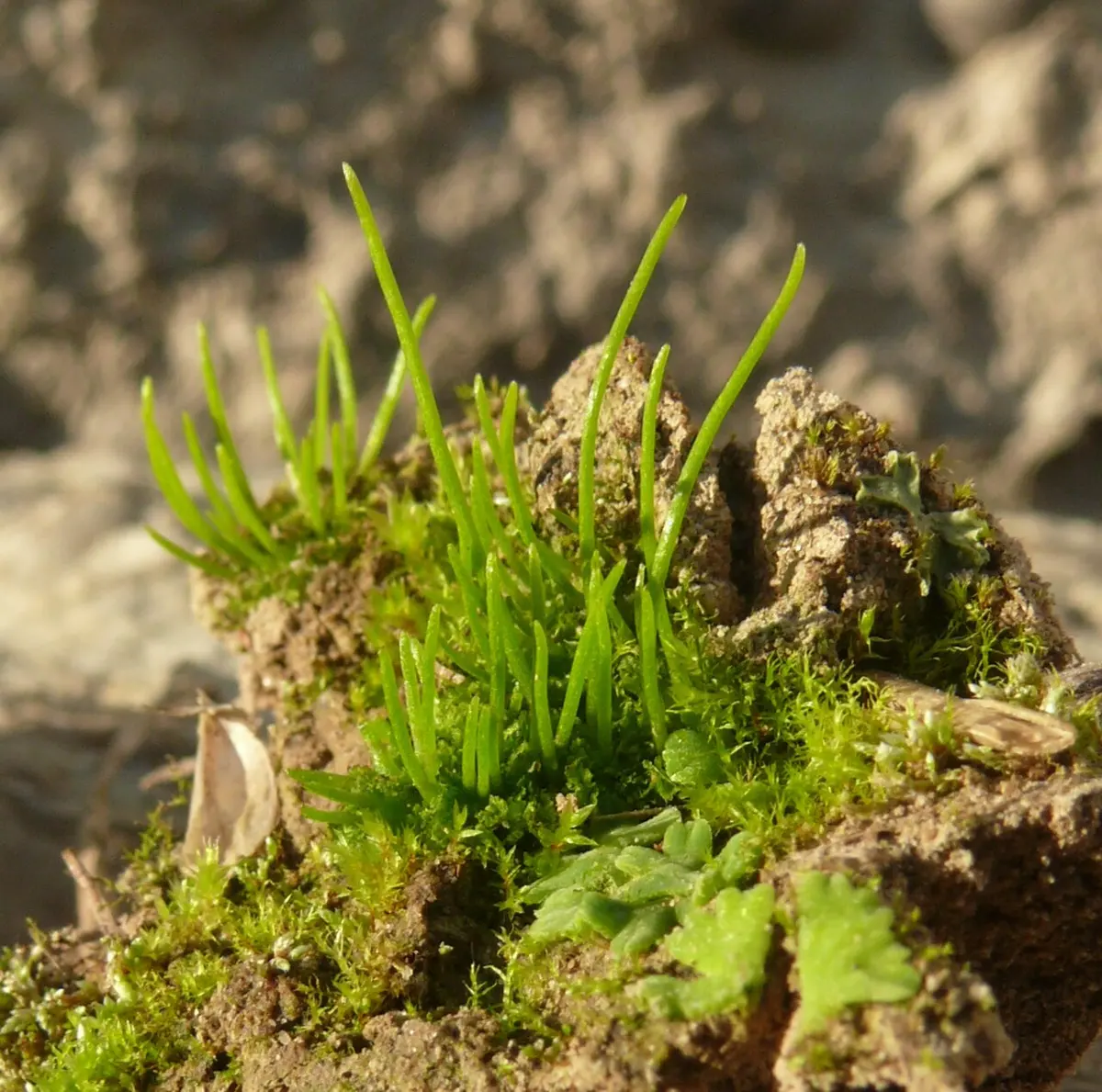
From Greek anthos, flower, and keras, horn: the sporophyte grows up from the thallus like a thin green horn. Their main features:
- i.The gametophyte is a dorsoventral, flattened thallus.
- ii.Rhizoids are unicellular, unbranched and smooth-walled; there are no ventral scales.
- iii.The sex organs are sunk in the upper (dorsal) side of the thallus.
- iv.The sporophyte is long, cylindrical and horn-like. It has a foot, a short region at its base that keeps growing (in place of a seta), and a long capsule.
- v.The sporophyte depends on the gametophyte for water and minerals, but it is green and makes much of its own food, so it is only partly dependent.
- vi.The capsule has a columella.
- vii.The thallus has cavities full of mucilage, in which nitrogen-fixing cyanobacteria (Nostoc) live.
- viii.A spore grows into a short, simple protonema-like stage and then into the thallus.
Examples: Anthoceros, Notothylas, Megaceros.
3. Bryopsida (mosses)
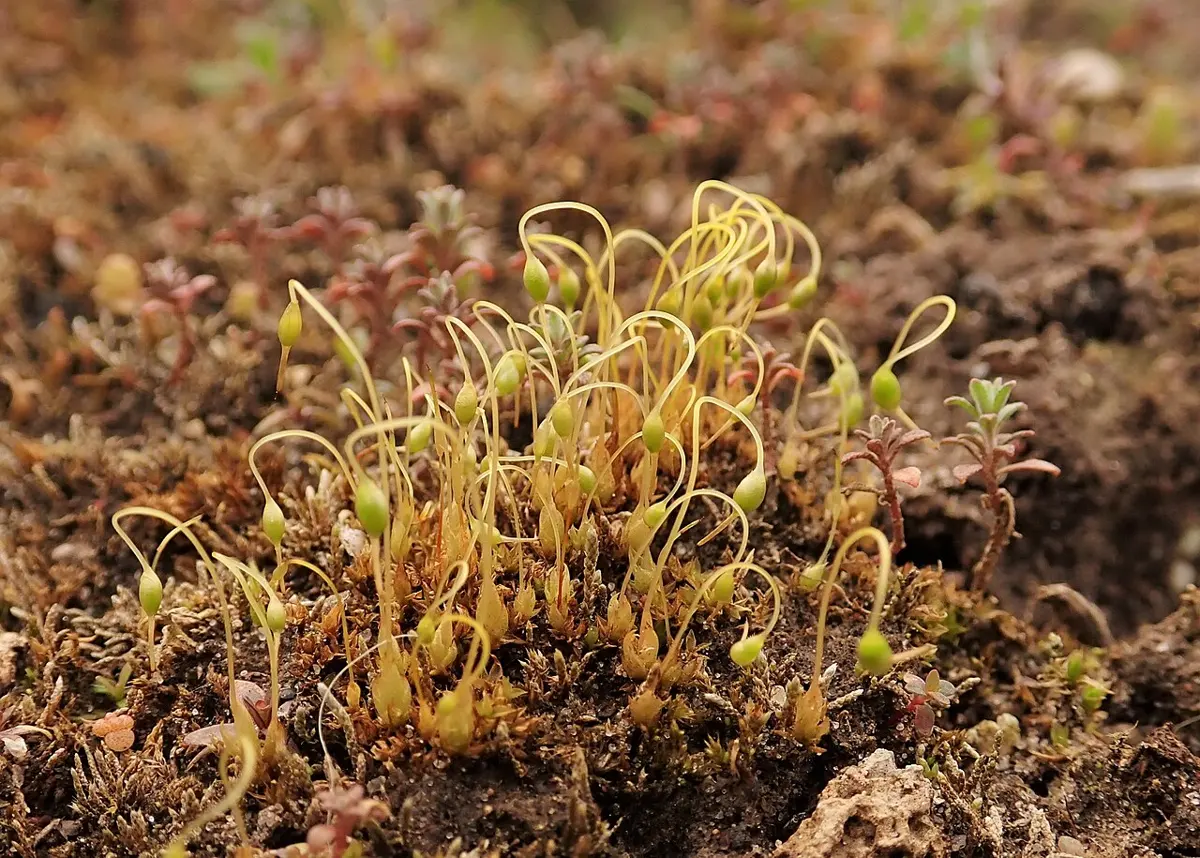
From Greek bryon, moss. Their main features:
- i.The gametophyte is upright and radially symmetrical: an axis with small leaves arranged spirally all round it, and rhizoids at the base.
- ii.Rhizoids are multicellular and branched, with oblique cross walls.
- iii.The sex organs are at the tips of the leafy shoots.
- iv.The sporophyte has a foot, seta and capsule.
- v.The sporophyte depends on the gametophyte (partly: a young moss capsule is green).
- vi.The capsule has a columella, and its mouth is ringed by a row of teeth, the peristome, which open and close with the air’s dampness and let the spores out a few at a time.
- vii.A spore grows into a branched green thread, the protonema, from which the leafy shoots then grow as buds.
Examples: Polytrichum, Funaria, Sphagnum.
Comparing the three classes
| Feature | Liverworts | Hornworts | Mosses |
|---|---|---|---|
| Gametophyte | thalloid or leafy, dorsoventral | thalloid, dorsoventral | leafy, upright, radial |
| Rhizoids | unicellular | unicellular, smooth | multicellular, oblique septa |
| Ventral scales | present (thalloid) | absent | absent |
| Sporophyte | capsule, or foot + seta + capsule | foot + long horn-like capsule | foot + seta + capsule |
| Columella | absent | present | present |
| Protonema | absent | short, simple | well developed |
| Examples | Marchantia, Riccia, Porella | Anthoceros, Notothylas | Funaria, Polytrichum, Sphagnum |
A bryophyte has a flat thallus, unicellular rhizoids, scales on its lower side, and capsules with no columella. To which class does it belong?
Pick an answer to see why.
2.5.4 Marchantia
Systematic position
| Rank | Name |
|---|---|
| Kingdom | Plantae |
| Division | Bryophyta |
| Class | Hepaticopsida |
| Order | Marchantiales |
| Family | Marchantiaceae |
| Genus | Marchantia |
Occurrence
Marchantia grows in moist, cool and shady places: on damp soil, rocks, walls, rotting logs and tree trunks, and along the banks of streams and rivers. Look for it at the foot of a wet wall in a garden, beside a dripping water tap or a dhara, and in plant pots kept in shade. Marchantia polymorpha also grows quickly on ground burnt by a forest fire.
Plant body
The plant body is a gametophytic thallus: a flat, dark green ribbon a few centimeters long that lies flat on the ground (prostrate). It is dorsoventral and dichotomously branched: every so often the tip forks into two equal lobes. A distinct midrib runs down the middle of each lobe. At the tip of each lobe is a small apical notch, in which the growing point sits.
On the upper (dorsal) surface, along the midrib, are small gemma cups, which produce the gemmae used in vegetative reproduction. Under a hand lens the upper surface is covered with a pattern of small diamond shapes, each with a white dot in the middle: each diamond is an air chamber under the surface, and the dot is its air pore.
The lower (ventral) surface carries two kinds of structure:
- scales: multicellular, purple or violet, in rows on each side of the midrib, which protect the growing point and hold water against the lower surface;
- rhizoids: unicellular, colorless and unbranched, which fix the thallus and take in water and minerals. (Marchantia has two kinds: smooth-walled ones, and tuberculate ones with peg-like ingrowths in their walls, which run along under the thallus and carry water like wicks.)
Marchantia is dioecious: each thallus is either male or female, and you can tell which only when its sex organs appear (Figure 7.5).
Marchantia: E. Strasburger, Lehrbuch der Botanik (1900), public domain
Marchantia: E. Strasburger, Lehrbuch der Botanik (1900), public domain
Reproduction
Marchantia reproduces by vegetative and sexual methods.
1. Vegetative reproduction
a. Fragmentation. As the thallus grows at its tips, the older parts behind die and rot. When the rotting reaches a fork, the two lobes are separated, and each grows on as a new plant. In a dry season the thallus may die back to a few living pieces, which grow again when the rain returns.
b. Gemmae. This is the commonest way Marchantia multiplies. Gemmae are made in large numbers inside the gemma cups on the upper surface. Each gemma is a small green disc of many cells, thicker in the middle than at its edges, on a one-celled stalk. It has a notch on each side, with a growing point in it. Most of its cells have chloroplasts; scattered among them are colorless oil cells, rhizoidal cells (which will grow rhizoids) and mucilage cells, which swell when wet and help push the ripe gemmae out of the cup.
A ripe gemma breaks from its stalk. A raindrop falling into the cup splashes the gemmae out up to a meter away; water, wind and small animals carry them further. On damp ground the side that lands down grows rhizoids, and each notch grows into a new thallus, so one gemma makes two plants that soon separate. A gemma is a piece of its parent, so gemmae from a male thallus grow into male plants and those from a female thallus into female plants.
Marchantia: E. Strasburger, Lehrbuch der Botanik (1900), public domain
2. Sexual reproduction
Marchantia is dioecious. Its sex organs are carried on special upright branches of the thallus, the gametophores. A gametophore carrying antheridia is an antheridiophore; one carrying archegonia is an archegoniophore.
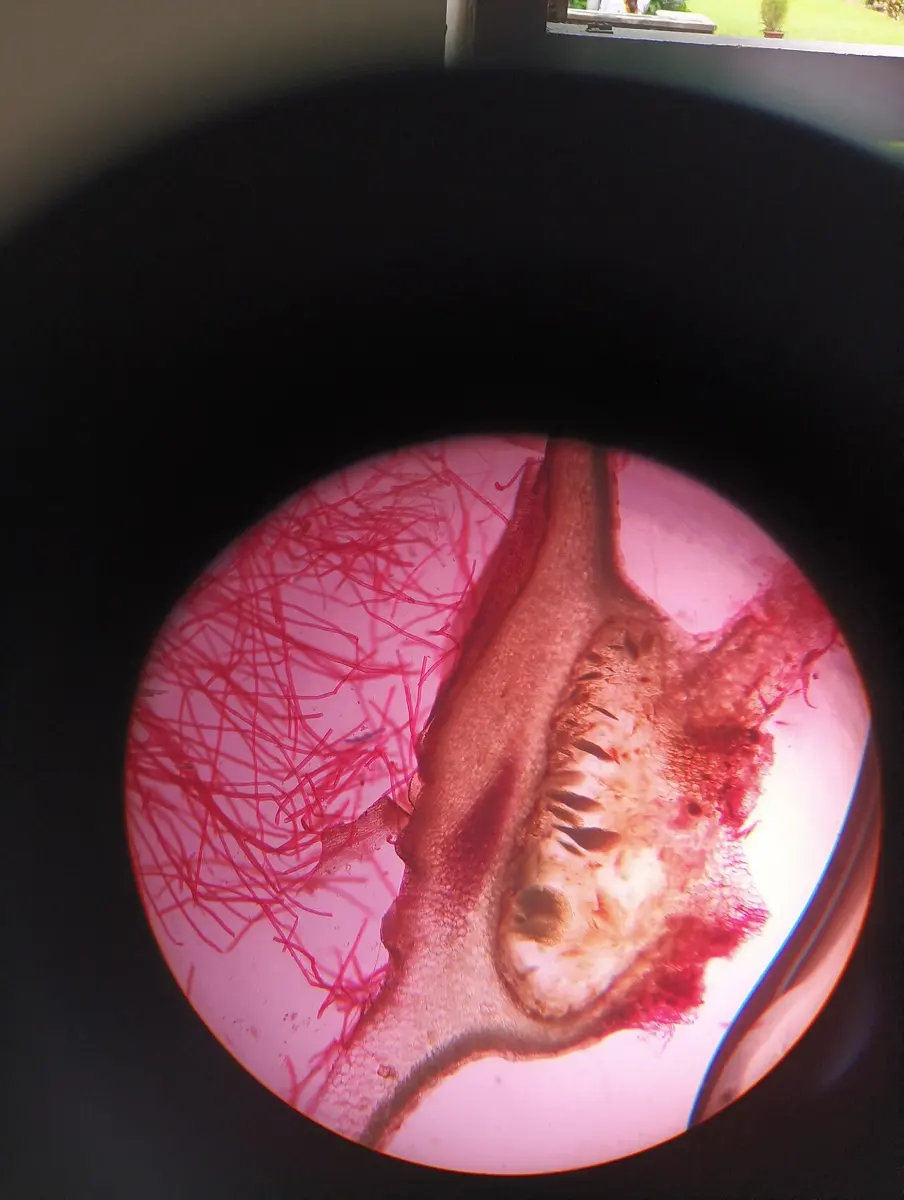
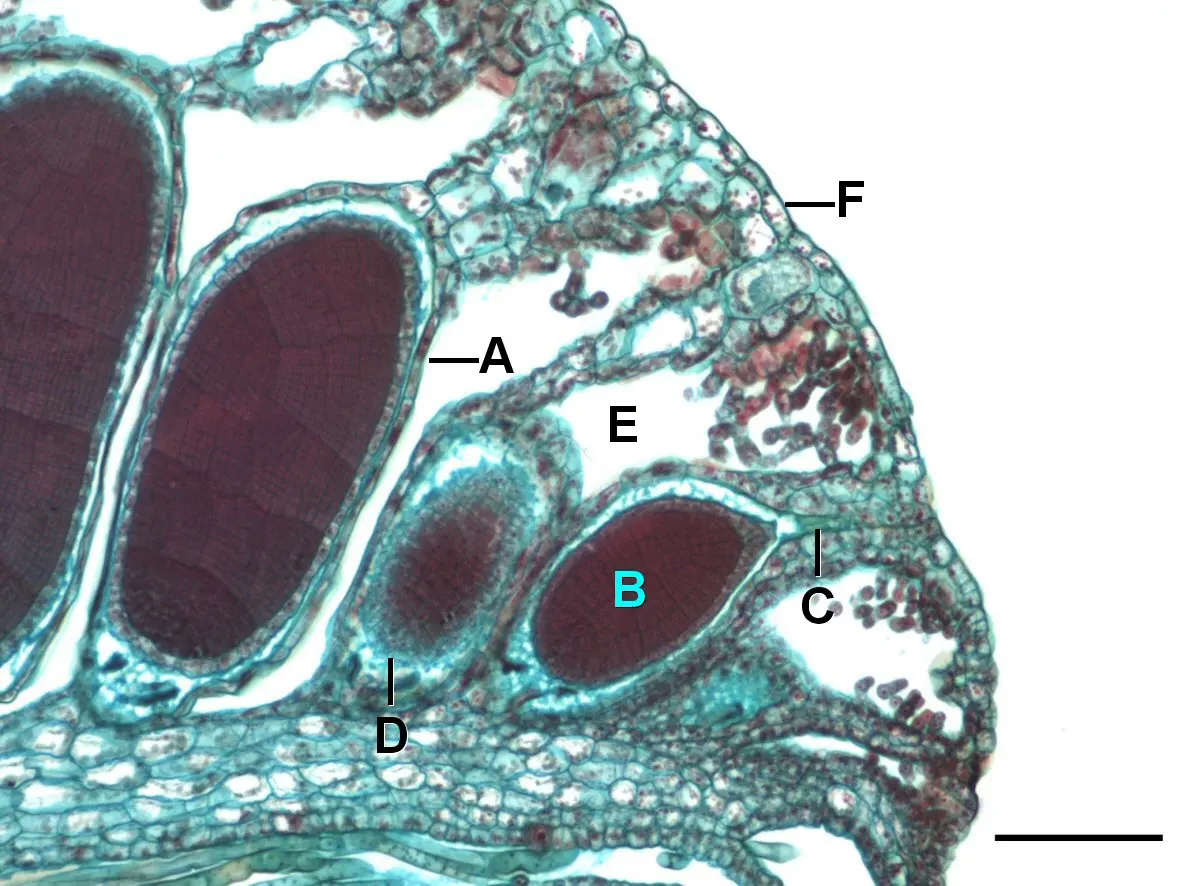
The antheridiophore and antheridia. The antheridiophore has an upright stalk about 2–3 cm long, topped by a flat, slightly curved disc with eight lobes, the male receptacle. On its upper side are flask-shaped antheridial chambers, each opening by a pore, alternating with air chambers. Each antheridial chamber holds one antheridium, fixed to its floor by a short, many-celled stalk.
The antheridium has an oval body with a jacket one cell thick, filled with small cells, the androcytes (antherocytes). Each androcyte becomes one antherozoid, the male gamete: a tiny curved cell with two flagella at one end. When the antheridium is ripe and water stands on the receptacle, its jacket absorbs water and bursts, and the antherozoids pour out through the pore into the water.
Marchantia: E. Strasburger, Lehrbuch der Botanik (1900), public domain
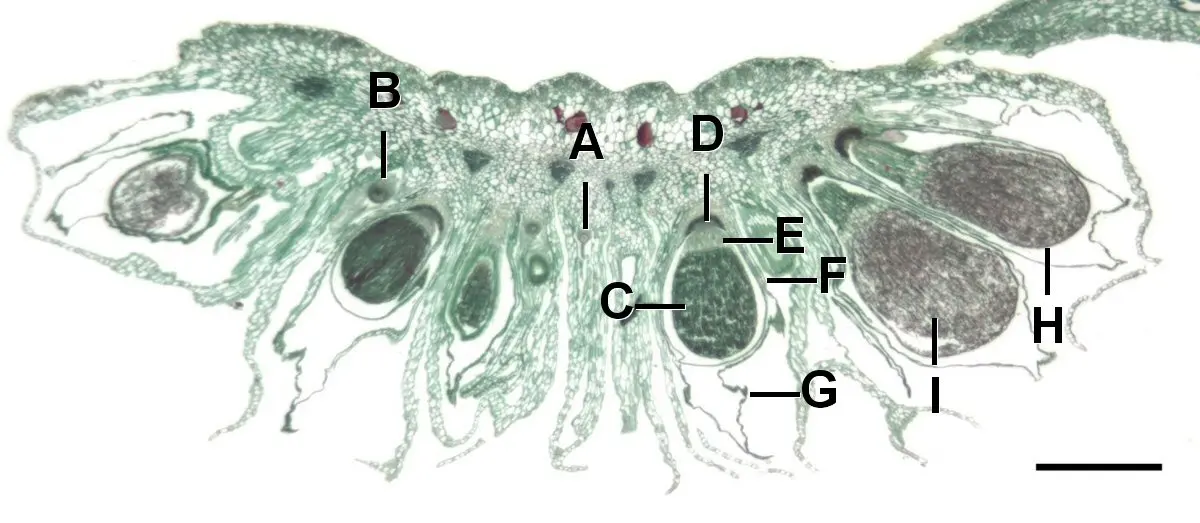
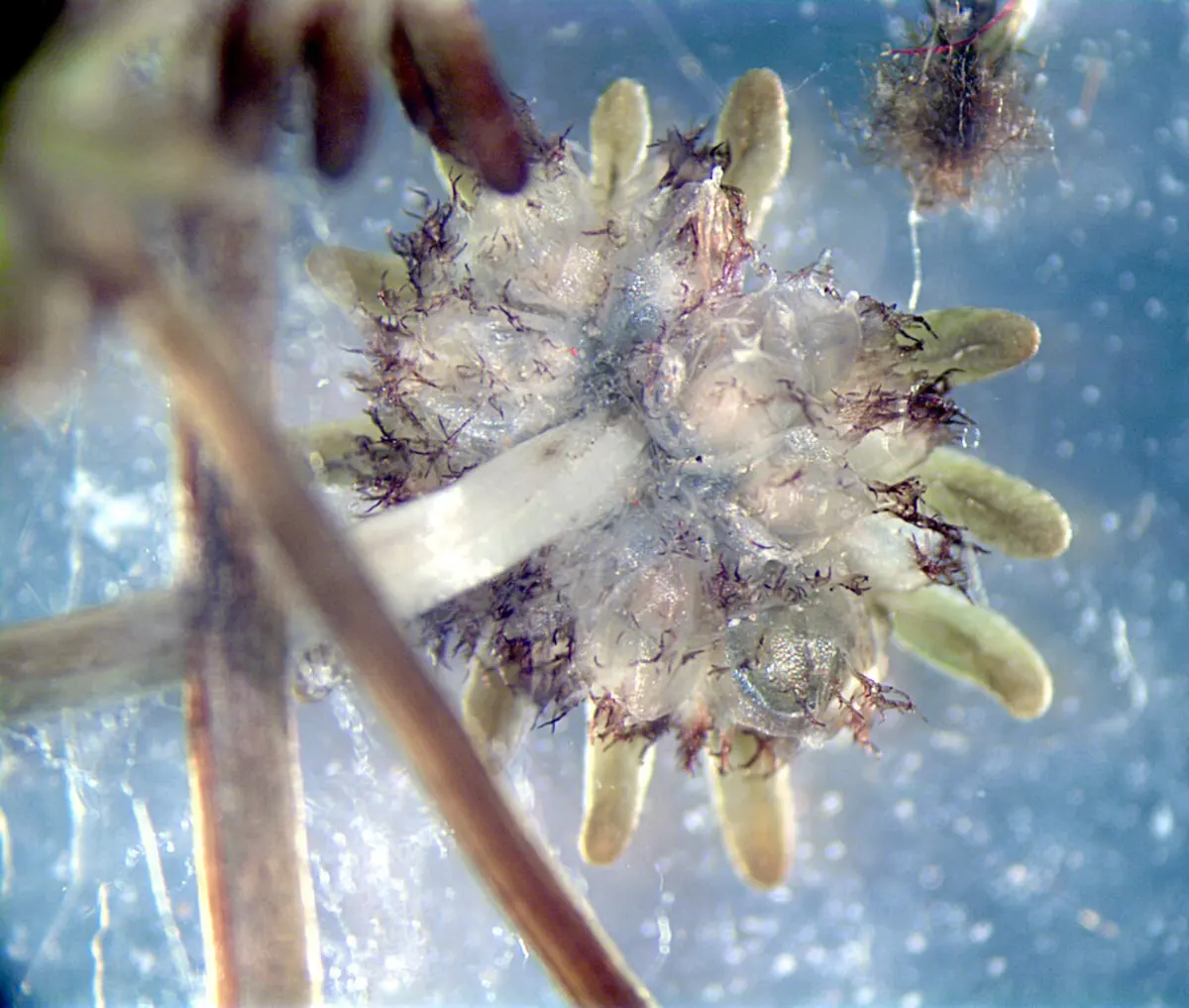
The archegoniophore and archegonia. The archegoniophore has a longer stalk and an umbrella-shaped head, the female receptacle, usually with nine finger-like rays spreading out from it. The archegonia grow in eight rows between the rays (which is why the head is also described as eight-lobed). They grow on the head’s upper side when young, but the middle of the head then grows upwards so much that they end up on its lower side, hanging neck-down: about 12–16 in each row. Each row is covered by a protective fringe, the perichaetium (involucre).
A mature archegonium is a flask-shaped organ on a short stalk (Figure 7.11):
- the swollen venter holds a large egg (oosphere) and, above it, a small venter canal cell;
- the long, narrow neck holds a row of 4–6 neck canal cells;
- the tip of the neck is closed by four cover cells (lid cells).
Marchantia: E. Strasburger, Lehrbuch der Botanik (1900), public domain
Fertilization. In a ripe archegonium the neck canal cells and the venter canal cell break down into a mucilage that swells by absorbing water. Its pressure pushes the cover cells apart and opens a passage down the neck to the egg. Fertilization needs water: after rain, antherozoids swim from the antheridia in a film of water, or are thrown in splashing drops from a male receptacle onto a female one nearby. The mucilage oozing from the archegonium’s neck gives off chemicals that attract them. Many antherozoids swim down the neck, but only one fuses with the egg, making the zygote (2n).
The sporophyte
The zygote is the first cell of the sporophyte generation. It divides by mitosis into an embryo, which grows inside the venter of the archegonium into a many-celled sporophyte. The sporophyte never leaves the gametophyte: it hangs under the female receptacle and is completely dependent on it for its food (it is called parasitic on the gametophyte).
A mature sporophyte has three parts (Figure 7.12):
- the foot, sunk in the tissue of the receptacle, which absorbs food and water from the gametophyte;
- the seta, a short stalk joining the foot to the capsule, which lengthens just before the spores are shed and pushes the capsule out;
- the capsule, an oval body with a jacket one cell thick enclosing many spore mother cells (fertile) and elater mother cells (sterile).
Around the young sporophyte are three coverings: the calyptra, grown from the old venter; a second sheath, the pseudoperianth; and outside them the perichaetium round the whole row.
Each spore mother cell divides by meiosis into four haploid spores. The elater mother cells first feed the spore mother cells; then they grow into long, narrow, spindle-shaped elaters, with spiral bands of thickening in their walls. When the capsule is ripe, its wall splits into several teeth curling back from the tip. The elaters twist and untwist as they dry and take up moisture, flicking the spores out into the air. A spore landing on damp ground germinates into a new gametophyte (male or female).
Marchantia: E. Strasburger, Lehrbuch der Botanik (1900), public domain
Life cycle of Marchantia
The life cycle shows a clear alternation of generations: the haploid gametophyte (the thallus) makes gametes; they fuse into a diploid zygote, which grows into the sporophyte; the sporophyte makes haploid spores by meiosis, and each spore grows into a gametophyte again. The gametophyte is the large, long-lived, independent, dominant generation; the sporophyte is small, short-lived and dependent.
2.5.5 Economic importance of bryophytes
Bryophytes have been useful to people since prehistoric times: Stone Age people used them to stuff bedding, plug gaps and pad clothes and babies’ wrappings. Today they interest ecologists, botanists, industry, gardeners and the makers of medicines.
1. Ecological importance
a. Bog succession. In a cold, wet place a pond or lake may fill up slowly with plants. Mosses, especially Sphagnum, with sedges and other water plants, spread over the water as a floating mat that looks like solid ground but shakes when you step on it: a quaking bog. Dead Sphagnum piles up below the mat; the bog fills and becomes a marsh, then shrubs and finally a forest grow there. (This is one kind of succession, the slow change of one community into another.)
b. Formation of soil. Lichens and then mosses are pioneers on bare rock. They trap dust, hold water and give out acids that break down the rock’s surface; when they die their remains add organic matter. The thin soil they build lets grasses, ferns and then larger plants grow.
c. Food and shelter. Many small animals (mites, springtails, insects, snails, the tardigrades or “water bears”) eat bryophytes, lay their eggs in them or shelter in them. Many birds line their nests with moss.
d. Soil conservation. Mats of moss cover and bind the soil, so rain running over it doesn’t wash the soil away. In a forest the moss on the ground and on the trunks soaks up rain and releases it slowly, which keeps springs flowing into the dry season.
e. Indicators of pollution. Bryophytes have no waxy cuticle to keep things out and no roots: they take in water and everything dissolved in it through their whole surface. So many kinds die where the air has much sulphur dioxide, and living or dried mosses soak up heavy metals (lead, cadmium, zinc) from the air and water. The kinds of moss growing in a place, and the metals measured in them, are used to monitor air and water pollution.
2. Medicinal uses
Bryophytes contain many unusual chemical compounds, and some kill bacteria or fungi. In traditional medicine in China and India, mosses and liverworts have been used for ringworm and other skin infections, and moss ash mixed with honey and fat for cuts, burns and wounds. Scientists have extracted several antibacterial substances from them. Sphagnum has been used as an antiseptic, absorbent dressing (2.5.1). (Liverworts got their name because of the old belief that their liver shape meant they could cure the liver; there is no evidence that they do.)
3. Packing material
Dried mosses are light, springy and soak up shocks, so they make good packing for glassware, fragile goods and live plants sent long distances. Gardeners still wrap the roots of seedlings in damp Sphagnum to keep them moist.
4. Fuel
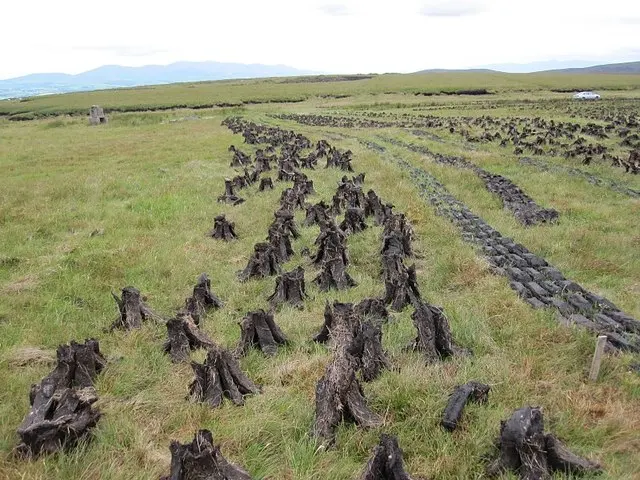
In cold, wet places Sphagnum grows on top while the moss below dies and doesn’t rot, because the bog is waterlogged, acidic and has little oxygen. Year after year the dead moss is pressed into a dark brown, carbon-rich material, peat. Peat is cut, dried and burnt as fuel, as it has been for centuries in Ireland, Scotland and Finland.
5. In experimental botany
Liverworts and mosses are good tools for research in genetics, plant development and physiology: they are small, quick to grow, and their main plant body is haploid. Marchantia polymorpha and the moss Physcomitrium patens are used in laboratories round the world (2.5.4).
6. Ornamental and garden use
Bryophytes are grown in gardens (the moss gardens of Japan are famous), in terrariums and on bonsai pots. Sphagnum and peat are mixed into potting soil, where they hold water and air, and are used in greenhouses to grow orchids and seedlings.
7. Industrial uses
Peat is more than a fuel: it has been used to make alcohol, ammonium sulphate (a fertilizer), paraffin, dyes and tanning materials. Dried mosses have been used to stuff mattresses and cushions and to fill the gaps between the logs of wooden houses.
Which property of mosses makes them useful for monitoring heavy metals in the air?
Pick an answer to see why.
Exercise
A. Choose the correct option
- Which of the following best describes bryophytes?
Pick an answer to see why.
- Which stage of the bryophyte life cycle is haploid?
Pick an answer to see why.
- Which describes the gametophyte of Marchantia?
Pick an answer to see why.
- In the sexual reproduction of bryophytes, how do the male gametes reach the egg?
Pick an answer to see why.
- Which structure in bryophytes produces the egg?
Pick an answer to see why.
- What is the main role of mosses and lichens in the formation of soil on bare rock?
Pick an answer to see why.
- What is peat, and how is it used?
Pick an answer to see why.
- In bryophytes, where are spores produced?
Pick an answer to see why.
- What event begins the sporophyte generation in Marchantia, and why is it important?
Pick an answer to see why.
- In a lengthwise section of a mature Marchantia male receptacle seen under a microscope, A is a small chamber just under the upper surface with green cells, opening by a pore, and B is a larger flask-shaped chamber holding an oval body on a short stalk. What are A and B, and what does B do?
Pick an answer to see why.
B. Answer the following questions
Define the following:
- a.gemma
- b.archegonium
- c.antheridium
- d.alternation of generations
Answer
Compare the characters of algae and bryophytes.
Answer
What is the dominant plant body in Marchantia, and why is this significant for its reproduction and life cycle?
Answer
How does calling bryophytes “amphibians of the plant kingdom” reflect their ecological adaptations and reproduction?
Answer
Give the characteristic features of bryophytes.
Answer
Describe the economic importance of bryophytes.
Answer
Explain how the presence or absence of certain bryophyte species can show the health of the environment and changes in it.
Answer
Alternation of generations occurs in the life cycle of Marchantia. Explain it with reasons.
Answer
Marchantia: E. Strasburger, Lehrbuch der Botanik (1900), public domain
Study the thallus of Marchantia in Figure 7.17 and answer:
- a.Is the thallus male or female? Give reasons.
- b.Label A and B.
- c.Write the function of A and B.
Answer
Printable PDFs
- Study notes 3 pages
- Worksheet 4 pages Answer key
Quiz yourself: Classification of Living Beings, Grades 5–12 →
Practice every question in the book, and keep track of the ones you miss →
A companion to your textbook, not a replacement for it: study from the book your school uses, and where the two differ, follow your teacher. Found a mistake? Please tell us.