
In 1783 a British judge named William Jones arrived in Calcutta to sit on the Supreme Court there. Cases there turned on Hindu law, and the court relied on pandits to say what the old Sanskrit law books meant. Jones found that different pandits gave different rulings, so he decided to learn Sanskrit himself and read the books with his own eyes. He studied with a pandit from Nadiya, रामलोचन (Rāmalocana), and the more Sanskrit he learned, the more something odd kept showing through. It looked like the Greek and Latin he had learned at school in England.
On 2 February 1786 he said so, in a talk to the Asiatic Society he had founded in Calcutta. Sanskrit, he told them, bore to Greek and Latin “a stronger affinity, both in the roots of verbs and in the forms of grammar, than could possibly have been produced by accident; so strong, indeed, that no philologer could examine them all three without believing them to have sprung from some common source, which, perhaps, no longer exists.” He thought Gothic, Celtic and old Persian probably belonged with them too.
You can check his idea without leaving home. The Sanskrit for a name is nāma, and so is the Nepali, नाम; Latin has nōmen, and English has name. Sanskrit’s पिता (pitā) is Latin’s pater and Greek’s patḗr, and English father is the same word worn by a few thousand years of speaking. Two is दुई, duo in Latin; three is तीन, trēs. Jones wasn’t the first to notice such things, and his own list of relatives wrongly included Egyptian, Chinese and Japanese. But his talk is where the study of language families is usually said to begin. The “common source” got a name, Proto-Indo-European, and the family now has more than 580 languages. More than three billion people, about two in every five alive, speak one of them, Nepali among them.
So a language has relatives, and relatives live in different places. How did they get there?
How a language travels
There are only two ways. People who speak a language can move and take it with them. Or people who stay where they are can take up a language from someone else, from neighbors, rulers, traders or school. Geographers call the first relocation and the second expansion, but the plain words will do: a language is carried, or it is caught.
Once a language has been carried somewhere, it starts to drift. Every generation speaks a little differently from the last, and two groups who no longer talk to each other drift in different directions. Given enough centuries, one language becomes several that can no longer understand each other. That is why languages come in families, and why a family’s map is a record of old journeys. Linguists count about 7,700 languages that people speak as their first language, in roughly 250 families, plus some 180 isolates, languages with no known relatives at all.
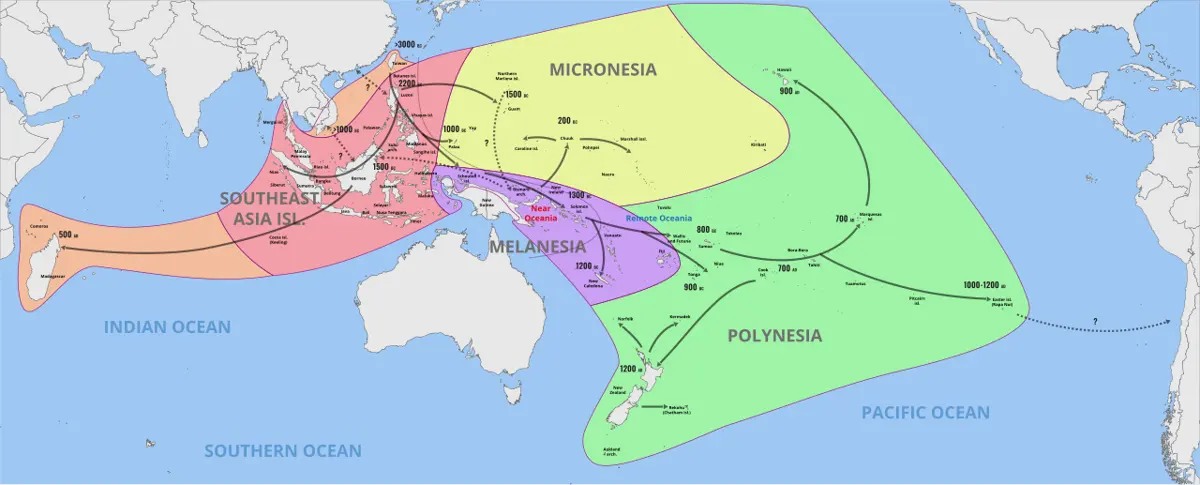
The most far-flung family before European ships went everywhere was the Austronesian, and its journey is written in its numbers. The word for five is lima in Indonesian and Malay, limá in Tagalog in the Philippines, lima again in Hawaiian, out in the middle of the Pacific, and rima in Māori in New Zealand. Far to the west, off the coast of Africa, Malagasy in Madagascar says dimy. The family’s ancestor most likely said something close to lima. Trace the languages back by how much they share, and they point to Taiwan, about 5,200 years ago. From there seafarers spread south through the islands of Southeast Asia, then east across the Pacific as far as Easter Island, and west across the Indian Ocean to Madagascar, and Malagasy’s closest living relative is still spoken some 7,000 km away, on Borneo.
Africa has a journey on the same scale. About 5,000 years ago, people speaking an early Bantu language began to spread out of West Central Africa, bringing a way of life in which farming mattered more and more. Their descendants now speak some 600 Bantu languages across central, eastern and southern Africa, Swahili and Zulu among them. The land steered them. A study of about 400 Bantu languages found the migrants followed open savannah where they could; where they had to push into rainforest, they were held up by about 300 years on average.
Those were languages carried by people who moved. Today the biggest spreader works the other way. English has about 1.5 billion speakers, and roughly three in four of them learned it as a second language, at school or at work, without anyone moving at all. It was caught. Every language that spreads this way has a cost somewhere else, because a family that switches to the language of jobs and schools often stops passing on its own. Nepal’s own languages, and what happens when families switch, are the subject of Peoples of Nepal.
How a religion travels
Religions travel by the same two ways, but they differ in how keen they are to be caught. Some religions set out to win followers anywhere: Christianity, Islam, Buddhism and Sikhism are the usual examples. Others pass mostly within families and communities, from parents to children: Hinduism and Judaism are the usual examples. The first kind can spread a long way from where it started, and often ends up with most of its people far from home. The second kind stays near its first home, and travels mainly in the luggage of people who move.
The world’s numbers show it. In 2020, by one large count, about 29% of the world’s people were Christians, 26% Muslims, 15% Hindus and 4% Buddhists, and 24% had no religion. Christianity began in Judea, at the eastern end of the Mediterranean, yet the region with the most Christians now is Africa south of the Sahara, home to 31% of them, ahead of Europe’s 22%. Islam began in Arabia, yet 59% of the world’s Muslims live in Asia and the Pacific, and the country with the most is Indonesia, with about 240 million. Islam reached its islands with merchants on the sea routes of the spice trade, slowly and, by most accounts, mainly peacefully.
Buddhism has gone furthest of all from home. It began with a teacher born at Lumbini, in Nepal’s Tarai, and spread across Asia. Then, over centuries, it faded from India itself, and by about the 1100s it had largely given way to Hinduism there. Today India’s roughly 10 million Buddhists are less than 1% of its people. The countries where most people are Buddhist are far away: Cambodia, Thailand, Myanmar, Bhutan, Sri Lanka, Laos and Mongolia.
Hinduism, passed down mostly within families, did the opposite. Of the world’s 1.2 billion Hindus, 97% live in just two countries, India and Nepal, the only ones where Hindus are the majority. Beyond them, it has traveled mostly with people who moved.
How each of these religions began and spread, ruler by ruler and road by road, is told in World History, for the Curious, and what each one teaches in Philosophy and World Religions. Geography’s part is the pattern, and how to read the maps of it.
Reading the maps
A map of languages or religions usually gives each country, or each region, one color: the color of its largest group. That’s a useful summary and an easy thing to misread.
India is the plainest case. On a map of religions it is colored Hindu, and it should be: most Indians are Hindus. But India’s Muslims, about 213 million of them in 2020 by Pew’s estimate (the last census, in 2011, counted 172 million), are only 15% of its people, and that makes India home to the third-largest number of Muslims in the world, after Indonesia and Pakistan. On the map they are invisible. A language map has the same trap. Colored by home language, it paints English over Britain, the United States and Australia, and leaves uncolored the hundreds of millions in India, Nigeria and everywhere else who use English every working day.
The lines can mislead too. A map needs a line between one color and the next, but on the ground a language often changes the way a dialect does, a little from one village to the next. Where the line goes can be a matter of politics as much as speech. Hindi and Urdu are the plainest example nearby: spoken, they are understood by each other’s speakers with little trouble, and linguists often treat them as two standard forms of one language, Hindustani. Written, Hindi uses Devanagari and takes its learned words from Sanskrit, while Urdu uses a Persian-Arabic script and takes them from Persian and Arabic, and each is an official language under its own name. The line people repeat about this is usually credited to the linguist Max Weinreich: a language is a dialect with an army and a navy.
So a map of peoples shows a real pattern, drawn with a crayon too thick for the details. The crudest map of peoples of all was drawn with the thickest crayon there is.
Why races were given up
Many old books, and some still in use, divide humanity into a few races. Nepal’s Grade 10 Geography book, for those who take it as an optional subject, has four: Caucasoid, Mongoloid, Negroid and Dravidian, each with its skin, its face, its homeland and, it says, its character, though the lesson ends by saying that getting ahead depends on a person’s ability and opportunity, not on जाति, its word for race, and that so much mixing has gone on that the groups can no longer be told apart. Every one of those four words is worth recognizing, because you’ll meet them. And every one has been dropped by the scientists who study human variation.
The words are older than any of the evidence. The man who made “Caucasian” famous was a German doctor, Johann Friedrich Blumenbach, who in 1795 sorted humanity into five varieties, mainly by comparing skulls and skin. He took the name of his first variety from the Caucasus mountains. The most beautiful skull in his collection, as he judged it, was a Georgian woman’s, and he held that the most beautiful people of all lived on the mountains’ southern slopes. The name rests on one man’s sense of beauty. To be fair to him, Blumenbach also argued against those who called Africans inferior, and put the differences he saw down mostly to climate.
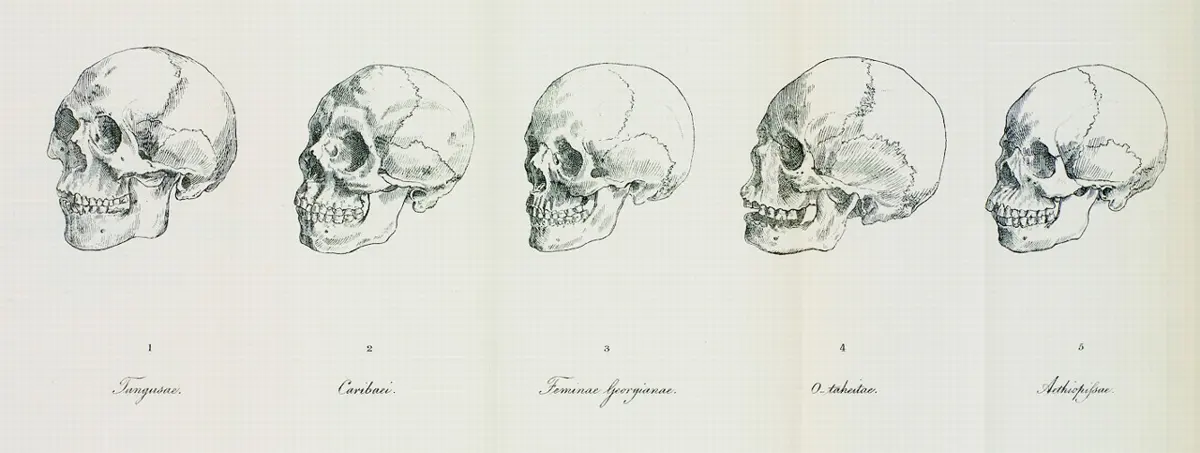
Blumenbach was more careful than the people who copied him. He insisted that his varieties “run into one another by insensible degrees,” so that no clear line could be drawn between them. The tidy list of five lasted. His warning didn’t.
The old lists also mix up things that have nothing to do with each other. The Grade 10 book defines its fourth race, the Dravidian, as the people who live in the Dravidian region and speak Dravidian languages, Tamil, Telugu, Kannada and the rest. But a language family isn’t a kind of body. A language can be caught by anyone, and whole peoples have switched. A list that puts a language family beside skin colors is sorting by two different things at once.
The deeper trouble is what the bodies themselves show. Take skin color, the trait races were most often drawn by. When researchers put the skin color of peoples who have lived in the same place for a long time beside satellite measures of sunlight, they matched strongly: darker where the sun’s ultraviolet light is strongest, lighter toward the poles. Dark skin protects the body from strong sunlight, and paler skin lets the body make vitamin D where sunlight is weak. Skin color has changed more than once in human history, wherever people settled under a different sun, so similar skin says almost nothing about who is related to whom. It is a map of sunlight, not of family trees, and it shades gradually across the world.
Genes tell the same story, only more firmly. Any two people share about 99.9% of their DNA. And of the small part that differs, most of the difference is between people in the same community, not between continents. In one large study of 52 populations around the world, 93 to 95% of the genetic variation was among people within the same population; only 3 to 5% separated the major regions of the world. Put another way, if every population but one vanished, the one left would still hold most of humanity’s genetic variety.
And the difference that does exist changes gradually. Our species began in Africa and spread out from there. Each time a small group moved on to new land, it carried only part of the variety of the group it came from, and the next group that moved on carried part of that. So genetic variety should fall, step after small step, the farther people live from Africa by the routes people walked, and that is what the samples show.
The dots slide down one long slope, from Africa at the top left to the Americas at the bottom right, with no steps at the edges of continents. Africa’s peoples are the most varied of all, and most of the variety found anywhere else is a part of what is found in Africa. If the world were divided into a few races, the dots would sit in a few separate clumps. They don’t.
To be fair to the other side of the argument, genes aren’t completely without pattern. With enough of them, a computer can usually tell roughly which part of the world a person’s ancestors came from, and the change is a little quicker across the great barriers, the oceans, the Sahara and the Himalaya. Asked for five groups, the program in the 2002 study of 52 populations found five that roughly follow the continents: Africa, East Asia, Oceania, the Americas, and one that takes in Europe, the Middle East and the part of Asia south and west of the Himalaya together. But the groups such programs find depend on how many groups they are asked for and on where the samples were taken; where samples are spread evenly over the land, the boxes give way to gradients, and the people who live between them come out as mixtures. Nor are those five the old four. Variety runs across the world in gradients, not in boxes.
That is why the scientific bodies have said it outright. The American Association of Biological Anthropologists, the people whose job is the study of human variation: “Humans are not divided biologically into distinct continental types or racial genetic clusters.” Their statement adds something just as important. Race isn’t biology, but it is still a social reality: people have been sorted, ruled and treated differently by these labels for five hundred years, and that sorting has real effects on their lives and even their health. The old lists’ talk of each race’s character never had any evidence behind it. What it did have was a use, which is how ideas like that last. The labels people in Nepal use for one another, जात, जाति and the rest, are a different story, told in Peoples of Nepal.
One family
Jones, listening for kinship in the roots of verbs, found that Sanskrit and Latin were cousins. It turns out the same is true of the people who speak them, and of everyone else. The languages and religions on the map really do have homelands and routes, and the maps of them are worth reading carefully. The map of people themselves has no lines to draw, only a long slope running out from Africa, with all of us somewhere on it.
Found a mistake? Please tell us.