More than the printed sheet
The businesses elsewhere, in full
Cashify (India). Mandeep Manocha, Nakul Kumar and Amit Sethi started it in 2013, under the name ReGlobe. At first it only bought: you typed in your phone’s details online, an agent came to your home, checked the phone and paid cash the same day, and Cashify sold the phones on to shop-owners across India, often after small repairs. Phone makers and online shops sent it the old phones from their trade-in offers. By 2018 it was buying about 100,000 smartphones a month; the gap between what it paid and what shops paid it was usually 30–35%, and the shops then made about 10% themselves. Later it opened its own stores and sold refurbished phones to the public. In 2024–25 it took in ₹1,096 crore: ₹999 crore from selling used devices and ₹97 crore from repairs and other services. Even so it lost ₹10.5 crore that year (₹53 crore the year before), because buying the phones takes 82% of its costs: the margins are thin, even at that size.
Back Market (France). Started in Paris in 2014 as a website for refurbished phones. Its phones come from a network of about 1,800 refurbishers. In January 2022 investors valued it at US$5.7 billion; a year later, expecting hard times, it cut 13% of its staff and paused its growth abroad. In 2024 it said it was making a profit in Europe for the first time, after ten years and nearly 30 million devices sold; phones, once all it sold, had become 60% of its sales. In 2025 it had 17 million customers in 17 countries and began offering repairs in France, Germany and Spain.
Badili (Kenya). Rishabh Lawania and Keshu Dubey started it in 2021. It buys phones from people and runs trade-ins for brands such as Samsung and for phone dealers, through its website and a network of shops and agents, pricing each phone by its model and age. Because stolen phones are the biggest danger, sellers must show ID and photos and swear an affidavit that the phone is theirs, and people who sell often are checked more closely. Badili repairs the phones and sells them with a one-year warranty. It raised US$2.1 million in 2022, and in 2025 borrowed US$400,000 from Proparco, the French development bank, to grow in Kenya, Uganda and Tanzania.
The money, worked through
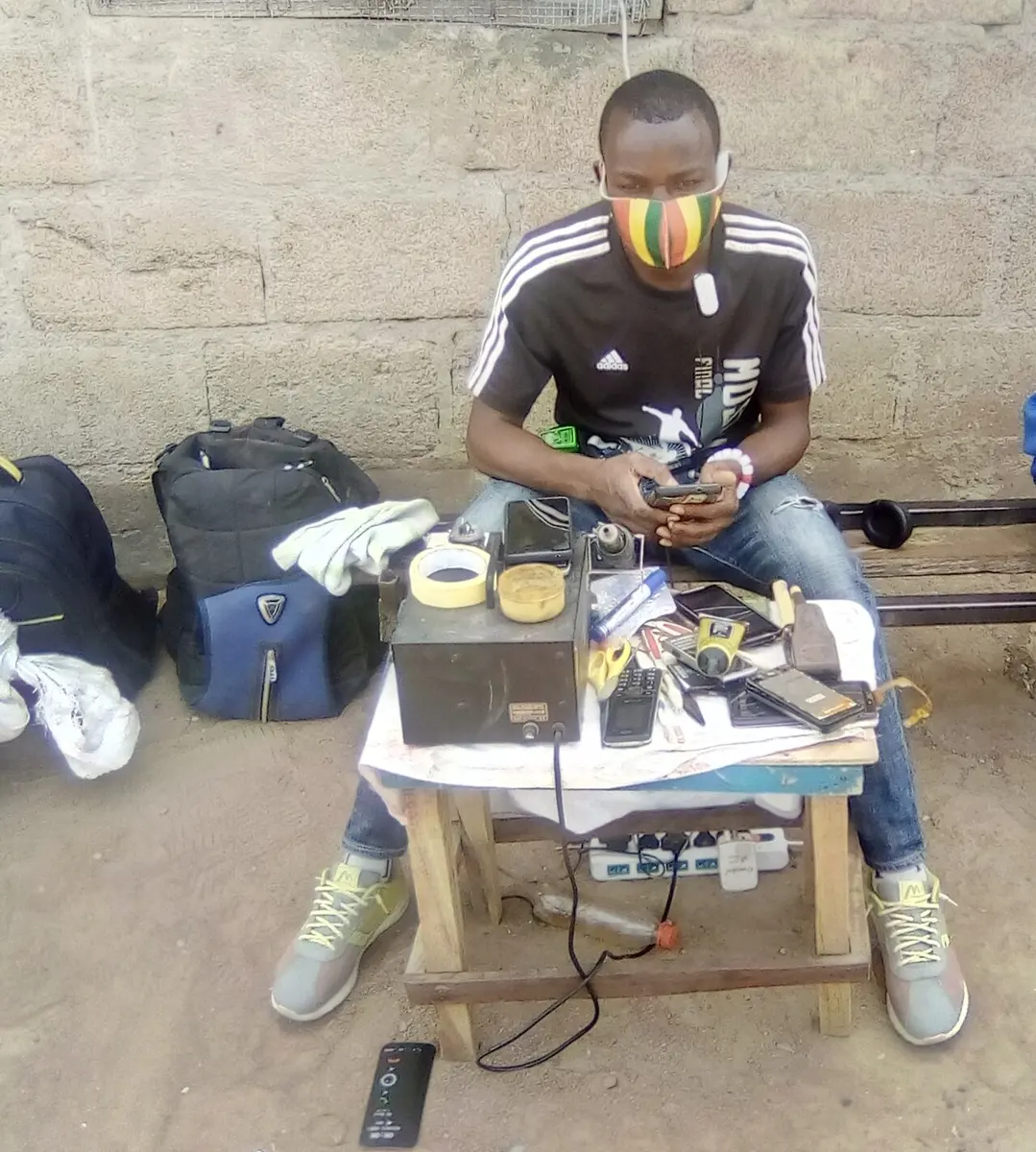
Step 1: a repair stall. In Bara, Dukhiram Mahara Chamaar opened his shop with Rs 20,000 after three months’ training and expected to make Rs 400–500 a day (2020). Open 26 days a month, that is 26 × Rs 400–500 = Rs 10,400–13,000 a month. The report doesn’t say whether parts were already paid for out of that.
Step 2: reselling a phone. In October 2026 SabKo Phone in Kathmandu was selling a refurbished iPhone 12 for Rs 39,999, with up to six months’ warranty. Suppose you keep a gap like Cashify’s, about 30% of the selling price: 30% of Rs 40,000 is Rs 12,000. Out of that gap come your rent, your time and the repairs of phones that come back under warranty.
Step 3: what you can pay for it. Rs 40,000 − Rs 12,000 = Rs 28,000 for the old phone and its new parts together. If it needs a new screen, the screen comes out of the Rs 28,000 too, so you pay the seller less.
We found no reliable list of repair prices, part prices or buying prices in Nepal. To find them: ask three repair shops what they charge for a screen and a battery on three common models; get an online quote for a used phone from a Kathmandu refurbisher, as if you were selling; and look up the same models on second-hand listings. The difference between what people sell for and what refurbished phones sell for is your gap.
Other places in Nepal it could fit
Phones are now everywhere. In the 2021 census, 73% of Nepal’s households had a smartphone: 78.3% in municipalities and 62.2% in rural municipalities. By early 2026 the figure was 85.1% (Kantipur). And phones don’t last: the Department of Environment found that a phone is used for about two years (Kathmandu Post, 2023), while Nepal imported 1.84 million smartphones in 2023/24 alone (Department of Customs).
So the customers are in every district, but the refurbishers we found are in Kathmandu. A trusted shop fits in a district headquarters or market town, where families from the villages around come to buy their phones, and near schools and colleges. It doesn’t have to be large: Dukhiram’s shop in Bara is in a village, Bharwalyia.
What to do with what can’t be fixed
Nepal has no law of its own for electronic waste. The Solid Waste Management Act 2011 covers hazardous waste, and the National Waste Management Policy 2022 mentions e-waste, but its plans haven’t been put into practice; local governments are responsible, and experts say they can’t yet handle it (Kathmandu Post, 2023). Phones hold gold, silver and copper, but also harmful materials, and scrap collectors burn wires to get the copper out. Doko Recyclers, started in 2017, recycles e-waste properly; only 2% of the devices it receives can be refurbished. Keep dead phones for parts, and send what’s left to a proper recycler, never to a fire.
Questions people ask
- How long does it take to learn phone repair?
- Dukhiram trained for three months (Caritas Nepal, 2020). The Mobile Phone Repair Technician course at Balaju School of Engineering and Technology was 390 hours (2022/23). Then most people learn more by working beside an experienced repairer.
- How do I know a phone isn’t stolen?
- Ask for the seller’s ID and keep a copy, and check the IMEI at mdms.nta.gov.np: the Nepal Telecommunications Authority advises buying only registered phones. Kenya’s Badili also makes sellers sign a statement that the phone is theirs.
- What warranty should I give?
- SabKo Phone gives up to six months, Badili a year. Start with what you can really honour, perhaps a month, and write it down for the buyer.
- Can a refurbished phone be as good as new?
- Many buyers think it is good enough: Back Market sold nearly 30 million refurbished devices in its first ten years. It depends on good parts and on testing every function before you sell.
Related
Sources for this part
The sheet’s own sources are listed on it, above.