
In 1910 a German explorer named Leo Frobenius came to the Yoruba town of Ife, in what is now southwestern Nigeria. He was traveling through West Africa collecting objects and stories, and he was shown a head cast in metal, life-sized, with a calm, finely modeled face. It was the head of Olokun, the god of the sea. Frobenius was overwhelmed. He wrote that he had found Atlantic Africa’s Poseidon, the Greek god of the sea. In the next breath he called the people of Ife, the people who had kept the head and shown it to him, a “degenerate and feeble-minded posterity”, and was saddened that they should be its rightful keepers. He paid six pounds for it. Ife complained, the British who ruled Nigeria held an inquiry, and he had to give it back.
Frobenius couldn’t believe that the ancestors of the people in front of him had made something so beautiful. He wasn’t alone. Many Europeans who came across great works in Africa decided that someone else must have made them, some ancient people from the east, anyone but the Africans around them. The same idea sat, more politely, inside the word that books used for the art of Africa and of many other places: “primitive.” In an edition of 1951, Ernst Gombrich’s The Story of Art put it in a chapter headed “Strange beginnings: prehistoric and primitive peoples; ancient America.”
The word is worth looking at, because it carries a story inside it: that art grows up like a person, from a clumsy childhood to a skilled old age, and that some peoples got stuck at the beginning. Every object in this chapter says that story is wrong. Its makers were specialists, working in materials and methods as demanding as any in Europe, for patrons who knew exactly what they wanted. Where their art doesn’t look like a European statue, it is because they wanted something else from it.
Clay, copper and brass
Some of the oldest sculptures known from Africa south of the Sahara were made of baked clay in central Nigeria. They are called Nok, and the first of them were found in mining deposits in the 1920s. More than five hundred are known now: heads, mostly, and pieces of seated or kneeling figures, some nearly life-sized, made somewhere between about 500 BCE and 200 CE. Look at one and you see a style that is sure of itself. The eyes are carved as half-circles, with a hole drilled for the pupil, the eyebrows sweep over them in one curve, and the hair or cap is built up in careful bands. Nobody fumbled their way to this. It was a tradition with rules.
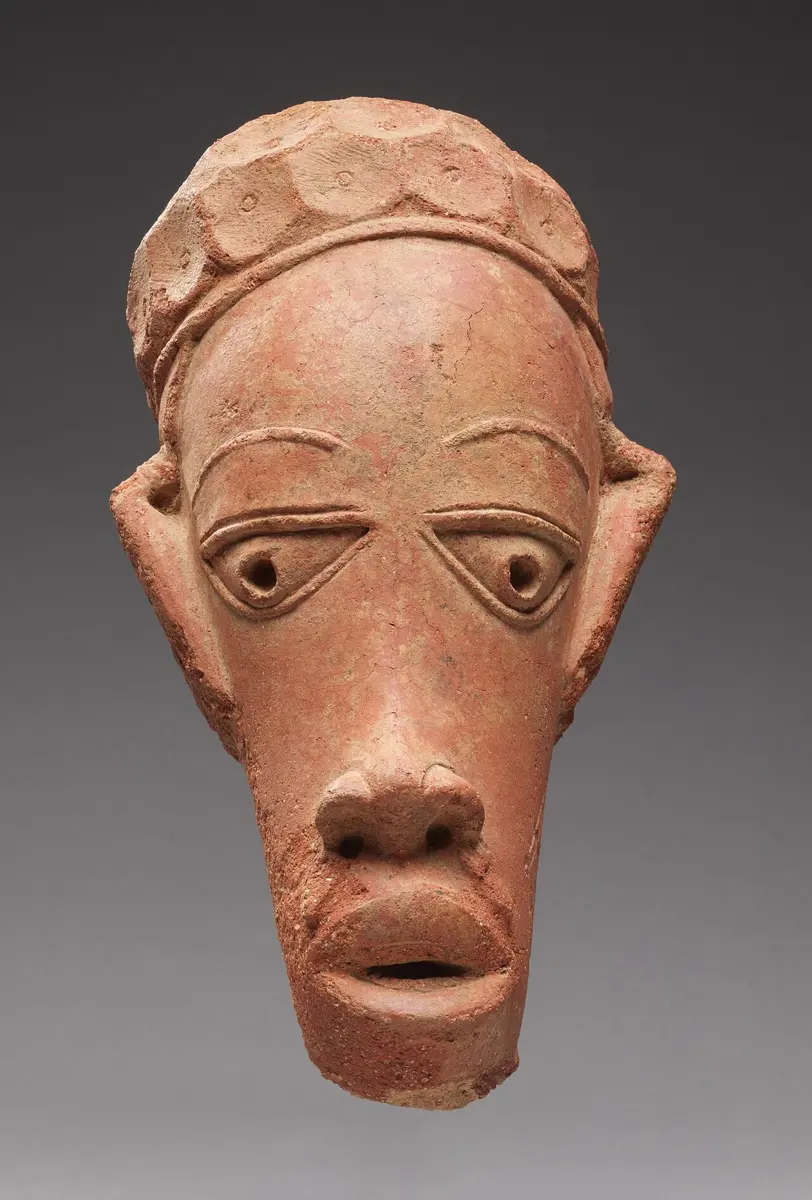
How they were used is harder to know. In the 2000s a team of German and Nigerian archaeologists dug Nok sites carefully and found many of the figures deliberately broken and placed in pits or under stone pavements, as if they had been buried on purpose. The methods used to build them are ones that in this region are practiced by women, so the makers may well have been women. And there is a sadder fact. A figure dug up for sale, not by archaeologists, comes with no record of where it lay, and what it could have told us about its place and use is lost. The head in this photograph is one of these: the museum bought it in 1995 from a dealer in Brussels, with no record of where it came from.
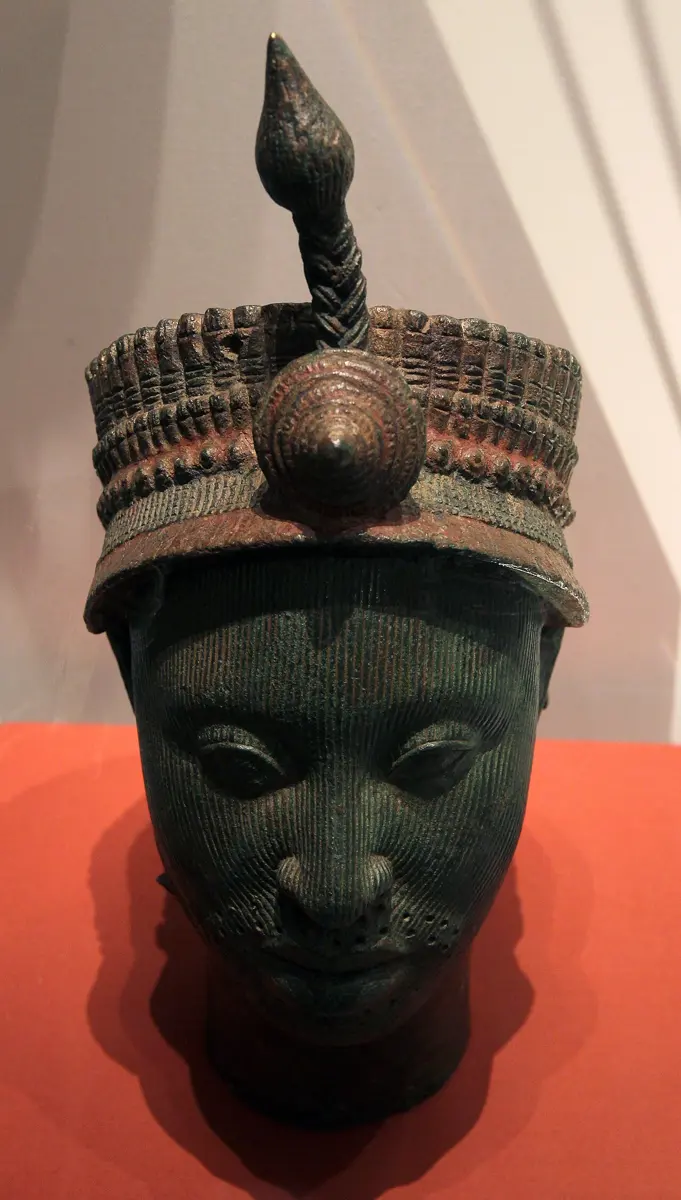
The metal heads of Ife were made centuries later, between about the 1100s and the 1400s, for the kings of Ife. Most of those known today came to light in 1938, when men digging the foundations of a house in a compound just behind the king’s palace struck metal: more than a dozen heads, buried there long before. Some are of brass, a mix of copper and zinc; one of them, the face of a king named Obalufon, is of almost pure copper. The faces are calm, balanced and close to life-sized, many with fine parallel lines running down them. The Obalufon mask has holes round the mouth where a beard was once fixed, and slits under its eyes so that it could be worn. These were not portraits to hang on a wall but faces for the ceremonies of kingship.
The kingdom of Benin, in what is now southern Nigeria, made metal art for its kings, the Obas, on an even bigger scale. Its brass casters belonged to a guild, the Igun Eronmwon, who worked for the king. They worked by the lost-wax method, modeling each piece first in wax over a core of clay, covering it in clay, melting the wax out and pouring metal into the space it left: the same method Lost Wax follows in Patan.
Their best-known works are plaques. Nearly nine hundred of them once covered the wooden pillars of the Oba’s palace courtyard, rectangles of brass a little under half a meter high, recording in relief the history and customs of the court. Important figures are made larger and put in the middle. The backgrounds are filled with a pattern of river leaves, and the designs along the edges served the casters as a kind of signature. Each plaque’s sides are bent back so it could be fixed to the beams. Before 1897 the plaques had been taken down and kept in a storeroom of the palace.

In 1897 British troops took Benin City and carried off the court’s works by the thousand. They ended up in museums and private collections across Europe and America; Germany’s museums alone held more than eleven hundred. The plaque in the photograph went to the British Museum in 1898, which sold it in 1950, and it passed through dealers and collectors in New York before it came to Cleveland. Some are now going home: in 2022 Germany handed twenty Benin works back to Nigeria, with its foreign minister saying, “We are here to right a wrong,” and in 2025 the Netherlands returned 119, the largest single return so far. How a sacred image is lost and found again, from Benin to Patan, is told in Stolen Gods, near the end of this book.
Cut down, piled up and plastered
Africa’s builders were as daring as its casters, and three places show three very different ways of building.
In the highlands of northern Ethiopia, the town of Lalibela has eleven churches that were not built at all. They were cut. Around the year 1200, tradition says under a king named Lalibela, workers chose places where the ground was solid volcanic rock, soft enough to carve but firm enough to stand, and dug trenches down into it, leaving a great block standing free in the middle. Then they carved the block from the outside into the shape of a church, with doors, windows, roofs and moldings, and hollowed it out from the inside, into halls, pillars and arches, all of one piece of rock. Nothing was added; everything was taken away, the way a sculptor carves a statue, but on the scale of a building, and starting from the top.

The most famous, Bete Giyorgis, the Church of St. George, is cut in the shape of a cross, about 12 meters each way and 13 meters deep, standing in a pit about 25 meters square. You come to it through a tunnel in the rock. A Portuguese priest, Francisco Alvares, who went to Ethiopia with an embassy from Portugal in the 1520s, saw the churches and described them in detail. Then he stopped, because he thought nobody at home would believe him, and wrote: “I swear by God, in Whose power I am, that all that is written is the truth.” People told him the work had taken twenty-four years.
Far to the south, in Zimbabwe, stands Great Zimbabwe, a city of stone and the capital of a kingdom that ruled the region from the 1000s to the 1400s, built by the African people of the region. Its builders did the opposite of Lalibela’s: they piled up. The granite of the hills there splits naturally into flat slabs, and the builders gathered these, without quarrying, and laid them in courses, one on another, with no mortar at all. The biggest building, the Great Enclosure, is an oval about 90 meters long and 67 wide, with an outer wall in places over nine meters high and four meters thick, and inside it a solid conical tower about 17 meters round at its foot.

When Europeans came to it in the late 1800s, the popular opinion was that it must have been built by some ancient people from the east. In 1905 a British archaeologist, David Randall-MacIver, dug there properly and found everything pointing the other way: the objects in the ruins were the same as those of the African people around them, and the buildings were, he wrote, “unquestionably mediaeval and native African.” Among the ruins he found Chinese porcelain and glass from the Arab world, which had come up from the coast of the Indian Ocean, and he thought the city had grown rich by trading the gold of the country around it with merchants from that coast.
The third way of building is the humblest material of all: mud. The Great Mosque of Djenné, in Mali, is built of sun-dried mud brick. The building that stands today was put up in 1907. Its walls are thick, its towers rise in rounded points, and all over its walls stick out bundles of palm sticks, like the bristles of a brush.

Those sticks are scaffolding. Rain washes mud away, so once a year the town replasters the mosque together, in a festival, climbing the walls on the palm sticks to spread fresh mud over the whole surface. A building that rain would slowly wash away stands because a whole town looks after it. In 2009 part of one tower fell, and it was rebuilt with help from the Aga Khan Trust for Culture. A mud building is never finished; that is part of what it means.
Masks that move
Go into almost any museum with African art and you will see masks hanging on a wall, or standing on a stand, lit like statues. It is a strange way to meet them, though it is how one famous admirer met them. In 1907 the Spanish painter Pablo Picasso saw African masks in the ethnographic museum at the Trocadéro in Paris, and the face in a study he painted that summer for his Les Demoiselles d’Avignon shows what he saw there. He met the face without the dance. Most masks were made to be worn, and seen in motion, by a crowd, outdoors, with music.
The Art Institute of Chicago says so plainly of one of its own Yoruba masks. The carved headdress is what museums show; the festival it belonged to, Gelede, is held in the streets, with orchestras, costumes of wood and cloth, dance, music, singing and drama, and the watchers join in. Gelede honors the community’s powerful older women, and asks for their goodwill. The mask is worn on top of the head, like a helmet, as one part of a whole costume of cloth, beads, seeds and carvings, so that the carved face sits above a dancing body of color.
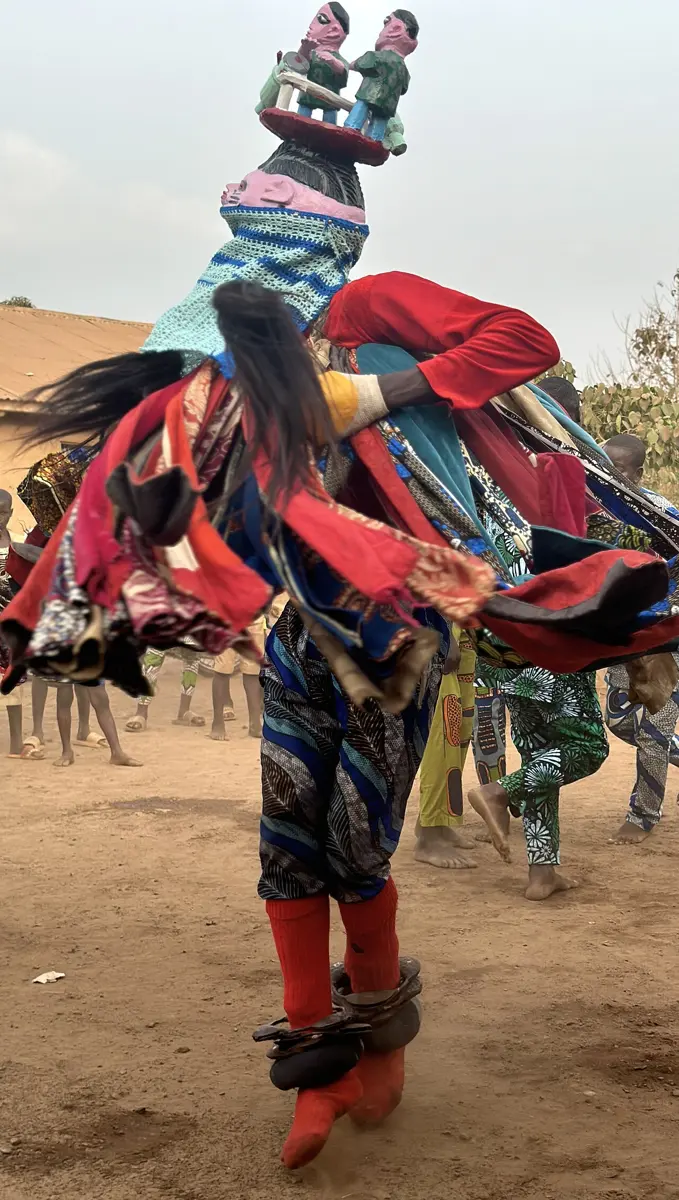
Masks like these are not only faces to look at. Among the Yoruba, at the Egungun festivals, costumed men move through the town embodying the presence of the ancestors, while songs are sung in their praise. Among the Chokwe of Angola, the mask called mwana pwo shows a female ancestor, with marks on her face and a fine hairstyle, and it is always worn by a man, who dances her part. In both cases, the mask is only one part of the work of art. The rest is the costume, the dance, the drums, the song, the crowd and the day.
Readers in Bhaktapur hardly need this explained. The town’s thirteen dancing gods, told in Stage and Mask, wear masks made new every year, then burned. Hang one of those masks alone in a museum in another country, and it is a beautiful face; but it is no longer the god.
The art of Africa is as varied as the continent, made over more than two thousand years, by trained specialists who knew exactly what they were doing: Nok’s potters, Ife’s and Benin’s casters, Lalibela’s rock-cutters, Great Zimbabwe’s wall-builders, Djenné’s masons and townspeople, and the carvers and dancers of the masks. It looked different from Europe’s because it was made for different things: for kings and their ancestors, for the faithful, for a town that keeps its mosque alive, for a festival where a mask comes alive in the dance. The word “primitive” said more about the people who used it than about the art. The next chapter crosses the oceans, to the art of the Americas and the Pacific.
Found a mistake? Please tell us.