
Most of the buildings in this book were made for gods and kings. Most of the buildings anyone in Nepal has ever lived in were made by the people who lived in them, out of whatever lay within a day’s walk: clay from a pond, grass from a riverbank, stone from the hillside, timber from the forest. Nobody signed them and few were drawn or written about. But a house built that way is a record of its place. Look at what it is made of and how its roof is shaped, and you can tell, roughly, how much rain falls there, how cold the winter is, and what grows nearby.
This chapter looks at houses that way, as made things, from the plains to the high valleys, and then at some of the things made to go inside them. What a house means to the family in it, who sleeps where and who may enter the kitchen, belongs to the book Peoples of Nepal. Here the question is how it was made.
Mud, grass and clay in the Tarai
On the plains of the Tarai there is little stone, and in the old days there was plenty of forest, tall grass and river clay. The Tharu built with exactly those. A frame of timber posts holds up the roof. The walls are bamboo, covered with clay and dung, or built up thick from mud and straw, often 30 to 45 centimeters through. The roof was thatched with grass, and in many villages later with clay tiles. A deep veranda runs along the front, roofed but open, which is where much of the day happens in the heat.
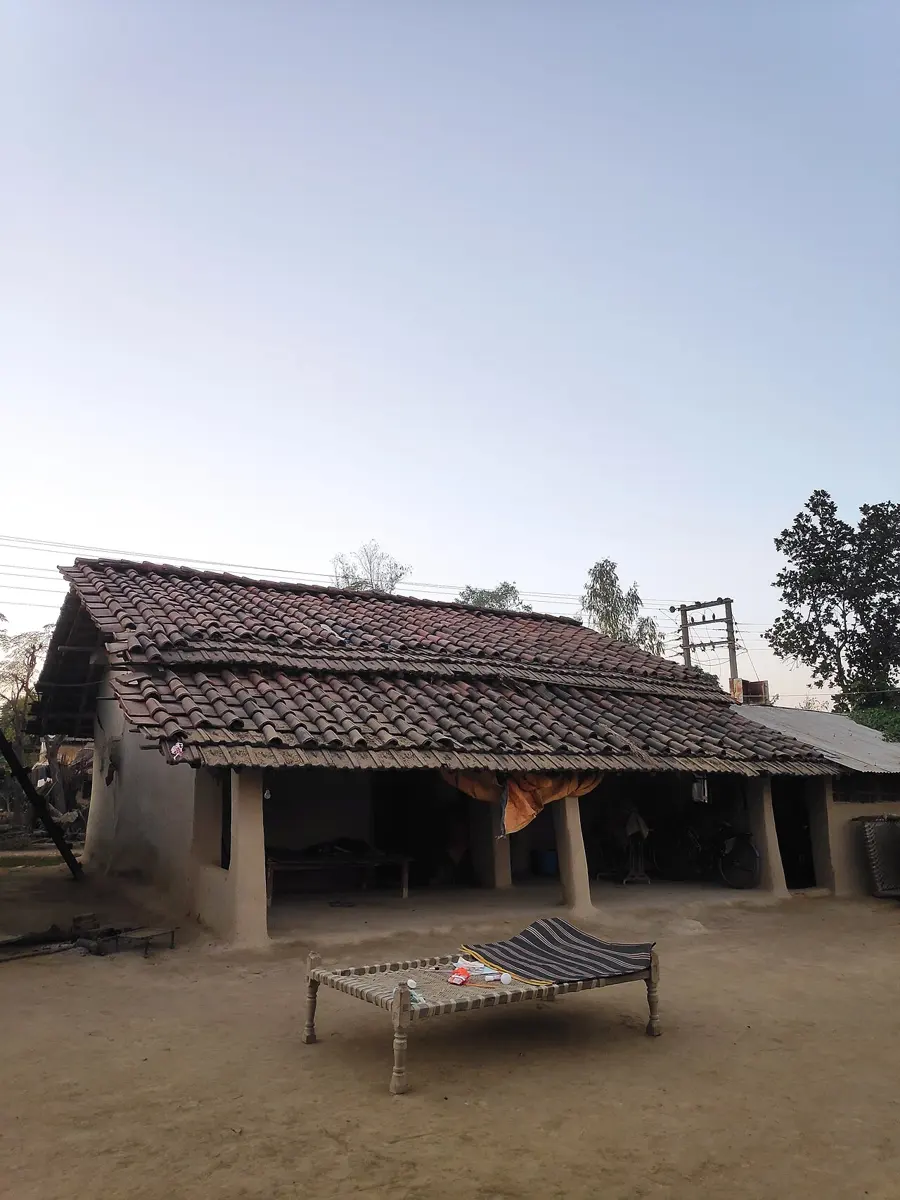
This is good building for the Tarai. Thick clay walls are slow to heat, so the inside stays cooler through a hot afternoon, and the veranda and the overhang keep the monsoon rain off the walls, which clay needs. The materials cost nothing but work. Builders in Kanchanpur told a reporter in 2019 which grass to cut for the roof, khariya, and which trees gave the right timber, and that a house took about 17 to 25 days to put up. Clay for the walls came from the bottoms of ponds. And the builders said such houses stood up well to earthquakes.
Nobody builds a house like that alone. In Bardiya in 2026, a Tharu family of 59 people split up to found a new settlement, and the Kathmandu Post watched them put up nine houses at once: some carried timber, some wove the bamboo walls, some plastered them with mud. “We do not work for wages here,” Chhalluram Chaudhary told the reporter. “We work for each other.”

The same clay made the biggest thing inside the house. Tharu women build their grain stores, called denhari, out of clay mixed with straw and rice husk, right inside the house. Some are round, some square, some taper like a cone, some taller than the women who made them, and lined up in a row they can serve as a wall between rooms. “The food grains kept in Denhari neither decay nor get infested with insects,” a farmer in Kanchanpur, Dhan Bahadur Kushmi, told The Himalayan Times in 2020. Many are decorated, like the walls described in Painted Walls.
These houses are disappearing, and the reasons say a lot about what a building needs. The forests the timber and grass came from became community forests, so the materials now have to be bought. The tile makers closed. Clay can no longer be dug freely. The habit of building for each other faded as young people left for work. By 2019, one builder in Kanchanpur said, a traditional house cost about as much as one of concrete. The same happened to the denhari: tin and plastic bins have taken their place in many homes.
Stone and slate in the hills
Climb into the hills and the materials change. Here there is stone everywhere, broken out of the hillsides and turned up by every plow, and some places have a stone that splits into thin flat sheets: slate.
The Gurung villages on the ridges of the Annapurna region show the change happening. Their houses, an English anthropologist, Alan Macfarlane, and his Gurung co-author Indrabahadur Gurung wrote in 1990, were first built of a wooden framework covered with mud and dung and thatched with grass, much like a Tarai house. More recently, stone and slate houses had replaced many of them, though the verandas of the new houses were still plastered with mud and dung. A wall of stones laid in mud is heavy and thick, and it holds the warmth of the cooking fire on a cold night. A slate roof sheds rain and doesn’t burn or rot. By the 1980s, though, corrugated iron was often used instead of slate.
Inside, the Gurungs sleep downstairs and keep grain, baskets and tools in the room above. The fire is the middle of the house: a tripod over a square hole in the floor, with a wooden rack hanging above it for drying meat and grain in the smoke. A visitor stepping in from the daylight can hardly see for the smoke and the dark.
Across the hills, the stone house is fitted to its slope. Houses are built along the contours on terraces cut into the hillside, like the fields around them.
Flat roofs where it hardly rains
North of the Himalaya the materials change again, and so does the shape. In Mustang, behind the main range, the monsoon barely arrives. At Jomsom, in Mustang, the rain in a whole year is about 290 millimeters; at Lumle, 54 kilometers away on the other side of the mountains, it is about 5,500, as the chapter on the monsoon in Geography explains. There are few trees, and not much wood to spare.
So the houses are built of what there is: walls of stacked stone, or of mud brick, or of earth rammed hard between boards, and a flat roof. The roof is a layer of clay packed over beams and sticks. In a place with real rain it would turn to mud in a week. Here it lasts, and it is useful: a flat roof is a yard in the sun, where people dry grain and vegetables and stack the year’s firewood. The houses crowd together, wall against wall, with narrow lanes between.
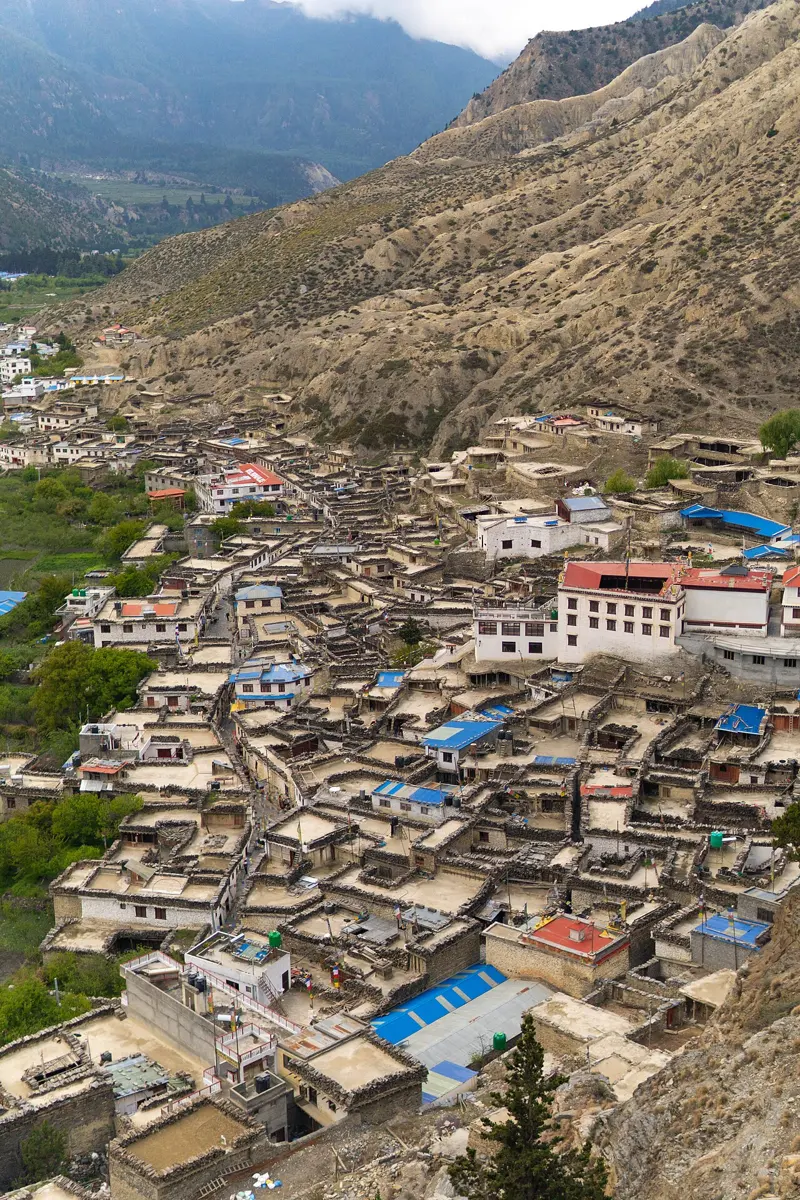
The firewood on the roofs does two jobs. People stack it around the edges, and a big stack showed a family’s wealth. It also kept the roof and the top of the walls dry when the snow melted. The roof is a weather record in its own right: it is flat because it hardly rains, and stacked with wood because there are few trees.
The weather has started to change, and the houses are showing it. Rain at Jomsom was 286 millimeters in 2010, and in 2021 it was 666. Clay roofs that had been fine for generations began to leak. The flat roofs were made for light snow, too, and heavy snow can bring one down. “This can happen with climate warming because the weight of the snow is greater than usual,” an archaeologist, Mark Aldenderfer, told Mongabay. Many families have put tin or concrete roofs on. In Gharpajhong, near Jomsom, 60 of its 600 houses had such roofs by 2024, Nepali Times reported. A man in Thini, another Mustang village, plastered the bottom of his mud walls with cement where the rain splashed. A neighbor who built a new concrete house in 2019 found it too cold in winter. A house is fitted to its climate so closely that when the climate moves, the house has to move with it.
Things made for the house
The houses are only the shell. What filled them was made just as close to home, much of it by makers whose names can be found.
The Gurung house of Macfarlane and Gurung’s book had shelves of brass dishes, bowls and jugs around its walls, brought out only on special days and a sign of how well the family was doing. Its water was carried in copper vessels, which had replaced the old wooden ones over the previous fifty years. The Gurungs didn’t work metal themselves. Each village had its families of blacksmiths, who made pots and pans, knives and plow tips for a number of Gurung households and were paid in grain. Men made baskets of bamboo for carrying and storing, trays for winnowing, fish traps and mats for drying grain. Women made the sitting mats, of thick grass, and they wove. Many still sat at a backstrap loom in the winter months, the warp held tight by the weaver leaning back against a strap round her body, weaving wool and the fiber of a nettle into coarse cloth and sacks. Older Gurung women wore necklaces of gold and turquoise that came from Tibet.

Clay for pots is scarce in the hills, so pots came from towns that had it. The most famous is Thimi, between Kathmandu and Bhaktapur, a town of potters from the Prajapati community. They dig a brittle red clay found under the topsoil of the rice fields, throw it on a heavy wheel, and set the pots in the sun to dry. For firing, the pots are carried to the town square, stacked, and covered with straw and ash, and they smolder there, so that smoke drifts through the streets. More than half may crack. Out of it come water jars, cooking pots, lamps for temples and the big jars for brewing and storing. In 2002 Tulisi Bahadur Prajapati, who had started at twelve, told Nepali Times he had hoped all his children would be potters. Only his daughter took up the trade; his three sons had gone to work in Kathmandu. In 2017 Ratna Bahadur Prajapati, 63, who had made pots for almost fifty years, told the Associated Press that the money his two sons sent home from Australia and Japan was enough to live on. Fewer than 300 of the town’s nearly 2,000 Prajapati families still lived by pottery. “I fear that the tradition will fade away,” said another potter, Dil Krishna Prajapati.
Grass made baskets as well as roofs. In the Tarai, Tharu and Muslim women make baskets from the stalks of a tall grass, its flowering top cut off, a craft called sikki. The stalks are soaked in water so they bend and are worked with a needle. The baskets were made for carrying and keeping things at home. Since the late 1980s, when a craft business brought in a way of coiling the stalks, they have been made for sale too, some of them abroad.
Weaving can become a symbol. Dhaka is a patterned cloth woven on a hand loom. The Limbu women of Terhathum in the east are known for it and still weave it, though cheap machine-made cloth has cut deep into their trade. In about 1958 Ganeshman Maharjan brought a handloom to Tansen, in Palpa, and started weaving dhaka there, and the Palpali dhaka cap became a mark of being Nepali. His wife, Purnamaya Maharjan, was still in the business at 88, in 2026, and remembered when, under the Panchayat, “wearing Dhaka caps was extremely common.”
What all of these share with the houses is that each fits a place. Thimi’s pots are made where the clay is, and dhaka where the weavers learned it; denhari were possible because the Tarai has clay and rice straw, and a Mustang roof works because it barely rains. When cheap things from elsewhere arrived by road, tin roofs, plastic bins, factory cloth, they did the same jobs with less work, and some of these crafts began to vanish. The ones that survive mostly do it by being sold to people who don’t need them, which is a new life, not the old one.
Found a mistake? Please tell us.