
In the late 1980s a painter from Bihar named Ganga Devi was at work inside a room of the Crafts Museum in Delhi. She had cancer and was going through chemotherapy, and still, over three or four months, she covered the walls from top to bottom with a कोहबर (kohbar), the painted wedding room of her people, where a bride and groom spend their first nights. She signed and dated it 1.1.1990. She died the next year.
In 2015 the museum was renovated, and the room was knocked down. An official said the paint was fading and peeling, and that it couldn’t be saved. A former director of the museum said it had been in good shape a few months before, and asked whether any conservator had looked at it before the walls came down. Either way, it was gone.
It is a sad story, and an old one. Most of the art in this chapter was painted on walls of mud by women, for a wedding or a festival, and it was never meant to outlast the wall. Walls crack, get replastered, are painted over for the next wedding, or are pulled down for concrete. Ganga Devi’s room was unusual only in that somebody wrote down whose it was.
A wedding on the wall
Mithila is the old country of King Janak and Sita, the flat, river-crossed land that now lies on both sides of the border between Nepal and Bihar, with Janakpur on the Nepal side and Madhubani on the Indian. For centuries its women have painted the inside walls and floors of their houses. A story told in Janakpur says it began when King Janak asked his people to paint their walls for Ram and Sita’s wedding. Nobody knows when it really began; one account traces it back at least to the 1300s.
The paintings were made for occasions: weddings above all, but also festivals and feasts. The wall was mud, and the paints were what the house had, flour, clay and cow dung, with colors from the earth and from plants, put on with fingers and twigs. The richest painting went in the kohbar, the room where a new couple stayed, covered with geometric designs that were believed to help the bride have children. A girl learned from the older women of her house. Madhumala Mandal, who grew up in Kuwa village near Janakpur, was guided by her grandmother and mother and painted gods on her family’s doors and walls, and even out with the cattle she was drawing shapes on the ground.
It was women’s work, done between other chores, and for a long time no one outside thought of it as art at all.
Off the wall
Two disasters changed that. In 1934 a great earthquake shook Nepal and Bihar together. In Madhubani, among the broken houses, a British official, W. G. Archer, saw the paintings on their inside walls. He photographed them and later wrote about them, and that was how the wider world first heard of Mithila painting.
The second was a drought in the mid-1960s that left families in Bihar with no harvest. Looking for a way to bring in money, the Indian government encouraged the women to paint on paper so their work could be sold. About then an artist from Bombay, Bhaskar Kulkarni, came to the village of Jitwarpur and urged them to move their pictures from the walls to sheets of paper.
That simple change made the art portable. A wall stays where it is; a sheet of paper can travel to Delhi, Paris or Tokyo, and carry its painter’s name with it. Sita Devi and Ganga Devi became known all over India and abroad. A painting by Sita Devi of about 1973, of a dancer between two horn players, is in the Victoria and Albert Museum in London. Baua Devi was a teenager when Kulkarni came to Jitwarpur, and in 1989 she was the only woman from India in a great exhibition in Paris, Magiciens de la Terre, with her serpent maidens, the Nag Kanya.
Paper also let the painters paint new things. Ganga Devi went to the United States and came home to paint a series of what she saw there, a roller coaster among them. While she was ill, she painted her own struggle with the disease.
Paper also showed how many styles there were, and the difference used to run along the lines of caste. The Brahmin women’s paintings were filled with bright colors, deep blues and yellows. The Kayastha women worked mostly in fine lines of black, sometimes with red. Dusadh women, from a caste far lower in the old order, painted patterns that came from the small protective tattoos women wore, and drew with an ink of cow dung, then went over the lines in black dots. Gods and the stories of the Ramayana were mostly the subjects of the higher castes; the others painted their own heroes and their daily lives.
Painters today mix the styles freely, and the old link between caste and style is touchy, since it says as much about who was allowed what as about taste. Dulari Devi learned to paint from an older painter, Karpoori Devi, and now teaches others at the Mithila Art Institute in Madhubani. One of her paintings, of India’s prime minister arriving at a village in a helicopter, was in a show in San Francisco in 2018 that was named after her own words: Painting Is My Everything. Since about 2003 a few men have become good Mithila painters too.
The Nepal side
Janakpur’s walls were painted as richly as Madhubani’s. In the 1980s an American artist, Claire Burkert, and a Janakpur professor, Rajendra Bimal, went round the town recording the murals that were left. Then, in 1988, Burkert started going house to house with a young woman named Manjula Thakur, then 26, to find women who would paint on paper for a living. That became the Janakpur Women’s Development Center, begun in 1989. About forty women work there, making paintings, pottery, papier-mâché and textiles.

It was hard for some of them at first. In many families of the Tarai a woman was expected to stay inside the house, her face behind the veil called the ghunghat. Working as artists meant going out, earning, and being seen. Manjula says that the work gave her the “strength and inspiration to make my world better”. Madhumala Mandal now paints on canvas at the center, and her work has been shown in the United States and Hong Kong. Her own house in Kuwa is one of the few left that are still covered in murals.
The border runs through the painters’ lives as much as through the land. Mithileshwari Devi Karna was born in Madhubani, settled in Janakpur after her marriage, and has shown her paintings in Japan and been honored by the Nepal Academy of Fine Arts. Mithila was one country long before it was two.
Clay that stands out
Mithila isn’t the only painted wall in the Tarai. Among the Tharu of the east, in Sunsari, Morang, Saptari, Siraha and Udayapur, women sculpt their walls. Their art is called mokha. They take clay from ponds and mix it with cow dung, rice bran and straw, and in Sunsari and Morang with jute too. With this they build raised designs on the mud walls of their houses, around the windows and on both sides of the doors: flowers and geometric patterns, peacocks and parrots, elephants and horses. When it dries they coat it with white clay and color the raised parts, with a little milk in the paint.
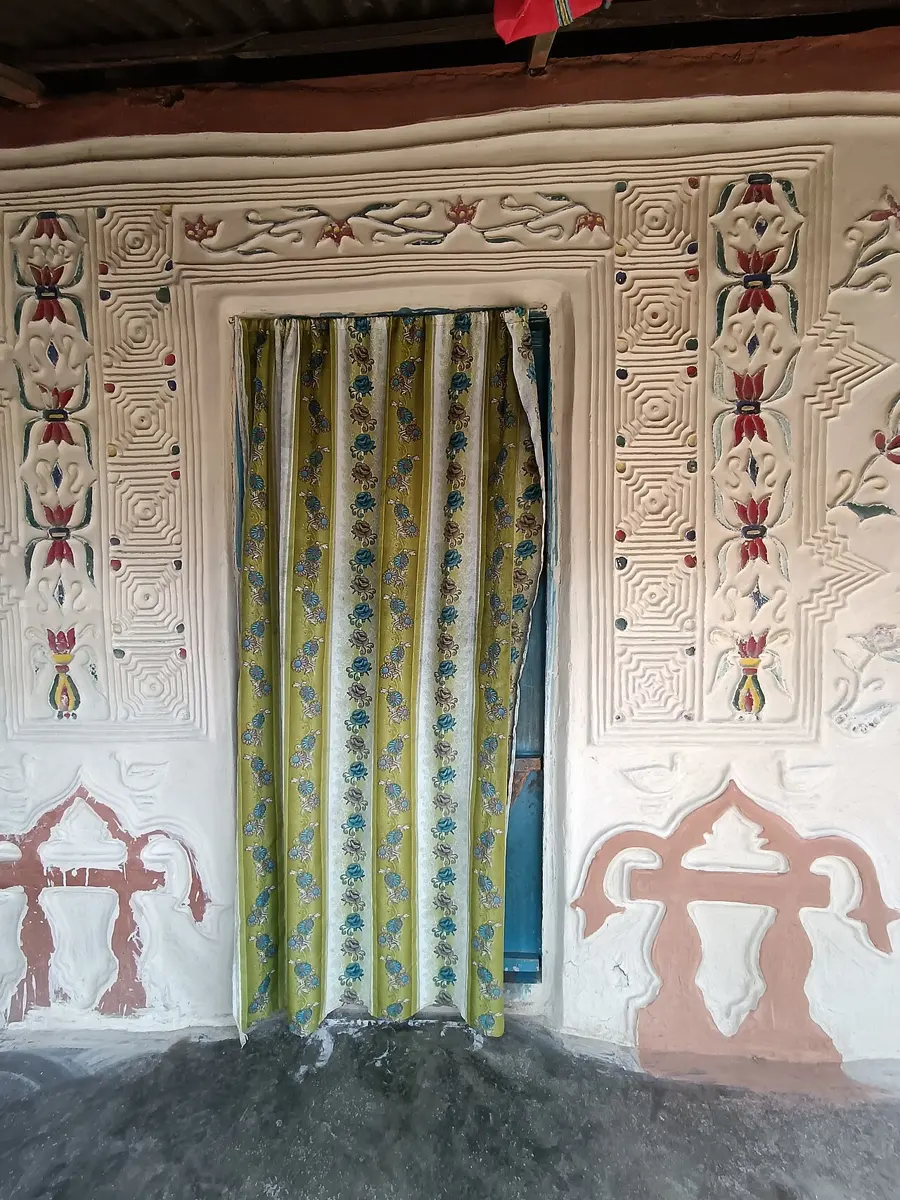
Mokha is made for weddings and festivals, and in some villages it is renewed every year before Tihar. One saying goes that a house without mokha loses half a kilo of rice every day. Like Mithila painting, it passes from mother to daughter, with no school and no teacher. Two foreigners who spent years visiting Tharu villages called their book about it Art without Artists.
In the west the Tharu paint a different kind of wall. On Krishna’s birthday, Krishna Janmashtami, Tharu families in Banke, Bardiya, Kailali, Kanchanpur and Surkhet gather at the house of the village elder, where a painting called the Ashtimki is made on the wall. It tells the beginning of the world. At the bottom is water with fish, crabs, tortoises and crocodiles, and a boat carrying Gurbaba, the creator in the Tharu story, with his followers. In the middle a kadam tree grows with Krishna playing his flute in it. The Pandavas and Draupadi are there, a many-headed demon, and the sun and moon at the top corners. The colors are red clay, white stone powder and the black of burnt wild grass, put on with tender bamboo shoots crushed at the tip. That night the women worship the painting, figure by figure, and sing the Ashtimki song till morning.
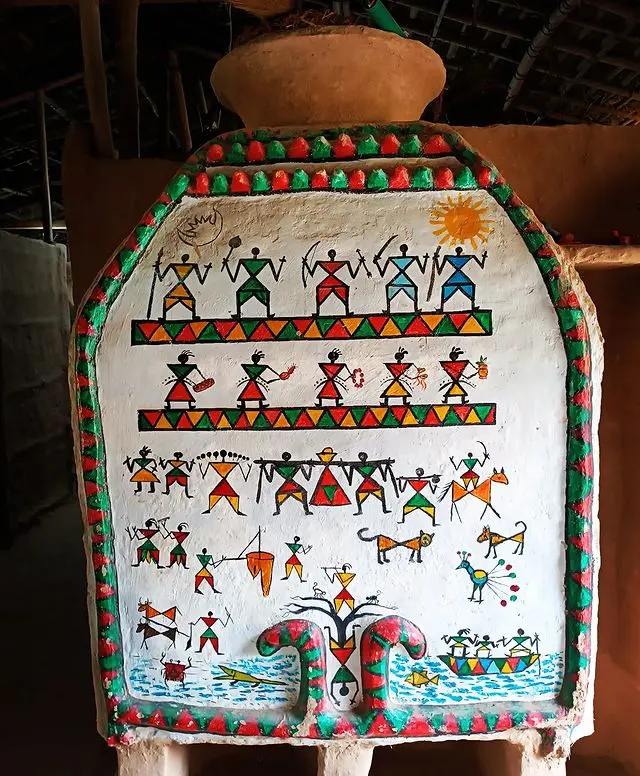
Here the frame of this chapter breaks. The Ashtimki has traditionally been painted by men, with women helping, and the painter fasts until it is finished. Only now are girls and women learning to paint it too. Wall art in Nepal is mostly women’s, but not always, and the people who make each kind are the ones to ask.
When it goes to market
All of these walls are vanishing for the same reason. Concrete is replacing mud. A painted wall of clay needs work every year, and a cement wall needs none. Janakpur’s new houses no longer carry murals, and in eastern Nepal some mokha is being cleared for wider roads.
So is the art that moved to paper, cloth and pottery still the same art? Some things changed. A kohbar painted for a wedding was part of the wedding; a painting for sale is a picture. The subjects widened to roller coasters and helicopters. In Janakpur, some shops have sold paintings brought in from India as Nepali originals, and a former head of folk arts at the Nepal Academy of Fine Arts warns that too much selling can make the art harder to keep. But the women’s hands, the lines and the stories are the same, and for the first time the painters earn by them. “Had I not pursued this career as an artist,” says Rebati Mandal, a painter at the Janakpur center, “I would not have been able to support my family and lead a life of dignity.”
What changed most is that names began to be kept. For centuries the women of Mithila and the Tharu villages painted walls that were cracked, replastered and painted over, and nobody wrote down who had made them. Paper, museums and centers like Janakpur’s gave them names, prices and a place in books like this one. The walls themselves are still the place where the art began, and every one still standing is worth a careful look before it is gone. If you want to keep a record of one near you, Your Town’s Past has a word on asking first.
Found a mistake? Please tell us.