
In November 1494 a printer in Venice brought out a fat mathematics book by a Franciscan friar named Luca Pacioli. Most of it is arithmetic and geometry. Tucked inside, as the eleventh treatise of its ninth section, is a short guide for merchants on keeping their accounts, and in it Pacioli makes a promise that sounds too confident. Add up every entry on one side of your ledger, he says, “even if there are ten thousand”, and then every entry on the other side. The two totals should be the same. If they aren’t, you have made a mistake somewhere, and you should look for it.
Ten thousand entries, written by tired people over twelve months, and the two sides are supposed to come out equal to the last coin? That isn’t luck, and it isn’t a trick. It comes from one simple habit, and that habit is most of what accounting is. Here it is.
Every change has two sides
Take Yasmin’s shop on the morning it opens. All it has is Rs. 500,000 in cash, and that money came from two places: Rs. 300,000 of Yasmin’s own savings, which is her capital, and Rs. 200,000 lent by the bank, which is a liability. The cash and the claims on it are the same half-million rupees, described once by what they are and once by whose they are, so they add up to the same amount:
assets = capital + liabilities
Rs. 500,000 = Rs. 300,000 + Rs. 200,000
On that first morning the line is easy to see. The question is what keeps it true once the shop starts buying and selling, day after day, for years.
Now the habit. Every time something happens that changes the shop’s money, at least two things in that line change, and the changes keep the two sides equal. So you write down both. Not just “paid Rs. 15,000”, but what that payment did on each side. That’s double entry: every transaction written twice, once for each thing it changed, by the same amount.
Yasmin’s first week
Here is how it goes, step by step.
She buys paint, brushes and tools for Rs. 150,000 in cash. Cash goes down by Rs. 150,000 and goods on the shelf go up by Rs. 150,000. Both changes are on the left side, and they cancel. The shop has exactly what it had before, in a different form. Nothing on the right side moves, because nobody’s claim on the shop has changed.
She buys another Rs. 80,000 of goods from a wholesaler and promises to pay later. Goods go up by Rs. 80,000 on the left. On the right, a new liability appears: the shop now owes the wholesaler Rs. 80,000. In Nepali, someone the business owes is its साहु. Both sides grow, by the same amount.
Then she starts selling, and this is the part that surprises people. Over the week she sells goods for Rs. 70,000 in cash. Cash goes up by Rs. 70,000. What else changed? The shop didn’t borrow it, so nobody outside has a claim on it. The extra belongs to the owner, so the other side of a sale is Yasmin’s capital going up by Rs. 70,000.
But those goods had cost her Rs. 52,000, and they have left the shelf. So the goods go down by Rs. 52,000, and the other side of that is her capital going down by the same amount. Put the two together and her share of the shop has grown by Rs. 18,000. That’s her profit on what she sold.
She pays the month’s rent, Rs. 15,000. Cash goes down, and nothing the shop can keep comes back for it, so her capital goes down too. Rent, wages, electricity: every cost of running a shop works this way, and every sale works the opposite way. Income raises the owner’s share and expenses lower it. Profit isn’t a separate thing kept in a drawer. It is just how much the owner’s share has grown.
Last, she pays the wholesaler Rs. 50,000 of what she owes. Cash goes down and so does the debt. The shop is smaller on both sides, and still balanced.
At the end of the week the shop has Rs. 355,000 in cash and Rs. 178,000 of goods, Rs. 533,000 in all. On the other side, it owes the bank Rs. 200,000 and the wholesaler Rs. 30,000, and Yasmin’s share is Rs. 303,000. That’s Rs. 533,000 too. Her share started at Rs. 300,000, so the week made a profit of Rs. 3,000. The books didn’t need a separate calculation for that. It was sitting in the capital all along.
One thing never happened. No step changed only one thing. A shop can’t gain cash from nowhere, or lose goods into nothing. Something always went somewhere, so there is always a second place to write it.
Why the totals come out equal
Now Pacioli’s promise makes sense. In a real set of books each kind of thing gets its own page, or account: one for cash, one for goods, one for each person who owes the shop or is owed by it, one for sales, one for rent. Every transaction is written on two of those pages. Accountants call the left-hand side of every account debit and the right-hand side credit, and the rule is simply that each transaction goes on the debit side of one account and the credit side of another, for the same amount. Which side is which, and why, needs a chapter of its own.
So when the year is over and you add up every debit in the book and every credit in the book, each transaction has been counted once on each side. The totals have to be equal. Ten thousand entries or ten, it makes no difference. That list of all the balances, debits in one column and credits in the other, is called a trial balance, and it was Pacioli’s test.
It catches real mistakes. If a tired clerk writes Rs. 5,400 on one page and Rs. 4,500 on the other, the totals won’t agree, and the hunt begins. A shop that keeps only one side of each transaction has nothing to compare against. Its mistakes sit there quietly.
It doesn’t catch everything, though, and this matters. If a sale was never written down at all, both sides are missing it, and the totals still agree. The same if the right amount went onto the wrong page of the right kind. Balanced books are books with no lopsided mistakes. They aren’t yet true books. Checking that takes other people, and a good part of this book is about them.
The notebook on the counter
Many small shops keep their accounts another way. There is a notebook by the till. Money in goes on one page, money out on another, and the back pages hold the उधारो, what each regular customer has taken on credit. This is single entry, एकोहोरो लेखाप्रणाली: each transaction written once, from one side only, usually the cash side.
It works, up to a point. The shopkeeper knows how much cash came in, and who owes what. For a small shop with a good memory that may be enough.
But try asking the notebook a few questions. Did the shop make a profit this month? Cash went up, but was that because goods sold well, or because new stock hasn’t been paid for yet? How much does the shop owe its suppliers in all? What is the whole business worth? The notebook can’t say, because it only ever wrote down where the money went, never what came back in exchange. And it can’t check itself. A missing page or a wrong sum leaves no trace. Courts and tax officers trust such records less, and you can see why.
Double entry costs one extra line per transaction. In return the books tell you, at any moment, what the business has, what it owes, what the owner’s share is, and how much it has grown, and they warn you when you’ve slipped.
The method of Venice
Pacioli didn’t invent any of this, and he didn’t say he had. He called it the method of Venice, which he said was “certainly to be recommended above all the others”.
Pacioli was born around 1447 in Sansepolcro, a small town in Tuscany, and went to Venice as a young man, where he tutored the three sons of a merchant. He later became a Franciscan friar and taught mathematics in Perugia and other Italian cities. A few years after his book came out he was in Milan teaching mathematics to Leonardo da Vinci, who drew the pictures of solid shapes for another of Pacioli’s books.
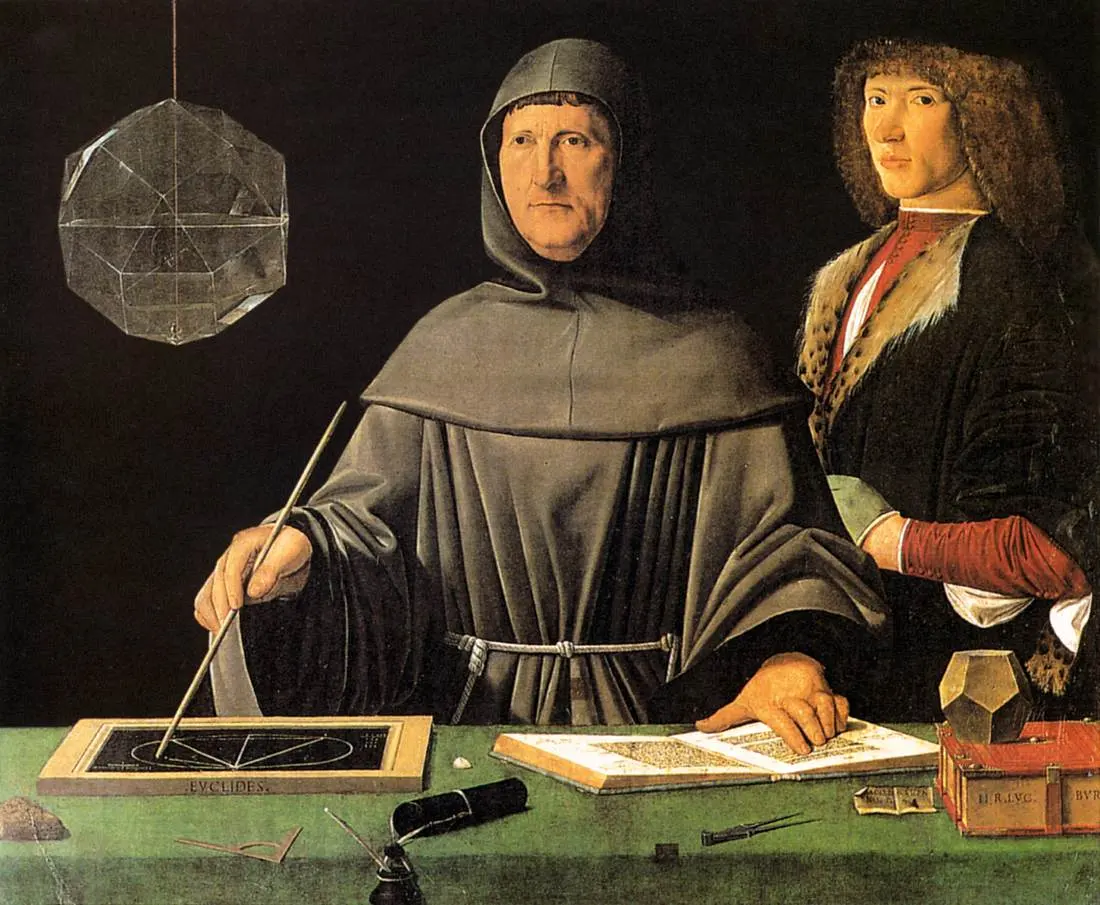
By his time Italian merchants had been keeping books this way for about two hundred years. A ledger of 1299–1300, kept by a Florentine company of merchants working in the south of France, shows full double entry, and the treasurers of the city of Genoa were keeping their books on the same principle by the 1340s. Nobody knows who first thought of it. It seems to have grown among the merchants and bankers of the Italian trading cities, as their dealings got too large and too spread out to hold in anyone’s head.
What Pacioli did was print it. His Summa was written in Italian, not the Latin of most learned books, so a merchant could read it, and it was printed rather than copied by hand, so it could travel. Within about fifty years there were books on the method in German and English, and the first English one, printed in London in 1543, is lost: not a single copy survives.
His treatise reads surprisingly like a modern textbook, with a few differences. He wants three books: a rough memorandum where everything is jotted down as it happens, a journal where each transaction is written out properly in date order, and the ledger where it is sorted onto its pages. In the journal, each entry starts with “per”, for the account that receives, and then “a”, for the account that gives, divided by two little slanting lines. Every journal entry, he says, makes two entries in the ledger, one on the left and one on the right, and you must never write one without the other. He has the merchant begin his journal “with the name of God”, and he warns that the cash account can never show less than nothing, since a merchant can’t pay out more cash than he has. If it does, there is a mistake in the books.
He is also clear about why any of it matters. A merchant needs three things, he writes: cash or something as good, to be a good bookkeeper and ready with figures, and to arrange all his dealings by debit and credit, so that he can understand each one at a glance. Without that, merchants “would have no rest and their minds would always be troubled”. More than five hundred years later the method is the same one Yasmin’s shop would use, and the same one used by a bank, a school club, a cooperative and the Government of Nepal.
Two columns, all the way up
It’s worth seeing how far that one habit reaches. The trial balance is the two sides added up. A balance sheet, the statement every company publishes, is Yasmin’s week written out on the last day of the year: what the business has on one side, what it owes and the owners’ share on the other, equal. A profit and loss account is the story of how the owner’s share grew or shrank in between. Even an auditor, an outsider checking the books, works partly by following entries from one side to the other and asking whether each really happened.
None of it needs a debit rule to understand. It needs only the question Yasmin asked on her first day, asked again every time anything happens. What changed? And what changed with it?
Found a mistake? Please tell us.