
In June 1770 the English potter Josiah Wedgwood’s firm made out a bill for a customer, Lady Winterton. It is still kept, at the British Museum: one tall sheet of paper, written out by hand. Across the top it says “Bought of Josiah Wedgwood, Potter to her Majesty”, and under that, a note that his goods are sold at his London warehouse “for Ready Money only”. Then come the goods, a dessert service: baskets with stands, bowls, fruit dishes, two dozen plates and a box to pack them in, each with its price.
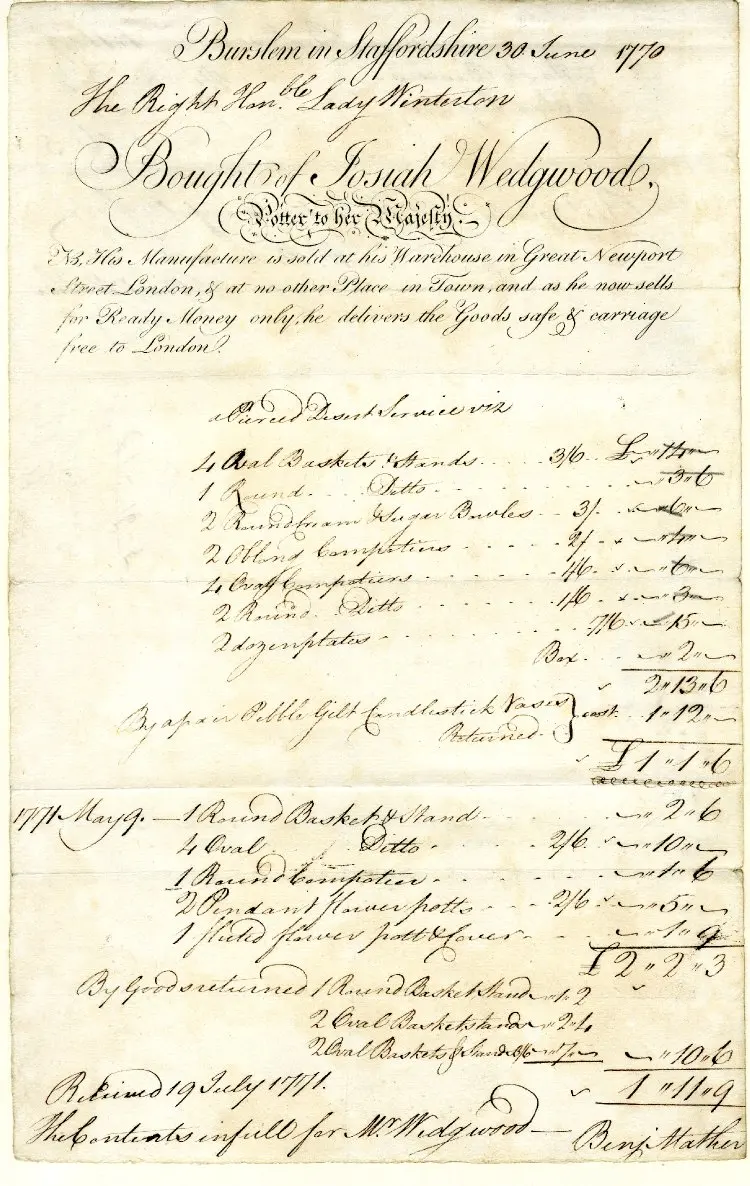
Under them is a line that begins “By a pair Pebble Gilt Candlestick Vases Returned”. She had sent two vases back, and their price, £1 and 12 shillings, is taken off. In May of the next year she bought more baskets and flower pots, then sent some of those back too, and each return is taken off in the same way. At the very bottom is the last line: “Received 19 July 1771. The Contents in full for Mr Wedgwood”, beside the final sum, £1, 11 shillings and 9 pence, and the signature of Benjamin Mather, a young clerk at Wedgwood’s London warehouse, written “Benj. Mather”. Ready money only, and the bill was settled more than a year after the first date on it.
That one piece of paper holds nearly everything this chapter is about. It is a bill, which says what was sold, to whom, when and for how much. It records goods coming back and the amount taken off for them. And once its last line was written, it became a receipt, proof that the money was paid. A customer holding such a paper can show it to anyone who says she still owes. A clerk writing the sale and the payment into the books has a paper to point to for every figure.
Nothing without a paper
Accounts follow one plain rule before any other: nothing goes into the books without a paper behind it. A paper that shows a transaction really happened is called a source document, in Nepali आधारभूत कागजात, a basic document: an order, a bill, a receipt, a cheque, a voucher. Preparing them is the first step of all accounting work. The journal, the ledger and the balance sheet all come after.
The reason is simple. A set of books is a copy of what happened, written by someone who could be wrong, careless or dishonest. On its own, a line that says “rent paid, Rs. 15,000” is only the bookkeeper’s word. With a landlord’s receipt for Rs. 15,000 clipped behind it, it is a fact that anyone can check. So the papers do two jobs at once. They tell the bookkeeper what to write, and they let someone else, later, check what was written. Any figure in a finished set of accounts can be followed back, step by step, to the papers it came from, and any paper can be followed forward to the place where it was entered. That double path is what makes accounts something more than one person’s story.
Luca Pacioli, the friar who printed the merchants’ method of bookkeeping in 1494, put it in a merchant’s terms. When you take money out of a bank, he wrote, have the banker make you write a receipt, “because, as I have told you, things can’t be too clear for the merchant”. Keep the agreements and papers, and write in your books where you keep them, “so that you may easily find them”. And when you pay someone, have them write the receipt in a receipt book, “so that a receipt cannot be easily lost or go astray”. He blamed the need for all this on “the bad faith of the present times”. Merchants have been saying the same ever since.
The papers behind Yasmin’s first week
Yasmin’s shop had seven transactions in its first week, and every one of them should have a paper behind it. Here they are.
| What happened | The paper behind it | Who writes it |
|---|---|---|
| Yasmin puts in Rs. 300,000 of her savings | a voucher recording it, signed by her | Yasmin |
| The bank lends the shop Rs. 200,000 | the loan agreement | the bank |
| She buys Rs. 150,000 of goods for cash | the seller’s bill, marked paid | the seller |
| She buys Rs. 80,000 of goods on credit | the wholesaler’s bill | the wholesaler |
| She sells Rs. 70,000 of goods for cash | copies of her own numbered bills | Yasmin |
| She pays Rs. 15,000 rent | the landlord’s receipt | the landlord |
| She pays the wholesaler Rs. 50,000 | the wholesaler’s receipt | the wholesaler |
Most of the papers come from someone else, and that is the point of them. A bill written by the wholesaler is harder to invent than a note written by the person keeping the books. The one that holds the shop together most is the bill, or invoice.
An invoice is the paper a seller sends with the goods. The English word comes, by a roundabout road, from the French envoi, a sending, and that is exactly what it is: the paper that travels with the parcel. In Nepali it is a बीजक, and people also simply call it a बिल, a bill. It names the seller and the buyer with their addresses, gives the bill a number and a date, lists each thing sold with how many, the price of one and the total, takes off any discount, and says what is to be paid and on what terms, and who pays to carry the goods. When the wholesaler’s Rs. 80,000 of paint arrives, his bill comes with it.
Yasmin doesn’t just file it. Before she ever writes it into her books, she sets it beside two other things: what she asked for, and what actually came. If she sent the wholesaler a written order, a purchase order, that is the first paper of the whole deal, and the order counts among the basic documents too. If the bill says twenty tins of white and the carton holds eighteen, or the order said one price and the bill says another, this is the moment to find out, while it is still a question and not yet a figure in the books.
The other side of the counter has its own papers. Every sale Yasmin makes for cash gets a bill from her own bill book, each with its own number, and a copy stays in the book. Those copies are her record of the Rs. 70,000 of sales. The Rs. 52,000 those goods had cost her has no paper of its own. It is worked out from the bills she paid when she bought them.
When money is paid, the paper is a receipt, रसिद. It says who received how much, from whom, when, and for what, and the person who received the money signs it. That is why the receipt belongs to the one who paid: it is their proof. When Yasmin pays her rent, the landlord writes the receipt and Yasmin keeps it. When a customer pays Yasmin for paint, Yasmin writes the receipt, or marks the bill paid, and the customer keeps it. It is the same paper every student in Nepal has carried home: the receipt the school gives for the fees, which is how the school shows it received them and how the family shows it paid.
Payments through a bank leave papers of their own, and the bank’s statement, its list of everything paid into and out of an account, is one of them. A cheque is an order, written by the account holder, telling the bank to pay someone from that account. The counterfoil is the small stub left in the cheque book when the cheque is torn out, where the writer notes the date, the payee and the amount: her own copy of what she sent out. Money put into an account goes in with a deposit slip, called a paying-in slip in British books and a deposit voucher by Nepal’s banks, and the stamped copy is the depositor’s record of it.
Last, there is the paper that checks all the others. At the end of the month the wholesaler may send Yasmin a statement of account: every bill he sent her, every payment he received from her, and what she still owes. His statement should say Rs. 30,000, the Rs. 80,000 of goods less the Rs. 50,000 she paid. Her books say the same. If they didn’t, one of them would have missed a paper, and going through the papers line by line would find it.
A paper that vouches
One transaction in Yasmin’s week has no outsider’s paper at all: her own Rs. 300,000. Nobody else wrote anything down when she put her savings into her own shop. For that, and for many entries like it, the business writes its own paper, a voucher.
The word comes from vouch, which in old English law meant to call someone into court to stand witness. A voucher is a paper that stands witness for a transaction. In a business or an office it says what happened, for how much, and which accounts it changes, and it carries two things a scribbled note doesn’t: the outside papers attached to it, and signatures. The last steps of making one are plain. The person who makes the voucher and the person who approves it both sign it, and the papers behind the transaction are attached. So for Yasmin’s savings the voucher is a short note of the date and the amount, signed by her, with the bank’s slip clipped to it if she paid the money into the shop’s account.
Nepal’s government offices take this furthest. Every transaction in an office’s books starts as a printed form, the गोस्वारा भौचर, which is the same form in federal, provincial and local offices, and each transaction gets its own, even when several happen on the same day. Its last section has room for three signatures, one each for the person who prepared it, the one who put it forward and the one who approved it, and a line for how many pages of supporting papers are attached. If it pays someone, it names them, with their bank account and, where they have one, their PAN. So a payment carries the names of the people who prepared it, put it forward and approved it, and the papers behind it.
The word has a wider life in Nepali than in English, and it helps to know its three uses. Banks call the slip a customer fills in to deposit money a voucher, and the bank’s copy is a बैङ्क भौचर. Government offices call their journal entry form a गोस्वारा भौचर. And Nepal’s school books use भौचर for the journal, the book of entries, and for each entry in it, the line that says which account is debited and which credited, with a few words saying why. All three share the idea of the English word: a written record, made at the time, that someone else can check. How those entries are written out in full and gathered day by day into one book, the journal, comes next.
The government is strict about which paper comes first. The rule for a government office that collects revenue is this: money a taxpayer pays by cheque is counted as the government’s income only once the bank’s voucher has come in showing the money has reached the government’s account. A promise to pay, even on a cheque, isn’t money until a paper says it has arrived.
When goods come back
Lady Winterton sent back a pair of vases, and Wedgwood’s clerk handled it with a line on the bill. A business with many customers on credit needs something tidier, and there are two papers for it.
Suppose that later in the year a builder named Pasang, who buys from Yasmin on credit, takes twenty tins of paint at Rs. 800 a tin, Rs. 16,000 in all, and finds that three of them are the wrong shade. He sends the three tins back. With them goes a short paper from him, a debit note, saying what he is returning, why, and that he has taken Rs. 2,400 off what he owes her. It is called a debit note because in his books, what he owes Yasmin is shrinking, and he records that on the debit side of her account.
Yasmin checks the tins, agrees, and sends Pasang a credit note: a paper from the seller saying that his account in her books has been credited with Rs. 2,400, the three tins at Rs. 800 each. In her books he now owes Rs. 13,600 instead of Rs. 16,000. The credit note is how the seller tells the customer in writing that his account has been credited, and it is the paper the return is recorded from.
The first bill stays as it was. The sale of twenty tins really happened, and so did the return of three. Each has its own paper, so the trail stays whole: anyone checking can see both, and see that they agree. Nepal’s VAT rules ask the same of a registered business whenever the price of something already billed changes: it issues a credit or debit note with its own number, naming the first bill’s number and date, and keeps all such notes with its records.
The bill with a number on it
In Nepal, many bills carry one more line, near the top: the seller’s PAN, स्थायी लेखा नम्बर, the permanent account number. It is a nine-digit number that the Inland Revenue Department gives a taxpayer once, for good, and anyone in business must take one and put it on the bills they issue. A water bill or a telephone bill in Nepal carries the company’s PAN in the same way. That number is what turns a shop’s paper into a paper the tax office can follow.
It matters most for value added tax, VAT, which Nepal has charged since मङ्सिर १, २०५४ (Mangsir 1, 2054), at 13% (the rate in 2082; the Inland Revenue Department publishes the current one). A shop registered for VAT adds the tax to its prices, collects it from its customers and pays it to the government. But it doesn’t pay all of it. It may take off the VAT it was itself charged on what it bought for the business.
The sums show why the bill matters. Suppose a shop registered for VAT buys paint for Rs. 10,000. The supplier’s bill adds 13% VAT, Rs. 1,300, so the shop pays Rs. 11,300. It sells the same paint for Rs. 12,000, and its own bill adds Rs. 1,560 of VAT, so its customer pays Rs. 13,560. The shop owes the government not Rs. 1,560 but Rs. 1,560 less the Rs. 1,300 it paid, which is Rs. 260: 13% of the Rs. 2,000 of value it added. The supplier has already paid in the Rs. 1,300.
But the shop may take off that Rs. 1,300 only if it can prove it paid it. Nepal’s VAT Act says the deduction is given only when the claim is backed by the documents the rules require, and for a purchase inside Nepal the rules name one: the supplier’s tax invoice. It is made out in three copies, the original for the buyer, with the words “tax invoice” clearly on its face and the seller’s registration number, his PAN, near the top. The PAN shows that the tax was charged by a seller registered to collect it, who must pay it in. And since the law also asks a registered business to note in its accounts the registration number of the other side of each transaction, if it has one, a tax officer holding both sets of papers can find the same sale twice, once as the supplier’s sale and once as the shop’s purchase. A bill with no PAN, or no bill at all, breaks that chain. The Act even puts a duty on the buyer: “It shall be the duty of the recipient to obtain the invoice.” Each customer who asks for a bill is doing a little of the tax office’s checking for it.
Yasmin’s first-week figures leave VAT out, so that the sums stay plain: none of her bills in this book so far has any VAT on it. Whether her shop is registered for VAT, and what VAT does to a shop’s books, gets its own chapter much later. For now it is enough to see that the plain-looking number at the top of a bill is a link between two sets of books.
Papers that prove things have to be kept where they can be found. Filed by date, each new one on top of the last, they stay in the order the books were written in, which is the way of filing that suits vouchers and receipts.
How long to keep them isn’t left to taste. Nepal’s Income Tax Act says that the documents behind a tax return, and those that support the costs a business claims, must be kept for five years after the end of the income year, unless the department says otherwise in writing. Since 2083 the Act also has the department arrange for them to be kept electronically, as Chapter 34 tells, so a paper today may be a file. Pacioli wanted more: papers kept for an “everlasting memorial” of what was done. Wedgwood’s bill has lasted more than two and a half centuries, long after anyone needed to prove what Lady Winterton paid for her baskets.
Underneath every set of books, then, there is a pile of plain paper: orders, bills, receipts, cheque stubs, deposit slips, statements, debit and credit notes, vouchers with their signatures. Each says that something really happened, and most were written by someone other than the person keeping the books. The books sort and add up what the papers say. The papers let anyone who doubts the books go back and look. A balanced set of books with no papers behind it is only a tidy story. With them, it is a record.
Found a mistake? Please tell us.