
In July 2026 a short video went round Facebook as a paid advertisement, from a page with a blue tick. It showed one of Nepal’s best-known businessmen talking with a well-known podcaster, and it looked like a clip from a real interview, because it was one. A machine had changed the words. In the new version the businessman explained that the Government of Nepal had started an investment platform, and that it guaranteed an income of Rs 535,500 a week. Put in Rs 38,080, the video said, and you could earn more than Rs 154,700 a week. A link underneath led to what looked like a page of The Kathmandu Post, with news stories on it. The page was a copy, the stories were made up, and the page asked for your personal details.
Techpana’s fact-check desk took it apart within days. His picture and voice had been used without permission, it reported, and his company asked people to be careful. Then, a few days later, the same account was found to have made the same kind of video with another of the country’s business leaders, cut from a television interview he had given. He had promoted no such platform either. Neither man had any part in the trap: their faces were stolen for it.
It would be easy to laugh. Rs 535,500 a week, from the government, through a Facebook ad? But someone paid to show this video as an advertisement, and the trick it plays is an old one that has worked for more than a century. So the question isn’t who could fall for it. It’s how it is built, and why it works as often as it does.
How a trap is built
Here is the plain answer. Before you give money to anyone, you would normally ask a few questions. Who says so? Has it worked for anyone else? Can I check it first? And how often does a thing like this turn out to be real? A money trap is a claim built so that every one of those questions seems answered before you think to ask it.
Who says so? A face you trust, a government, a newspaper. Has it worked for anyone? Here are the people who have already been paid. Can I check it first? No time: the offer closes today. And how often is a thing like this real? That question is the one the trap never mentions, because the honest answer is almost never.
So a scam is mostly made of four things: a borrowed authority, a story of others who won, a clock, and a promise that leaves out how rare such promises are to be true. Each borrows something that is usually a good reason to believe, which is why it works. Most famous faces really are who they seem, people who say they were paid usually were, and some offers really do end. The trap is in putting all four together in front of a claim that can’t survive the fourth question.
The people who were paid
The oldest and plainest of these traps carries a man’s name. In December 1919, in Boston, an Italian immigrant called Charles Ponzi took $870 from fifteen people. The next month he gave them back $1,218, their money and 40% more. By February he was offering 50% in forty-five days, or double your money in ninety.
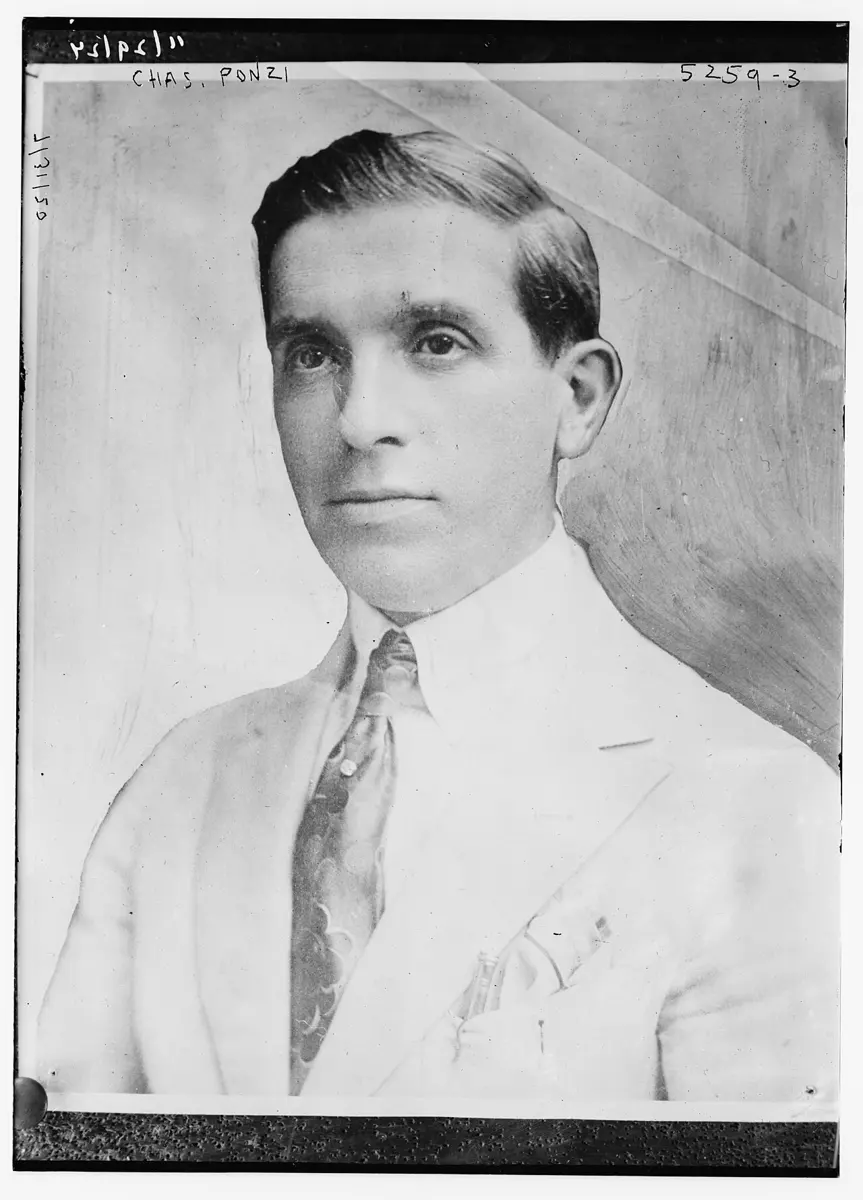
His explanation sounded clever. Countries had agreed on a kind of postal coupon that could be bought in one country and swapped for a stamp in another. Ponzi said a coupon bought for about one cent in Spain could be exchanged in the United States for a six-cent stamp, and that he was buying cheap coupons abroad and cashing them in at home. What he was really doing was much simpler. The money from newer investors paid the older ones. One newspaper man in Boston put it exactly: he was taking money in at one window to pay it out at the next.
Here is what that means in plain steps. Nothing is earning any money. The first people are paid, so the promise looks kept. They tell their friends, and the friends bring more money, which pays the first people and some of the friends. But every payment is a debt to someone newer, so the money coming in has to keep growing, faster and faster, just to stand still. The moment new money slows down, or too many people ask for theirs back at once, there is nothing underneath.
The first fifteen people really were paid. That is the part that makes the trap work. Their stories were true, and so were the stories of the people paid after them. Seventeen new people paid in $5,290 in February. In March it was $28,724. In April 471 people brought $141,671, in May about four times as many brought well over $400,000, and in June 7,824 people climbed the stairs to his office to pay in $2.5 million in cash. The crowd outside blocked the street, and Ponzi now and then handed out free coffee and doughnuts.
That is the shape every such scheme has to have, and why none can last. To pay 50% every forty-five days, out of nothing, the money owed grows by half every forty-five days. Keep that up for a year and the debt is about 27 times bigger. No city has enough newcomers for long.
A financier named Clarence Barron, asked about it by a Boston newspaper in July 1920, did a simpler sum. He agreed that a person could make a little money trading postal coupons, but said it would be impossible to turn over more than a few thousand dollars that way, while Ponzi was talking about millions. And he pointed out something odd. Ponzi kept his own money in banks that paid him about 5%, while he offered other people 50%. Someone who really had a machine that grew money by half in six weeks wouldn’t need anyone else’s money at all.
The paper printed this on its front page on Monday, 26 July, and a crowd came to get its money back. Ponzi paid every one of them, and by the afternoon the run had turned into a rush of new investors. Paying people was his best advertisement. Late that same afternoon he agreed with the district attorney to stop taking money until his books had been checked. By then 30,195 people had paid in $9,582,591, and he had promised them $14,374,818. In August the newspaper found that he had been in prison in Canada years before under another name, and he was arrested. When what he had left was finally shared out, his investors got about twelve cents for every dollar they were owed. Even in prison, many of them stayed loyal to him.
Nepal has had its own Ponzi, and it looked more modern. By late 2025 an app called SMC had spread across the country. Its company was registered with the Office of the Company Registrar, and it had a real office in Khairahani, in Chitwan. It said it worked with Universal, Warner Bros. and Disney, and that members would be paid for watching film advertisements. Members earned a commission for bringing in new members, on three levels, and were told their money would sit in an investment fund paying up to 1.2% a day. In December 2025 and January 2026 the police’s Cyber Bureau arrested eleven people. By its estimate more than 70,000 Nepalis had joined. By early January it had 255 complaints, often several members of one family in a single complaint, adding up to about Rs 12 crore, and it said plainly what the app had been: no real business, new members’ money paying the old ones, a Ponzi.
The 1.2% a day sounds small. But if it were paid every day for a year, and each day’s gain were left in to earn too, it would multiply money about 78 times.
Borrowed faces
The SMC app is a good example of the first piece of the trap, too. A registration certificate and an office with a sign are real things, and they are usually a good sign. Here they were used, in the Cyber Bureau’s words, to make people believe the whole thing was completely legal. Registering a company says that it exists. It doesn’t say that what it does is honest, or that it is allowed to take people’s savings. Ponzi’s firm had a grand name too, the Securities and Exchange Company, which made it sound like the kind of place serious money went.
Authority works because it usually deserves to. Nobody can check everything, and leaning on people and offices that have earned trust is how anyone gets through a day. Frank Stajano, a computer scientist at Cambridge, and Paul Wilson, one of the hustlers who recreated real tricks for the BBC program The Real Hustle, made this one of their seven principles of why scams work. People are trained by the society they grow up in not to question authority, and the hustlers borrow it by posing as a police officer, a workman or someone from the bank. People are very good, they noted, at recognizing someone they already know, by face or voice. They are poor at checking a stranger who says he is from the bank, the police or the water company.
A video of a famous face is the first kind of evidence made to look like the second. You do know that face. But the question isn’t whether the face is real. It is whether he said it. And for that, the face is worth little now, because a machine can put any words in it. The same kind of video turns up across borders with whatever face fits. In November 2025 India’s government fact-checkers warned about an advertisement in which the Prime Minister seemed to introduce a platform paying 3.5 lakh Indian rupees a month for an investment of 21,000. No such scheme existed. A template that works with any face shows you how little the face is adding.
What does add something is outside the video. Did The Kathmandu Post report this platform on its own website, not on a page you reached from an advertisement? Does the government say anything about it on its own sites? Has any fact-checker looked? A real government scheme paying weekly incomes would be everywhere in the news. When the only place a claim exists is inside the advertisement for it, that tells you more than anything the advertisement says.
The clock
The third piece is time. The offer ends today, the price goes up tomorrow, your account will be closed in an hour. Stajano and Wilson made this the seventh of their principles: under pressure people use a different way of deciding, quicker and more led by feeling, and the hustler wants exactly that. In a long con, they wrote, the build-up can take weeks, but the end always corners the victim: put the money down now or lose everything.
The same thing happens at the other end, when people want to leave. As the crowds came for their money in August 1920, speculators walked up and down the line offering to buy Ponzi’s promises at a discount, and Ponzi followed them, warning that anyone who sold now was giving up certain profits. It is a known sign of a Ponzi scheme: when people try to cash out, the promoter tries to keep them in, sometimes by offering even more to stay.
The law has noticed the clock too. In Britain, a law of 1974 gives buyers several days to change their minds about some agreements signed at home, the kind a salesman talks you into at your own door. Stajano and Wilson pointed to it as a sign that the danger is real. The law can’t make anyone wiser. It can give them time, which does nearly the same job.
That turns the clock into a question you can ask yourself. What would I lose by waiting a day? A real investment, a real job and a real scheme from the government will all still be there tomorrow, after you’ve checked. Very often the only thing that can’t survive a day’s wait is the trap.
How often is it real?
The last piece is the one the trap leaves out. Before you look at a single detail of an offer, ask what kind of offer it is, and how often offers of that kind turn out to be true.
Start with the size of it. Nepal’s minimum wage is Rs 19,550 a month. Rs 535,500 a week is more than two years of that wage, every week. The smaller promise in the same video, Rs 154,700 a week for Rs 38,080, is four times your money back every seven days. No honest use of money grows like that. Every investment carries some risk, and the higher the return, usually, the higher the risk, so the first sign of a Ponzi scheme on the American market regulator’s list is high returns with little or no risk, and anything called guaranteed deserves the most suspicion of all. A guaranteed return of four times your money a week isn’t a rare good offer. It belongs to a class of offers in which the real ones are, for practical purposes, none.
And if that is where you start, very little in the advertisement can move you far. A clue is worth something when it shows up more often for real things than for fake ones. A famous face, a government’s name, a newspaper’s page, a crowd of people saying they were paid: every one of these can be made for a fake as easily as for the real thing, and a fake will always have them. So seeing them should move you hardly at all. Barron’s point, turned into a question, is the quickest check: if it paid that well, why would they need you?
Some scams, oddly, seem built to be easy to spot. For years, emails arrived from strangers with tales of stolen millions, corrupt officials and secret deposit boxes, offering a large share of a fortune to anyone who would help, and in the end asking the helper to send money. The computer scientist Cormac Herley, at Microsoft Research, noticed that 51% of such emails in one collection said the money was in Nigeria, and in 2012 he asked why scammers would still say that, when “Nigerian scam” was one of the first things a search engine suggested after the country’s name. They clearly weren’t short of imagination. They had made up everything else.
His answer is about base rates from the scammer’s side. Sending emails costs almost nothing, but every reply means a great deal of writing back, and most of the people who reply will see through it before they pay, which wastes those hours. The people who will go all the way are rare, perhaps one in ten thousand or fewer. So the scammer’s best email isn’t a convincing one. It’s one so strange that anyone who has heard of the trick, or searches for it, or asks a sensible friend, never replies. The silliness is a filter. Herley worked this out from a model and the numbers he could find. It is his argument, not something anyone measured. But one line of it is worth keeping: the people the filter lets through are the ones who don’t ask anyone.
That is perhaps the most useful thing about all four pieces of the trap. Each works on one person, alone, in a hurry. Ponzi’s investors included a judge, and a woman from a town near Boston who sold all her property to put in $33,000. Nobody in this chapter was stupid. Each of them was answering the questions the trap had already answered for them. The way out is to hand those questions to someone else for a day: show the video to a friend, look for the platform on the government’s own site, ask what kind of offer this is and how often such offers are real. What to do when a family’s phone has an earning app on it, or when money has already gone, is in Safe Online, in Practice: Walk away from “watch videos, earn daily” and Lost money online? Tell an adult at once.
Money is the easiest place to see all this, because the promise is a number and the number can be checked. The same four pieces turn up in claims that are harder to check, and the hardest of all are the ones about health, where what is being offered isn’t money but getting better.
Found a mistake? Please tell us.