
On the morning of 29 May 1919 a storm broke over Príncipe, a small island off the west coast of Africa. Arthur Eddington, an astronomer from Cambridge, had come all that way to photograph an eclipse of the Sun that afternoon, and the thunderstorm lasted until about half past eleven. The Sun came out for a few minutes, then the clouds closed in again, and in the last half hour before the eclipse it could only be glimpsed through drifting cloud. Cloud still got in the way of the stars, and the team took sixteen photographs. Across the Atlantic, in the town of Sobral in northern Brazil, a second British team was pointing its telescopes at the same eclipse, and had better luck with the weather.
They weren’t really interested in the Sun. They wanted the stars next to it. On any ordinary day those stars are up there, but the Sun’s glare hides them. For a few minutes in a total eclipse, with the Moon covering the Sun, they come out and can be photographed. And if light is pulled by gravity, starlight passing close to the Sun on its way to us should bend a little. The stars near the Sun would then seem to have shifted slightly outward, away from it. To see whether they had, the astronomers would compare the eclipse photographs with photographs of the same stars taken at night, months earlier or later, when the Sun was somewhere else in the sky. The shift they were hunting for was a few hundredths of a millimeter on the photographic plates.
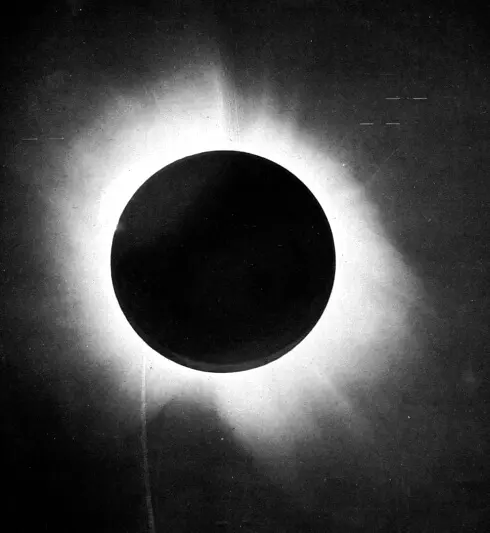
There were three possible answers, and the expedition’s report set them out. The stars might not move at all, which would mean light ignores gravity. They might move by a small amount, 0.87 seconds of arc at the Sun’s edge, which is what you get by treating light as something that falls toward the Sun the way a stone falls toward the Earth, by Newton’s law. Or they might move by twice that, 1.75 seconds of arc, as a new theory of gravity said they must. That theory was Albert Einstein’s, finished in 1915. A second of arc is a tiny angle: 1.75 of them is about the width of a coin seen from three kilometers away.
Eddington told a story about this, which reaches us as the astrophysicist Subrahmanyan Chandrasekhar passed it on decades later. Frank Dyson, who organized the expeditions, explained the three answers to Eddington’s companion on the trip, Cottingham, before they set out. Cottingham gathered that the bigger the result, the more exciting it would be, and asked what it would mean if they found double Einstein’s figure. “Then,” said Dyson, “Eddington will go mad, and you will have to come home alone.”
Under the joke lay something serious. Einstein’s theory had said, in advance and in numbers, what the stars would do. If they had stayed put, or moved by only half, the theory would have lost. Einstein knew it. Writing about another of the theory’s predictions, a slight reddening of the light from the Sun that nobody had yet managed to settle, he put it flatly: “If the displacement of spectral lines towards the red by the gravitational potential does not exist, then the general theory of relativity will be untenable.” Here was an idea naming the result that would sink it.
What a good idea risks
That’s the heart of how science decides what to believe, and it fits in a few lines. A good idea does more than explain what is already known. It says what you should see next, and so what you shouldn’t. Before the test, you can write down the result that would prove it wrong. Then you go and look, preferably at the place where it is most likely to fail. An idea that has been put in danger many times and survived has earned some trust. An idea that could never lose, whatever happened, has told you nothing at all.
It sounds backward. Surely the best idea is the one that fits everything? A young student in Vienna named Karl Popper came to the opposite conclusion in that same year, 1919, and he found it among the most admired theories of his day. He worked for a while with Alfred Adler, a famous psychologist whose theory said that much of what people do comes from feelings of inferiority. Popper once described to him a case that didn’t seem to Popper to fit the theory at all. Adler explained it in terms of inferiority feelings at once, without having seen the child. How could he be so sure? “Because of my thousandfold experience,” Adler said. Popper couldn’t resist replying: “And with this new case, I suppose, your experience has become thousand-and-one-fold.”
What bothered him was that the theory fitted everything. He gave an example. A man pushes a child into the water to drown it. Another man gives his life trying to save a child. Adler’s theory explains both with equal ease: the first man needed to prove to himself that he dared to commit a crime, the second that he dared to save the child. Freud’s theory, popular among Popper’s friends, explained both just as easily, the first by repression and the second by the urge turned to something better. Popper couldn’t think of anything a person might do that the theories couldn’t explain, and the people who admired them saw that as their strength. “It began to dawn on me,” he wrote, “that this apparent strength was in fact their weakness.”
With Einstein it was the opposite. His theory forbade the stars to stay put. “Every ‘good’ scientific theory is a prohibition,” Popper wrote. “It forbids certain things to happen. The more a theory forbids, the better it is.” A theory that forbids nothing can’t be caught out, because nothing can happen that it says can’t. The word that has stuck for an idea that could be caught out is falsifiable: some possible observation would show it false. It doesn’t mean the idea is false. It means it is brave enough to be tested.
Popper was careful about one thing. He didn’t say Freud and Adler saw nothing. He thought much of what they said might be important, and might one day become part of a psychology that could be tested. His complaint was only that their admirers counted every case they could explain as fresh proof, when each case had been fitted to the theory to begin with.
More than one explanation
A good idea risks something. A good thinker goes further and keeps several ideas in play at once, then tries to kill each one.
The planet Uranus, found in 1781, showed how. By the 1840s it was nearly round its first orbit since its discovery, and it wasn’t keeping to the path that Newton’s law of gravity said it should. There were three explanations on the table. Perhaps Newton’s law worked differently so far from the Sun. Perhaps the old observations were wrong. Or perhaps an unseen planet, farther out, was pulling Uranus off course. Urbain Le Verrier, in France, took the third idea and worked out where such a planet would have to be. On 31 August 1846 he presented its orbit, and he posted his result to Johann Galle at the Berlin Observatory, who received it on 23 September. That night Galle and Heinrich d’Arrest found the planet about a degree from where Le Verrier had said. It was Neptune.
The unseen-planet idea rescued Newton, but it did so by sticking its own neck out: it said where to point a telescope. If nothing had been there, the rescue would have failed.
In 1859 Le Verrier found a second puzzle. Mercury’s orbit slowly swings around the Sun, and it was swinging a little too fast, by 38 seconds of arc a century more than Newton’s law and the pull of the other planets could account for. (Later work put the gap at about 43.) He tried the trick that had worked so well before: something unseen, inside Mercury’s orbit, perhaps another planet. A French doctor, Edmond Lescarbault, reported that he had seen a small black dot cross the face of the Sun that March, and on 2 January 1860 Le Verrier announced a new planet and gave it a name, Vulcan.
Vulcan made a prediction too: look near the Sun and you will find it. Astronomers looked for half a century. During an eclipse in 1878 two astronomers in the United States each reported a planet near the Sun, but in different places, and neither matched the other. Astronomers from the Lick Observatory in California photographed the sky around the Sun at the eclipses of 1901, 1905 and 1908 and found nothing: if anything was there, it had to be too small and faint to matter. This time the rescue lost.
Then, in November 1915, Einstein worked out what his new theory said about Mercury. Out came 43 seconds a century, with no unseen planet needed. He wrote to his friend Michele Besso: “Perihelion motions explained quantitatively … you will be astonished.” Less often told is that an earlier version of his theory, which he and Besso had tested against Mercury in 1913, gave only about 18 seconds. Einstein kept quiet about it and went on working on that version for two more years. Only when he wrote to a colleague in November 1915 did he list those 18 seconds among his reasons for giving it up. The historian Michel Janssen, who studied the calculation, thinks that was reasonable: an answer that predicted far too much would have sunk the idea at once, but falling short by more than half was disappointing rather than fatal. Real tests don’t always knock an idea out with one blow.
The habit of holding several explanations at once was given a name in 1890 by an American geologist, Thomas Chamberlin. He called it the method of multiple working hypotheses, and he set it against having one ruling theory, which tempts a person to collect what fits and avoid the hard tests. It’s a habit for anyone, not only astronomers, and one of its best recent cases flew over Nepal.

The white-rumped vulture was once one of the commonest large birds of prey in South Asia. From the 1990s it and two of its relatives began to vanish, falling by more than 95%. Tens of millions of vultures disappeared from the subcontinent. Sick birds looked dull and listless, some with their heads drooping for a long time, and then collapsed, sometimes straight off their perches. Opened up, the dead birds had their insides crusted with uric acid crystals, a condition called visceral gout, a sign that their kidneys had failed.
What could do that? Researchers tested one explanation after another. A team working in Pakistan looked for lead, mercury and other poisonous metals, for pesticides, for bird flu, West Nile and other viruses, and for starvation; most of the dead birds had been well fed. Each was looked for hard, and none held up. Then the team asked a new question. The vultures lived mostly on dead livestock, so could a medicine given to the animals be to blame? They asked 74 vets and sellers of animal medicines which drugs harmed the kidneys and were taken by mouth, and only one fitted: diclofenac, a painkiller that farmers in India had begun giving their cattle and buffaloes in the mid-1990s, and that later came into wide use in Pakistan and Nepal. In 2004 the team reported what they found. Every one of 25 vultures that had died of kidney failure had diclofenac in its kidneys; none of 13 that had died of other things did. Vultures eat dead cattle at carcass dumps, the usual way of disposing of livestock in South Asia. To check, the team gave vultures the drug, and also fed them meat from treated livestock. The birds developed the same kidney disease.
The diclofenac idea then made a prediction that could have lost. Take the drug away and the vultures should stop dying. Nepal banned diclofenac for animals in 2006. That year, at Pithauli in Nawalparasi, Dhan Bahadur Chaudhary, with help from Bird Conservation Nepal, started the Jatayu Vulture Restaurant, which buys old cattle that farmers can no longer keep, cares for them until they die naturally, and lays out the carcasses for the vultures, testing them for the drug. By 2012, after years of work by government offices and Bird Conservation Nepal, diclofenac could no longer be bought in Nepal. That same year, the count of white-rumped vultures turned from falling to rising, and it has grown by about 13% a year since. Where the drug went on being used, or other painkillers that harm vultures took its place, the birds haven’t recovered like this. The idea had been given every chance to fail, and it hadn’t.
Simpler first
When several explanations fit, which should you try first? The usual advice is the simplest, the one that asks you to assume the fewest new things. It goes by the name of Occam’s razor, after William of Ockham, an English friar who died in 1347 and wrote that “plurality must never be posited without necessity”.
Le Verrier followed the razor. One more planet, with Newton’s law kept as it was, was the simplest thing to assume, and it had worked once already, with Neptune. He was right to try it first. But the razor only chooses between ideas that predict the same things, and Vulcan and Einstein’s theory didn’t. One said there was a planet near the Sun to be found; the other said there wasn’t, and that starlight would bend. When two ideas disagree about what the world will show, there’s no need to choose by taste. The world decides.
Ideas that can’t lose
Some ideas fail tests. Others are built so that nothing could ever count as a failure, and those are the ones to watch for.
Any idea can be saved from a bad result, if you are willing to add something to explain the result away. Popper called this a twist, and it is what separates Neptune from a bad excuse. Le Verrier’s new planet came with an address. A bad rescue comes with nothing to check. It just makes the problem disappear, and leaves the idea safer than before, and emptier.
Conspiracy stories are where this goes furthest. One guide to such stories lists the habits of thinking that keep such stories going, and one is that they are “immune to evidence”. Evidence against the story is explained as part of the plot: the stronger the evidence, the harder the plotters must be working to make people believe it. Take the belief that the American Moon landings were filmed on Earth. A NASA spacecraft orbiting the Moon has photographed the landing sites from about 21 kilometers up, sharply enough to show the trails the astronauts’ boots left in the dust. To someone sure the landings were faked, a NASA photograph is only more of NASA’s work. And the lack of any evidence for the fakery becomes proof of how good the cover-up was. Every way the world could turn out has already been fitted in.
The question that cuts through it is simple to ask, of anyone, including yourself: what would change your mind? If the honest answer is “nothing could”, the belief has stopped being a claim about the world. That doesn’t mean everything official is true. Real plots happen. The carmaker Volkswagen fitted its diesel cars to cheat emissions tests. But real plots come out the ordinary way, through internal documents, government investigations and people inside who speak up, the same kind of evidence that a believer in a cover-up has decided not to trust.
Astrology was one of Popper’s favorite examples of an idea whose followers found confirmation everywhere. But astrology can be tested when astrologers agree to a prediction sharp enough to fail. In one such test, published in the journal Nature in 1985, astrologers helped design the experiment and said beforehand that, given a person’s birth chart and three personality profiles, they would pick that person’s own profile at least half the time. Picking at random gets it right one time in three. They did no better than chance.
None of this means an idea that can’t be tested is worthless. Popper said as much: many scientific ideas began as myths, and became testable later. A question of what is good or beautiful isn’t settled by any experiment at all. The test of risk is for claims about how the world works. When a claim like that can’t lose, it hasn’t won either.
The answer from 1919
The results were announced in London on 6 November 1919, at a joint meeting of the Royal Society and the Royal Astronomical Society. The smaller telescope at Sobral gave 1.98 seconds of arc. Eddington’s cloudy plates from Príncipe, with only a few stars on them, gave 1.61. Newton’s half had lost.
There was a third result, and it is the one people argue about. The bigger telescope at Sobral had given 0.93, close to the half. The team set those plates aside: they believed the Sun’s heat on the telescope’s mirror had blurred and changed the focus during the eclipse. Sixty years later that decision was questioned. Some scholars, and then the physicist Stephen Hawking in his famous A Brief History of Time, suggested the team might have seen what it hoped to see. The question was a fair one to ask.
In 1978, for the hundredth anniversary of Einstein’s birth, the surviving Sobral plates were measured again at the Royal Greenwich Observatory, on a modern machine. The big telescope’s plates, worked out in both directions this time instead of one, gave 1.55. The small telescope’s gave 1.90. Both sets together gave 1.87, close to Einstein. The blurred plates hadn’t held a hidden win for Newton after all. Radio telescopes, which can watch distant radio sources pass close to the Sun without waiting for an eclipse, have since measured the bending to within a few hundredths of a percent of Einstein’s value. The reddening of light that Einstein named as his theory’s other weak point was measured on Earth in 1959, between the top and bottom of a tower at Harvard University.
Einstein’s theory has kept walking into danger ever since, and new tests of it are still being run. It could still lose. That is why physicists trust it. And the question about the 1919 plates, whether the people doing the measuring saw what they wanted, is one science learned to ask of itself, because sometimes the answer is yes.
Found a mistake? Please tell us.