
Staying Safe, in Practice
Small things to do before something goes wrong, at home, on the road and in Nepal’s weather. Pick one, try it, and tick it off.
81 things to do. Open one, do it, and tick it off.
Earthquakes
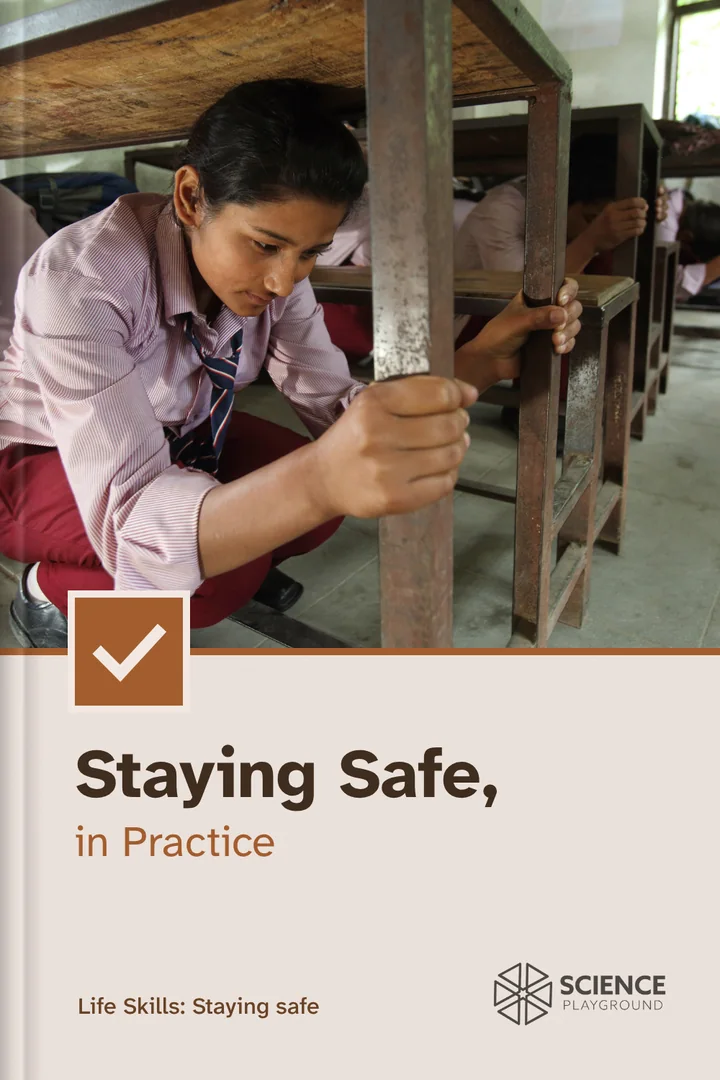
- Practice drop, cover and hold on
Where you’d take cover at home and at school when the ground shakes, and where you’d meet afterwards.
Official advice - Fix tall furniture to the wall, and keep heavy things low
Falling things are the commonest injury in an earthquake. Strap the tall cupboard, and put heavy things down low.
Official advice - Tie shoes and a torch to your bed
An earthquake at night leaves the floor dark and covered in glass. Keep shoes and a torch where they can’t be thrown away.
Official advice - Know what your house is built of
Almost everywhere, drop, cover and hold on. Find out whether your home is the one exception.
Official advice - Caught outside, get away from walls and wires
Don’t run indoors. Get clear of walls, wires, signs and trees, then drop and cover your head.
Official advice - In an earthquake, never jump from a window or roof
Upstairs when it shakes? Stay in, drop and hold on. Never jump.
Official advice - When the shaking stops, wait a minute, then walk out
Wait a minute, shoes on, torch not flame, walk to clear ground, and expect aftershocks.
Official advice - Stay out of a cracked house until someone has checked it
New cracks or a leaning wall? Stay out and sleep elsewhere until someone who knows has looked at it.
Official advice - If you’re trapped, knock or blow a whistle
Rescuers listen for sound. Three knocks every few minutes, or a whistle. Teach it to everyone at home.
Official advice - Know where your class goes in an earthquake
Ask what your class does, where it gathers, and tell your family. Then do the drill as if it were real.
Official advice - Pack a go-bag and keep it near the door
One bag near the door with what you’d need for three nights in the open.
Official advice - Don’t pass on a date for the next big earthquake
Nobody can predict the day. Don’t forward the message. Do one useful thing instead.
Official advice
Gas, fire and electricity at home
- Keep the cylinder upright and the regulator off
Upright, below the stove, away from heat, and the regulator off when you finish cooking.
Official advice - Check the gas pipe with soapy water
Soapy water on the pipe and joints. Bubbles mean a leak.
Official advice - Smell gas? Touch no switch, open up, get out
No switches, no flame, no phone. Open up, regulator off, get out, call 101 from outside.
Official advice - If your clothes catch fire, stop, drop and roll
Don’t run. Stop, drop to the ground, and roll until the flames are out.
Official advice - Know two ways out, and leave a fire at once
Two ways out, keys where everyone can reach them. Get out, stay out, call 101.
Official advice - Ask for a smoke alarm at home, and test it monthly
One alarm, in the right place, tested every month.
Official advice - Do a two-minute fire check before bed
Flames out, plugs out, doors closed.
Official advice - Never sleep with a fire or gas heater in a closed room
Charcoal, wood and gas heaters make a gas you can’t see or smell. Never sleep beside one in a closed room.
Official advice - Keep a heater a meter from you and off when you go out
Sit a meter away, dry nothing on it, and turn it off before anyone leaves the room.
Official advice - Sit facing a fire, not with your back to it
Warm yourself facing the flames. Keep fleece and nylon away from them.
Not tested on its own - Never leave a candle or diyo burning in an empty room
Out when you leave, out before bed, on something that won’t burn.
Official advice - Treat a tingle from a tap, pump or rod as a warning
A tingle, a hot plug or a burn mark is a warning, not a nuisance. Stop, and tell an adult today.
Not tested on its own - Stay far from a fallen wire, and from anyone on it
Every fallen wire is live. Stay 10 meters back, and don’t touch anyone on a wire until the power is off.
Official advice - Use one plug per socket, and never join two extension leads
One high-power plug per socket. No lead plugged into a lead. A hot plug is a warning.
Official advice - Charge your phone on a table, not under your pillow
Use a genuine charger, leave it uncovered, and don’t charge overnight.
Official advice
Medicines, chemicals and falls
- Never keep kerosene or pesticide in a drink bottle
Own container, clear label, away from food, out of reach.
Official advice - Never mix two cleaning products
One product at a time, window open, rinse before you use another.
Official advice - Stay back from a roof edge and an open stair
Keep off low edges, and don’t let small children near open stairs, windows or balconies.
Not tested on its own - Never climb into a septic tank, even to help someone
Don’t go in after them. Stay at the top and call for help.
Not tested on its own
On the road
- Strap your helmet on, every ride
A helmet with an open strap isn’t correct use. Click it, even for the shop round the corner.
Strong evidence - Buckle up, in the back seat too
Front or back, car, jeep or microbus: if it has a belt, wear it.
Strong evidence - Get on and off only when the bus has stopped
Stopped means stopped, even if the conductor is shouting. Then let the bus leave before you cross.
Official advice - Wear something light or reflective when you walk after dark
Light colors at dusk, reflective at night, and a torch in your hand.
Official advice - On a bicycle, wear a helmet and carry lights
Fastened helmet, white light in front, red behind, nothing loose near the chain.
Official advice - Stay off the roof of the bus
If the only space left is the roof or the door step, wait for the next bus.
Official advice - Speak up when a bus goes too fast
Say it out loud, note the number, and call 103.
Not tested on its own - Don’t get in with a driver who has been drinking
Don’t get on. Call home, walk with someone, or wait for another ride.
Official advice - Cross at the zebra crossing or the bridge
Drivers expect people at crossings. Walk a little further to one, and look both ways even there.
Official advice - Walk on the footpath, or face the traffic
Footpath where there is one; where there isn’t, the right-hand edge of the road, so you see vehicles coming towards you.
Some evidence - Wear the helmet on the back seat too, and buckle it
A pillion rider’s head is as exposed as the rider’s, and an unbuckled helmet comes off in a fall.
Strong evidence
Weather, landslides and forest fires
- Learn the signs that a slope is moving
Cracks, tilting trees, new springs, muddy streams, a rumble. If you see them, tell people and leave.
Official advice - Know your way to high ground, and go early
Walk the route now. When water rises or someone warns you, go, even before an official alert comes.
Official advice - Never walk through moving floodwater
Ankle-deep and fast is enough to take you down. Turn back, and keep clear of wires.
Official advice - Check the weather and roads before a trip in the rain
1155 is free for weather and flood news. In heavy rain, ask about the road, and avoid night travel.
Official advice - When you hear thunder, go indoors
Hear thunder? Stop what you’re doing and go into a solid building. A tree is the worst place to wait.
Official advice - In a strong wind, get away from tin roofs and trees
Strongest building, lowest floor, small room, no windows, and cover your head.
Official advice - Put out every flame near a forest, and leave a fire early
Leave no flame behind in the dry season. If fire comes near, don’t wait.
Official advice
Rivers and water
- Leave the riverbank when the water changes
A sunny sky doesn’t make a river safe. If it rises, drops, turns muddy, or a siren sounds, get up the bank.
Official advice - Stay out of rain-filled pits, ponds and canals
A pit full of rainwater can be far deeper than it looks. Keep out, keep little ones out, and report it.
Official advice - Keep a lid on wells and water tanks
A lid that stays on, and a tank a small child can’t climb.
Official advice - Learn to swim, and never swim alone
Learn with a trained teacher, swim where someone is watching, and wear a life jacket on any boat.
Official advice - To help someone in water, reach or throw, don’t go
Stay on land. Shout, reach with something long, or throw something that floats, and call for help.
Official advice
People and crowds
- Plan how you’ll get home before you go out
Who with, which way, what time, and who knows.
Not tested on its own - If you think you’re being followed, go where people are
Check by crossing the road. Then go to where people are.
Not tested on its own - If someone touches you on a bus, you can report it
It isn’t your fault. Move, say so, note the number, and call 100 or 1145.
Not tested on its own - Don’t go with someone who promises a job far away
Tell your family first. A real job can wait for them to check.
Not tested on its own - In a crush, stay on your feet and keep your bag on you
Go while you can. If you can’t, stay upright, keep your bag on, and save your breath.
Not tested on its own - If you get lost, stop and stay where you are
Go to the agreed spot or stop where you are, ask someone safe, and never leave with a stranger.
Not tested on its own - In a big crowd, keep to the edge and know a way out
At a jatra or a concert, stay where you can still move, find the way out when you arrive, agree a meeting place, and leave early if it gets too tight.
Official advice
Animals and the forest
- If a strange dog comes near, stand still
Don’t run. Stand still with your hands down, look away, and back off slowly once it loses interest.
Not tested on its own - In the Tarai, sleep off the floor under a net
A well-tucked mosquito net and a bed off the floor help keep night-time snakes away. Wear footwear in the fields.
Some evidence - Near the forest, go together and let animals hear you
Go together, talk, carry a torch, and take care at dawn, dusk and night.
Official advice - If you meet a leopard, don’t run and don’t crouch
Stand tall, hands up, shout, back away slowly. Never run, crouch or hide.
Official advice - Stay far from a wild elephant or rhino
Don’t go closer for a look. Never near a calf. Move away early.
Not tested on its own - Keep your food out of sight around monkeys
Don’t offer, don’t touch, and get any bite checked.
Not tested on its own - Leave a hornet nest alone
No stones, no sticks. Keep away and tell an adult.
Not tested on its own - Don’t eat mushrooms picked in the wild
Only farmed ones. Cooking doesn’t help. Ill after eating them? Go at once.
Official advice
Hills and farms
- In the high hills, climb slowly
Slowly, with rest days, and no more than 500 meters higher each night.
Official advice - Don’t trek alone, and leave your route with someone
Go with someone. Leave your route and date at home.
Not tested on its own - Take two steps back from the edge for a photo
Stay back, stand still, and look where your feet are before you press.
Not tested on its own - Cutting grass on a steep slope? Go together, and skip wet days
Go with someone, say where, and keep off wet rock.
Not tested on its own - Keep children away from the fodder cutter
Not a toy. Children stay away, and nobody rides on a tractor.
Not tested on its own
Being ready
- Agree on two meeting places and one far-away contact
One place outside home, one further away, and a relative elsewhere that everyone contacts.
Official advice - Decide who helps grandparents and small children
Name the helper now, not when it’s shaking.
Official advice - Carry your family’s numbers on paper
A card in your bag, because a dead phone can’t give you a number.
Official advice - Find the nearest open ground before you need it
A place with no walls, wires or trees above you. Walk the way there once, before you need it.
Official advice - Learn how to turn off the gas, water and power
Find all three, and know when to use them.
Official advice - Save the emergency numbers in your phone
Police 100, fire 101, ambulance 102, saved under names you’ll find in a panic and taught to the people at home.
Official advice - Learn to say where you are
Tole, ward, a landmark and the nearest main road: what an ambulance needs to hear, and how a phone map can show the spot.
Official advice
General safety information, written from published guidance, not a safety inspection or professional advice. No page can fit every building, road or storm. In a real emergency, follow the police, fire service, and local authorities. You use it at your own risk: see our terms. Spotted a mistake, or know something better? Tell us.
Cover photo: Department of Foreign Affairs and Trade, CC BY 4.0
