
Water-powered ram pumps for hill villages
A pump with no motor that uses a stream’s own fall to push part of its water up to a village or field far above.
- Who can take it up
- Household, Community, Business
- Where
- Chure, Middle hills
- The slope
- Uses the slope

How it works
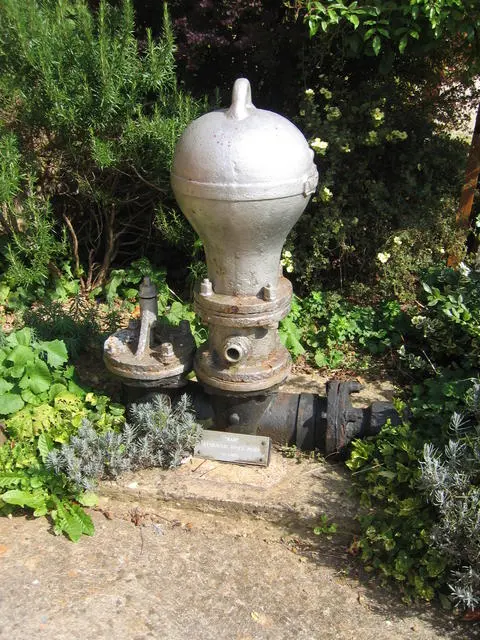
A hydraulic ram, or hydram, is a pump whose only moving parts are two valves. Water from a stream runs down a strong drive pipe that falls a few metres to the pump. As the water speeds up, it slams the first valve, the waste valve, shut. The sudden stop makes a jolt of pressure, the same knock you hear when a tap is shut fast, and that jolt pushes a little water through the second valve into an air chamber and up a thinner delivery pipe. Then the waste valve drops open again and the cycle repeats, over and over, day and night.
It needs no fuel and no electricity. The catch is that most of the water goes back to the stream: in Nepal, water falling 5–6 m drives a hydram that sends about a tenth of it up to around 100 m. The higher the lift, the smaller the share. So it suits a village or farm that sits high above a stream with water to spare, filling a tank at the top that feeds taps or irrigation.
Where it has worked
- AID Foundation (AIDFI) (Negros, Philippines, since 1990s): Designed a simple ram pump that local workshops can make and mend, for upland villages left poor by the sugar crash. By 2007 it had 98 pumps at 68 sites serving about 15,000 people, lifting water up to 200 m; villagers pay P10–25 a month per household into a repair fund (Ashden Award, 2007). ashden.org
- International Water Management Institute (Mansehra, Pakistan): Eight ram pumps on the Siran River lift water 150–200 feet (about 45–60 m) to about 400 households, with no power or fuel. About 51.5 acres of rain-fed or unused land are now farmed, including about 10 acres of kitchen gardens, and ten people at each site were trained to run and repair the pumps (2026). iwmi.org
- Bhutan Water Partnership, with Nepal’s CRT/N (Rubesa, Wangdue Phodrang, Bhutan, since 2019): A hydram made by Nepal’s Centre for Rural Technology was installed in December 2019 with the district, the community and a local fabricator. It lifts about 8,000 litres a day to a tank 100 m above, for 29 households who had no reliable water before (2020). gwpo-gwp.org
Why it fits Nepal’s slopes
Nepal’s hills are full of villages that sit well above their streams: the water is in sight, but carrying it up takes time and strength, and most hill farms depend on rain alone (Nepali Times, 2006). A ram pump turns the very thing that makes this hard, the fall of a hill stream, into the power to lift water. What it needs is a stream that keeps flowing in the dry season, since that is when a tank of lifted water matters most.
In Nepal now
The Centre for Rural Technology, Nepal (CRT/N) revived the hydram here and promotes it: about 30 have been installed, each serving 30–40 households, mostly paid for by donors (INFORSE), in some 25 villages (GWP, 2020). In Dhading, two pilots brought drinking water to Sunaula Bazaar and water for the toilets of a school of 600 in Mahadevsthan (LEISA, 2015). In Chhettritandi, Nawalparasi, one lifts about 32,000 litres a day and irrigates more than 30 hectares for 54 households; it won CRT/N an Adaptation at Scale Prize in 2019. Still, few farmers know of them. The new step: local workshops that make, install and service hydrams, and user groups with a repair fund, as in the Philippines.
Where in Nepal
Villages and farms in the middle hills and Chure that sit above a stream flowing all year, with a drop of a few metres just below the intake for the drive pipe, and firm ground above for a tank. The places CRT/N has worked, such as Dhading, Kavre and Nawalparasi, show the kind of site.
Safe for the slope?
A ram pump takes water from a stream and returns most of it straight back, so it digs no cuts into the slope and moves no soil beyond the trenches for its pipes and a small pump house. Its risk is water in the wrong place: an overflowing tank, a burst pipe, or irrigation run onto a steep, unstable slope can soak the ground in the monsoon. So set the tank on firm ground, lead its overflow to a drain or the stream, and water terraces or drip lines, not bare slopes.
What it costs, and who pays
In Nepal a hydram costs about US$1,500–3,000, depending on its size and the site, and takes about 25 days to make and install (INFORSE). In the Philippines a system for 50 households cost about P200,000–250,000 (£2,200–2,700) in 2007 (Ashden). It burns no fuel; the running cost is replacing valve rubbers and gaskets in time. Who pays: so far mostly donors, with users paying for upkeep. A municipal or provincial grant for hydrams, or what a household could pay alone: no reliable figure.
The catch
- Needs a stream that flows all year, with a drop just below the intake.
- Lifts only a small share of the water, less the higher it goes.
- Badly made pumps leak under the high pressure and stop.
- Valves and gaskets wear out; with no repair fund, pumps sit idle.
- Others downstream may need the same water: agree first.
Where to learn it
The Centre for Rural Technology, Nepal (CRT/N) in Kathmandu makes and installs hydrams and has worked with communities in Dhading, Kavre and Nawalparasi. ICIMOD has shown a working hydram at its Godavari demonstration centre (Nepali Times, 2006). AIDFI in the Philippines has shared its design with Nepal.
First steps
- Walk the stream below your village in the dry season: is it still flowing, and where does it drop a few metres?
- Measure roughly how high the village or field sits above it; a phone’s altitude reading is a start.
- Visit a working hydram, such as CRT/N’s in Dhading or Nawalparasi, and ask its users what breaks and who fixes it.
- Take your numbers to CRT/N or your ward office and ask what a pump for your site would cost and who would keep its repair fund.
Sources
- Hydraulic Ram Pump (Hydram) in Nepal, INFORSE Solutions (inforse.org)
- Hydram: a low carbon technology (CRT/N, Dhading), LEISA India, 2015 (leisaindia.org)
- CRT/N wins the Adaptation at Scale Prize for hydrams, ENERGIA, 2019 (energia.org)
- Hydram in Bhutan with CRT/N, Global Water Partnership, 2020 (gwpo-gwp.org)
- AID Foundation: ram pumps bring running water to hillside villages, Ashden, 2007 (ashden.org)
- AIDFI Ram Pump, MIT Solve, 2021 (solve.mit.edu)
- Negros NGO wins BBC prize for water delivery tech, GMA News, 2010 (gmanetwork.com)
- The blessing that flows: ram pumps in Mansehra, IWMI, 2026 (iwmi.org)
- It’s perfectly eco-logical (ICIMOD Godavari), Nepali Times, 2006 (nepalitimes.com)
Facts checked October 2026. The places and projects named are examples, not recommendations.