
Pine needles into fuel and power
Gather the dry needles that carpet chir pine forests every spring, the fuel of many forest fires, and press them into briquettes or burn them for power.
- Who can take it up
- Community, Business
- Where
- Chure, Middle hills
- The slope
- Protects the slope

How it works
Chir pine (Pinus roxburghii) drops a thick mat of long, dry, resin-filled needles in spring. Animals don’t eat them and people rarely burn them as firewood, so they pile up, and in the dry months before the monsoon they carry fire quickly across a hillside.
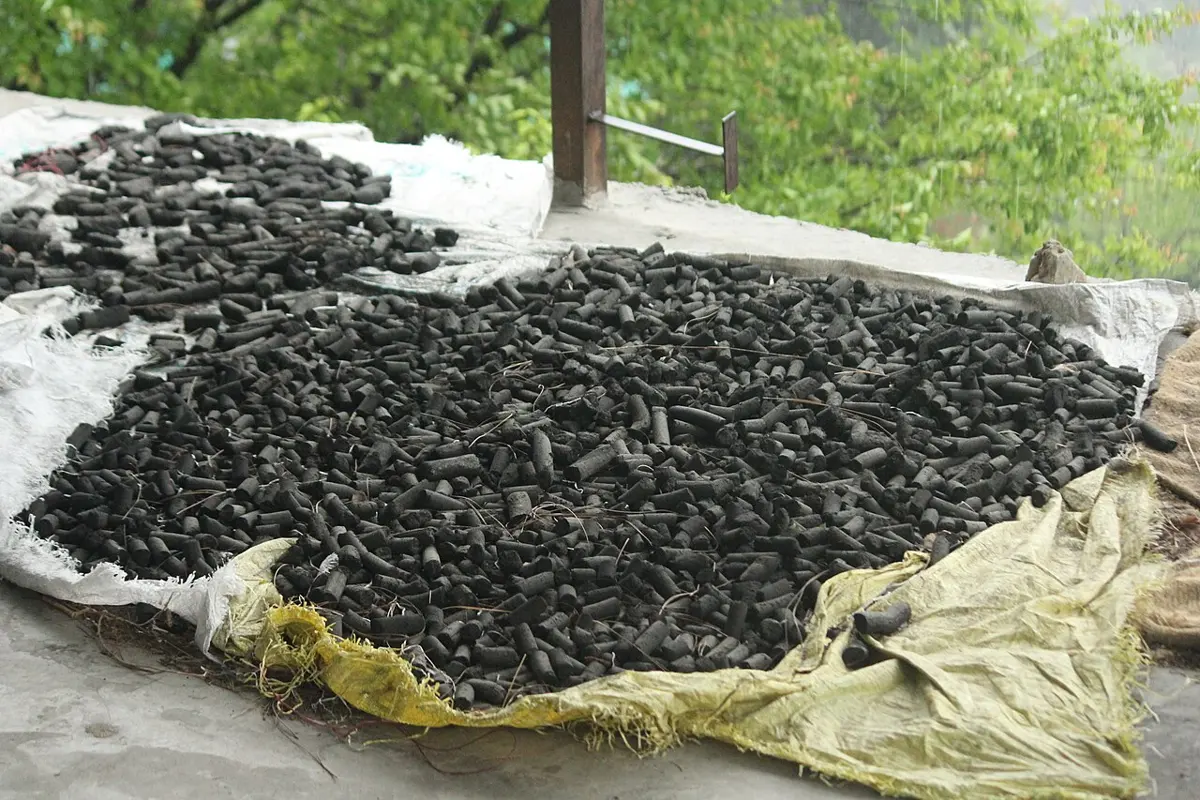
There are three ways to turn them into something worth money. The simplest is to collect and sell them by weight to a factory that burns them, as a cement plant in Himachal Pradesh did. The next is to make briquettes: crushed needles are pressed in a hand-driven machine into small dense sticks that burn longer than loose needles and can be sold to hotels, eateries and homes. The hardest is a gasifier: chopped needles are burnt with little air to make a gas that runs a generator, leaving about a tenth of the needles as charcoal for cooking.
Each way pays people to clear the forest floor in the season when fire is most likely, which is the real point.
Where it has worked
- Avani Bio Energy (Berinag, Pithoragarh, Uttarakhand, India, since 2011): Built a 9 kW pine-needle gasifier, then a 120 kW plant at Chachret with an agreement to sell 750,000 units a year to the state’s power company. It paid collectors about Rs 1 a kg; each plant needs over 100 of them (2012). ICIMOD credits Avani’s plants with training almost 300 local youth and women and sending over 500,000 units to the grid. businesstoday.in
- Ambuja Cement Foundation and the forest department (Hamirpur, Himachal Pradesh, India): About 200 village families in self-help groups and forest committees collected nearly 600 tonnes of needles in a year, sold at Rs 165 a quintal to a cement plant that burns them as fuel. Villagers earned about Rs 12.61 lakh, from 20 collection centres; a hectare of pine forest gives 2–3 tonnes a season (2012). indiaenvironmentportal.org.in
- Forest department, Nowshera division (Rajouri, Jammu and Kashmir, India, since 2021): Fifteen hand-operated hydraulic presses turn needles into briquettes with no binder, about 80 g from 100 g of needles. They sell at Rs 12–15 a kg; one women’s group supplies five hotels about ten quintals a fortnight in winter and its members earn Rs 12,000–13,000 a month (2024). Still a pilot. india.mongabay.com
- Government of Uttarakhand (Uttarakhand, India, since 2021): The warning case. A 2021 scheme expected 58 pine-needle power plants; only six of 250 kW were built, and the energy agency calls them unsuccessful. After the 2024 fires the state raised what it pays for needles from Rs 3 to Rs 50 a kg instead (2024). thehindu.com
Why it fits Nepal’s slopes
Chir pine is a tree of the Himalayan foothills, growing from about 400 to 2,300 m on dry, well-drained slopes; it covers 8.54% of Nepal’s forest (DFRS, 2015, cited by Aryal and others, 2018). It was planted widely on bare hills in the 1980s; in 1981–82 it made up 57% of the trees planted by the Community Forestry Development Project (FAO). The needles fall in the same dry spring when Nepal burns: in 2021, with a quarter of the usual January–April rain, satellites counted about 41,000 fire hotspots in Nepal by 7 April (NASA). Steep slopes make the needles hard to carry, but they are the reason the fires spread so fast.
In Nepal now
Many community forests have chir pine, and in Kumaon next door the needles are raked for animal bedding (Kala). But we found no business in Nepal that turns pine needles into fuel. In 2018 researchers from Tribhuvan University and CEEN tested needles from Hattiban Community Forest in the Kathmandu Valley: about 751 g of needles lay on each square metre in autumn, and high-pressure pellets gave the most heat (5,555 kcal a kg) and were the only product within Nepal’s indoor smoke limits (Baral and Shrestha). Nepal does have a charcoal briquette trade made from forest shrubs and twigs, with about 30 community groups and four companies in some 25 districts (Kathmandu Post, 2018). The new step: community forests selling needles, or pressing briquettes, in the fire season.
Where in Nepal
The chir pine slopes of the middle hills and the Chure: in central and eastern Nepal mostly on sunny, south-facing slopes, in the west on slopes of every aspect (Aryal and others, 2018). Places in our sources include the old plantations of Kavre and Sindhupalchok, Syangja’s Panchase area, and Hattiban in the Kathmandu Valley. A site needs a road or track close by, since needles are light and bulky to carry.
Safe for the slope?
Clearing needles moves no soil and makes no cuts, and in the dry months it takes away the fuel that lets fire sweep up a slope. The real cost is to the soil: researchers in Uttarakhand found that taking pine litter stops its nutrients going back into a soil that is already poor, and makes it harder for oak to return (Manral and others, 2020). So rake by hand, never down to bare soil, leave the steepest and most eroded slopes alone, and focus on strips near roads and villages, where an expert in Uttarakhand says most fires start (The Hindu, 2024).
What it costs, and who pays
Collecting needs only rakes, sacks and a weighing scale; the money comes from a buyer. In India collectors have been paid from about Rs 1 a kg (Avani, 2012) to Rs 1.65 a kg (Ambuja, 2012), and now Rs 50 a kg from the Uttarakhand government (2024). A hand-operated briquette press, as used in Jammu and Kashmir: no reliable figure for its price. Avani’s plants were paid for with an investment of US$250,000 from Acumen Fund and a Rs 24 lakh grant from Mahindra & Mahindra (Business Today, 2012); the cost of one plant: no reliable figure. What a buyer in Nepal would pay for needles or briquettes: no reliable figure.
The catch
- Needles fall only in spring, so work and income are seasonal.
- Bulky and light: carrying them off steep slopes costs more than they are worth unless a road is near.
- Taking all the litter leaves a poorer soil; leave some.
- Most pressed needle fuels tested in Nepal were too smoky for indoor stoves.
- Power plants have mostly failed, even with government support in Uttarakhand.
- Selling forest products needs the community forest’s operational plan to allow it.
Where to learn it
Tribhuvan University’s Central Department of Environmental Science and the Centre for Energy and Environment Nepal (CEEN) made the Hattiban pine-needle tests. Your Division Forest Office can say what your community forest’s operational plan allows. Across the border, Avani in Berinag, Pithoragarh, has run pine-needle plants since 2011, and ICIMOD has listed its work as an adaptation solution for the region.
First steps
- Walk a chir pine forest near you in March or April: how thick is the needle mat, and how close is the nearest road?
- Ask your community forest committee whether needles are collected now, by whom, and what the operational plan says about selling them.
- Look for a buyer before collecting: a brick kiln, a factory, hotels or a briquette maker that would pay by weight.
- Read the Hattiban study and the Jammu and Kashmir briquette story, then try a small batch with a hand press before buying any machine.
Sources
- Uttarakhand company producing power with pine needles (Avani), Business Today, 2012 (businesstoday.in)
- When the problem is part of the solution: pine-needle power, ICIMOD (icimod.org)
- Harnessing the energy of pine needles for rural development (Avani), ISTI Portal, Government of India (indiascienceandtechnology.gov.in)
- Pine needle power projects to check Uttarakhand forest fires prove to be inadequate, The Hindu, 2024 (thehindu.com)
- Best of waste: pine needles boost rural economy (Hamirpur), Indian Express via India Environment Portal, 2012 (indiaenvironmentportal.org.in)
- Converting pine needles from a fire risk into a livelihood opportunity, Mongabay India, 2024 (india.mongabay.com)
- Properties of briquettes and pellets of pine needles from Hattiban Community Forest, Baral and Shrestha, Nepal Journal of Environmental Science, 2018 (nepjol.info)
- Briquette economy, Kathmandu Post, 2018 (kathmandupost.com)
- Climatic upshot using growth pattern of Pinus roxburghii from western Nepal, Aryal and others, Pakistan Journal of Botany, 2018 (ir.xtbg.ac.cn)
- Provenance trial of chir pine and its scope in Nepal, FAO (fao.org)
- Changes in soil biochemical properties following replacement of Banj oak forest with Chir pine, Manral and others, Ecological Processes, 2020 (doi.org)
- Indigenous uses and structure of chir pine forest in Uttaranchal Himalaya, Kala, FAO (fao.org)
- A fierce fire season in Nepal, NASA Earth Observatory, 2021 (science.nasa.gov)
- Community forests in Nepal, RECOFTC (recoftc.org)
Facts checked October 2026. The places and projects named are examples, not recommendations.