
If you have heard of only one psychology experiment, there is a fair chance it is this one. Some college students were put in a pretend prison in a university basement. Half were made guards and half were made prisoners, by the toss of a coin. Within days the guards had turned cruel and the prisoners were breaking down, and the experiment, planned for two weeks, had to be stopped after six. The lesson drawn from it was simple and frightening: put good people in a bad place, and the place wins.
That story has been told in textbooks for fifty years, in films, in courtrooms and on television. The trouble is that the record doesn’t support it. The guards were coached, the routine they followed was borrowed, and several of the young men said they had been playing a part. The study, as it turns out, says less about what a prison does to people and a good deal more about what a leader can get people to do. How that came to light is a story about how science checks itself, slowly.
The story as it was told
In August 1971 a small advertisement appeared in a local newspaper near Stanford University in California. It asked for male college students for a “psychological study of prison life”, at 15 dollars a day for one to two weeks. Seventy-five young men answered. The researchers, led by the psychologist Philip Zimbardo, gave them questionnaires and interviews and kept the 24 who seemed the most stable and mature, with no history of crime. Then chance split them in two. In the end 21 took part: ten prisoners and eleven guards.
One Sunday morning, real police officers from the town of Palo Alto arrested the prisoners at their homes, often as neighbors looked on. They were charged with burglary or armed robbery, handcuffed, fingerprinted at the station and driven blindfolded to the “Stanford County Jail”: a short stretch of basement corridor in the psychology building, with three small cells whose doors had been replaced with bars, and a cupboard for solitary confinement that the guards called the Hole. There each prisoner was stripped, sprayed for lice and given a loose smock with a number on it, with no underwear, a chain locked round one ankle and a nylon stocking over his hair. From then on he was called only by his number.
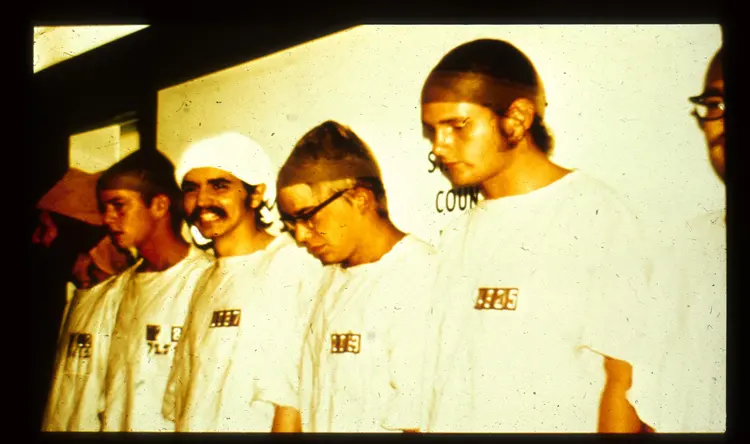
The guards wore khaki, carried whistles and wooden clubs, and hid their eyes behind mirrored sunglasses. They worked eight-hour shifts, three at a time, and went home in between. Zimbardo himself played the prison superintendent, and an undergraduate, David Jaffe, played the warden.
On the second morning the prisoners rebelled, tearing off their numbers and pushing their beds against the cell doors. The guards broke in with a fire extinguisher, stripped them and put the leaders in the Hole. From then on, in Zimbardo’s telling, things grew steadily worse. The counts, when prisoners lined up to recite their numbers, began at about ten minutes and stretched until some lasted hours, some of them in the middle of the night. Going to the toilet became a privilege the guards could grant or refuse. One night-shift guard, whom the prisoners nicknamed “John Wayne” after the film cowboy, kept inventing new humiliations.
The prisoners crumbled. One was released on the second day, crying and raging, and four more followed in the next few days. On the sixth day Zimbardo ended it. The first scientific report, written with two of his graduate students, one of them Craig Haney, said that the guards had received no specific training, that at least a third of them had become far more aggressive than anyone would have predicted, and that half the prisoners had suffered emotional disturbance severe enough to need early release. The personality tests taken beforehand had predicted almost none of it. The cause, they concluded, lay in the situation, not in the people.
The story arrived at a powerful moment. Within weeks, deadly violence at two American prisons, San Quentin and Attica, put prisons on the front pages, and Zimbardo was called to speak to the United States Congress. More than thirty years later, when photographs appeared of American soldiers abusing prisoners at Abu Ghraib in Iraq, he was sought out by reporters again, and served as an expert witness at the trial of one of the guards.
What the archives hold
The criticism began almost at once. Within two years a famous psychoanalyst pointed out that two guards in three had not done sadistic things for their own pleasure, which hardly showed that the right situation turns anyone into a sadist. Soon after, two other psychologists gave 150 students a description of the study, without saying how it had turned out. Nine in ten of them predicted that the guards would be oppressive, hostile and humiliating. If students who had never been near the basement could guess what was wanted, the young men inside it probably could too.
Still, these were arguments from outside. What happened inside the basement was known almost entirely from Zimbardo’s own accounts. Then Zimbardo gave the study’s papers, films and tapes to Stanford University’s library, and much of it was later put online. Nearly half a century after the study, a French researcher, Thibault Le Texier, went through it all, the papers, 6 hours of film and 48 hours of sound recordings, and tracked down and interviewed 15 of the men who had taken part. He published what he found, first in French and then in English: the study, he wrote, had been debunked.
The first thing he found was that the prison had been run before. Three months before the study, Jaffe had led a group of students in Zimbardo’s own class in a weekend prison of their own, in the basement of a student residence called Toyon Hall, with six guards and six prisoners. The arrests, the ankle chain, the stripping, the numbered uniforms, the counts, the exercises and the cleaning duties all came from that weekend. Of the 17 rules read to the Stanford prisoners, Le Texier counted 11 copied straight from the students’ list. The famous version said that the guards had made up their own rules. The first report thanked Jaffe for having “pre-tested some of the variables”, and the debt went little further in the famous telling.
The second thing was that the guards had been told what to do. On the day before the arrests Zimbardo met them for an orientation, and part of it was filmed. His words, as later published, ran like this:
We can create boredom. We can create a sense of frustration. We can create fear in them, to some degree. … They’ll have no privacy at all. … They will have no freedom of action. … In general, what all this should create in them is a sense of powerlessness. We have total power in the situation. They have none.
Jaffe went through the routine the guards should follow, drawn from his weekend: how to run a count so that it humiliated, the use of sarcasm, push-ups and jumping jacks, and a blanket full of burrs for the prisoners to pick clean, which, he said, took hours. The guards were handed a suggested daily schedule, with counts in the middle of the night, and Jaffe noted in his log that it was followed pretty closely. When one guard held back, Jaffe took him aside. “Every guard is going to be what we call a tough guard,” he told him, because whether the study looked like a prison depended largely on the guards. Later in the same talk he asked him to react the way he pictured the police reacting.
The third thing was that the guards thought they were on the research team. They filled in reports on the prisoners, and they took it that the prisoners were the ones being studied. “It was our job to make sure this was a simulated prison,” one of them told Zimbardo a year later, “not that we were being experimentees too.” The first report did say, in a single sentence, that the guards believed the study was mainly about the prisoners. What it couldn’t say was what that belief did. A guard who thinks he is helping a professor get his results has every reason to be tough.
The fourth was that many of them said they were acting. “Throughout the entire experiment I was an actor, and I was hamming it up,” said the night-shift guard the prisoners called John Wayne, at the debriefing on the last day. Another of the harshest guards wrote to Zimbardo three months later that he had been acting all along, and in a later letter that for the experiment to be at all useful, guards had to act something like guards. The first report had itself noted that most guards, asked later why they kept up the harassment, said they were “just playing the role”. It treated that as an excuse. It may also have been a plain description.
The fifth concerned the prisoners. The famous version says they could have left at any time but forgot that they could. The plan Zimbardo sent to Stanford’s ethics committee before the study said that the prisoners would be led to believe they could not leave except for emergencies, and that they would be discouraged from quitting. They were paid only at the end. When two prisoners asked to leave, they were turned down: there were only two conditions under which they could go, Zimbardo told his team, medical or psychiatric. “I think they really believed they can’t leave,” he added. Prisoner 8612, who had tried to quit on the second day and became the first to be released, told an interviewer on the day the study ended that he had decided to “just act mad, or upset” to get out, and built himself up to it. He said much the same to Zimbardo a year later, and again on camera years after that. Whether he was faking is impossible to know, as Le Texier himself says, though he judges it likely that 8612 wanted to look as though he was breaking down. Of the ten prisoners, it looks to Le Texier, from the records, as though only two showed real signs of a breakdown.
Last came the evidence itself. Less than a tenth of the study had been recorded, and what was recorded was chosen. “Our concerns in filming were cinematic,” Haney wrote in a report soon after: they had taped the dramatic and the unusual, and missed the everyday life of the prison that would have shown what it was really like.
The reply
As the findings began to spread, Zimbardo answered on the study’s website, replying to a journalist’s article and to Le Texier’s French book. He did not accept that any of it changed the study’s main conclusion.
His points deserve to be heard. The guards, he wrote, were told they could not hit the prisoners. They were asked to create boredom, frustration, fear and a sense of powerlessness, and to be firm and in control, but “we did not give any formal or detailed instructions about how to be an effective guard”, and nobody ever told them to be brutal. Being asked to be tough was mild beside the pressure real guards face from their bosses. For the first two shifts, he said, no guard behaved in a dominant way. What changed things was the prisoners’ rebellion on the second day, after which several guards began to treat the prisoners as dangerous. Some guards stayed fair to the end, which to him showed that the cruel ones chose cruelty on their own. The night-shift guard went far beyond being a tough guard: by the fifth night he was making the prisoners play a degrading game of his own invention, and no one had asked for that. As for prisoner 8612, a researcher who thinks someone is breaking down must treat it as real, and in the documentary interview 8612 had called his time as a prisoner the most upsetting experience of his life. He had, he added, put the whole archive where anyone could read it.
He also admitted a fault, and it was a large one. Playing the superintendent, he wrote, he had stopped being a scientist. The study had no independent observer, and he became so caught up in running the prison that he stopped noticing the prisoners’ suffering: their last trip to the toilet each night, which the guards turned into a torment, was only a checkmark on his schedule. What ended it was a visit from Christina Maslach, a young psychologist he was going out with, who saw the hooded, chained prisoners being marched to the toilet, ran outside in tears, and told him that the prison had turned a teacher who loved his students into a man who could ignore their suffering. He stopped the study the next morning.
Later Zimbardo and Haney answered in print too. The study, they wrote, still stands as a demonstration of what can happen when one group is given nearly total power over another in a place as dehumanizing as a prison, and they rejected criticism they called misleading, inaccurate and unscientific. They called it perhaps “among the most carefully documented and heavily scrutinized” studies in psychology, and admitted that, to their discredit, they had quickly lost control of the experiment. Le Texier replied that neither answer said a word about the borrowed student prison, the guards who didn’t know they were being studied, or the prisoners who couldn’t leave. Zimbardo’s statement doesn’t deny that the coaching and the guards’ words at the debriefing are in the archive; it argues over what they mean.
A prison built for television
What would happen if someone ran a prison study and didn’t tell the guards what to do?
Some thirty years after Stanford, Stephen Reicher and Alex Haslam, whose reading of Milgram appears in the last chapter, tried to find out, with the BBC filming it all for a television series. Fifteen men, older than Stanford’s students and from many walks of life, chosen from more than 300 who answered an advertisement, were first sorted into five groups of three who were alike in personality, and then one man from each three was chosen by chance to be a guard. So there were five guards and ten prisoners. An independent ethics committee watched, with the power to stop the study. The guards were given a timetable and told to keep the place running smoothly, but not how to do it. The researchers did make planned changes along the way, such as letting the guards promote one prisoner to guard.
It went nothing like Stanford. The guards were uneasy with their power and couldn’t agree how to use it, partly because they knew the country would be watching. The prisoners organized. Late on the sixth day the men in one cell broke out, and the guards’ regime collapsed. Everyone then voted to run the place as a commune of equals, and two guards chose to leave. The commune began well, and then faltered, and some of the men started planning a far harsher regime, with themselves in charge. Rather than let the study end in bitterness, the researchers stopped it on the eighth day.
Reicher and Haslam drew two conclusions. People don’t simply become the role they are handed: they take it up when they have come to see the group as their own. And when a group fails, a strong leader who promises to fix things becomes tempting. Stanford’s guards, they argued, may not have slipped into their roles at all, since they had been given clear guidance on how to behave.
Zimbardo rejected all of it. It was no replication, he wrote, but a reality show. Every man knew he would be on national television and wore a microphone, the researchers kept intervening, and nothing about it resembled a real prison. He called it fraudulent, though in a postscript he granted one point: the study showed what he had long argued, that abuse in prisons can be stopped when everyone knows their behavior is being watched. The two answered that the men soon grew used to the cameras, and that where the cameras did matter, that was worth studying in itself: people who know they will be watched and judged may hold back from abusing their power.
Both of them are right that the BBC study is no copy of Stanford. It is one study of fifteen men on television. It can’t prove what would have happened in the Stanford basement without the coaching. What it does show is that the famous result isn’t what happens whenever people are given these roles.
What is left
There is still a good deal to learn from the prison study, though not what it was famous for.
In the same issue of the journal that printed Le Texier’s paper, Haslam, Reicher and a colleague went through the archive again, looking especially at Jaffe’s talk with the reluctant guard. Their reading is that the guards were neither puppets following a script nor people turned cruel by their uniforms. They were asked to join a cause: to help make a study that would expose the evils of prison and lead to reform. Those who took that cause as their own threw themselves into it and were inventive in what they did, the way keen followers try to work out what their leader would want. Others refused, and the guard in Jaffe’s talk kept refusing, which the role story can’t explain. The authors say plainly what their evidence can’t do: with so few people and no comparison, it can’t prove that the leadership caused the cruelty. But it points somewhere useful. Cruelty in groups seldom grows on its own. Someone usually tells the group that what it is doing is necessary, even good.
The other lesson is about science itself. For nearly fifty years a study with a handful of young men, run once, without an independent observer, by researchers whose press release on its second day already spoke of the prison reforms it would show were needed, was told as settled fact. The doubts were raised early and printed, and they made little difference. What finally made the difference was the archive. Zimbardo kept the papers and the tapes, and he gave them to a library. A researcher with time and patience read them, and a journal printed what he found, beside a reply. That is how science corrects itself: slowly, against a famous name and a good story, and only because the record was kept and someone went back and read it.
Philip Zimbardo died in 2024, at 91, at his home in San Francisco. His prison study is still taught, but America’s AP Psychology course now asks students to debate its methods and its ethics, and the criticism of it, beside his reply.
The plainest way to put it is this. The Stanford prison study did not show that ordinary people turn cruel as soon as they put on a uniform. Its guards were given a routine, coached to be tough and told they were helping the research, and the prisoners were kept from leaving. A later study in Britain, without coaching, went a very different way. What survives is smaller and still worth knowing: cruelty in groups usually has leaders, people can be drawn into it when they believe in the cause, and some of them refuse. And a story, however famous, is only as good as the record behind it.
Found a mistake? Please tell us.