
A newborn baby looks as if it can do almost nothing. It can’t hold up its head, it sleeps most of the day, and it cries in the same way for hunger, cold and a wet cloth. But it has been listening for weeks already. In 1980 two researchers gave newborns a dummy wired to a tape player. Sucking in one rhythm played their mother’s voice; sucking in another played a different woman’s. The babies learned which rhythm did what, and chose their mother’s voice more often. Only days old, they already preferred one particular person.
The first two years are when a person is built fastest. The body triples its weight in the first year, and the brain makes more connections than it will ever keep. A baby who arrived knowing one voice ends up, by the time it can walk, firmly attached to a few particular people, upset when they leave and comforted when they come back. This chapter follows that building: its order, what helps and harms it, and the long argument about the bond between a baby and the people who raise it.
Growing and developing
Nepal’s school books begin with two words that sound alike. Growth means getting bigger: height, weight, the size of the head, things a tape measure or a scale can show. Development means changing in kind as well as size: a hand that could only grab learns to pinch a grain of rice between finger and thumb; cries turn into words. Growth slows and stops; development goes on all life.
The books also divide life into stages, following the developmental psychologist Elizabeth Hurlock. Before birth comes the prenatal period, about 270 to 280 days. Then a newborn, from birth to about two weeks; babyhood, from two weeks to two years; early childhood, from two to six; late childhood, to ten or twelve; and so on through adolescence and adulthood. Stages like these are a convenience for talking about change. No child wakes up on its second birthday different from the day before.
Life before birth has three periods of its own. For the first two weeks the fertilized egg, a single cell, divides again and again; by the fifth day it is about a hundred cells, and it travels down to the womb and settles into its wall. Many never get that far: fewer than half survive past those two weeks. From the third week to the eighth comes the embryo, when the main organs take shape: the heart begins to beat, and a tube forms along the back that will become the brain and spinal cord. From the ninth week to birth is the fetus, which mostly grows and finishes what has been laid out. By about the twenty-fourth week it can hear, which may be how a newborn comes to know its mother’s voice so soon.
Because so much is laid out so fast, the embryo is easily harmed. Some things that reach it through the mother’s blood, called teratogens, can damage it, and the damage is worst when they arrive while the organ they hit is being formed. Alcohol is one: no amount drunk during pregnancy is known to be safe, and it can leave a child with lasting problems of growth, learning and behavior. Smoking is linked to babies born small. Rubella, German measles, can harm the baby too, and so can some medicines and radiation. A baby born small, under 2.5 kilograms, has a harder start.
Then comes birth, and the hardest change any of us ever makes. Inside, the baby was kept at the mother’s body temperature, fed and given oxygen through the cord, and never had to breathe. Within minutes it has to do all of that itself: breathe air, keep warm in a room of perhaps 16 to 21 degrees, suck and swallow, and get rid of its own waste. Nepal’s Education books list these four adjustments, and they are the newborn’s whole job for its first two weeks.
It comes equipped for them. A newborn arrives with reflexes, actions that need no learning. Touch its cheek and it turns its head and opens its mouth, which is called rooting; put something in its mouth and it sucks; put a finger in its palm and it grips; startle it and it flings out its arms. Most of these have faded by four or five months, as movements the baby chooses take over. It also arrives with preferences. Newborns look longer at faces than at other patterns, and breastfed babies a week old turn toward the smell of their own mother.
Growing in order
What comes next follows an order. Babies hold up their heads before they sit, sit before they stand, and stand before they walk. In 2006 the World Health Organization published a careful record of these steps. It followed 816 healthy, well-cared-for children in Ghana, India, Norway, Oman and the United States and noted when each reached six milestones.
Two things stand out. The order was much the same everywhere: about nine children in ten reached five of the milestones in one common order. But the age was not. Sitting without support, the narrowest window, came anywhere from just under four months to just over nine. Walking alone came anywhere from about eight months to nearly a year and a half. A child who walks at fifteen months and one who walked at nine are both in the ordinary range; differences like these between one child and the next, in body, mind and personality, are what psychologists call individual differences. And 4 children in 100 never crawled on hands and knees at all.
Textbooks add two rules of order. Development runs from the head downward, so a baby controls its neck before its legs, and from the middle outward, so it moves its arms before it can work its fingers. These are tendencies rather than laws. When researchers watched babies learning to reach, some full-term infants touched a toy with their feet several weeks before they managed it with their hands.
Inside the head, the order has a strange shape. Connections between brain cells, synapses, begin to form before birth and then multiply so fast that the brain ends up with far more than it will keep. A study of brains donated after death found that in the part of the cortex that handles hearing, the number of synapses peaked when the child was about three months old; in a part of the front of the brain it peaked later, after fifteen months. After the peak comes pruning. Connections that are used are kept, the rest are cut back, and in the front of the brain the cutting goes on until the teenage years. A brain goes on rewiring itself all through life, but in the first years it does so at full speed, one reason experience then matters so much.
Each stage also has its tasks, things a society expects a child to manage by a certain age. For babyhood and early childhood Nepal’s books list feeding oneself, walking, beginning to talk, controlling the bladder and bowels, dressing, playing with others, telling boys from girls, and getting ready for school. The years from two to six they describe as the toy age and the age of copying, when a child imitates everything and asks endless questions, and also, more bluntly, the problem age, when parents find the child hard to manage. How children come to talk and think is the next chapter’s story.
What helps and what harms
Some of what goes wrong in a child’s growth is easy to measure. A child who is too short for its age, stunted, has usually been short of food or often ill, or both. In Nepal’s 2016 national health survey, 36 children in 100 under five were stunted; by 2022 it was 25. That is a large improvement in six years, and still one child in four.
What all this means for a child’s mind is harder to say than it might seem, and a study from Bhaktapur shows why. Between 2015 and 2017 a team of researchers measured 600 babies, aged six to eleven months, who were taking part in a trial of vitamin B12. The babies had been chosen because they were already rather short for their age, so they were a group at risk, not a picture of all Bhaktapur’s babies; about a third were stunted. Each was tested on a standard American scale of thinking, language and movement, with toys and tasks suited to the age, and the researchers looked at what went with higher or lower scores.
Several things did. Babies born small scored lower on all three, by about five points on thinking; babies who had been in hospital in their first month scored lower on thinking and movement. Taller babies did better on thinking and movement. Babies with a history of diarrhea did worse on language, and so did those whose caregiver didn’t talk to them unprompted during the visit. And where the caregiver reported physically punishing the baby in the past week, its thinking score was about two points lower: a slight difference, only just past the usual test of chance. Put everything together, though, and it explained only between 8 and 16 percent of how much the babies differed. Most of what made one baby score higher than another was not in anything measured.
None of this proves that one thing caused another. Families who hit their children may differ in many other ways, and a test made in America may not measure a Nepali baby’s abilities fairly. Physical punishment has been studied far more widely elsewhere: a 2016 review that pooled studies of some 160,000 children found spanking linked with worse outcomes for children on 13 of 17 measures, about as strongly as physical abuse was. Nepal’s Children’s Act of 2075 (2018) counts physical punishment, at home, at school or anywhere, as violence against a child. What the Bhaktapur study does show is that development has many causes, each of them small, and that the things easiest to count explain only a little.
The bond
The most argued-about part of the first years is not the body but the bond.
In the 1940s a British psychiatrist, John Bowlby, studied 44 young thieves who had been sent to his clinic and found that many had been separated from their mothers for long stretches when small. It was a handful of troubled children, looked at backward, which can suggest an idea but not prove it. In 1951 he wrote a report for the World Health Organization arguing that a young child needs “a warm, intimate, and continuous relationship with his mother (or permanent mother substitute)”, and that losing it does lasting harm. The idea ran against a common view of the time, that a baby loves whoever feeds it.
The most famous test of that idea was done with monkeys. In the 1950s the American psychologist Harry Harlow raised newborn rhesus monkeys away from their mothers, each with two stand-ins: a frame of wire, and a frame covered in soft cloth. In his best-known experiment, for four of the infants the cloth mother held the bottle of milk, and for four the wire one did. Whichever one fed them, the infants spent their time clinging to the cloth mother. When frightened, they ran to her and held on; with her in the room, they would explore a strange place, coming back to her now and then. Being held, Harlow concluded, mattered enormously, and feeding barely at all. “The wire mother is biologically adequate,” he wrote, “but psychologically inept.” Experiments like these, which left baby monkeys alone and afraid, are now generally considered unethical.
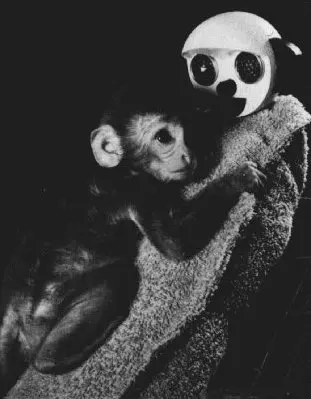
Bowlby built these findings, and what animal researchers had learned about young birds following the first thing they saw, into a theory of attachment. A baby, he argued, is born to keep close to the people who look after it, because for most of human history a baby left alone did not survive. Mary Ainsworth, a psychologist who joined his research unit in London in 1950, added the idea that made it testable. A well-attached child uses its caregiver as a secure base: it goes off to explore, and comes back, or looks back, when it is unsure.
Ainsworth went to look. In Uganda in the mid-1950s she visited 26 families every two weeks for up to nine months, watching their babies through an interpreter. Years later, in Baltimore in the United States, she watched 26 more families at home, about 72 hours each. Then she designed a laboratory test, the Strange Situation: twenty minutes, in eight short scenes, in which a baby of about one year is with its mother in an unfamiliar room, a stranger comes in, the mother leaves and comes back, leaves again and comes back again.
What matters most is the reunion. Most babies were upset when the mother left and, when she returned, went to her, were soothed and went back to playing; they were called secure. Some seemed hardly to notice her coming or going, and turned away from her when she came back: avoidant. Some were very upset, clung to her on return and at the same time pushed her away, and couldn’t settle: resistant. Later researchers added a fourth, disorganized, for babies whose behavior made no sense in any of these ways, such as freezing on the spot. Critics add that a baby’s own temperament, how easily it gets upset and settles, shapes its behavior in the test, and not only the care it has had.
How strong is this? The test has been used in many countries, and in 1988 two Dutch researchers pooled 32 studies from eight countries, nearly 2,000 babies. Secure was the most common pattern in every country. Avoidant was relatively more common in Western Europe, resistant in Israel and Japan. But the differences within a single country were about one and a half times as large as the differences between countries. They asked for more studies from Africa and South America, because there were almost none.
Some of the strongest evidence that the bond depends on care comes from Romania. In 2000 a study in Bucharest drew lots among 136 young children who had been abandoned as babies and were living in institutions: half went to foster families set up for the study, half stayed. By the age of three and a half, about half of the children in foster care were securely attached, against about one in six of those still in the institutions; among children of the same age who had never been in one, nearly two in three were. Those placed in a family before the age of two did much better: 69 percent secure, against 29 percent for those placed later. It is a single study, in one country, but it was a real experiment with lots drawn, which observation alone can never be.
There is something a little odd about the picture so far. The theory talks about the mother, and the test watches one adult and one baby in an empty room. In much of the world, babies are not raised that way.

A Nepali baby is often passed among a mother, a grandmother, aunts, a father, and a sister not much bigger than the baby. One small study among families with children under three in Dhanusha, not yet reviewed by other scientists, found that mothers and grandmothers carried most of the care, more so where the father worked abroad, and that families expected children to learn mostly by watching and copying parents and older brothers and sisters. Among the Efe, forest people of central Africa, researchers who followed babies from five months to three years described not one bond but many, held at the same time from the start.
The German psychologist Heidi Keller has argued, most forcefully in 2018, that attachment theory is a picture of Western middle-class family life presented as human nature. Among the Nso, farmers in Cameroon, she wrote, a baby is not frightened when a woman it doesn’t know picks it up and carries it off; it watches her calmly, and its stress hormone goes down. Where many people share the work, babies are expected to be at ease with many people. She called it unethical to run large programs that teach mothers elsewhere to care for babies in the Western style without knowing the local culture.
Others disagree. In 2016 a team led by the Dutch psychologist Judi Mesman asked 751 mothers in 26 cultural groups in 15 countries to describe their ideal mother by sorting cards of what mothers do. Their ideals came out strikingly close to the sensitive mother of attachment theory: a mother who notices a baby’s signals and answers them promptly. Poorer and rural mothers, and those with more children, described an ideal a little less like it. Mesman’s team then argued for “universality without uniformity”: caregivers everywhere answer babies’ needs, in many styles. Keller replied that no part of sensitive care, such as letting the baby lead, is found everywhere. Mesman answered that the two sides agree on much, including the need for more studies and for looking at everyone who cares for a baby, and differ on how far the idea of sensitivity can stretch. The argument is still open.
A moral sense before words?
The newest claim about babies shows how slowly certainty comes. In 2007 three researchers, led by Kiley Hamlin, showed babies a puppet show. A wooden shape with eyes tried to climb a hill. One puppet helped it up from below; another pushed it down from above. Then the babies were offered both puppets to reach for. Twelve of twelve six-month-olds, and fourteen of sixteen ten-month-olds, reached for the helper. The researchers suggested that judging others might be built in, a foundation for later moral thinking.
Other labs found it harder to repeat. So in a large planned test, called ManyBabies 4, 37 labs on five continents ran the same puppet show the same way, with rules written down in advance. Of the 1,018 babies tested, 567 completed it properly. Of the 302 who saw the helping show, just 49 percent chose the helper, which is what you would expect if they were choosing at random; babies who saw the same moves made on a lifeless object chose about as they did. Hamlin was one of the authors, and the team wrote that the preference, if it exists at all, must be weaker than first thought, or appear later. A famous finding built on a few dozen babies didn’t hold up when it was tested on hundreds.
None of this means babies understand nothing about other people. What they know is simply hard to see: they can’t tell us, so everything rests on where they look, what they reach for and how long they suck.
A baby who arrives knowing a voice ends its second year walking, beginning to talk, and attached to a few particular people. The order of those steps is much the same everywhere; the timing varies widely and mostly harmlessly. What harms development is real, and some of it, like stunting, is falling fast in Nepal, but no single thing explains much on its own. In Romania, children raised in institutions formed secure bonds far more often once they were placed with a family, especially early. What that care must look like, and from how many people, is still argued, between psychologists who see one pattern beneath the world’s differences and those who see many.
Found a mistake? Please tell us.