
Ask anyone in Nepal to explain why a friend acted the way he did, and sooner or later you’ll hear the word स्वभाव. उसको स्वभाव नै त्यस्तै हो: that’s just his nature. The big Nepali dictionary gives the word several meanings. One is a person’s habits and manner. Another is a quality born in someone that stays the same, always.
That last meaning makes two bold claims in a few words: that your nature came with you at birth, and that it never changes. Psychologists have spent about a century testing both. The answer to each turns out to be “partly”, and the details are worth knowing.
First, though, what they mean. Personality is the lasting pattern in how a person thinks, feels and acts: the part of you that turns up in many places and over many years. A girl who chatters at home usually chatters at school too, not every minute, but more often than not. The word comes from the Latin persona, the mask an actor wore on stage to show what kind of character he was playing. The idea of a face others recognize again and again is about right, though personality isn’t something you put on.
Boxes or scales
The oldest way to describe personality is to sort people into kinds. Greek doctors did it with four bodily fluids, or humors. Too much blood made you sanguine, cheerful and eager. Too much yellow bile made you choleric, bold and quick to anger. Black bile made you melancholic, gloomy and anxious, and phlegm made you phlegmatic, calm and slow to stir. Medicine kept this scheme going into the 1600s.
In the twentieth century the Swiss psychiatrist Carl Jung sorted people another way, into introverts, who turn inward, and extraverts, who turn outward. An American mother and daughter, Katharine Briggs and Isabel Myers, built a questionnaire on Jung’s ideas that places everyone in one of sixteen types, with four-letter names like INTJ. It is widely used in schools and companies around the world. Among research psychologists it has little credibility.
The trouble with types is that most traits don’t come in two piles. Measure how outgoing a large group of people are, and most land somewhere in the middle, with fewer and fewer toward either end, much as with height. A type test draws a line through that crowd.
So psychologists mostly gave up on boxes and moved to scales, called traits. Everyone is somewhere on each scale, and the question is where. But which scales? Here they borrowed a clever idea: if a difference between people matters, people will have made a word for it. In 1936 two American psychologists, Gordon Allport and Henry Odbert, went through a complete English dictionary and pulled out every word that could set one person’s behavior apart from another’s. They found almost 18,000. About 4,500 of them named lasting traits, words like sociable, aggressive and fearful.
Researchers then asked thousands of people to rate themselves on long lists of such words, and looked at which went together. Someone who calls herself talkative usually also calls herself lively and sociable. A statistical method called factor analysis sorts the words into bundles of this kind. Different researchers found different numbers of bundles, sixteen for one, two or three for another, but today most work with five, the Big Five:
- Openness to experience: curiosity, imagination and a wide range of interests, against a liking for the familiar.
- Conscientiousness: being organized, hardworking and dependable, against being careless and disorganized.
- Extraversion: being sociable, talkative and keen on excitement, against being quiet and reserved and needing time alone.
- Agreeableness: being cooperative, trusting and good-natured, against being blunt and uncooperative.
- Neuroticism: a tendency to feel worry, anger and sadness easily, against being calm and even-tempered. Turned the other way round, it is often called emotional stability.
Their first letters spell OCEAN. The five are descriptions, not marks out of ten, and a trait tells you what someone tends to do, not what they will do today.
Does knowing someone’s traits tell you anything worth knowing? It does. Studies that followed people for years found that traits predicted how long people lived, whether their marriages lasted, and how far they rose at work, about as well as their family’s wealth or their scores on intelligence tests did.
Where it comes from, and whether it changes
Personality is shaped by many things at once: the body and genes you were born with, how you grew and were raised, the people and groups you look up to, the values and roles your culture hands you, and what happens to you along the way.
Twins give a sense of the balance. In the Minnesota study of twins raised apart (see the chapter on genes and upbringing), between 39% and 58% of the differences in personality between people, depending on the trait, went with differences in their genes. Growing up in the same home made surprisingly little difference. Much of the rest seems to come from experiences each twin had alone, a different teacher, a different friend, along with the errors of any test. Those figures describe American adults, not one person, and not Nepal.
Plenty of people are sure that their place in the family shaped them: the bossy eldest, the spoiled youngest. To test this, a team used large surveys of about 20,000 people from the United States, Britain and Germany. They compared brothers and sisters within the same families, and people from different families too. They found no effect of birth order on extraversion, emotional stability, agreeableness, conscientiousness or imagination. The one difference was small and about thinking: older children scored a little higher on intelligence tests, and rated their own intellect a little higher.
So is personality fixed, as स्वभाव suggests? There are two ways to ask. The first is whether you keep your place among people your own age. Compare a group’s scores six or seven years apart, and in childhood the match is loose, a correlation of about 0.3 (1 would mean everyone kept exactly their place). By the college years it is about 0.5, at 30 about 0.6, and between 50 and 70 it settles around 0.7. Personality firms up as people grow older, but it never sets like concrete.
The second is whether the average person changes. Here 92 groups of people who were followed for years gave a clear answer. People tend to become more conscientious, calmer and more confident with others as they grow up, especially between 20 and 40. Openness and liveliness in company rise in the teenage years and fall again in old age, and agreeableness changes only late in life. A survey of 884,328 young adults online, in 62 countries, found much the same growing up everywhere. It came earlier where young people take on adult work and families sooner, which hints that the jobs of adult life help do the shaping. Those were people who answered a survey online, though, which matters for reasons that come up below.
Two older answers: Freud and Rogers
The Austrian neurologist Sigmund Freud pictured the mind as three parts in constant struggle. The id is there from birth: it wants food, comfort and pleasure, and it wants them now. The superego is learned from parents and society, the conscience that knows the rules and brings guilt. Between them is the ego, the part that deals with the real world and tries to satisfy the id without upsetting the superego.
When the struggle stirs up anxiety, Freud thought, the ego protects itself with defense mechanisms, without knowing it is doing so. It can push a painful memory out of mind, which he called repression. It can see its own unwanted feelings in other people (projection), or act out the opposite of a feeling it can’t accept, being sweetest to the person it resents (reaction formation). It can slip back into childish ways, or turn the feeling onto a safer target, as when someone scolded at work comes home and shouts at the family. He also claimed that personality is set in early childhood through a series of stages; these have found little support.
How well has Freud held up? The philosopher Karl Popper complained that the theory could explain anything a person did, which meant no observation could ever prove it wrong, and that is a weakness in a scientific idea. Others replied that parts of it could be tested. When they were, the results were mixed. A review in 1998 found good evidence that people do deny unwelcome facts, wall a threatening thought off from the rest of their thinking, and sometimes act opposite to a feeling they don’t want. Turning feelings onto a safer target had little support. No evidence was found for sublimation, Freud’s idea that forbidden urges get turned into art or work. Freud’s broad point, that much of what moves us happens outside awareness, has held. Most of his particular ideas haven’t.
In the middle of the century, the American psychologist Carl Rogers and others objected both to Freud’s gloomy picture and to the behaviorists, who described people as machines run by rewards. Their humanistic psychology rested on a few plain assumptions. People make real choices and shape their own lives. Every person has a pull toward growing into the best they can be. A person should be understood whole, through their own experience of the world, rather than through hidden urges or trained habits. And psychology should study healthy people, not only troubled ones.
Rogers built his account of personality around the self-concept, the picture you hold of who you are. Trouble comes, he thought, when that picture and your real experience don’t match. Say a boy has always been told he is the gentle one, and one day he feels real rage. If the rage doesn’t fit his picture of himself, he may not let himself notice it at all. Rogers called this gap between the perceived self and the person’s actual experience incongruence. Textbooks often put it as a gap between your real self and your ideal self, the person you think you ought to be.
Where does the gap come from? From love with conditions, Rogers said. A child who feels loved only when she is good, or top of the class, learns to hide or disown whatever might cost her that love. What every person needs instead is unconditional positive regard: being cared for and accepted as a person, whatever they do. Accepting a person doesn’t mean approving of everything they do. Given that, people grow toward what Rogers called the fully functioning person, open to their own experience, free to choose, creative. He insisted this was never a finished state: such a person, he wrote, is always in process, always changing.
He built a way of counseling on these ideas, in which the counselor listens with empathy, understanding what the other person is experiencing, and with warmth and honesty, rather than giving advice. That is humanistic psychology’s greatest strength: it treats people with respect and hope, and it put the relationship between helper and helped at the center of care. That part has been tested. Across 82 groups of clients, 6,138 people in all, those whose therapists were rated more empathic tended to do better, and positive regard showed a smaller link of the same kind across 64 studies. These are links, though, and don’t prove that the warmth caused the improvement.
Its weakness is the other side of the same coin. Ideas like growing into your best self or the fully functioning person are hard to measure, so they are hard to test. It also has less to say about why people differ from one another, the question trait research set out to answer. And its picture of a person growing toward a self of their own choosing was drawn in mid-century America. In a family where you grow up with obligations to many people, that picture may need some translating.
Measuring a personality
Psychologists have two broad ways of testing personality.
The first is the objective test: a fixed set of statements with fixed answers, such as true or false, or a scale from “strongly disagree” to “strongly agree”, scored the same way by anyone, with no judgment involved. The best known is the Minnesota Multiphasic Personality Inventory, the MMPI, made at the University of Minnesota around 1940 to help find psychological problems. Its best-known version, the MMPI-2, has 567 true-or-false statements. Since people can answer to look good, it has checks built in, such as statements almost nobody can honestly agree with, like “I have never told a lie.” Questionnaires are cheap, quick and the same for everyone. Their weakness is that they depend on people knowing themselves and telling the truth, and a person applying for a job has every reason to look calm and dependable.
The second is the projective test. Here you are shown something unclear and asked what you make of it, on the idea, from Freud, that people project their own feelings and concerns onto it. In the Thematic Apperception Test, made in the 1930s, you tell a story about each of a set of ambiguous pictures. In a sentence-completion test you finish sentences like “I worry about…” Such tests are hard to fake, because nobody knows what a good answer looks like. But someone has to interpret the answers, and different interpreters can read them differently.
The most famous is the inkblot test. Hermann Rorschach was a Swiss psychiatrist whose school nickname had been Klex, “inkblot”. In 1921 he published ten blots, half black and gray and half with color, to be shown one at a time with the question “What might this be?” He died the next year, in his late thirties.
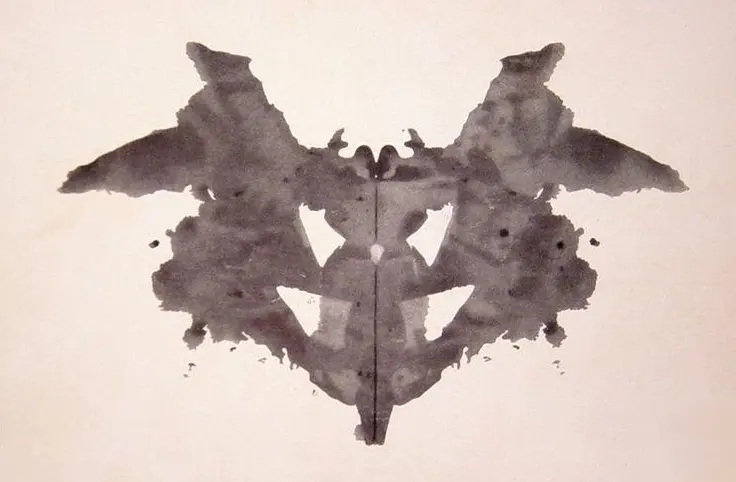
The Rorschach became one of the most used tests in psychology, and one of the most argued over. When three critics reviewed the evidence in 2000, they found support for only a small number of the many scores a tester works out from a person’s answers; most weren’t supported. Later another team went through every published study they could find on the 65 main scores of the most widely used scoring system.
Some scores did well and others didn’t. The best were scores of how a person sees and thinks, which can pick up badly disordered thinking. The weakest were rare scores and some newer ones. The scores also matched what doctors and observers saw much better than what people said about themselves. When the critics replied, they agreed that the thinking scores work, and accepted their use in some settings. They still held that the evidence was too thin to use the test to judge feelings, and the two sides went on arguing over studies that had never been published. So the Rorschach is neither useless nor an X-ray. Some of its scores measure something real, and many have little or no evidence behind them.
Does the Big Five travel?
The Big Five was built from English words and tested mostly on people who could read, lived in towns, and in later years often answered online. So researchers carried it to people who were none of these (see also the chapter on who was in the study), in two studies that point different ways.
The Tsimane are about 10,000 people who farm, hunt and fish along rivers in the Bolivian Amazon. Only a quarter of the adults can read. A team translated a standard 44-question Big Five questionnaire into the Tsimane language, had it translated back to check it, and had a Tsimane assistant read it aloud to 632 adults. To show the answers from “strongly disagree” to “strongly agree”, they used drawings of a person who was revealed a little more at each step. The five traits didn’t robustly appear. The answers fell mainly into two bundles, one about being sociable and kind, the other about being hardworking. The researchers suggest this may suit life in a small society, where there are only a few ways to make a living and get ahead. Tsimane who had been to school or spoke Spanish fitted the five no better.
The other is the survey of 94,751 people in 23 low- and middle-income countries, asked face to face, where the questions mostly failed to measure their traits, though they worked far better online in the same countries. Its authors point to habits of answering, the presence of an interviewer, and little schooling.
The two studies say different things. The big survey shows that the questions failed, not that the traits are missing; the Tsimane study suggests the shape of personality itself may differ. The Tsimane who had been to school did no better, which sits awkwardly with blaming schooling. Nobody yet knows which explanation is right. In Nepal, one team built a Nepali version of one scale, the twelve questions on neuroticism from an older British questionnaire. It took two rounds, with five questions reworded, before the questions hung together as they should. As far as we could find, no one has yet tested all five traits in Nepali.
That doesn’t stop personality tests from being everywhere, on phones, in magazines, and in a different form at the ज्योतिषी’s, the astrologer’s, where a कुण्डली, a birth chart, is read for character. They share one trick. A description vague enough to fit almost anyone feels personal when you believe it was made for you. And when astrologers in a careful test tried to match birth charts to the right person’s personality test results, they did no better than chance. This book offers no personality test and recommends none. A real assessment is done by a trained psychologist, for a reason, with tests whose record is known.
So the dictionary’s स्वभाव is half right twice over. Your nature is partly inborn: genes account for a good part of the differences between people, though nothing like all. And it is partly lasting: people keep their place among others more firmly as they age, while nearly everyone grows calmer and more dependable. Psychologists describe personality with five broad scales rather than boxes, and those scales predict real things. But they were built in particular places, and in a Bolivian forest they didn’t hold. Freud gave psychology the idea that much happens below awareness, and Rogers the idea that people grow best when they are accepted; neither theory measures personality, and the tests that try, from questionnaires to inkblots, are only as good as the evidence behind each score.
Found a mistake? Please tell us.