
Two baby boys, identical twins, were adopted by two different American families, and each family named its son James. The brothers grew up apart and were reunited only as men of 39.
What the newspapers reported next has been told ever since. Both Jims had married a woman called Linda, divorced her and married a Betty. One had named his first son James Alan, the other James Allan. Both had owned a dog called Toy. They smoked and drank about the same amount, had liked mathematics at school and disliked spelling, and got headaches at the same time of day.
A psychologist at the University of Minnesota, Thomas Bouchard, brought the two men to his laboratory for tests, and they became the best-known pair in the Minnesota Study of Twins Reared Apart, which began in 1979, ran for twenty years and studied 137 pairs of twins who had been separated early in life, most as babies, and brought up in different homes.
The story makes it sound as if a person is written in advance, down to a dog’s name. Bouchard himself warned that dwelling on such odd matches is misleading: on average, he said, identical twins raised apart are about 50 percent similar, and each is a person in his or her own right. Go through every detail of any two strangers’ lives and some things will match. What the Minnesota study really found came from measuring hundreds of people on the same tests, and it is both stranger and less spooky than the story. To see it, the old question has to be put a better way.
The wrong question
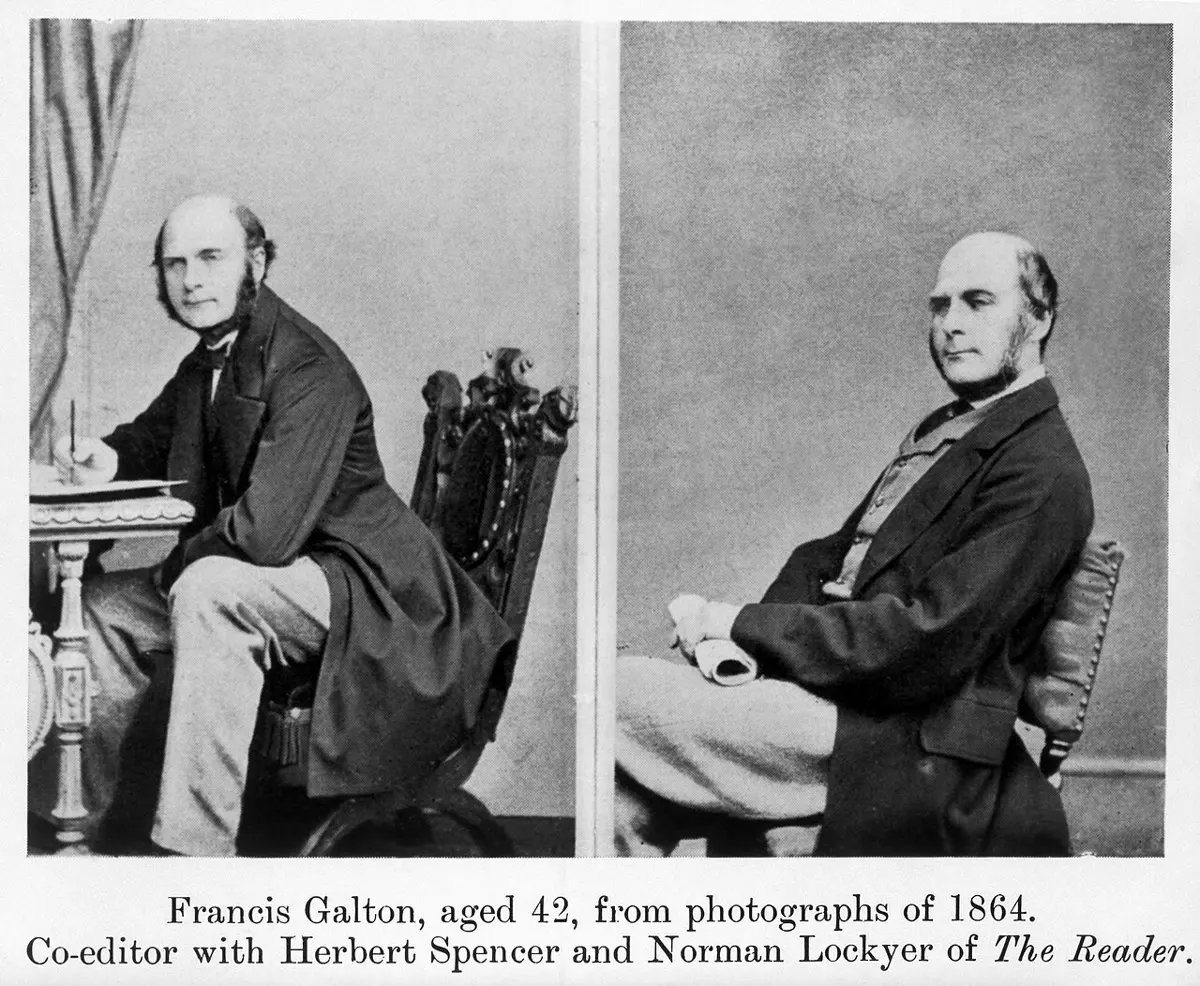
Is it nature or nurture? The English scientist Francis Galton made the pair of words popular in 1874, in a book about where British scientists came from. Nature, he wrote, is all a person brings into the world, and nurture every influence from outside after birth, from food to schooling. He called the phrase “a convenient jingle of words”, and he thought that when the two compete, nature wins. Galton also invented the word eugenics, for the idea of “improving” people by controlling who had children. It became one of the worst misuses of science, used to rank people and decide whose children were wanted, and this book returns to it when it comes to intelligence.
The trouble is the word “or”. A comparison usually credited to the psychologist Donald Hebb puts it best: which contributes more to the area of a rectangle, its length or its width?
The area is length times width. Take away either and there is no area at all. You can’t say that 60% of a rectangle comes from its length. And that is how genes and surroundings work in a person. Every trait you have, from your height to your temper, was built by your genes inside the world you grew up in, at the same time and all the way through. Neither does anything alone.
So for one person the question has no answer. For a group of people, though, there is a different question that does: why do these people differ from each other? Some of those differences can be traced to differences in their genes, and some to differences in their lives. That question can be measured, and this chapter is mostly about what happens when people measure it, and how easily the answer is misread.
What genes are
Almost every cell in your body carries a full set of instructions, written in a long molecule called DNA. The DNA is packed into 46 chromosomes, 23 pairs: one of each pair came from your mother’s egg and the other from your father’s sperm. Twenty-two pairs are alike in boys and girls. The 23rd decides sex: two X chromosomes in a girl, an X and a Y in a boy.
A gene is a stretch of that DNA, and many genes are instructions for making a protein, one of the working parts a cell is built of and run by. People have about 20,000 genes that make proteins. Since you have two copies of each, one from each parent, and the copies can differ, each person carries an almost unique mix.
That mix is your genotype, the genetic makeup you were born with. What can be seen or measured, your height, the shape of your chin, how quickly you react, is your phenotype. The phenotype is what the genotype becomes inside a particular life, which is the rectangle again.
The textbook case is a condition called phenylketonuria, PKU. A child born with two faulty copies of one gene, called PAH, can’t break down phenylalanine, one of the building blocks of the protein in ordinary food. It builds up in the blood and, without treatment, causes intellectual disability. Few things could be more genetic: one gene, inherited in a simple pattern. Yet in countries that test every newborn, children with PKU are put on a diet low in phenylalanine from the first weeks, and the damage doesn’t happen. The genotype is the same. The phenotype depends on the food.
Why would a harmful version of a gene survive at all? Here the evolutionary view of psychology comes in: it asks how natural selection, the way versions of genes that help people survive and have children spread over many generations, has shaped bodies and behavior. A standard example is the gene for sickle-cell anemia. A child with two copies of the faulty version is seriously ill, but a person with one copy is usually well and is thought to be protected against malaria, so where malaria was common the version spread. Eugenics was built on a twisted form of the same view.
PKU is rare, and it is the simple kind. Most traits aren’t governed by one gene but by many, each pushing a little. Height is shaped by a vast number of small genetic differences, by one estimate more than 100,000. Behavior, which comes out of a whole brain living a whole life, is further still from a single switch. No gene makes a person shy or clever or kind; at most, some make it a little more likely.
Twins, and children who were adopted
You can’t breed people in a laboratory or swap them between homes, so psychologists use the experiments life has already run.
Twins come in two kinds. Identical twins grow from one fertilized egg that split in two within its first two weeks, so they carry the same genes. Fraternal twins grow from two eggs and two sperm, so they share on average half the genes that vary between people, like any brother and sister. Both kinds usually grow up together, the same age, in the same home. So if identical twins turn out more alike than fraternal twins on some trait, the likeliest reason is the extra genes they share. This is the twin method, and Galton was already collecting facts about twins in the 1870s.
Adoption gives a second test. An adopted child gets genes from one family and an upbringing from another. If adopted children grow up to resemble their birth parents, whom they may never have met, more than the parents who raised them, genes are at work.
Twins who were adopted apart, like the two Jims, combine both. They have the same genes and different homes. That is why Bouchard wanted them, and what his team found shook psychology.
They gave their twins about fifty hours of tests each, on ability, personality, interests and attitudes. Identical twins raised apart were very alike in many of them. On a standard intelligence test their scores went together with a correlation of about 0.70, close to the three earlier studies of twins raised apart, in America, England and Denmark, and the one after it in Sweden. (A correlation of 1 would mean perfectly matched scores, and 0 no connection at all.) On personality the result was odder still.
Identical twins raised apart were about as alike in personality as identical twins raised together, in the same house by the same parents. Fraternal twins raised apart were about as alike as fraternal twins raised together. Growing up in the same family, it seemed, had hardly made them more alike at all.
Other kinds of family point the same way. Two unrelated children adopted into one home have IQ scores that go together a little while they are small, at about 0.25, but by their teens that has fallen to near zero. And one team gathered nearly every twin study published in fifty years, on 17,804 traits, with about 14.5 million pairs of twins. Across all the traits, about half of the differences between people went with differences in their genes. For most traits, the twins’ pattern fitted a world where the family they shared made them barely more alike.
This is one of the best-tested findings in psychology, and also one of the most misunderstood. It doesn’t say that parents don’t matter. Bouchard’s team said so themselves: parents who badly neglect or mistreat their children can harm all of them, and determined parents may pass on their values. What it says is that in most families studied, the home children share doesn’t explain much of why they turn out different from one another. Most of the part that isn’t genetic is made of things siblings don’t share: a different teacher, a different friend, an illness, a chance meeting, a book one of them read.
The twin method has critics, and they make two points. It assumes that identical twins aren’t treated more alike than fraternal twins for reasons that have nothing to do with their genes; if they are, the method overstates the genes. Most checks have found the assumption holds up fairly well, but the argument goes on. And the twins raised apart weren’t separated at random. Bouchard’s team noted that only a few had grown up in real poverty or with parents who couldn’t read, and that their figure shouldn’t be stretched to such homes. They added that their numbers described “the broad middle-class, in industrialized societies.” As usual in psychology, that is a careful way of saying: not anyone like most people in the world.
What “heritable” means
The number twin studies give is called heritability: of all the differences in a trait within one group of people, the share that goes with differences in their genes. It is a measure of a group, at one time, in one setting, and almost every way it gets misread comes from forgetting that.
It says nothing about one person. A heritability of 60% for personality doesn’t mean 60% of your personality came from your genes and 40% from your life. That is the rectangle mistake again.
It says nothing about how a trait could change. Height is one of the most heritable things about people: in well-fed countries, most of the differences between people go with their genes. Yet in many countries people grew a great deal taller over the last century, far too fast for their genes to have changed. South Korean women born in 1996 were about 20 centimeters taller than those born a hundred years before. In Nepal, the share of children under five who were too short for their age, a sign of poor food and repeated illness, fell from 57% in 1996 to 25% in 2022. Nepal’s children didn’t get new genes in 26 years. The food and the health care changed.
And it says nothing about the differences between groups. Here a thought experiment helps. Take a sack of mixed seed and sow half in a well-fed field and half in a starved one.
In each field the soil is the same everywhere, so the differences between plants come from the seed: inside each field, height is almost entirely heritable. Yet the whole gap between the two fields comes from the soil. High heritability inside each group tells you nothing about why the groups differ. So a heritability figure can’t explain a difference between countries, castes or classes.
There is one more surprise. Because heritability is a share, it depends on how much the surroundings vary. Where everyone gets much the same food, schooling and care, the differences left are mostly genetic, and heritability is high. Where some children get plenty and others very little, differences in life are large, and heritability falls.
In 2003 the American psychologist Eric Turkheimer and his colleagues tested this on intelligence. They studied seven-year-old American twins, many from families near or below the poverty line. In the better-off families most of the differences in IQ went with genes, as the earlier studies had said. In the poorest families the share that went with genes was close to zero, and the home made most of the difference. Why is argued. One reading is that where differences in life are very large they swamp everything else; another is that poverty holds back what a child’s genes could do, so their differences only show where life allows it.
When later studies were pooled, the pattern turned up in the United States, where heritability ran from about a quarter in families well below average in income and schooling to about three fifths in families well above it. In Western Europe and Australia it didn’t appear. The authors suggested a reason without proving it: those countries give more even access to good schools and health care, so being poor changes a child’s chances less. Joseph Henrich and his colleagues, who named psychology’s WEIRD samples, give this case as a warning: a figure as famous as the heritability of IQ was worked out mostly on Western, well-off families, and can come out quite differently in poorer ones.
Nobody has measured these traits in Nepali twins, as far as we could find. So there is no heritability of intelligence or personality for Nepal, and a figure from Minnesota can’t stand in for one.
Looking for the genes themselves
If half the differences in a trait go with genes, which genes? For a long time researchers guessed. They picked a likely gene, one with a known job in the brain, and checked whether a version of it was commoner in people with a trait.
The most famous such result came in 2003. A team reported that people with a short version of a gene for moving serotonin, a chemical messenger in the brain, were more likely to become depressed after stressful events than people with two long versions. It was a lovely idea, a gene that mattered only when life went badly, and many studies followed. Years later a team tested 18 of the most studied “depression genes”, that one included, in samples of up to 443,264 people. None was clearly linked to depression, and as a set they did no better than genes picked at random. The many links reported earlier, they concluded, were probably false alarms: small studies, and luck.
What replaced guessing was searching. Modern studies read millions of points along the DNA of very large numbers of people, and look for any that go with a trait. They find not one gene but thousands, each with a tiny effect. One study of about 3 million people found 3,952 places in the DNA linked to how many years people stay in school. A score built from their whole DNA accounted for 12 to 16% of the differences, and once the parents’ genes were allowed for, only about half of that was left: real, but far less than twin studies suggest, which is one of the open puzzles of the field. And all those 3 million were of European ancestry, so the score is a tool tuned on one set of people. Used on Americans of African ancestry, it predicted less than a sixth as well, a limit of the tool, not a fact about anyone’s schooling. For people in Nepal, nobody knows how well it would work.
These studies also turned up something that sounds like a riddle. Half of the genes you could have had from each parent, you didn’t get. Yet in a study of more than 21,000 people, the genes their parents carried but didn’t pass on still went with how long the children stayed in school, with almost a third of the effect of the genes they did get. The likeliest explanation is that those genes worked through the parents and other relatives, perhaps through the home they made, the books on the shelf, the value they put on school. Its authors called it genetic nurture. Nature and nurture turned out to be braided so tightly that a gene can act through upbringing.
The braid runs the other way too. Bouchard’s team suggested that genes shape behavior largely by shaping the life a child leads. A lively, adventurous toddler gets different experiences from a timid one, draws a different response from adults, and as she grows older chooses friends and pastimes that suit her. Genes nudge a child toward certain surroundings, and the surroundings then do much of the work. That may be part of why the two Jims, raised apart, ended up with such similar habits.
So nearly everything about a person is heritable to some degree, and the family a child shares with brothers and sisters matters less to how they turn out than almost anyone expected. Those findings have held up in study after study. But heritable never meant fixed. PKU is genetic and is prevented with food. Height is highly heritable, and South Korean women grew 20 centimeters taller in a century. A figure measured in comfortable American homes fell to nothing in poor ones.
Bouchard put it this way: twin studies refute both biological and environmental determinism, the idea that either our genes or our upbringing simply decides who we are. They don’t deny that surroundings shape behavior, and they don’t make too much of genes.
Asking whether a trait comes from nature or nurture is like asking whether a rectangle’s area comes from its length or its width: every trait is built by genes inside a life. What can be asked is why people in one group differ, and heritability answers that, for that group, in that setting, and no more. It says nothing about you alone, nothing about what could change, and nothing about why one group differs from another. The two Jims are a wonderful story. The rest of the twins, measured carefully, are the science.
Found a mistake? Please tell us.