
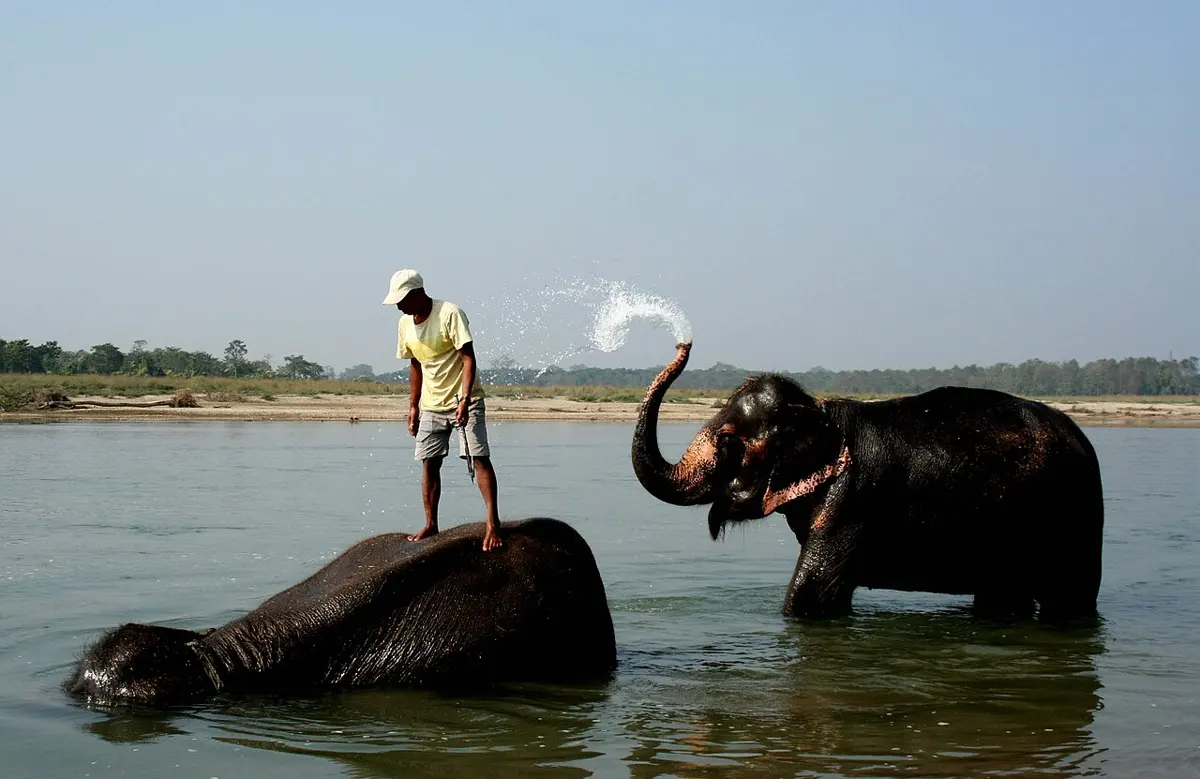
Elephants in Nepal can catch tuberculosis, the same disease people catch, and the surest test for it needs a sample from inside the trunk. To give one, an elephant has to hold still while a little water is squirted into its trunk, lift the trunk so the water runs down to its base, then put the tip into a bucket and blow hard. An elephant has to do that willingly. So Ariel Fagen, a researcher from an American veterinary school, went to an elephant stable in Chitwan with a whistle and some chopped banana.
The five elephants she worked with had been trained the traditional way, which in Nepal mixes punishment, unpleasant pressure and rewards: one standard tool is a sharpened bamboo stick, whose point pressed behind the left ear tells an elephant to turn right. Fagen used no punishment at all. Once or twice a day, for about twelve minutes at a time, with the mahouts standing by in silence, she whistled and gave banana each time an elephant did a little more of what she wanted. Four of the five, all young females of five to seven, learned the whole trunk wash in 25 to 35 sessions. The fifth, in her fifties, never did.
How does a whistle and a piece of fruit teach an elephant something so odd? That is what this chapter is about, and the main answer is simple.
Learning is a lasting change in what an animal or person does or knows, brought about by experience. The last words matter. A newborn baby sucks without being taught, which is a reflex. A child who can reach the top shelf this year because she has grown taller hasn’t learned anything; she has matured. Being tired, ill or drugged changes what you do too, but it wears off. Learning is the change that stays because of something that happened to you.
Psychologists sort the ways it happens into a few kinds. You can learn that one thing signals another, as the elephants learned that the whistle meant banana. You can learn that an action brings a result, as they learned that lifting the trunk brought the whistle. You can learn by watching someone else. And sometimes you can work a problem out in your head and get it right the first time.
For much of the twentieth century a school of psychologists, the behaviorists, built their science on the first two. They studied only what could be seen and measured, behavior, and set thoughts aside. They assumed that what animals and people do is shaped by what happens to them, and that the same laws of learning hold for rats, pigeons, dogs and people, so that animals could stand in for people in experiments. That gave psychology some of its most careful experiments, and it left things out.
Learning what comes next
The Russian physiologist Ivan Pavlov won a Nobel Prize in 1904, and not for psychology. His prize was for how digestion works. To study the saliva of his dogs, his team moved the opening of a salivary gland’s duct to the outside of the skin, so that every drop could be collected and counted.
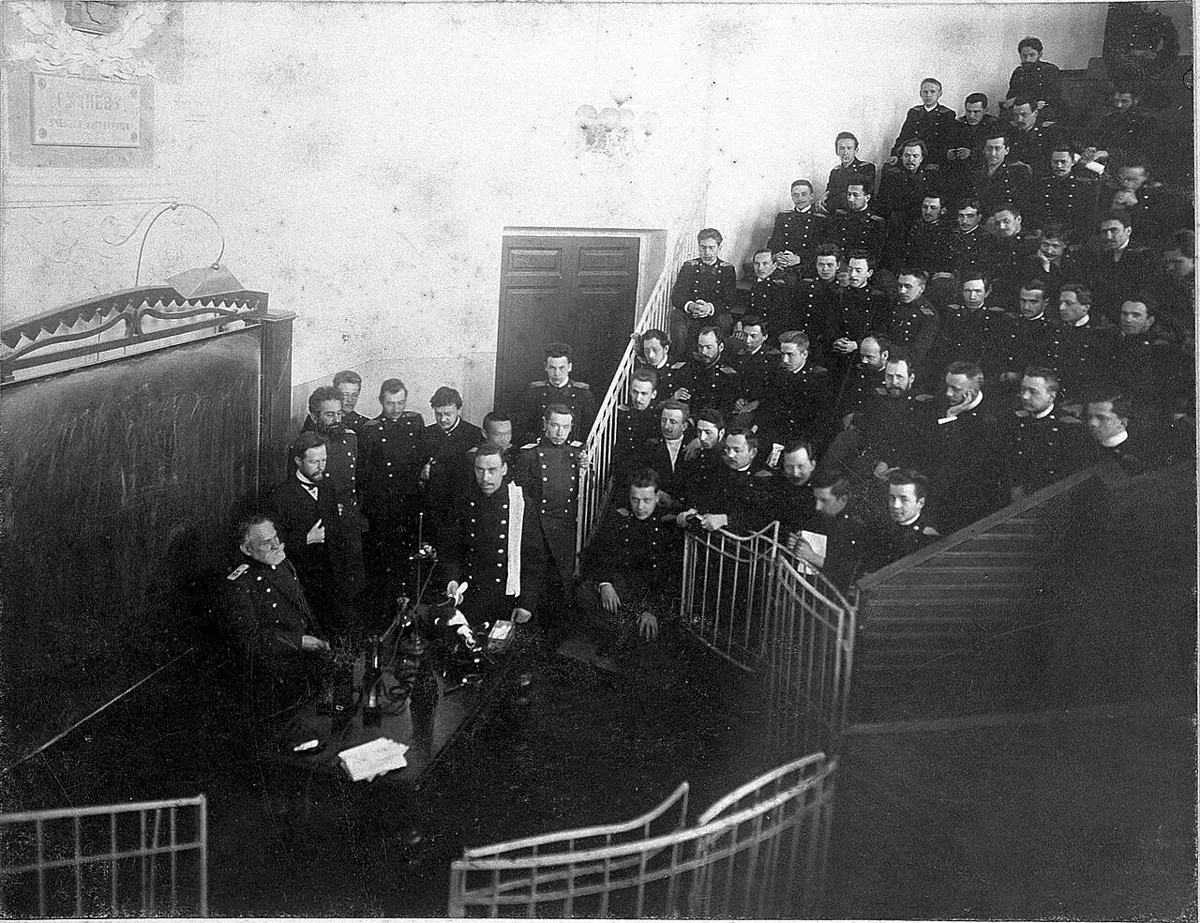
Food in a dog’s mouth makes saliva flow; no dog has to learn that. But Pavlov’s dogs also drooled at things that had come before food. So his laboratory made this its work. In one dog, as Pavlov described it, the ticking of a metronome had been followed again and again by food. Now the metronome alone was played, with no food, and saliva began to flow after 9 seconds: eleven drops in 45 seconds. As he put it, the sound had become “the signal for food”.
The parts have names. The food is the unconditioned stimulus, and the saliva it brings is the unconditioned response: “unconditioned” because they need no learning. The metronome starts out as a neutral stimulus, meaning nothing to the dog. After it has come before the food often enough, it is a conditioned stimulus, and the saliva it now brings on by itself is the conditioned response. The whole process is called classical conditioning.
The order matters. Pavlov found that the signal has to start before the food; given the other way round, no link formed at all. Some links took many pairings, but a smell worked after 20 and a buzzer once after a single pairing. (The famous bell is mostly a myth: his laboratory used metronomes, buzzers, tones and smells, and the Russian word for a buzzer seems to have become “bell” in English. One lecture does mention “the buzzing of an electric bell”, so how much of a bell there was is argued.)
What is learned can be lost and found again. Play the signal over and over with no food, and the drooling fades; that is extinction. But give the dog a rest and play the signal again, and some of the drooling comes back, which is called spontaneous recovery, so the old link was weakened rather than wiped away. A sound like the signal brings on some response too, which is generalization, and with training the dog can learn to respond only to the exact sound, which is discrimination. A learned signal can itself be paired with a new one, so that the new signal works without food ever following it. That is higher-order conditioning.
Not every pairing is learned equally easily. Rats made sick after drinking a flavored water learned to avoid that flavor, but those made sick after a light and a sound didn’t learn to avoid the light or the sound. Psychologists call this biological preparedness: an animal is built to link sickness with food, which is what usually causes it, and the link can form in one go, even when the sickness comes hours later. If you have ever gone off a food after being ill once, that may be what happened.
Feelings can be conditioned too, and the most famous attempt to show it is a story worth telling with care. In 1920 John Watson, the founder of behaviorism, and Rosalie Rayner tested a baby they called Albert B., who had grown up in a home for sick children where his mother was a wet nurse. At about nine months he showed no fear of a white rat, a rabbit, a dog, a monkey, masks or burning newspaper. At eleven months they let him reach for the rat and, as he did, struck a long steel bar with a hammer behind his head. After seven such pairings over two sessions a week apart, the rat alone made him cry and crawl away. Five days later he also shrank from a rabbit, a dog, a fur coat and a Santa Claus mask, and less strongly from cotton wool. A month after that the reactions were still there, but weaker. Then Albert left the hospital, and nothing was done to undo it.
The story went into nearly every textbook, often grown in the telling. It proves less than it seems. It was one baby, with no other child to compare him with, and the evidence that he was left with a lasting fear is thin. Nobody even knows for sure who he was: one team named a baby from the hospital who died at six, and another made a case for a different one, a man who lived to 87 and who, his niece said, had a mild dislike of animals. Nothing like it would be allowed today. What survives is the idea that a fear can be learned by association, and so perhaps unlearned. Some treatments for fears, which come near the end of this book, are built on it.
Classical conditioning explains why a pressure cooker’s whistle can make a hungry person’s mouth water, and why advertisers show their product beside a famous face. What it doesn’t explain is how anyone learns to do something new. A dog doesn’t learn to drool; it already could.
Learning from what happens after
In America, the psychologist Edward Thorndike shut hungry cats in boxes with food outside, in plain view. The door opened if the cat clawed a loop of wire or turned a wooden button. At first a cat struggled, clawing and biting at everything, until by accident it hit the right thing and got out. Put back in, it got out a little faster each time, as the useless movements dropped away. One cat took 160 seconds the first time and about 7 seconds by its 24th. Thorndike said the action that worked was “stamped in by the resulting pleasure”. His law of effect says it plainly: actions followed by satisfaction become more likely, and actions followed by discomfort less likely.
B. F. Skinner, an American psychologist, turned this into a science of its own. In a small box of his design a rat could press a lever, or a pigeon peck a key, and a machine recorded every press and delivered food by the rules the experimenter set. It is called operant conditioning: the animal acts, and what follows decides whether it acts that way again.
There are only four kinds of consequence. You can add something or take something away, and the action can become more or less likely. In psychology “positive” means something is added and “negative” that something is taken away; neither means good or bad.
The banana for a lifted trunk is positive reinforcement. A beeping that stops when you fasten your seat belt is negative reinforcement: the action is made more likely by taking an unpleasant thing away. People often mix that up with punishment, but punishment makes an action less likely. A scolding for being late is positive punishment, and losing your phone for the evening is negative punishment.
Banana is a primary reinforcer, good in itself. The whistle was a secondary reinforcer: it meant nothing to the elephants until it had been paired with banana, and then it was worth working for. Money and praise work the same way. A whistle can also be blown at the very instant the trunk goes up.
Nobody could wait for an elephant to do the whole trunk wash by chance and then reward it. So Fagen did what Skinner called shaping: reward anything close to what you want, then only what is closer, step by step. Each part was trained this way, trunk to the hand, holding still for the water, trunk up, tip in the bucket, the blow, and then the parts were linked into a chain. In the tests along the way, the share of tries done right rose from about four in ten to about nine in ten.
The elephant study is now taught in Cambridge’s A Level psychology, so it is worth being clear what it shows. The elephants were five females at one stable, and the trainer was the researcher herself. There was no group trained the old way to compare them with. So the study shows that rewards alone can teach a working elephant a hard task in a few weeks. It doesn’t show that rewards work better than the old methods, though its authors offer it as an alternative worth trying.
How often the reward comes matters as much as whether it comes. A reward for every right action teaches fastest. Rewards that come only now and then, after an unpredictable number of tries, make an action that is very hard to stop, because the next try might always be the lucky one. That is the pattern of a gambling machine. Rewards that come by chance can even teach nonsense. In 1948 Skinner fed eight hungry pigeons every 15 seconds whatever they did, and six developed odd rituals, one turning circles round its cage, each repeating whatever it had been doing when food last came.
Punishment can stop an action, at least for the moment. Its weakness is that it says what not to do without saying what to do instead. Physical punishment can also teach fear of the person giving it, and studies of children have linked it with more aggression later, though those studies are correlations, and which way the link runs is still argued.
There is a darker finding in this field, and its own authors changed their minds about it. In 1967 Martin Seligman and Steven Maier gave dogs electric shocks that some could stop by pressing a panel with their nose and others couldn’t. Later, in a box where they could escape a shock by jumping a low barrier, the dogs that had been able to stop the shocks escaped normally, while many of the others didn’t even try, and waited for the shocks to end. The explanation was that those dogs had learned that nothing they did mattered, which was named learned helplessness and studied for years as a laboratory model of depression in people.
Nearly fifty years later the same two men, after decades of experiments on the brains of rats, wrote that the theory “got it backwards”. Giving up in the face of long, unpleasant events, they now argued, isn’t learned at all. It is the brain’s default, driven by a small region in the brainstem. What is learned is control: when an animal finds that its actions work, a region at the front of its brain notices and switches the default off. The new account rests on animal experiments, and how far it applies to people is still being worked out. But it turns the old lesson round. The lasting thing an experience can teach is not that nothing works. It is that something does.
Operant conditioning runs classroom reward schemes and explains a great deal of everyday habit. But some actions can’t be shaped however they are rewarded, since animals slip back into what their kind does by nature, and much human learning happens with no reward of one’s own at all.
Learning by watching
In 1961 the psychologist Albert Bandura and two colleagues brought 72 children, aged about three to six, from the nursery school at Stanford University into a playroom. In the room an adult played. For some children the adult played quietly with toys. For others the adult attacked a five-foot inflated Bobo doll, hitting it with a mallet, sitting on it, punching it, tossing it in the air and kicking it, saying things like “Sock him”. A third group saw no adult. Each child was then mildly frustrated and taken to another room with toys, including a mallet and a Bobo doll, and watched for 20 minutes through a one-way mirror.
Children who had seen the attack copied a great deal of it, blows and words alike, far more than the others. Boys copied more of the hitting than girls did, and the man’s hitting was copied more than the woman’s. None of these children had been rewarded or punished for anything. They had learned simply by watching.
In a later study, in 1965, children saw a film of an adult rewarded for the attack, punished for it, or neither. Those who saw it punished copied it less. But when all the children were then offered treats to show what the adult had done, every group could do it. Seeing the punishment hadn’t stopped them learning. It had only made them less willing to show it. Psychologists call this the difference between learning and performance, and seeing someone else rewarded or punished vicarious reinforcement.
Bandura described four things that have to happen. You have to pay attention to what the model does. You have to remember it, which he called retention. You have to be able to do it yourself, reproduction. And you have to want to, motivation, which depends a lot on what happened to the model. People copy models who seem like themselves more readily. The same process spreads good habits as easily as bad ones: children copy reading, kindness and patience too.
The Bobo doll studies have their critics. The room was nothing like real life, in one later study children who had never seen a Bobo doll were much more likely to copy, and the studies say nothing about whether watching aggression changes anyone for long. Whether violent films and games make young people more aggressive has been argued ever since, and the evidence is still disputed.
Learning by working it out
In 1913 the psychologist Wolfgang Köhler went to Tenerife, in the Canary Islands, to run a research station for chimpanzees. He hung bananas out of reach, or put them outside the bars beyond an arm’s length, and gave the apes sticks and boxes. Thorndike’s cats had escaped by blind trial and error. Köhler’s chimpanzees, he reported, often failed for a while and then suddenly did the right thing, stacking boxes to climb on, or reaching with a stick. He called this insight: a solution that arrives all at once, in the head, before it is tried. People call it the “aha” moment.
His most famous case is less tidy than the textbooks make it. A chimpanzee called Sultan had two hollow bamboo rods, each too short to reach the fruit, one thin enough to fit inside the other. For over an hour he tried with one rod, then the other, and pushed one along the ground with the other, but never joined them, even when Köhler put a finger into the open end of a rod under his nose. The experiment was stopped and the keeper left to watch him. Within five minutes, the keeper reported, Sultan was sitting on a box idly playing with the rods, found himself holding them in a line, pushed one into the other, and at once ran to the bars and drew in a banana with the long stick. Köhler himself noted that chimpanzees are forever poking sticks into holes in play. So the flash of insight came out of play and experience, and the big moment happened when the scientist wasn’t watching.
Elephants once seemed to fail such tests, perhaps because they were given sticks to hold with the trunk they feel for food with. Researchers at the Smithsonian’s National Zoo in Washington tried something else on a seven-year-old elephant named Kandula, and reported it in 2011. They hung fruit out of reach. In his seventh session he pushed a big plastic cube under it, stood on it and took the fruit, and later did the same with a tractor tire. Insight isn’t only for apes.
Learning can also happen quietly, with nothing to show for it until there is a reason. In other experiments, rats allowed to wander a maze with no food in it seemed to learn nothing. But once food was put at the end, they ran the maze about as fast as rats that had been rewarded all along. They had been building a map of it in their heads the whole time, which is called latent learning.
Insight and maps in the head are where learning becomes thinking. How children build their own understanding of the world, alone and with others’ help, comes in a later chapter.
Go back to the stable in Chitwan. The whistle came to mean banana, which is Pavlov’s kind of learning. Lifting the trunk came to bring the whistle, which is Skinner’s, built up step by step. Between them they taught four young elephants a hard new task without one blow. People learn in all those ways, and in two more besides: by watching others, often without anyone meaning to teach, and by thinking a problem through until the answer comes. What the behaviorists got right is that a great deal of what we do was learned from what happened around us. What they left out is the mind doing the learning.
Found a mistake? Please tell us.