
In the middle of Kathmandu, a few kilometers from the airport, a white temple stands in the grounds of the Bhagwan Mahavir Jain Niketan, a Jain center that the prime minister opened in 1991. Nepal’s 2021 census counted 2,398 Jains in the whole country, most of them in Morang and in Kathmandu, and the community’s own website once called this temple an important place for them all. It went on with some pride: the temple, it said, is open to every Jain tradition, with places built for the तेरापन्थी (Terāpanthī) and the दिगम्बर (Digambara) Jains as well, an example of Jain unity.
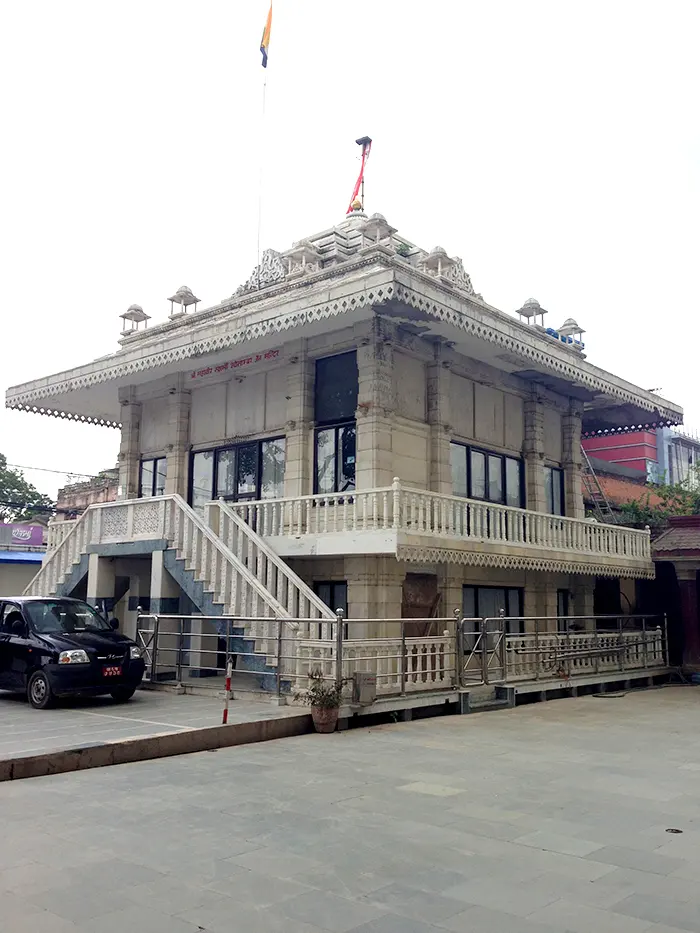
Union is worth boasting of, because the Jains are an old community with old disagreements. They are few in Nepal and not many anywhere, about 4.2 million in India by its census of 2001, but their teaching on harm, on truth and on how much a person should own has traveled far beyond them. This chapter tells it as Jains tell it, with its two great traditions side by side.
Ford-makers on a wheel of time
A Jain temple holds images of the जिन (Jina), the “victors”, people who conquered every passion in themselves, came to know everything, and then taught others the way to freedom. Another name for them is तीर्थङ्कर (tīrthaṅkara), “ford-maker”: a ford is a shallow place where a river can be crossed on foot, and a तीर्थङ्कर makes a crossing over the river of rebirth for others to follow.
Jains don’t count them as founders of a religion. Time, in Jain teaching, has no beginning and no end, and in the part of the world where humans live it turns like a wheel with twelve spokes. In one half of each turn, life slowly gets worse, in knowledge, length of life, goodness and happiness, over six long ages; in the other half it slowly gets better again. Jinas are born in the harder ages, when people most need reminding of what is true, and twenty-four have come in our own downward half. We live, Jains say, in the fifth age of a downward half, “the unhappy age”, which began soon after the death of the last Jina, and lasts 21,000 years.
The first Jina of our half-cycle was Rishabha, whose name means “bull”. Jain tradition credits him with the arts of a settled life: farming, crafts, reading, writing and mathematics. Historians have no evidence that he lived, but for Parshva, the twenty-third, there is some, mostly in Buddhist books. The twenty-fourth was Mahavira, born, by Jain tradition, in 599 BCE, though most scholars place him somewhat later; his life is told in World History, for the Curious, The Questioners. The Jinas’ images look much alike: seated or standing, perfectly still, eyes on nothing. Each has an emblem to tell him by, a bull for Rishabha, a lion for Mahavira, and Parshva can be known by the snake’s hood over his head. A twelfth-century story tells why. As a young prince Parshva went to see an ascetic tending his fires, knew that a snake was trapped in one of the logs, and had it pulled out and split. The snake was half burned. Parshva had a sacred formula recited to it, and it was reborn as a king of the serpents.
Three jewels
What the Jinas taught is summed up in one line that every Jain tradition accepts, the first sentence of the तत्त्वार्थ सूत्र (Tattvārtha Sūtra), written some time between the second and fifth centuries CE: right faith, right knowledge and right conduct together are the path to liberation. These are the रत्नत्रय (ratnatraya), the three jewels. Right faith is trusting what the Jinas saw. Right knowledge is understanding it: that the world is made of souls, the जीव (jīva), and of things without life; that every soul is by nature all-knowing and blissful; and that कर्म, which Jains count as a fine kind of matter, clings to the soul through anger, pride, deceit and greed, and weighs it down from birth to birth (more in Free Will and कर्म). Right conduct is living so that no new कर्म sticks and the old falls away. An old श्वेताम्बर (Śvetāmbara) scripture, the उत्तराध्ययन सूत्र (Uttarādhyayana Sūtra), adds a fourth: “Right knowledge, faith, conduct, and austerities; beings who follow this road, will obtain beatitude.”
In the same scripture Mahavira speaks to his chief disciple, Indrabhuti Gautama, about how short a life is: “As a dew-drop dangling on the top of a blade of Kusa-grass lasts but a short time, even so the life of men; Gautama, be careful all the while!”
When the last of its कर्म is gone, a soul rises by its own nature to the top of the universe, to a crescent-shaped place where the freed souls live, each a सिद्ध (siddha), “perfected”, knowing everything and never born again. That is मोक्ष (mokṣa), liberation. Only a human being can reach it, and only one who has given up the household for the life of a monk or nun. Nobody born in this unhappy age will get there in this life, but they can move closer, life by life.
The Jains’ most common prayer, the नमस्कार मन्त्र (namaskāra mantra), says nothing about asking. It bows to five kinds of beings: the Jinas, the freed souls, the heads of the monastic orders, the teachers, and every monk and nun. Its words are the same, or nearly, in every tradition, and no name is in it, only virtues. It is often the first prayer a Jain child learns, the first said on waking and the last before sleep.
Great vows and small vows
Right conduct starts from five vows, the first and greatest of them अहिंसा (ahiṃsā), not to harm any living being, and then truth, not stealing, chastity, and not clinging to things. Monks and nuns take them in full as महाव्रत (mahāvrata), the great vows; lay Jains take them as अणुव्रत (aṇuvrata), the small or limited vows, as far as a life of work and family allows. How far the Jains carry अहिंसा, finding life even in earth and water, is told in Who Counts.
The small vows still ask a good deal. A lay Jain is vegetarian, filters drinking water, and by custom eats nothing after dark, when small creatures can’t be seen. Truth includes honest business, and not stealing includes not cheating on taxes. Not clinging means owning only what you need. Seven more vows sit beside the five: to limit how far one travels and how much one uses, so as to do less harm; to avoid pointless harm, which includes speaking badly of people; to sit still in meditation for forty-eight minutes a day; to keep some activities to set times; to live a monk’s life now and then, for a day; and to give to monks, nuns and the poor.
Becoming a monk or nun is a public event. In the ceremony of दीक्षा (dīkṣā), the new मुनि (muni), monk, or साध्वी (sādhvī), nun, takes the great vows and pulls out their own hair by hand, a sign that they no longer care for the body’s comfort. From then on they own nothing. They go on foot, barefoot, and never cook; they eat what lay families give them, a little from each house, a way of collecting alms called gocarī, “going like a cow”, from a cow grazing a mouthful here and a mouthful there. The monks and nuns, the laymen and laywomen are counted together as the fourfold community, which Jains say Parshva founded. Lay people support the mendicants and confess their faults to them, and the mendicants teach.
Worship that asks for nothing
A Jain temple can look much like a Hindu one, with images, lamps and flowers. The difference, Jains say, is in what the worshipper is doing. The Jinas are freed souls; they can’t hear a request or answer one, and there is no creator to ask either (God). What Jains honor in the images is the perfection the Jinas reached, as a model to follow. One scholar of Jain worship put the puzzle this way: “What does it mean to worship beings that one believes are completely indifferent to, and entirely beyond the reach, of any form of worship whatsoever?”
The answer shows in the eightfold पूजा (pūjā) of the श्वेताम्बर Jains who worship images. The worshipper bathes and puts on clean, unstitched clothes kept only for worship, and says “nisihi”, “giving up”, at the door. They walk three times round the images, once for each jewel, and then make eight offerings: water, sandalwood paste, flowers, incense, a lamp, then rice, sweets and fruit. The rice is laid out on a table in a pattern: a svastika, whose four arms stand for the four kinds of birth, as a god, a human, an animal or plant, or in hell; three dots above it for the three jewels; and above those a crescent with a dot, the freed soul at the top of the universe. The offerings, many Jains explain, are less a gift to the Jina, who needs nothing, than a giving up by the worshipper, practice in letting go. Some Jains also turn to guardian deities for help with worldly troubles, and whether they should is one of the community’s arguments.
The year’s high point for the श्वेताम्बर Jains is पर्युषण (paryuṣaṇa), eight days in late August or early September. The word means “staying in one place”, and it began as a time of reflection for monks and nuns. The कल्पसूत्र (Kalpa Sūtra), with the lives of the Jinas, is read aloud, many families give up fresh vegetables, and many people fast. The दिगम्बर Jains keep their own festival straight after it, ten days for ten virtues, the first of them patience and forgiveness, with a chapter of the तत्त्वार्थ सूत्र read each day. Forgiveness is at the heart of both. A Jain prayer begins: “I grant forgiveness to all living beings. May all the living beings please forgive me. I have friendship with all the living beings. I have no hostility towards anyone.” It forgives first, and only then asks to be forgiven. Jains also keep Mahavira’s birthday, in the month of Chait, and Diwali, the night, they hold, on which he was freed.
Two traditions, and the road to Nepal
Some time in the early centuries CE, Mahavira’s followers drew slowly apart into the two great traditions that remain today. They take their names from how their monks dress. A दिगम्बर, “sky-clad”, monk goes naked, as दिगम्बर Jains hold the Jinas did, carrying a broom of peacock feathers and a water pot; a श्वेताम्बर, “white-clad”, monk or nun wears white robes and carries a bowl and a broom of soft white wool. The दिगम्बर images are naked, with eyes closed; the श्वेताम्बर ones have open eyes and a lower garment, and are often painted and set in carved altars. The two disagree on whether a woman can reach liberation in this life, as Equal People tells, and the श्वेताम्बर Jains count a woman, मल्ली (Mallī), among the twenty-four. And they disagree about the scriptures. The श्वेताम्बर Jains hold that most of the old आगम (āgama), the teachings of Mahavira’s disciples, survived, and were written down at Valabhi in Gujarat in the fifth century CE; the दिगम्बर Jains hold that the original आगम were lost, and keep other texts in their place. Both agree that one part, the oldest, was lost long ago. Within the श्वेताम्बर tradition, later centuries brought a further division, over images: the largest group worships them, while the स्थानकवासी (Sthānakavāsī) and the तेरापन्थी do not.
The two traditions tell the story of the first loss differently, and in one telling Nepal has a part. In the श्वेताम्बर version, as the twelfth-century monk Hemacandra wrote it down, a twelve-year famine scattered the monks of the Ganges plain. When it was over they met at Pataliputra and gathered what they still remembered of the scriptures. One teacher knew more than anyone else alive: Bhadrabahu. But he was on the road to Nepal, and had begun a meditation called महाप्राण (mahāprāṇa), which would take twelve years. Asked to teach, he agreed to give seven lessons a day without breaking it. Five hundred monks were sent to learn from him, and one by one they gave up, until only one, Sthulabhadra, was left. What Sthulabhadra learned, and what he couldn’t, is how the श्वेताम्बर Jains explain which parts of the scripture were lost.
The दिगम्बर version takes Bhadrabahu south instead. During the famine he led a large body of monks to the south of India, with, their tradition says, the emperor Chandragupta among them, and both died at Shravana Belgola in Karnataka, where their memory is honored today. Scholars call the details vague: the oldest record of the journey south is an inscription of about 600 CE, nearly nine centuries later, and they think the split itself came about slowly.
Nepal has another link in Jain tradition. मिथिला (Mithilā), the city where मल्ली was born and lived, as the श्वेताम्बर texts tell it, is identified with Janakpur, and the twenty-first Jina, Nami, is also said to have been born there.
What do Jains wish others understood? That the religion is not mainly a list of things given up, but a way of looking at every living thing as a soul like oneself. Jains often say that अहिंसा means not only not hurting but working for tolerance, forgiveness and the good of others, and so ordinary Jains give regularly to charity. They also point to the habit of mind in Many Sides: that any one view of a thing is likely to be partial.
So the Jain path is the path of the three jewels, right faith, right knowledge and right conduct, toward the freedom of a soul from the कर्म that weighs it down. Its teachers are the twenty-four Jinas, the last of them Mahavira, and its heart is अहिंसा, kept by monks and nuns in full and by lay families as far as a working life allows. It is worship that asks for nothing, and festivals in which forgiveness is asked of every living being. Two great traditions, sky-clad and white-clad, keep it, and in one of their stories its greatest teacher of the day had set out on the road to Nepal. The Sikhs come next. For the hard part of asking forgiveness, see Getting Along, Apologize Properly.
Found a mistake? Please tell us.