
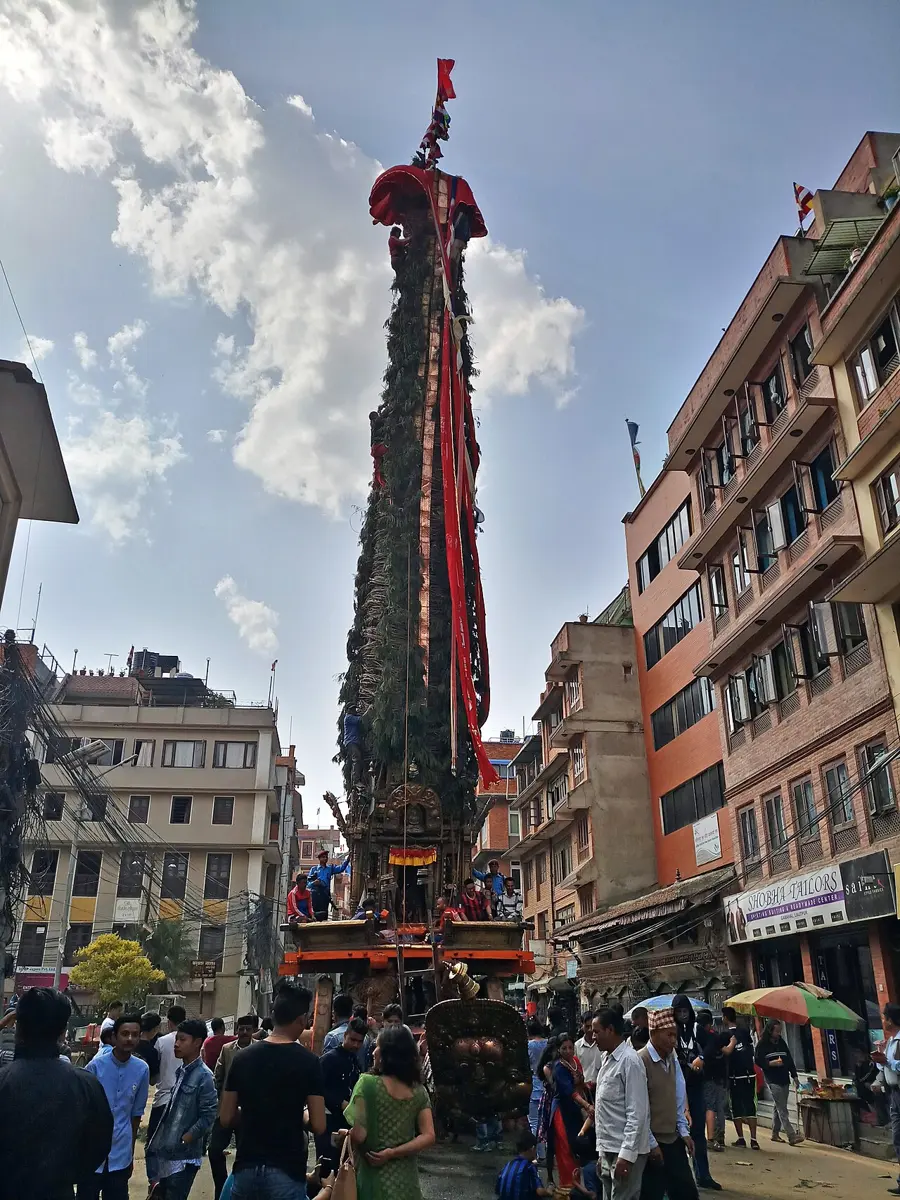
Every spring a tower of green branches about twenty meters high rolls through the narrow streets of Patan. It is huge and unwieldy, a crowd of young devotees hauls it through streets barely wide enough for it, and it stops at the important places on its way, for a day or for several weeks. Inside, under all that greenery, sits a small, red, much-repainted god. After about two months the chariot reaches the open ground of Jawalakhel, and there, in front of a huge crowd, with the living goddess Kumari and the country’s highest officials watching, a small black vest studded with jewels is held up from the chariot for everyone to see. An old story says the vest was a serpent’s gift to a farmer, and that it is shown each year so that its true owner can claim it. Nobody ever does.
That is the Bhoto Jatra, the showing of the vest, and it ends the longest chariot festival in Nepal. Ask the people in the crowd who the god in the chariot is, and you may get three different answers, all of them sincere.
The god of Bunga
To the Newars of Patan he is Bunga Dyah, the god of Bunga, because his home is the village of Bungamati, a few kilometers to the south. He is the only god in Nepal with two home temples, one in Bungamati and one in Ta Baha in Patan, and he spends half the year in each. His worship is very old. A Buddhist manuscript copied in 1071 already has a small painting of him, labeled “Bugama Lokeshvara of Nepal”, and a Tibetan pilgrim who spent eight years in the Valley in the thirteenth century wrote about him at length.
He is three things at once. He is first of all a god of rain, very likely far older than either Buddhism or Hinduism in the Valley, and his festival falls in the hot weeks just before the monsoon. The farmers of the Valley, the Jyapus, have always been at its heart. He is also, for Buddhists, a form of अवलोकितेश्वर (Avalokiteśvara), the bodhisattva of compassion, the being who puts off his own final freedom to help everyone else; that is why Newar Buddhists also call him Karunamaya, “full of compassion”, and Bunga Lokeshvara. And from about the seventeenth century he has also been Rato Machhindranath, the Red Matsyendranath, identified with a great yogi of the Hindu Nath tradition; that is how Hindus came to be among his devotees. One Hindu story says that Matsyendranath, thrown into the sea as a baby, was swallowed by a fish and learned Shiva’s secrets of yoga inside it, which is how he got his name, “lord of the fish”. Rato Machhindranath is the name most non-Newar Nepalis know, and the one in the guidebooks.
The story of how he came to the Valley has many versions, and it shows the three identities woven together. In the one told most often, the yogi Gorakhnath came to the Valley and was ignored, or came looking for his teacher and couldn’t find him. Either way he sat down to meditate on top of the serpents that bring the rain, the नाग (nāga), and held them there. No rain fell for twelve years. To end the drought, King Narendradeva, a teacher of the old rites called Bandhudatta and a farmer named Lalita set off to fetch Gorakhnath’s own teacher, Matsyendranath, from Kamarupa, far away in what is now Assam. After many adventures they brought him back, in some tellings as a bee caught in a sacred jar. When Gorakhnath saw his teacher arrive, he stood up to bow to him, the serpents slipped free, and the rain came.
Some of that story is history. A king called Narendradeva really ruled the Valley in the seventh century. The oldest chronicle of Nepal, written in the fourteenth century, says that he and the teacher Bandhudatta began the festival. The festival is still run by Buddhist priests and kept by Hindus and Buddhists alike. One of the priests of the Bungamati temple, a Shakya, put the belief plainly to a reporter: strictly speaking, he said, it isn’t Machhindranath who brings the rain, it’s the serpents. Machhindranath is worshipped to welcome the monsoon because his coming ended the great drought.
Monks who marry
The people who look after Bunga Dyah belong to a Buddhism found nowhere else on earth, Nepal’s own, as The Buddha’s Way tells.
Most Buddhists picture a monk with a shaved head who never marries and owns almost nothing, like the थेरवाद (Theravāda) monks of Sri Lanka or the lamas of a Tibetan monastery. Newar Buddhism has monks of a different kind. Its सङ्घ (Saṅgha), the community of monks, is made up of married householders, and has been for centuries. They belong to two groups, the शाक्य (Śākya) and the वज्राचार्य (Vajrācārya), and they live with their families in the old monasteries of Kathmandu, Patan and Bhaktapur, the courtyards called बहाल (bahāl) and बही (bahī), more than three hundred of them in the Valley. A boy joins by an initiation in his father’s monastery, with his head shaved, which its own books call “the Observance of Going forth”, after the way the Buddha’s first monks left home. He stays a monk for life, receiving alms as one at the great festivals of giving, and he marries, raises children and earns his living like anyone else. A वज्राचार्य, “master of the vajra”, is also consecrated as a priest and serves Buddhist families as their family priest, from a baby’s first rice to a funeral, much as a Brahmin does for Hindu families.
The tradition has its own story of how this came about. Its monks, the story goes, were once celibate and were forced back into family life long ago, some say by the Hindu teacher शङ्कर (Śaṅkara), and Newar Buddhists often date the loss of the old celibate monasteries to the reign of King Jayasthiti Malla in the late 1300s. Its holy language is still Sanskrit. The prayers, the spells called धारणी (dhāraṇī) and the hymns are sung in Sanskrit from long folding books made for the purpose, and in every वज्रयान (Vajrayāna) rite a family sponsors, the वज्राचार्य repeats in Sanskrit the bodhisattva’s vow, to help all beings reach awakening. A Newar scholar calls it the only surviving form of “Sanskrit Buddhism”, the kind that once filled the monasteries of northern India.
Membership comes by birth. Only a boy whose father and mother are both शाक्य or वज्राचार्य may be initiated in his father’s monastery. That makes the monks of Newar Buddhism something found nowhere else in the Buddhist world: a caste, marrying only within itself, just as the Brahmins do among Hindus. And it sits inside a larger order. Newar society, Buddhist and Hindu alike, is arranged by caste. When a scholar asked Buddhist merchants in Kathmandu’s old market about it around 1980, they disagreed about the exact order of the castes, but they agreed that they themselves stood near the top, below only the priests, and that the castes once called untouchable stood far below, because of what they had done in earlier lives. The most secret rites of वज्रयान were open only to the high castes. Nepal’s Constitution today makes untouchability and caste discrimination an offense punishable by law, as Article 24 says.
This is an old argument inside the tradition, and not only between it and its critics. The Buddha himself taught that birth doesn’t make anyone noble, as Equal People tells. One merchant told the same scholar that ethics in modern Nepal had to start by rejecting “the hierarchy and discrimination of the caste system”. By the 1980s some monasteries in Kathmandu had begun to initiate sons whose mothers were not of the caste, though they kept them out of the tantric shrine; others refused, and Patan was stricter still. The argument goes on, among the people whose religion it is.
A hundred springs
High in Mustang, a small temple with a three-tiered roof stands among trees, under bare brown mountains. On its uphill side, spring water pours out of a long row of spouts. There are 108 of them, a holy number for Hindus and Buddhists alike.

For Hindus this is Muktinath, “the lord of liberation”, one of the holiest shrines of Vishnu anywhere. Its oldest name is शालिग्राम (Śāligrām), after the fossils found all around it, ammonites, the coiled shells of ancient sea creatures, which Hindus worship as Vishnu himself. The Mahabharata already lists the place among the great pilgrimages, and Hindus have come from all over South Asia for centuries, many of them on the full moon of Janai Purnima, when high-caste men change their sacred thread. Inside the temple Vishnu is worshipped in the form of a black ammonite.
For Tibetan Buddhists the same place is Chumig Gyatsa, “a hundred springs”. A guidebook written in Tibetan for pilgrims, which a British scholar translated, tells how it was made holy by Padmasambhava, the great teacher who is said to have brought Buddhism to Tibet, and by the eighty-four great masters of the tantric tradition, who came here with water from Lake Manasarovar. The god in the little temple, it says, is the local serpent spirit of the springs, and Hindu pilgrims know him as Vishnu. The guide also tells of “the precious fire that burns from water” nearby, a symbol, it says, of the butter lamp.
So the same black stone is Vishnu to one pilgrim and a serpent spirit to another, and nobody needs to settle which. But sharing a place is not the same as becoming one people. Two anthropologists who walked with Hindu pilgrims to Muktinath in 1980 had expected to see the warm equality that some scholars said pilgrimage creates. They found nearly the opposite. A Brahmin woman stepped off the trail so that a Buddhist traveler wouldn’t brush against her. Brahmin pilgrims flatly refused tea from a tea shop offered by one of the anthropologists, himself a Brahmin, because food cooked by non-Brahmins broke their code. A wealthy Brahmin group from the Terai and a poor one from the hills kept their distance, and the hill group’s spokesman said of the others that they were “Vaishnavas in name and tikas only”. Hindus and Buddhists came to the same springs, and each kept their own rules on the way.
Both, and still different
How do people hold two faiths in one place without mixing them up? Many Newars would say the question is badly put. Newars are, very roughly, half Hindu and half Buddhist, and the two halves share festivals, gods and streets.
The Kumari, the living goddess, is the plainest case. Kathmandu’s Kumari, the best known of several in the Valley’s towns, is a small girl chosen from a Buddhist family of the शाक्य clan, the same married monks’ caste that tends Bunga Dyah. Once chosen she represents Taleju Bhawani, a Hindu goddess to whom the old kings of Nepal were devoted, and Hindus and Buddhists alike revere her; the Shah kings used to receive tika and blessings from her. When she reaches puberty she loses her divine status, and another girl is chosen. A custom like that raises a question about the girl herself, and Nepalis have argued it out. In 2005 a lawyer went to the Supreme Court, arguing that it denied the Kumaris their rights as children; a professor went to the same court to defend it as heritage, saying that people who don’t understand the culture shouldn’t judge it. The court, deciding in 2008, found that the custom didn’t keep the Kumari from an education and wasn’t child labor, called it an important cultural and religious institution, and ordered help for former Kumaris and a study of how to protect the rights of Kumaris past and present. Today a tutor comes every day to Kathmandu’s Kumari, and she does her homework and sits her exams.
Gods are shared in the same way. When a scholar asked Buddhist merchants in Kathmandu whether worshipping Shiva earned less merit than worshipping अवलोकितेश्वर, most said it made no difference. Yet they had an image that showed exactly how they saw it: a form of अवलोकितेश्वर, Srishtikanta Lokeshvara, from whose body all the other gods come out, Hindu gods among them. Every god deserves worship, in this picture, and every god has a place, but the places are below the Buddhas and bodhisattvas.
And when the talk turned to what religion is finally for, the difference came back. A merchant who believed that all kinds of meditation lead to the same goal still insisted on a “firm contrast” between the Buddha’s dharma and the Hindus’ dharma: the Hindus’ highest goal, he said, was स्वर्ग (svarga), heaven, while the Buddhists’ was निर्वाण (nirvāṇa), the end of rebirth, and much harder to reach. Living side by side, sharing a god and a chariot, he hadn’t concluded that the two were the same. He had concluded that his own way went further.
Nepal’s school course for Grades 9 and 10 asks students to look at the country’s धार्मिक सहिष्णुता, religious tolerance, in its “tradition and present practice”, and both halves of that are worth taking seriously. The tradition is an old ideal in this part of the world. Ashoka, the emperor whose pillar stands at Lumbini, had it carved on rock that a person should not praise his own religion or condemn others’ without good cause, that “contact (between religions) is good”, and that everyone should learn the good teachings of other religions. It hasn’t always held here. After Prithvi Narayan Shah took the Valley, the Capuchin friars left in 1769 with their Newar Christians, and Nepal stayed closed to missionaries until 1951, as Christianity tells; in 1944 the Rana government ordered the Valley’s new थेरवाद monks to stop preaching and return to lay life or leave the country, as The Buddha’s Way tells. Tolerance in Nepal has been both a tradition and, at times, a practice that failed.
That is the Valley’s mix: not a blend in which differences melt away, but neighbors who honor each other’s gods and are still quite sure about their own. Young devotees pull the chariot, the Buddhist priests tend the god, the country’s officials come to see the vest, and each of them could tell you, if you asked, what is really happening.
Nepal’s own mix, then, is not one religion made out of two. It is people who share places, festivals and even gods while keeping their own teachings. Bunga Dyah is a rain god, a bodhisattva and a Hindu yogi all at once, carried by Buddhist priests through streets full of Hindus and Buddhists. Newar Buddhism keeps the Sanskrit Buddhism of old India alive, with married monks who are also a caste, and argues with itself about that caste. Muktinath is Vishnu’s shrine and the hundred springs of Padmasambhava, and the pilgrims who come for each keep their own ways. A Buddhist girl is worshipped as a Hindu goddess, and the country has had to ask what that asks of a child. Tolerance is an old ideal here, and it hasn’t always been kept. What people do when their beliefs truly conflict, and whether one faith can be right where another is wrong, is the question of Many Truths. And for learning what a festival means to the friend beside you, see Getting Along, Ask a friend about their faith, and listen.
Found a mistake? Please tell us.