
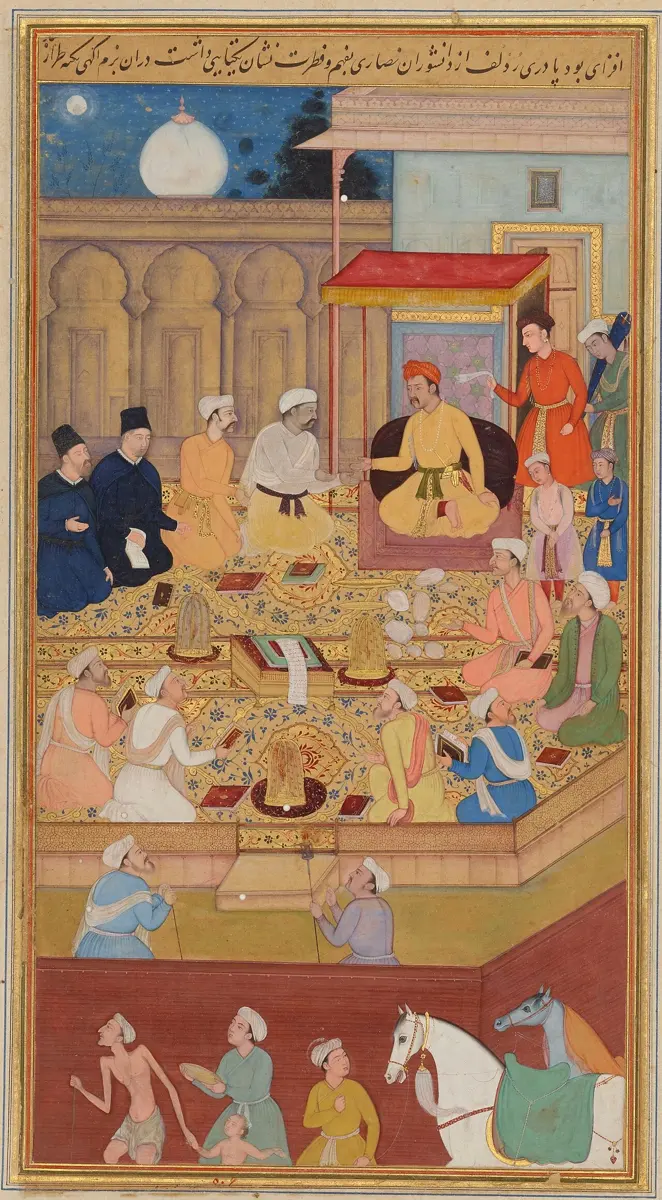
On Thursday evenings in the 1570s, the Mughal emperor Akbar went to a hall he had built for one purpose: to listen to people argue about God. At first only Muslims came, and they quarreled over who should sit where, so the emperor gave each group one of the hall’s four sides. Then they quarreled over religion, so fiercely, wrote one of the scholars present, that they called one another fools and heretics. Akbar widened the circle. In time the hall held Sunni and Shia scholars, Sufis, philosophers, Brahmins, Jain monks, Zoroastrians, Jews, Jesuit priests from Europe, and even a चार्वाक (Cārvāka), of the old Indian school that held this world is all there is.
Two men who were there wrote it down, and they tell it very differently. Abu’l Fazl, the emperor’s friend and historian, called it a court of truth where each side “emerged from haughtiness and conceit, and began their search anew.” Abdul Qadir Badauni, a strict Sunni scholar, thought it a disaster, and he blamed it for leading the emperor away from Islam. But Badauni also recorded the conclusion Akbar reached, as Badauni saw it: that wise and holy people are found in every religion, that “the Truth is an inhabitant of every place”, and that it could not be right to think it confined to one faith.
Badauni’s complaint and Akbar’s conclusion are the two ends of a question every religious person meets sooner or later, and in Nepal sooner rather than later. If my faith says one thing and my neighbor’s says another, what do I make of hers?
Three answers
Philosophers sort the answers into three families, and the names are clumsy but useful.
The first is exclusivism. One religion is true, and where another disagrees with it, the other is wrong. That sounds harsh, but it is how most people treat most claims. If I say the bus leaves at nine and you say ten, we can’t both be right. Many believers see their faith the same way. The Gospel of John has Jesus say, “I am the way, the truth, and the life. No one comes to the Father, except through me.” The Qur’an says, “If anyone seeks a religion other than [islam] complete devotion to God, it will not be accepted from him.” An exclusivist need not be unkind. He may be gentle, curious, a good neighbor. He simply thinks that on the big questions his neighbor is mistaken. The hardest question put to him is about the neighbor. If she is as thoughtful and as devout as he is, and nobody can show either of them wrong without first assuming his own faith, some philosophers say neither can be sure that only one faith is true. Others answer that a believer may fairly think he has been given something his neighbor hasn’t, and that the same may be true for believers of other faiths.
The second is inclusivism. My religion has the whole truth, or the clearest view of it, but others hold parts of it, and their followers are not shut out. The Catholic Church took this view at the Second Vatican Council, in a short declaration on other religions: the Church “rejects nothing that is true and holy” in them, it said, and their teachings “often reflect a ray of that Truth which enlightens all men”, while it still proclaimed Christ as the way, the truth and the life. The Catholic theologian Karl Rahner called a good person of another faith, saved by Christ without knowing it, an “anonymous Christian”. The Muslim scholar Morteza Mutahhari said much the same from the Muslim side: a person who seeks the truth sincerely, and to whom Islam has stayed hidden through no fault of their own, is not an unbeliever but, in his phrase, a “dispositional Muslim”. The Qur’an itself has a verse that Muslims read in this light: “The [Muslim] believers, the Jews, the Christians, and the Sabians, all those who believe in God and the Last Day and do good, will have their rewards with their Lord.” How that verse fits the one about “complete devotion to God” is an old argument among Muslim scholars.
Nepal’s own mix is full of inclusivists. The Buddhist merchants of Kathmandu, in Nepal’s Own Mix, worshipped Shiva and thought it earned as much merit as worshipping अवलोकितेश्वर (Avalokiteśvara), yet kept an image in which all the gods come out of the body of अवलोकितेश्वर. Every god has his place, and the places are below.
The third is pluralism. No single religion is the true one; several, perhaps all the great ones, are equally good ways to the same end. In Nepal and India this is the view most people know best, usually in the words of Swami Vivekananda. At the first Parliament of the World’s Religions in Chicago, he told the audience that his people “accept all religions as true”, and he quoted a hymn he had said since he was a boy: “As the different streams having their sources in different places all mingle their water in the sea, so, O Lord, the different paths which men take through different tendencies, various though they appear, crooked or straight, all lead to Thee.” The Rig Veda’s line that the sages give many names to what is One, quoted in God, is often read the same way.
The one Real
The best-known pluralist in philosophy was an Englishman, John Hick, and he came to it by a very ordinary road. He was a devout Christian teaching in Birmingham, a city of many faiths, and he worked with Muslims, Sikhs, Hindus and Jews there against racism. As he spent time in their mosques, synagogues, gurdwaras and temples, he wrote, “essentially the same thing was going on in all these different places of worship”: men and women opening their minds and hearts “upwards” toward a higher reality that made a claim on their lives.
So he built a theory to explain it. There is one ultimate reality, which he called the Real. No human mind can grasp it as it is in itself. Each great religion meets it through its own culture, its own scriptures and ideas, and so experiences it as Allah, the Trinity, Vishnu or Shiva, or as something beyond any person, such as Brahman. The test of a religion is what it does to people: whether it turns them, in his words, “from self-centredness to Reality-centeredness”. And by that test, he argued, no great religion stands out above the rest. Every one has its saints, and every one, taken as a whole, is “an unique mixture of good and evil”. Each, he concluded, “constitutes a valid context of salvation/liberation; but none constitutes the one and only such context.”
Hick said he had been attacked “as anti-Christian, as too narrowly Christian, as an atheist, a polytheist”, and the critics did come from every side. Some asked what was left of the Real if nothing at all could be said about it: if every god is real only as people experience it, have we not ended up with many gods, which no monotheist would accept? Others noticed that people who give their lives to a cause with no religion in it, the poor, the planet, are changed in much the same way, so the change proves nothing about a divine reality. Others asked why Hick’s test, kindness and patience against hatred and greed, should decide which religions count: that is one more standard chosen by one man, as much as any exclusivist’s. And another pluralist, Mark Heim, made a further point. Hick says every religion leads to the same goal, the move from self to Reality. But the Buddhist’s goal is the end of craving and rebirth, the Christian’s is life with God, the Hindu devotee’s is to serve and love Vishnu forever. To say they all really want Hick’s one goal, in Heim’s view, is to deny that religions differ in what matters most. A pluralist like that, he argued, is an inclusivist in disguise, with his own theory in the middle.
“All paths are one” is a claim too
That is the heart of it. “All religions lead to the same place” sounds like the humble answer, the one that takes no side. It is in fact a claim about God, salvation and the world, and a large one, and it contradicts what many believers hold most dearly.
A Christian who believes that Jesus rose from the dead and that no one comes to the Father but through him cannot also believe that it makes no difference whether you follow Jesus. A Muslim who believes the Qur’an is God’s last word cannot think it no better than any other book. Even in the Valley, where faiths share so much, the Buddhist merchant who believed that all kinds of meditation lead to the same goal still insisted that the Hindus’ highest goal was heaven and the Buddhists’ the much harder निर्वाण (nirvāṇa). When the Catholic Church restated its view in the year 2000, it said exactly this. Respect for other religions does not mean the belief that “one religion is as good as another”, and the equality on which honest dialogue rests “refers to the equal personal dignity of the parties in dialogue, not to doctrinal content.” So telling believers that their differences don’t matter can be its own kind of disrespect. It asks them to give up what they think is true before the conversation begins.
None of this settles who is right. Exclusivists, inclusivists and pluralists can all give reasons, and philosophers still argue over each. The elephant in the old parable, told in Many Sides, has a lesson here too: the story only works because someone can see the whole animal, and every answer to rival truths quietly claims to be that someone. What can be said is that the three answers are three different beliefs, and none of them is the neutral ground.
Conversion
The question stops being a puzzle when one person changes faith. Now the rival truths meet in a family, at a funeral, in a village, and in Nepal the argument is mostly about people who become Christians. Each side is best heard in its own words.
Conversion is also a legal matter in Nepal, and the law’s own words are on our page on Article 26. The first view wants a community’s faith protected. Those who hold it point to something found all through Nepal’s religious life: a faith here is seldom one person’s alone. It is a family’s rites for its dead, a village’s festivals, a way of life handed down, and someone who leaves takes himself out of all of it. One party, the Rastriya Prajatantra Party, promised in its latest manifesto to enforce the constitution’s and the law’s rules strictly, to blunt what it called the growing pace of conversion, and to control and discourage “organized and planned” conversion.
To the Christian churches the duty runs the other way. Jesus told his followers, “Go and make disciples of all nations,” and the Buddha, too, sent his first monks out “for the welfare and happiness of the people, out of sympathy for the world”. Some faiths, Judaism among them, as Judaism tells, don’t seek converts at all; Christianity and Islam do, and many believers in each think they would be failing their neighbors if they didn’t share what they believe saves. In 2011 three great Christian bodies from around the world, the Catholic Church, the World Council of Churches and the World Evangelical Alliance, set out together what that may and may not mean. Deception and coercion, they said, “betray the gospel”. The exploitation of “poverty and need has no place in Christian outreach”, and Christians should refuse “all forms of allurements, including financial incentives and rewards”. But they also said that the right to “profess, practice, propagate and change one’s religion” comes from the dignity of every human being.
International human rights law puts that last point in its own words. The Universal Declaration of Human Rights, in Article 18, gives everyone “freedom to change his religion or belief.” Two of Nepal’s own church bodies, the Nepal Christian Society and the National Churches Fellowship of Nepal, joined a report to the United Nations in 2021 that says Nepal’s law goes too far, treating conversion, in its words, as “something forced and not freely chosen”. How the law draws its line, and the arguments about it, are told in Human Rights in Government and Law, for the Curious and in Religion in Daily Life in Peoples of Nepal.
Then there is the person who changes, and that is where the question is hardest. A sociologist who asked seventy converts at a church in Pokhara why they had become Christians found that the commonest reason was healing, from illness or from spirits, and the next was the care and kindness of the church. One man told him he had been troubled by spirits since childhood, had sacrificed twenty-one chickens and three goats, and had been made poor by it; then he went to the church, was healed, and was content. Nine in ten said they were glad they had changed. But seven in ten said their friends and neighbors had turned against them, shutting them out of festivals and rites, and nearly a third of those who were first in their families to convert had faced criticism or harassment at home, though most families came round. The same story can be told as a free choice that brought peace, or as a sick man drawn away from his family’s faith in his weakest moment. The convert, his family and the church may tell it differently, and each believes the telling is true.
What, then, do you do with rival truths? You can believe your own faith true and others mistaken, or true in part, or all equally good, and each is a real belief with real reasons, not a neutral place to stand. What people of every view can share is something smaller and harder: to let others hold and practice their beliefs free from interference or harassment, and to learn what those beliefs actually are. Living peaceably with a neighbor doesn’t require thinking her faith is true. It does ask for listening when she tells you what she believes and why, and whether a person should be free to leave a faith, or to invite others to his, is the very question on which Nepalis of good will still disagree. For one way to practice that, see Getting Along, Say their side before yours.
Found a mistake? Please tell us.