
Ten people sit in a room once a month. Each puts Rs. 1,000 on the table, and one of them goes home with all of it, Rs. 10,000. Next month they meet again, each pays in again, and someone else takes the pile. After ten meetings everyone has paid Rs. 10,000 and everyone has taken Rs. 10,000 once, and the group is finished. Nobody has lent anything to a bank or borrowed from one, and no interest has been written anywhere. Yet something has happened to every one of the ten, and it isn’t the same thing.
The arrangement has many names around the world. In Nepal it is the ढुकुटी (dhukuti), also written ढिकुटी (dhikuti), and its parts are simple. The members agree on a sum and a date. The pile collected at each meeting is the pot. Who takes the pot at each meeting is decided by drawing lots, by a turn agreed at the start, or, in the form that spread across Nepal’s towns, by bidding: the member who will accept the smallest pot gets it, and what is left over is shared among the rest. The meetings go on until every member has had one turn.
It can look like a game, and Nepal’s dictionary gives one sense of the word as just that, a game in which cash is won and lost. It is better understood as a machine that moves money between people over time, which is what every chapter so far has been about. Chapter 2 called it a loan to the early takers and savings for the late ones. This chapter takes it apart, then turns to the plainer case it grows out of: lending a little money to a friend.
Who saves and who borrows
Follow the person whose turn is the first meeting. She pays in Rs. 1,000 and goes home with Rs. 10,000. For the next nine months she pays Rs. 1,000 at each meeting and gets nothing. She has received the money first and paid most of it afterwards. That is a loan: Rs. 9,000 of other people’s money, repaid in monthly installments, like Chapter 15’s EMI.
Now follow the person whose turn is the last. He pays Rs. 1,000 a month for nine months and gets nothing back, then at the tenth meeting pays one more and takes the whole Rs. 10,000. He has paid first and received afterwards. That is saving, a regular sum like Chapter 9’s, with the group holding his money instead of a bank.
Everyone else sits somewhere in between. The second turn is nearly as much a borrower as the first, the ninth nearly as much a saver as the tenth, and the fifth and sixth borrow or save very little, for a short time. Nothing about the members decides this. The only thing that makes one person a borrower and another a saver is when their turn comes.
If the turns are drawn by lots and every pot is the full Rs. 10,000, the first taker has borrowed Rs. 9,000 and paid no interest, and the last has saved Rs. 9,000 and earned none. The early seats are lucky and the late ones aren’t. For people with no bank willing to lend to them, even the last seat is useful: it is a way of being made to save, with nine others watching.
Bidding changes this. Suppose someone needs the money at once, for stock before a festival or a fee due this week, and offers to take Rs. 8,380 instead of Rs. 10,000. The Rs. 1,620 left over is shared among the other nine, Rs. 180 each. A study of Nepal’s groups gives an example in dollars: a pot of $1,200 goes to a member who bids $800, and the $400 left is shared out. The discount the early taker gives up is the price of having the money now. It is interest in all but name. The late takers, who wait, collect it.
How much interest? A rate needs something to compare, and the ढुकुटी’s money comes at different times. Chapter 10 had the way to do it: bring every sum back to one moment. Money at a later meeting is worth less today, and a sum n months later is worth
at a monthly rate r. For any seat, list what it pays in and takes out at each meeting, with money in counted as plus and money out as minus. Then find the monthly rate at which all of them, brought back to the first meeting, add up to nothing:
That rate is the seat’s own. It is called the internal rate of return, and it is the same idea a bank uses when it states a loan’s rate. As in Chapter 14, the yearly rate is
A seat that takes and then pays is paying that rate; a seat that pays and then takes is earning it.
With the made-up high bids, the first taker gets Rs. 8,380 at the first meeting and small shares of the later discounts, Rs. 9,100 in all, for the Rs. 10,000 she pays in. Her loan has cost her 31.3% a year. The last taker pays Rs. 10,000 and gets back Rs. 10,900, and has earned 29.3% a year. With low bids both are about 6%. The bids set the rate, and the early seats and the late seats get much the same one, because the money they pay and the money they earn is the same money changing hands. When bidding is keen, the members who need money badly push the rate up for everyone.
Two seats behave oddly. The fifth and sixth seats hold very little of anyone’s money for very long, so a small difference in their sums becomes a large difference in their rate: with high bids, 24.4% and 36.2%. A seat whose money goes out, comes in, and goes out again can even have two rates that balance its sums. The widget takes the one between −5% and +5% a month, the only one that means anything here. The middle seats are the ones for whom the ढुकुटी is mostly neither a loan nor savings, only a meeting.
Why join at all, when a member saving alone would have the full sum by the same last date? Economists who modeled these groups in 1993 pictured people each saving for something they can’t buy in pieces, and found that lots and bids both leave them better off than saving alone, when no one will lend to them; which of the two is better depends on how alike their needs are. The reason is easy to see. Of ten people each saving for a bicycle or a sewing machine, the one who takes the first pot has it after a month instead of ten. Only the last taker waits as long as he would have alone.
From a grain box to a pot of cash
The word ढिकुर (dhikur) in Thakali, the language of the Thakalis of Mustang’s Thak Khola, means a box for storing valuables or grain. One account traces the group of that name back to the trade over the Himalaya centuries ago, and says it was probably at first a store of grain, paid in by households and drawn on in emergencies. Nepal’s dictionary gives ढुकुटी a Newar origin instead, and both senses, a storeroom for grain and the rotating group. Whichever way the word traveled, by the middle of the twentieth century cash had replaced grain, and among Thakali traders the ढिकुर had become a way of raising capital. Nepal’s Grade 8 social studies book still describes it that way, as a Thakali tradition built on cooperation, equality and goodwill, in which a fixed sum is collected and each member in turn uses the whole of it.
The early groups had twenty or thirty members, sometimes more than a hundred, and were open to anyone, whatever their caste, sex or people. They usually met once a year, and the pot was given by lots. Studies made between 1964 and 1988 found groups with a founder, an administrator and a written constitution. A member who missed a meeting paid a small fine. Each member who won the pot named a guarantor among the others, and two contracts were drawn up, one between the winner and the group and one between the winner and the guarantor. Books were kept, signed and witnessed. Default and fraud were described as exceedingly rare. The groups had their own complaints: the winning bid gave up a large part of the pot, nobody could plan when the money would come, and a member who had already taken the pot had nowhere to turn in a fresh emergency.
Over the second half of the century the ढुकुटी spread far beyond the Thakalis, to every part of the country. On the way it changed. Annual meetings became monthly ones, and lots gave way to secret bids. A professional organizer, running several groups at once, took the first pot of each as the price of the work and answered for the group finishing properly.
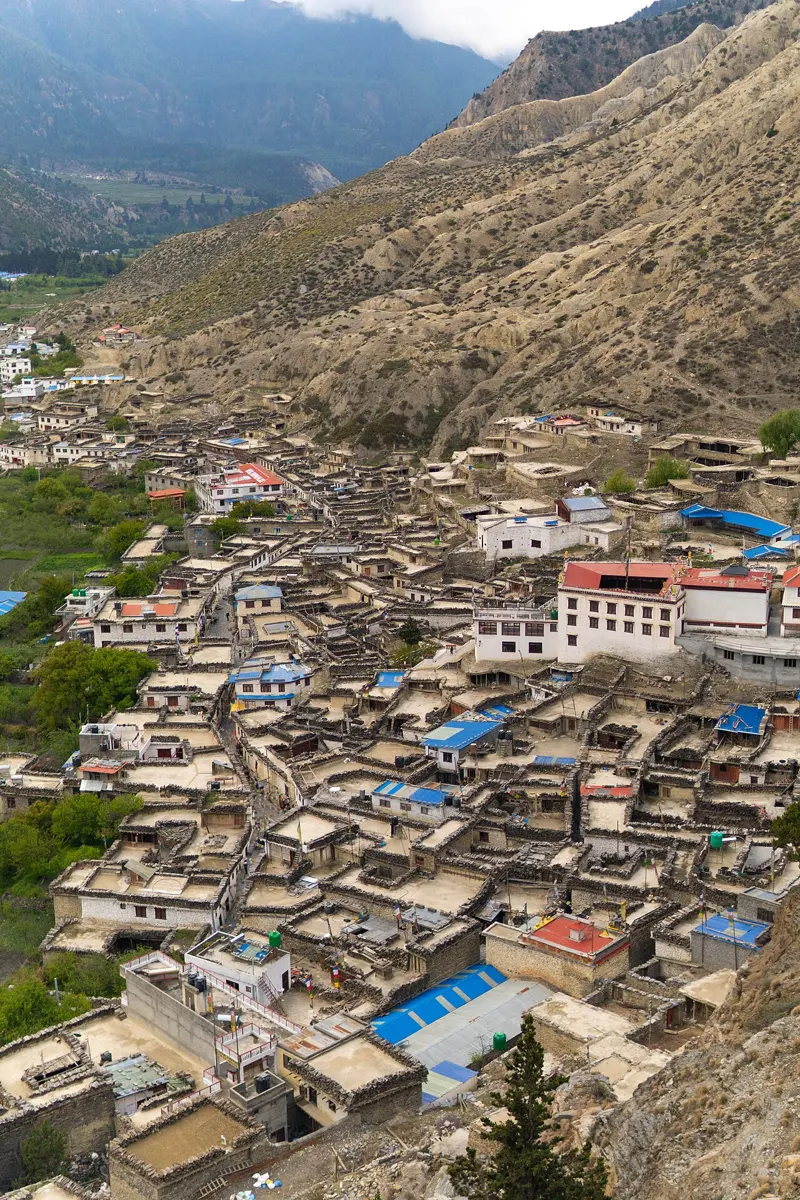
Nepal’s version is one branch of a very old tree. Groups like it are found all over the world. Among the Yoruba of West Africa it is the esusu, with evidence going back to the sixteenth century; carried across the Atlantic during the slave trade, it is still found under that name in the Caribbean, and now in American cities. Economists call all of them rotating savings and credit associations. The details differ, but the machine is the same: equal payments, one pot, a turn for each.
What makes it work is the same everywhere. The members know each other. A borrower who stops paying after taking the pot has to face nine neighbors, colleagues or relatives every month, and their good opinion is worth more to most people than Rs. 9,000. That is the ढुकुटी’s collateral: not land or gold, but standing among people one will go on meeting. It is also why the groups were cheap to run. No branch, no staff, no fees: the meeting did the work a bank’s staff would do.
When it breaks, and what the law says
The same studies give the other side. By the 1990s, bidding in some groups had become speculative. Members bid very low pots to get money at once, sometimes to put into something that promised more, and when the sums didn’t work out, they stopped paying. A study of 1995 estimated that about a third of the groups in Kathmandu ended early. A member left with nothing had little help: the groups worked beyond the protection of the law, and getting money back through the courts was hard.
A larger group run by an organizer changes the machine. The members no longer all know each other; they know the organizer. If the organizer collects the money and disappears, there is no one in the room to face. By 2015 the central bank’s spokesperson was saying that many innocent people had been cheated through such groups.
In 2012 Nepal Rastra Bank surveyed members of 148 groups in eight cities. Reported in the press, its estimate was that the groups’ dealings in those cities were worth about Rs. 5.18 billion, Rs. 3.34 billion of it in the Kathmandu Valley, where it counted 5,470 groups. Some members put in more than three-quarters of their income, a few more than all of it, and some had joined several groups to pay their dues in one. When a member defaulted, 81 in every 100 turned to the organizer to get their money back, and one in every 100 to the police. The bank’s deputy governor said the biggest problem wasn’t the size but what it did to families: people taking huge risks for a quick gain. The study listed the reasons people joined: banks they couldn’t reach, the gap between what banks paid on deposits and charged on loans, no product that fitted, and slow loan approval. It set out three choices for the government: ban the groups, regulate them, or have them register as savings and credit cooperatives.
The government chose the first. In 2016 an amendment to the Banking Offence and Punishment Act, 2064, added a definition and a ban. A ढुकुटी transaction, section 2(छ) says, is a transaction of collecting money among each other and taking or giving it in turns on the basis of agreement. Section 14क then says that nobody may run or have run a ढुकुटी transaction. The penalties are in section 15(3)(ख): the money involved is recovered, a fine equal to it is added, and a prison term follows the amount, from one to three years for up to Rs. 50 lakh, rising to seven to nine years above Rs. 50 crore. The government brings the case.
What this means for ten friends with Rs. 1,000 each is less clear than the words. The definition doesn’t mention organizers, bids or size, and names no group too small to count. The ban came after the central bank’s study of the city groups and their organizers. In the Supreme Court’s published decisions the word turns up only in what the parties said, never in a ruling on whether a group is lawful. So the plain answer is that the Act’s words ban the ढुकुटी, and how they would be applied to a small one hasn’t been decided in any case we could find.
Why did something so widely banned last so long beside banks? The central bank’s own study answered that: it was close, quick and fitted people the banks didn’t. A member could get a sum when needed, without papers, from people they trusted, and the price was set by the members themselves. Banks are better at two things: keeping deposits safe whatever the people around do, and lending more than a group of ten ever holds. Chapters 11 and 12 are about those two things. Where banks and cooperatives reach, they now do much of what the ढुकुटी did, with a law to fall back on when someone doesn’t pay.
Lending to friends and family
Strip the ढुकुटी down to two people and it becomes something nearly everyone does: one person lends another a sum and waits to be paid back. A cousin needs Rs. 5,000 for a fee. A friend is short for the bus pass. Most such loans are repaid and forgotten. The ones that aren’t can cost far more than the money, because the lender has lost the sum and the borrower has lost the lender’s trust, often without either being sure what was agreed.
Nepal’s law has a plain answer: write it down. The Muluki Civil Code, 2074, says that no dealing in money or goods, a loan included, is to be made without a deed. Its section 477 lists what such a deed should say: the names, ages and addresses of lender and borrower, with their parents’ and grandparents’ names, why the money was lent, how much, by what date it will be repaid, the rate of interest if any, that it may be recovered from the borrower’s property if not repaid, and the place and date; since 2080 it also needs a witness for each side, as Chapter 18 tells. The everyday name for such a paper is तमसुक (tamasuk), the document a borrower writes for the lender as proof of the loan. Chapter 14 gave the Code’s limits on what a lender may charge. No interest unless the deed says so, at most 10% a year, no interest on interest, and never more interest than the loan itself. A borrower who repays should get the deed back, signed off or torn up, or a receipt; a part payment is written on the back and signed. And even without a proper deed, a court may still order a debt paid from other evidence, such as a cheque or an account book.
A तमसुक is close kin to the promissory note of Nepal’s finance course and Chapter 11: a written promise, signed by the one who owes, to pay a sum to a named person. The Code counts any document that shows a loan was made, a receipt or a voucher included, as a deed. Between friends, even a page in a notebook that says who lent how much to whom, on what date, when it will be repaid, and whether there is any interest, signed by both, is a record of that kind; whether a particular page would satisfy a court is a question for a lawyer. What it certainly does is settle, before anything goes wrong, the questions that end friendships: was it Rs. 2,000 or 1,500, was it to be repaid “next week” or “sometime”, was it a loan at all? The Code also limits how long a lender may wait before going to court over an unpaid debt, counted from the repayment date in the deed, and in some cases the limit is as short as a year; for an old or a large debt the place to ask is a lawyer, not a book.
The other half of lending to friends is the loan not made. There is no rule that says when to say no. When the answer is no, it helps to say so plainly and early, with no long story: “I can’t lend that right now, I’m sorry.” A no given kindly costs a friendship less than a yes that turns into silence and avoided calls.
The ढुकुटी is a loan and a deposit in one, made of trust instead of paper. When its members know each other and need what it gives, it works the way a bank would; when they don’t, or when one person holds everyone’s money, it fails in ways a bank’s rules were made to prevent, and Nepal’s law now forbids it. The lesson carries over to the smallest loan between two people: what holds money together is a clear agreement, written down, between people who will go on meeting.
Try this
- In the widget, choose high bids and the first turn, then the last. Write down “Got in all” for each, and check that the first taker’s loss is the last taker’s gain.
- On paper, work out the first seat’s money at each meeting with low bids, where each of the other nine gets Rs. 45 at the first meeting, Rs. 40 at the second, and Rs. 5 less at each meeting until the ninth. Add up what she gets in all.
- The next time you lend or borrow money, even Rs. 100, write down who, how much, the date and when it will be paid back, and both sign it. Kushal, who is made up, lent Rs. 500 to a friend this way, and a month later neither had to argue about the amount.
Found a mistake? Please tell us.