
Pluck a guitar string, then press it down exactly halfway along and pluck again. The second note is higher, yet it sounds like the same note, only brighter. Singers call the two Sa and the next Sa; the gap between them is an octave. Now stop the string at two thirds of its length instead. That note, Pa, blends so sweetly with Sa that the tanpura humming behind a singer is usually tuned Pa, Sa, Sa, Sa (Ma in its place for a raag without Pa).
Here is the puzzle. Climb from Sa to Pa. From Pa, climb the same step again, and again, and again. Whenever a note goes past the next Sa, bring it down an octave, so every note stays between one Sa and the next. Does the climb ever land exactly on Sa again?
Guess first. After how many of these steps do you land exactly on Sa again?
Pick an answer to see why.
Two strings, one note
A string’s pitch is how many times a second it vibrates, its frequency, measured in hertz (Hz). For the same string at the same tension, the frequency goes as one over the length: half the length vibrates twice as fast. So the octave, half the string, is a frequency ratio of 2 : 1. Two thirds of the string gives Pa, 3 : 2 above Sa, the step called a perfect fifth. Three quarters gives Ma, 4 : 3 above Sa, a perfect fourth.
What makes these simple ratios sound sweet? A plucked string or a harmonium reed doesn’t sound only its pitch. It also sounds, more quietly, 2, 3, 4, … times that frequency, its harmonics. Sa at 200 Hz sounds 200, 400, 600, 800 Hz and so on. When two notes are played together, their harmonics can meet or nearly meet. Where two nearly meet, the sound wobbles in loudness, a beat, as many times a second as their frequencies differ. Hermann von Helmholtz argued in 1863 that this is why some pairs sound smooth and others rough.
Try these with the widget.
- a.Which ratio makes the most harmonics meet? Which makes none meet?
- b.For 3 : 2, which harmonic of Sa meets the 2nd harmonic of Pa? Why must it?
- c.Set 3 : 2 and detune Pa by +2 Hz. How fast does the fastest pair beat, and why that number?
Which pair of notes has harmonics that meet most often?
Pick an answer to see why.
Ratios multiply, steps add
Go up a fifth from Sa (× 3/2), then up a fourth from Pa (× 4/3). You land on the next Sa, because
So stacking intervals multiplies their ratios. Yet to the ear, a fifth plus a fourth adds up to an octave, step on step. Our ears hear pitch roughly by ratios: 110, 220, 440 and 880 Hz sound equally spaced, each an octave above the last, though the gaps in hertz are 110, 220 and 440.
There is a tool that turns multiplying into adding: the logarithm. Measure an interval by how many octaves it is, that is, how many times you must multiply by 2 to get its ratio:
An octave is ; two octaves, a ratio of 4, are . And because , sizes add when ratios multiply. Musicians split the octave into 1,200 small parts called cents:
Most calculators have no key, but any logarithm will do: , with to base 10 (the change-of-base rule).
On the widget’s circle, a note k cents above Sa sits of the way round. That is why every fifth turns the circle by the same angle, 701.96 cents’ worth, though in hertz each fifth is a bigger jump than the last.
A note is 3 octaves above another. What is the ratio of their frequencies?
Pick an answer to see why.
Why the circle never closes
Climbing n fifths multiplies Sa’s frequency by . Landing exactly on a Sa, m octaves up, would need
Look at the two sides. is 3 × 3 × … × 3, a product of odd numbers, so it is odd. , for n ≥ 1, is a product of 2s, so it is even. An odd number can’t equal an even one. No number of fifths ever comes back exactly to Sa, and no computer search could ever find one: the proof covers every n at once.
The same argument proves something about logarithms. If were a fraction , then , which we have just seen is impossible. So is an irrational number: its decimals never end and never repeat.
The widget showed how near twelve fifths come. They climb a ratio of
while seven octaves are . The leftover, , about 23.46 cents, is the Pythagorean comma: the amount by which twelve pure fifths overshoot seven octaves. It is about a quarter of the smallest step on a harmonium, and it never goes away.
Near misses: 5, 12, 41, 53
The circle never closes, but it comes close at some steps. From five fifths on, here are the closest returns, each closer than every one before it:
| Fifths | Octaves | Fifths overshoot (+) or fall short (−), cents |
|---|---|---|
| 5 | 3 | −90.2 |
| 12 | 7 | +23.5 |
| 41 | 24 | −19.8 |
| 53 | 31 | +3.6 |
| 306 | 179 | −1.8 |
| 665 | 389 | +0.08 |
Near misses make scales. Stop the climb after four fifths, Sa, Pa, Re, Dha and Ga, and put them in order: Sa Re Ga Pa Dha, the five notes of Raag Bhupali, the same five-note scale (the major pentatonic) heard in folk tunes across East Asia and far beyond. The next fifth, Ni, would land only 90 cents below Sa, crowding it; stopped at five notes, the scale has no gap smaller than a whole step. Twelve fifths give the twelve notes of the harmonium. And 53 fifths come within 3.6 cents of 31 octaves, a near miss noticed in China over two thousand years ago (the story below).
The record-breaking near misses can be found without trying every number. They come from writing as a continued fraction, a method for the best fractions near any number; its best fractions here are , the octaves over the fifths in the table.
Twelve equal steps
If twelve fifths overshoot seven octaves by a comma, share the comma out: make each fifth smaller by a twelfth of it, 23.46 ÷ 12 = 1.96 cents. Then twelve fifths close the circle exactly, and the twelve notes are evenly spaced, each 100 cents above the one before. This is twelve-tone equal temperament, the usual tuning of pianos, guitars and harmoniums today. Each small step, a semitone, is the same ratio:
The twelve notes of an octave are a geometric sequence with common ratio , and the eleven between one Sa and the next are the eleven geometric means between, say, 440 and 880 Hz (Grade 10’s Sequence and Series).
And the twelfth root needs no special key. Twelve is 2 × 2 × 3, so
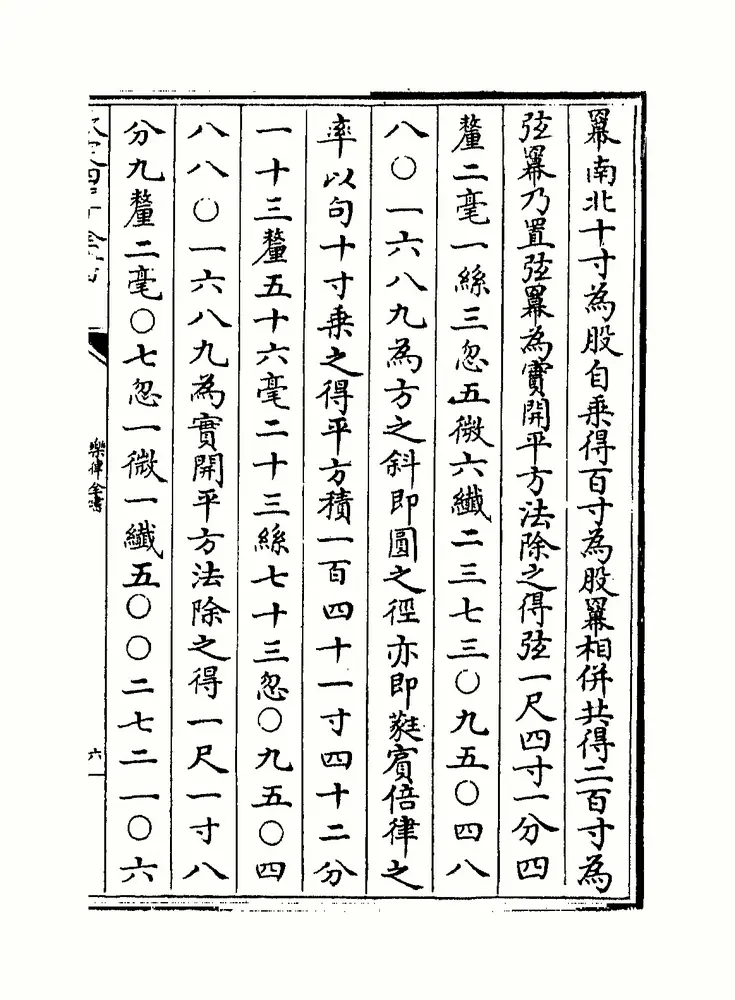
a cube root and two square roots (in any order), the roots of Grade 9’s Indices. The page of Zhu Zaiyu’s book in the story below shows the square roots, worked by hand over 400 years ago.
Why twelve and not some other number? Cut the octave into N equal steps and ask how near some step lands to the two sweetest intervals after the octave, the fifth (3 : 2) and the major third (5 : 4).
The price of twelve
Equal temperament isn’t free. Every interval except the octave is slightly out of tune, and you can hear it as beats. Take A at 440 Hz and the tempered E at 659.26 Hz. A’s 3rd harmonic is 1,320 Hz; E’s 2nd is 1,318.51 Hz. They nearly meet, 1.49 Hz apart, so the fifth beats about one and a half times a second: a slow, gentle wobble. The major third is worse. A at 440 Hz and the tempered C♯ at 554.37 Hz: A’s 5th harmonic is 2,200 Hz, C♯’s 4th is 2,217.46 Hz, and they beat about 17 times a second, a buzz you can hear on any piano.
Two notes played together beat 3 times a second. What does that tell you?
Pick an answer to see why.
This is where the rule breaks, twice. First, much of the world’s music is not built on twelve equal steps. The Natyashastra, the oldest surviving Indian treatise on the performing arts, music among them (its first complete version from somewhere between 200 BCE and 200 CE), divides the octave into 22 shrutis, and a singer in a raag places a note by ear, a little higher or lower than the same note in a neighboring raag, and slides between notes. A harmonium can’t: its pitches are fixed, and standard Indian models are equal-tempered. All India Radio kept the harmonium off its broadcasts from 1940 to 1971, for reasons that included exactly this.
Second, real strings don’t quite obey the whole-number harmonics. A piano’s thick steel strings are stiff, and their high harmonics run slightly sharp. So piano tuners stretch the octaves: high notes are tuned a little higher, low notes a little lower, by a few tens of cents at the ends of the keyboard, so that the octaves sound pure with the harmonics the strings really make. The mathematics of perfect ratios is exact; the strings are not.
Where this is used
- Guitar frets. On a guitar, the ratio of the distances of two neighboring frets to the bridge is , so the nth fret is a distance from the nut on a string of length L, and the 12th fret is halfway. That is why the frets get closer together towards the body: equal ratios, not equal lengths.
- Electronic instruments. The MIDI standard, which keyboards, phones and music software use to name notes, numbers them so that note 69 is A at 440 Hz; note N has frequency , and a frequency’s note number is , the same logarithm a tuner works out.
- The standard A. A = 440 Hz was agreed at a meeting in London in May 1939 and became the international standard ISO 16 in 1975.
Questions
★ Go up a fourth (4 : 3), then up a fifth (3 : 2). Where are you?
Pick an answer to see why.
A harmonium’s Sa is tuned to 240 Hz. Find Pa as a pure fifth and as an equal-tempered fifth. Played with Sa, how many times a second does the tempered Pa beat?
Hint
Answer
A guitar’s strings are 650 mm long from nut to bridge. How far from the nut is the 7th fret? Where would you press for a pure fifth, and how far apart are the two?
Hint
Answer
★★ How many cents is a whole step, Sa to Re, 9 : 8?
Pick an answer to see why.
Four fifths up and two octaves down give Ga as . Ga can also be tuned to , the simpler ratio, whose harmonics meet Sa’s at every 5th. How far apart are the two in cents? Where does the equal-tempered Ga (400 cents) fall between them?
Hint
Answer
Prove that no number of pure fourths (4 : 3) ever makes a whole number of octaves.
Hint
Answer
41 fifths come close to 24 octaves. Which is bigger, and by how many cents? Why does 53 beat 41?
Hint
Answer
Show that . Could Zhu Zaiyu have found , for a seven-step octave, the same way?
Hint
Answer
Where to go next
- Why Is a Magnitude 8 Earthquake Not Just a Bit Bigger Than a 7? Another logarithmic scale, where one step multiplies the energy by about 32.
- How Did a Book of Numbers Make Multiplying Easy? Logarithms as a calculating tool, from tables to the slide rule.
- Can You Prove √2 Is Not a Fraction? The same odd-against-even argument as this page’s proof.
- Computing, Going Further: How Does a Computer Make a Sitar-Like Note Out of Noise? Make plucked notes and Raag Bhupali’s scale in Python; How Does a Tuner Hear Which Note You Play? (Coming soon.); Can a Computer Compose a Tune That Follows a Raag? (Coming soon.)
- Grade 10, Sequence and Series: geometric means, the twelve notes of an octave among them.
Where these facts come from
- The Pythagoras legend, its first telling by Nicomachus of Gerasa (1st–2nd century CE), the weights 12, 9, 8, 6, why it is physically false, Vincenzo Galilei’s 1589 criticism and Mersenne’s 1636 explanation: Wikipedia, “Pythagorean hammers”, read October 2026.
- Pitch heard roughly logarithmically, A220 to A440 the same interval as A440 to A880: Wikipedia, “Pitch (music)”, read October 2026.
- Mersenne’s laws (frequency inversely proportional to length, proportional to the square root of tension), Harmonie universelle, 1636: Wikipedia, “Mersenne’s laws”, read October 2026.
- Harmonics of a vibrating string at whole-number multiples; piano strings’ inharmonicity: Wikipedia, “Harmonic series (music)”, read October 2026.
- Consonance as coinciding partials and dissonance as beating between partials (Helmholtz): Wikipedia, “Consonance and dissonance”; the first German edition of On the Sensations of Tone in 1863: Wikipedia, “On the Sensations of Tone”, read October 2026.
- The Pythagorean comma, 531,441 : 524,288, about 23.46 cents: Wikipedia, “Pythagorean comma”, read October 2026.
- Zhu Zaiyu (1536–1611), Ming prince, equal temperament described in 1584; He Chengtian (370–447); Simon Stevin’s manuscript of about 1605, less precise; Galilei’s lute frets; the suggestion that Matteo Ricci carried Zhu’s work to Europe; the fifth’s error of 1.96 cents and the third’s of 13.69 cents: Wikipedia, “Zhu Zaiyu” and “Equal temperament”, read October 2026.
- Zhu Zaiyu’s abacus and 24 decimal places; Stevin about 1605; Vincenzo Galilei’s possible earlier proposal, 1581: Wikipedia, “Twelfth root of two”, read October 2026. (One account says he used an abacus of 81 rods, Chinadaily; not confirmed in a second source, so left out.)
- The page of the Yuelü quanshu with and : Wikimedia Commons, 乐律全书全-115.jpg (public domain), read October 2026; the digits on it checked against the true values in our script.
- Jing Fang (78–37 BCE) and 53 fifths against 31 octaves; Mercator’s comma, about 3.6 cents; 53 equal steps’ fifth and thirds: Wikipedia, “53 equal temperament”, read October 2026.
- The major pentatonic from a chain of fifths, Bhoopali as its Hindustani name, the basic scale of Chinese music: Wikipedia, “Pentatonic scale” (with its melodies of China and East Asia); Raag Bhupali’s notes Sa Re Ga Pa Dha: Wikipedia, “Bhupali”, read October 2026.
- The tanpura’s usual tuning Pa-sa-sa-Sa, Ma for raags without Pa: Wikipedia, “Tanpura”, read October 2026.
- The Natyashastra’s 22 shrutis and its date: Wikipedia, “Natya Shastra” and “Shruti (music)”, read October 2026.
- The harmonium’s fixed, equal-tempered pitches in standard Indian models and its absence from All India Radio, 1940–1971: Wikipedia, “Indian harmonium”, read October 2026.
- Stretched octaves on pianos, from the strings’ stiffness (a total stretch on the order of ±35 cents across a piano’s range): Wikipedia, “Stretched tuning”, read October 2026.
- Fret spacing by the ratio , the 12th fret at half the string: Wikipedia, “Fret”, read October 2026.
- The MIDI note formulas with note 69 = 440 Hz: Wikipedia, “MIDI tuning standard”, read October 2026.
- A = 440 Hz agreed in London, May 1939; ISO 16 in 1975: Wikipedia, “A440 (pitch standard)”, read October 2026.
- Every number on this page (the cents, the comma, the near misses and their table, the equal steps from 5 to 60, the A440 table, the beats, the frets, Zhu Zaiyu’s digits) was computed by a script.
