
On sports day Pasang lines up for the 100 m race. Before he can reach the finish, he must reach the 50 m mark, halfway. Then he must cover half of what is left, 25 m. Then half of what is left again, 12.5 m, then 6.25 m, and so on. However close he gets, there is always another half still to run: infinitely many pieces. So how does he ever finish?
About 2,450 years ago the Greek thinker Zeno asked this very question, and argued that motion must be impossible. Pasang, of course, crosses the line in about 16 seconds. The way out of the puzzle is the idea of this unit, the limit: the number that a quantity gets closer and closer to, as close as you like, without ever having to reach it in a single step. By the end of the unit you will add up all of Pasang’s pieces, infinitely many of them, and get exactly 100 m.
Introduction
The idea of a limit grew out of two old problems. How do you find the area of a shape with a curved edge, like a circle, when area is measured in squares? And how do you draw the tangent, the line that just touches a curve at one point? Both answers come from the same trick: replace the hard thing with simpler things (straight-sided shapes, lines through two points) that get closer and closer to it, and see what they head for.
To study limits you need what you already know of algebra (factorizing), coordinate geometry (graphs) and a little trigonometry.
6.1 Concept of infinity
The word infinity comes from the Latin infinitas: in means “not” and finis means “end” or “boundary”. So something infinite has no end and no bound: a list that never stops, a process that never finishes. Infinity is written ∞.
Infinity is not a number. You can’t find it on the number line, and you can’t do ordinary sums with it. It is an idea: “without end”. When we say the real numbers run to + ∞ on the right and −∞ on the left, we mean they keep growing (or falling) past any number you name, not that they arrive somewhere called “infinity”.
Which of these is an infinite set?
Pick an answer to see why.
6.1.1 Division by zero
There is another way to see it. Division undoes multiplication: because 2 × 3 = 6. If were some number c, then 0 × c would be 5. But 0 times any number is 0, never 5. So no number works.
A number divided by 0 is undefined: has no value when a ≠ 0. What we can say is how behaves as x gets close to 0: it grows without bound, which we write . This idea, a value “becoming infinite” near a point, is what the next grade uses to study where a graph breaks.
Calculating with infinity
Since ∞ only means “grows without end”, a sum with it is a short way of saying what happens to something that grows without end. If two quantities both grow without end, so does their sum: ∞ + ∞ = ∞. If both fall without end, (−∞) + (−∞) = −∞. Multiplying keeps the sign rule for numbers: (−∞) × (−∞) = ∞, (−∞) × ∞ = −∞. And a fixed number added to something that grows without end can’t stop it growing: 5 + ∞ = ∞.
Some combinations have no single answer, and we come back to them in 6.3: ∞ − ∞, 0 × ∞ and .
What is −3 × ∞?
Pick an answer to see why.
Exercise 6.1
Questions 1 and 2
What is infinity? Do the integers extend to infinity?
Answer
Fill in the blanks: ∞ + ∞ = … and (−∞) + (−∞) = …
Answer
Fill in the blanks: (+ ∞) × (+ ∞) = …, (−∞) × (−∞) = … and (−∞) × (∞) = …
Answer
If x is a real number, fill in the blanks.
- i.x + (−∞) = …
- ii.x − ∞ = …
- iii.x + ∞ = …
- iv.x − (−∞) = …
- v.x × ∞ = …, for x > 0
- vi.x × (−∞) = …, for x > 0
- vii.x × ∞ = …, for x < 0
- viii.x × (−∞) = …, for x < 0
Answer
Questions 3 and 4
The function is given. Find f(x) when x = 0, −1, 1 and 2.
Answer
For which values of x is undefined?
Answer
The function is given. Find f(x) when x = 0, 1, 2 and 3.
Answer
For which values of x is undefined?
Answer
Question 5
The graphs of three functions are given. At which value of x is each function undefined?
Answer
6.2 Concept of limit
When a regular polygon is drawn inside a circle and its number of sides is made larger and larger, “close to infinitely many”, it gets as close to the circle as we like. We say the limiting shape of the polygon is the circle, and the limits of its perimeter and area are the circle’s circumference and area. The polygon never becomes a circle, since a polygon with any number of sides still has straight sides and corners; but no gap you can name stays between them. That is what a limit is about: getting as close as you like.
A regular polygon with 1,000 sides is drawn inside a circle of radius 1. Its area is about
Pick an answer to see why.
When one quantity gets as close as we like to a number or a shape, that number or shape is its limiting value (or limit). A limit is about closeness: where something is heading, not where it is.
Limits of sequences
A sequence is a list of numbers in order, by a rule: the nth term is f(n), with n = 1, 2, 3, …. Its limit is the number its terms get as close to as we like as n grows without end, n → ∞.
As the number of terms of the sequence grows towards infinity, its terms get very close to 0. We write: as n → ∞, f(n) → 0, that is,
read “the limit of f(n) as n tends to infinity is 0”. The limit of a sequence is the real number its terms get as close to as we like, as n → ∞. No term has to equal the limit: no is ever 0.
What is the limit of the sequence 4.9, 4.99, 4.999, 4.9999, …?
Pick an answer to see why.
The sum of an infinite series
The areas of the pieces, written one after another with plus signs, make an infinite series:
You can’t add infinitely many numbers one by one. Instead, add the first one, then the first two, then the first three, and so on: these are the partial sums.
| Partial sum | What it adds | Sum |
|---|---|---|
| S₁ | the first term | |
| S₂ | the first two terms | |
| S₃ | the first three | |
| S₄ | the first four | |
| S₅ | the first five | |
| the first n |
The partial sums make a sequence, 0.5, 0.75, 0.875, 0.9375, 0.96875, … Each falls short of 1 by , which heads for 0, so the sequence’s limit is 1. That limit is what we mean by the sum of the infinite series:
In general, for an infinite series , the partial sums are
S₁ = a₁
S₂ = a₁ + a₂
S₃ = a₁ + a₂ + a₃
and they form the sequence S₁, S₂, S₃, S₄, … The sum of an infinite series is the limit of the sequence of its partial sums.
Exercise 6.2
Question 1
Regular polygons with more and more sides are drawn inside equal circles, and the part of each circle outside its polygon is shaded. If the number of sides becomes infinitely large, what is the limiting value of the shaded area?
Answer
Question 2
In Figure 6.9, how many such equilateral triangles can be drawn?
Answer
If the process goes on for ever, what is the limiting value of the triangles’ sides?
Answer
What is the limiting value of their perimeters?
Answer
What is the limiting value of their areas?
Answer
Question 3
Circles with the same center are drawn one inside another, as in Figure 6.10, each radius the same fraction (here three quarters) of the one before. Draw two more such figures.
Answer
How many concentric circles can be drawn in this way?
Answer
If the circles are drawn for ever in this way, estimate the limiting value of their circumferences.
Answer
What is the limiting value of their areas?
Answer
Question 4
The graph of y = f(x) is shown. How does y change as x increases? For what value of x is y equal to 0?
Answer
Question 5
If n is a natural number, find the limit of each sequence.
Answer
Answer
Answer
Answer
Answer
f(n) = 2n
Answer
Question 6
Find the limit of each sequence.
0.1, 0.01, 0.001, 0.0001, …
Answer
7.1, 7.01, 7.001, 7.0001, …
Answer
2.9, 2.99, 2.999, 2.9999, …
Answer
Question 7
Where have you seen patterns of polygons drawn inside circles? Collect such examples.
- a.What shapes are found in those patterns?
- b.What is the limiting figure (boundary shape) of those polygons?
Answer
Question 8
Take a line segment AB 10 cm long. Halve it and write the length of the half. Halve that half, and write its length. Go on halving, and write the lengths as a sequence. What is its limiting value?
Answer
Question 9
In Figure 6.12, the outer square has an area of 16 square units. An inner square is formed by joining the midpoints of its sides, and the same is done again and again. How many inner squares can be drawn this way?
Find the side length of each square.
Answer
Write the sequence of their areas and find its limiting value.
Answer
Write the sequence of their perimeters and find its limiting value.
Answer
Find the sum of the areas of all the squares formed in this way.
Answer
6.3 Limit of an algebraic function
The meaning of x → a
To find the limit of a function, you must first be clear what x → a means.
x → 2 means: x takes values very close to 2, but never exactly 2, coming from both sides.
From the left, x is a little less than 2: x = 1.5, 1.9, 1.99, 1.999, 1.9999, … We write this (“x tends to 2 from the left”).
From the right, x is a little more than 2: x = 2.5, 2.1, 2.01, 2.001, 2.0001, … We write (“from the right”).
In general, x → a means that x takes values as close to the real number a as we like, from both sides, but x is never equal to a. Values close to a from the left are written , from the right . So x → a means both and .
Which list shows ?
Pick an answer to see why.
The indeterminate form 0/0
So can’t be given any one value. We call it an indeterminate form: an expression whose value can’t be determined uniquely. Other indeterminate forms are , 0 × ∞, ∞ − ∞, , and .
Note the difference: is undefined (no number works), while is indeterminate (every number works, so none is the answer). When putting x = a into a function gives , the function has no value there, but the function’s values near a may still head for one clear number, and that is what a limit finds.
Left-hand, right-hand and two-sided limits
Here, with 2 as a and 4 as l: for the limit of f(x) to be l = 4, x must approach the real number 2 very closely from both sides, and f(x) must approach the real number 4.
The limit of a function describes its behavior near a point: as x gets as close as we like to a real number a (from both sides, never equal to a), if f(x) gets as close as we like to a real number l, then l is the limit of f(x) as x tends to a. In notation,
The limit exists if the left-hand and right-hand limits are equal. If they are not equal, the limit does not exist.
and , but f(1) is . What is ?
Pick an answer to see why.
Why the tables keep finding the same numbers
For a function like , the tables are a way to see the limit, but there is a quicker way to be sure of it. Since x → 2 never lets x equal 2, x − 2 is never 0, so you may cancel it:
for every x ≠ 2.
As x → 2, x + 2 → 4. The same idea works whenever putting x = a in gives : factorize, cancel the factor that is 0 at a, then put a into what is left. Use it to check your tables in Exercise 6.3. (When putting a in gives a number divided by 0, as at 2, there is nothing to cancel: the values grow without end, and the limit doesn’t exist.)
Exercise 6.3
Question 1
Write the meaning of x → −3.
Answer
Write the meaning of .
Answer
Write the meaning of .
Answer
Write the meaning of .
Answer
Write the meaning of .
Answer
When x gets very close to m from both sides, which notation gives the limit of f(x)?
Pick an answer to see why.
Questions 2 and 3
. Find f(x) for x = 0, 1, 4 and 9.
Answer
For which value of x is in an indeterminate form?
Answer
. Find f(x) for x = 0, 1, 3 and 4.
Answer
For which value of x is in an indeterminate form?
Answer
Question 4
Complete each table and find the limit.
, with x = 2.9, 2.99, 2.999, 2.9999 and 3.1, 3.01, 3.001, 3.0001.
Answer
, with x = −2.1, −2.01, −2.001, −2.0001 and −1.9, −1.99, −1.999, −1.9999.
Answer
, with x = 3.9, 3.99, 3.999, 3.9999 and 4.1, 4.01, 4.001, 4.0001.
Answer
, with x = −3.1, −3.01, −3.001, −3.0001 and −2.9, −2.99, −2.999, −2.9999.
Answer
Question 5
.
- i.What is f(2)?
- ii.Find f(1.9), f(1.99), f(1.999), f(1.9999), and the left-hand limit as x → 2. Write it in notation.
- iii.Find f(2.01), f(2.001), f(2.0001), f(2.00001), and the right-hand limit as x → 2. Write it in notation.
- iv.What is the limit of the function? Write it in notation.
Answer
.
- i.What is f(3)?
- ii.Find f(2.9), f(2.99), f(2.999), f(2.9999), and the left-hand limit as x → 3. Write it in notation.
- iii.Find f(3.01), f(3.001), f(3.0001), f(3.00001), and the right-hand limit as x → 3. Write it in notation.
- iv.What is the limit of the function? Write it in notation.
Answer
Question 6
Make tables to find each limit. (Three values on each side are enough to see where f(x) heads.)
Answer
Answer
Answer
Answer
Answer
Answer
Answer
Answer
Answer
Answer
Answer
Answer
Question 7
Make tables to find each limit.
Answer
Answer
Answer
Answer
Answer
Answer
Question 8
Prove each limit.
Answer
The textbook prints as this limit, but near 3 the top is close to 9 − 6 + 4 = 7 and the bottom close to 9 + 1 = 10, and the tables below head for 0.7 from both sides. So the book’s number doesn’t work, and the limit to prove is .
Answer
Answer
Question 9
Use each graph to answer.
. Find , and .
Answer
. Find , and .
Answer
. Find , and .
Answer
From the graph of y = f(x), find , and .
Answer
Questions 10 and 11
From the graph, say whether the limit of f(x) at x = 2 can be found. Give the reason.
Answer
From the graph, say whether the limit of f(x) at x = 1 can be found. Give the reason.
Answer
Practice every question in the book, and keep track of the ones you miss →
Back to the race
Pasang’s 100 m, cut into halves of what is left, is the series
Its partial sums are 50, 75, 87.5, 93.75, 96.875, … m, and after n pieces he is short of the finish by exactly the last piece, m, which heads for 0. So the sum of all infinitely many pieces, the limit of the partial sums, is exactly 100 m: the same series as the halving square, times 100.
The times work the same way. At a steady 6.25 m/s (100 m in 16 s), the pieces take 8 s, 4 s, 2 s, 1 s, … and their sum is 8 + 4 + 2 + 1 + ⋯ = 16 s. Infinitely many pieces of time add up to a finite time, so Pasang finishes in 16 seconds, as anyone watching could tell you.
What it means: Zeno was right that the race can be cut into infinitely many pieces, and wrong that infinitely many pieces must take for ever. An infinite series can have a finite sum, and the limit is what tells you which ones do.
How the exam asks it
Grade 9’s final exam follows CDC’s Specification Grid and Model Question for Optional Mathematics, Grade 9 (2082). There Limits and continuity have 7 marks of the 75 (12 teaching hours):
| Where | How many | Marks | Levels |
|---|---|---|---|
| Multiple choice (Group A) | 1 | 1 | understanding |
| Its own question | 1, in four parts | 4 | one each: knowledge, understanding, application, higher ability |
| Joined questions | parts of 2 | 2 | application, higher ability |
In the grid’s model paper the multiple-choice question asks what the sequence with nth term heads for as n tends to infinity (0). The area’s own question gives a graph with an open circle and asks for the definition of the limit of a function, a reasoned answer about whether one integer can always be divided by another, a one-sided limit read off the graph, and whether the limit exists there, with a reason. In the questions joining areas, a limit is one mark: what a length or a coefficient heads for as an angle or a number approaches some value.
Where these facts come from
- Zeno of Elea, his dates and his paradoxes of the runner and of Achilles (opening, Introduction): Wikipedia, “Zeno’s paradoxes” and “Zeno of Elea”, read November 2026.
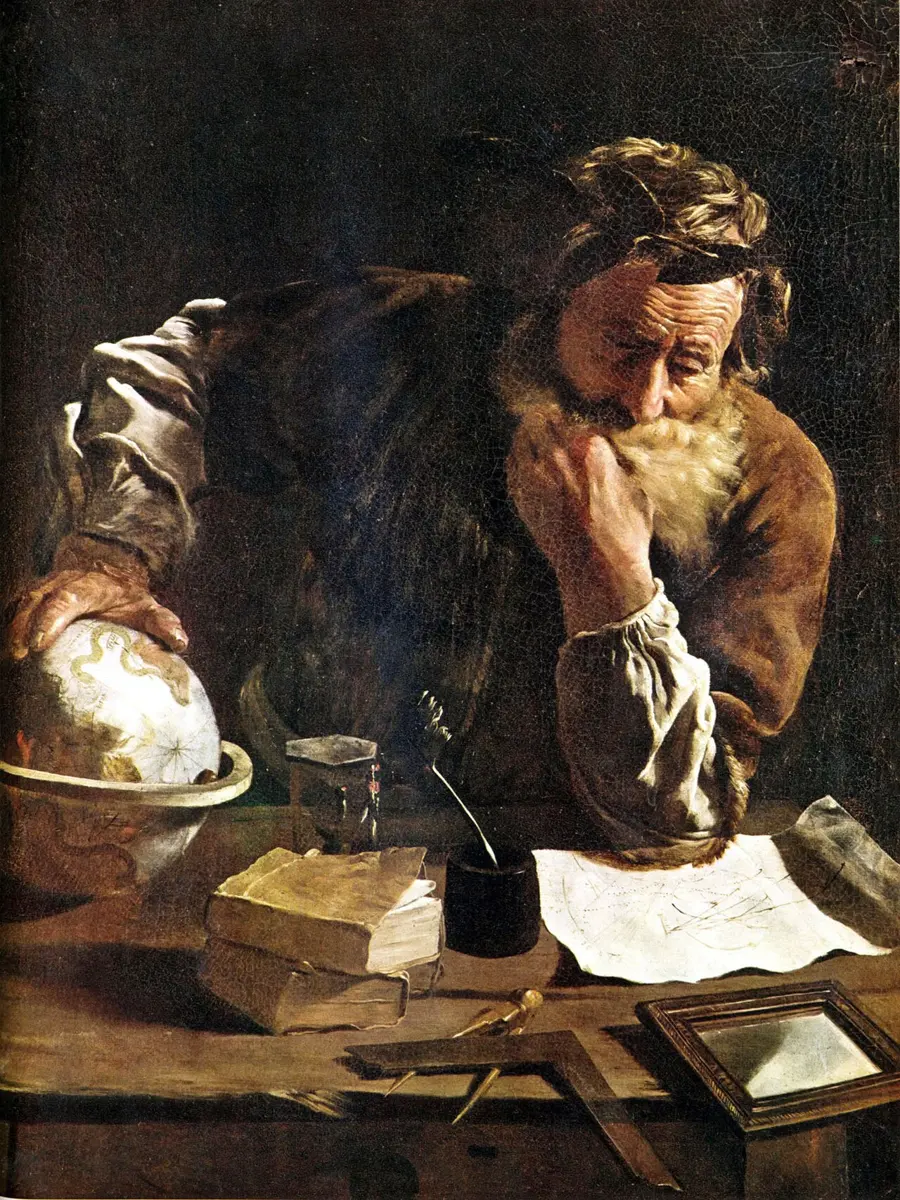
- Archimedes’ polygons of up to 96 sides and (story in the Introduction): Wikipedia, “Approximations of π” (Polygon approximation era) and “Measurement of a Circle”, read November 2026. Domenico Fetti’s Archimedes (1620): Wikimedia Commons.
- Newton and Leibniz, Cauchy’s course of 1821 and Weierstrass’s definition of the limit (Introduction): Wikipedia, “Limit of a function” (History) and “History of calculus”, read November 2026.
- John Wallis and the sign ∞ (1655) (fact in 6.1): Wikipedia, “Infinity symbol” (History), read November 2026.
- Brahmagupta’s rules for zero (628 CE) and Bhaskara II’s khahara (story in 6.1.1): Wikipedia, “Division by zero” (History) and “Brahmagupta” (Zero), read November 2026.
- 0.999… = 1 (fact in 6.2): Wikipedia, “0.999...”, read November 2026.
- The exam’s Limits and continuity questions (For the exam, How the exam asks it): CDC, Specification Grid and Model Question, Optional Mathematics, Grade 9 (2082), its table and model question paper (questions K, 13, 14b and 16d).
- The unit follows CDC’s Optional Mathematics, Grade 9, Unit 6, pages 267–290.

A companion to your textbook, not a replacement for it: study from the book your school uses, and where the two differ, follow your teacher. Found a mistake? Please tell us.