
Exam practice
Every question from the end of every unit, with hints and answers to open. After you check an answer, mark how you did, and come back to the ones you didn’t get.
16 questions
Unit 8 · Electricity and Magnetism
2. Differentiate between
Current electricity and static electricity.
Answer
| Current electricity | Static electricity |
|---|---|
| Electrons flow continuously through a conductor. | Charge builds up on an object and stays there. |
| It is produced by cells, batteries, generators and solar panels. | It is produced by rubbing (friction). |
| It flows through conductors such as metal wires. | It is made on insulators such as plastic, wool and nylon. |
| It flows all the time the circuit is complete. | It doesn’t flow, until it jumps away in a spark. |
| Example: a torch, the electricity in a house. | Example: a rubbed comb, lightning. |
Series combination and parallel combination of cells.
Answer
| Series combination | Parallel combination |
|---|---|
| The + of one cell is joined to the − of the next, in a line. | All the + terminals are joined together, and all the − terminals together. |
| The total voltage is the sum of the cells’ voltages. | The total voltage is the same as one cell’s. |
| A bulb gets brighter as cells are added. | A bulb’s brightness stays the same as cells are added. |
| The cells run down sooner. | The cells last longer. |
| Used in torches, remotes, radios. | Used where a small current is needed for a long time. |
3. Give reasons
It is dangerous to stay under a tall tree or beside a tall building during lightning.
Answer
Lightning usually strikes the highest point around, such as a tall tree or building. The huge current runs down it into the ground, and can jump sideways into a person standing beside it, or spread through the ground under it. So a person sheltering there may be struck or badly hurt.
Pieces of paper are attracted to a comb after it has been used to comb dry hair.
Answer
Combing rubs the comb against the hair, and electrons move from the hair to the comb, so the comb becomes negatively charged. When it is brought near the neutral paper, its negative charge pushes the electrons in the paper slightly away, leaving the near side of the paper positive. Opposite charges attract, so the paper is pulled up to the comb.
A crackling sound is heard when woolen clothes are taken off in the dark.
Answer
As the woolen clothes are pulled off, they rub against the body and hair, and electrons move from one to the other. Static charge builds up on the clothes. When enough has built up, it jumps across the air in tiny sparks, which can be seen as flashes in the dark; each spark heats the air suddenly, making the crackling sound.
4. Answer the following questions
What is electrostatic force? How is it produced? Describe.
Answer
The force of attraction or repulsion between electrically charged objects is called the electrostatic force. Opposite charges attract each other, and like charges repel.
It is produced when objects become charged. For example, when a comb is rubbed in dry hair, electrons move from the hair to the comb, so the comb becomes negative. Brought near small pieces of paper, it makes their near side positive, and the electrostatic force of attraction pulls the paper up to the comb.
What is static electricity? Write any three effects of it.
Answer
The electricity produced on insulators by rubbing (friction), when they gain or lose electrons, and which stays on them without flowing, is called static electricity.
Effects (any three):
- Lightning and thunder.
- Fires in fuel tankers and at fuel pumps, from sparks near fuel vapor.
- Damage to computer chips.
- Dust sticking to screens, and hair and fluff to clothes.
What is lightning? How is it produced? Explain.
Answer
Lightning is a giant electric discharge (spark) between a charged cloud and another cloud, or between a cloud and the ground, with a huge flash of light, heat and sound.
How it is produced: In a tall storm cloud, strong rising winds carry water drops up until they freeze. Small ice crystals and heavier soft hail crash into each other millions of times, and charge moves between them, as in rubbing. The light ice crystals become positive and are carried to the top of the cloud; the heavier hail becomes negative and gathers in the lower part. When the charge becomes very large, electrons rush through the air between the charged parts, or from the cloud to the ground, which becomes positive below the cloud. This sudden discharge is lightning; the air heated by it expands with a bang, the thunder.
How can we protect a house or a building from lightning?
Answer
By fitting a lightning rod (lightning conductor) and earthing it. A pointed copper rod is fixed at the highest point of the building. A thick copper strip or wire joins it, down the outside wall, to a copper plate or rod buried in a pit in the ground. The pit is filled with charcoal and salt, which keep the soil moist. If lightning strikes, the current passes from the rod, down the copper strip, into the ground, and not through the building. (Also: unplug appliances and stay away from windows and taps during a storm.)
What is a combination of cells? Why is it done?
Answer
Using two or more cells together in a circuit is called a combination of cells.
It is done to get the voltage or the length of use that an appliance needs: cells are joined in series to get a higher voltage (for example, two 1.5 V cells give 3 V for a torch), and in parallel to make them last longer.
Which combination of cells is used to make a bulb brighter? Describe with a diagram.
Answer
The series combination. The cells are joined in a line, the + terminal of one to the − terminal of the next, as in the left half of Figure 8.11. The voltages of the cells add up (1.5 V + 1.5 V + 1.5 V = 4.5 V), so a bigger current flows through the bulb and it glows more brightly. The more cells in series, the brighter the bulb (up to what the bulb can take).
Draw diagrams to show a series combination and a parallel combination of two cells.
Answer
A torch needs 3 V. How will you connect two cells of 1.5 V each? What are the advantages of such a combination?
Answer
Join them in series: the + terminal of one cell to the − terminal of the other (in a torch, they sit end to end in the tube). The voltages add up: 1.5 V + 1.5 V = 3 V.
Advantages: it gives the higher voltage the torch needs, so the bulb glows brightly; and the cells fit neatly end to end in a narrow tube.
A radio needs 3 V. How will you run it with two cells? Draw the diagram of the combination.
Answer
Each cell gives 1.5 V, so they must be joined in series, + to −, to give 1.5 V + 1.5 V = 3 V. The diagram is the series circuit on the left of the answer to question g, with the radio in place of the bulb.
Study Figure 8.13 and answer the questions.
- i.What type of combination of cells does it have?
- ii.What happens to the brightness of the bulb when the number of cells is increased? Give a reason.
- iii.Write the uses of such a combination.
Answer
- i.A series combination: the + terminal of each cell is joined to the − terminal of the next.
- ii.The bulb gets brighter, because in series the voltages of the cells add up, so a bigger current flows through the bulb.
- iii.Series combinations are used in torches, radios, TV remotes, clocks and toys, wherever a higher voltage is needed than one cell gives.
Look at the picture and answer the questions.
- i.What is shown in the picture?
- ii.What is it used for?
- iii.How does lightning strike when a negatively charged cloud comes just above a house? Explain with a diagram.
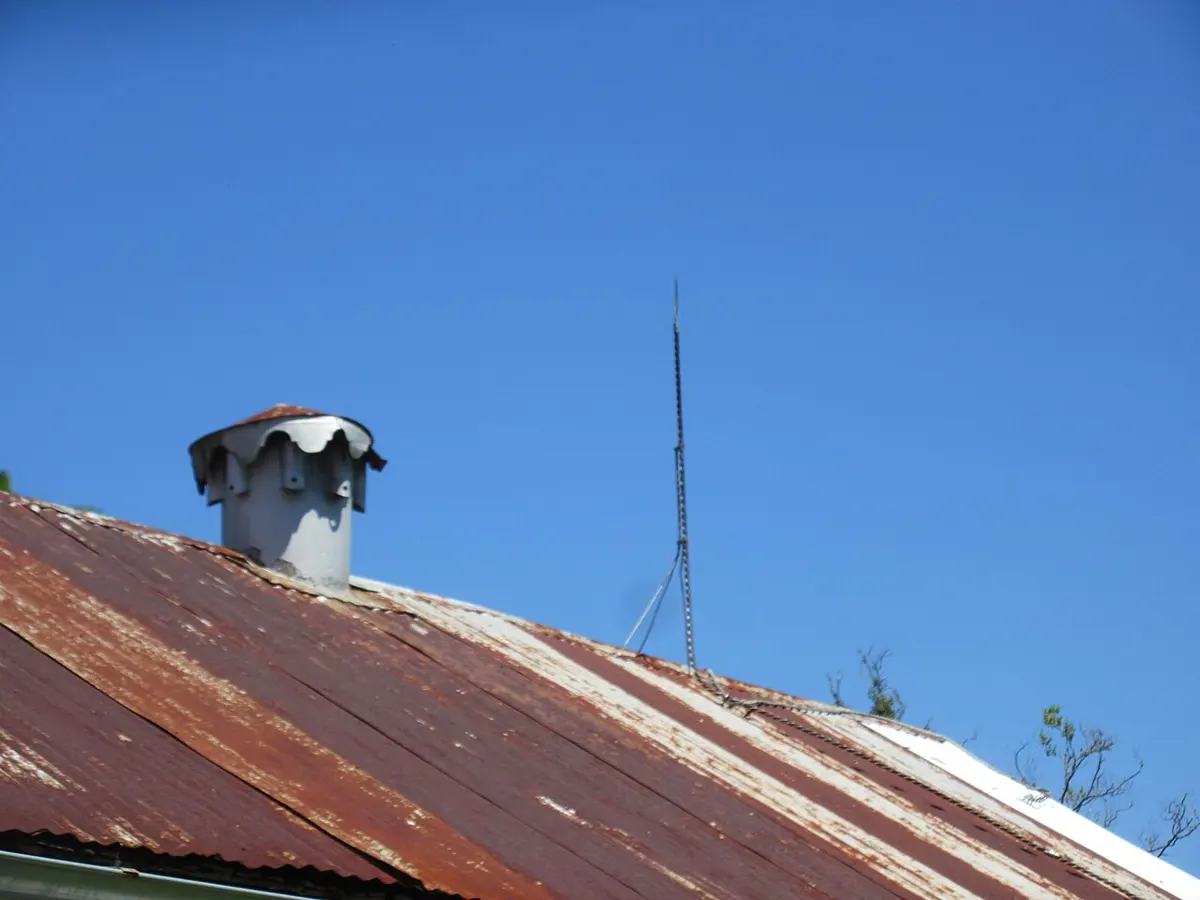
Answer
- i.A lightning rod (lightning conductor).
- ii.It protects the building from lightning: a strike hits the rod, and its current is led down a copper strip into the ground instead of through the building.
- iii.When a negatively charged cloud comes over the house, its negative charge pushes electrons in the ground and the house away, so the top of the house (and the pointed rod) becomes positively charged. When the charges become large enough, electrons rush through the air from the cloud to the highest point, the rod, in a giant spark: lightning. The current then runs down the copper strip into the earth. See Figure 8.6 and Figure 8.7.