
Your class is lining up for a photo. The teacher says, “Tall students at the back.” Some students walk to the back at once. Some stop and look round. Is a student of 140 cm tall? Is one of 145 cm?
Then the teacher says, “Students whose roll number is less than 10, sit in front.” Nobody stops to think. Roll numbers 1 to 9 sit down, and everyone agrees who they are.
Both are groups of students. But only the second is what mathematicians call a set. In this unit you will learn what makes a group a set, how to write a set in three ways, and how to say that something belongs to it. In Back to the photo you will turn “the tall students” into a set.
1.0 Review
With the bus in it, the poster is just a mixture: it is hard to say what kind of collection it is. Without the bus, it is the collection of the animals in the poster. And for that collection, anyone can say for sure whether a thing is in it or not: the goat is, the bus isn’t, a buffalo isn’t (it is not in the poster).
A collection like that is called a set. If we name the set A, we write its members inside curly brackets, separated by commas:
A = {elephant, lion, goat, deer, cat, ox}
What a set is
A set is a well-defined collection of objects. Well-defined means that, for anything at all, you can say for certain whether it belongs to the collection or not. Everyone who knows the rule gets the same answer.
- A set is named by a capital letter: A, B, C, …
- The things in a set are its members, also called its elements. When members are written as letters, small letters are used: a, b, c, …
Now sort them yourself. Pick a rule, tap the cards that belong to it, and press Check. Three friends have sorted the same cards. Do they agree with you?
Which of these is a set?
Pick an answer to see why.
In the set V = {a, e, i, o, u}, what are a, e, i, o and u called?
Pick an answer to see why.
Exercise 1.1
Question 1
Say what each collection is the set of.
Sunday, Monday, Tuesday, Wednesday, Thursday, Friday, Saturday
Answer
2, 3, 5, 7
Answer
a, e, i, o, u
Answer
Question 2
Look at each collection, and name the set.
Answer
Answer
Answer
Answer
Question 3
Cross out the odd one, and name the set that is left.
Answer
Answer
Answer
Answer
Question 4
Is each collection a set? Give a reason.
The Grade 6 students who write good letters
Answer
The students who sing well
Answer
The teachers who teach Grade 6 in your school
Answer
The Grade 6 textbooks
Answer
The factors of 30
Answer
1.1 Methods of describing a set
Writing the members inside curly brackets is one way to write a set. There are three ways, and each says exactly the same thing.
1. Listing method. Write every member inside curly brackets { } (also called middle brackets, or braces), separated by commas.
V = {a, e, i, o, u}
2. Describing method. Say in words what the members have in common, inside the brackets.
V = {vowels of the English alphabet}
3. Set-builder method. Use a letter, often x, to stand for any member, and give the rule it must obey. For example, for the prime numbers less than 10:
P = {x:x is a prime number less than 10}
Read it as “P is the set of all x such that x is a prime number less than 10”. The colon “:” means such that. The letter x is a variable: it stands in for each number in turn. The numbers that obey the rule are 2, 3, 5 and 7, so P = {2, 3, 5, 7} by listing.
See the three methods work together below. The rule tests each number; the numbers that pass make the listing.
To write a set by the listing method:
- a.choose a capital letter for the set;
- b.find all its members;
- c.write them inside { }, separated by commas;
- d.write each member once, never twice.
Which is the set-builder method?
Pick an answer to see why.
What is {x:x is a factor of 9} by listing?
Pick an answer to see why.
Exercise 1.2
Question 1
Write each set by the listing method.
The set of the months of the Nepali calendar
Answer
The set of colors in the national flag of Nepal
Answer
The set of whole numbers less than 10
Answer
The set of prime numbers less than 10
Answer
Question 2
Write each set by the describing method.
A = {2, 4, 6, 8, 10}
Answer
B = {1, 3, 5, 7, 9}
Answer
C = {3, 6, 9, 12, 15}
Answer
D = {1, 3, 9}
Answer
Question 3
Write each set by the set-builder method.
A = {2, 4, 6, 8, 10}
Answer
B = {1, 4, 9}
Hint
Answer
C = the set of composite numbers up to 20
Answer
T = {right-angled triangle, acute-angled triangle, obtuse-angled triangle}
Answer
Question 4
Write each set by the listing method, and say how many members it has.
A = {prime numbers that divide 15}
Answer
B = {x:x is a multiple of 4 up to 40}
Answer
C = {counting numbers greater than 2 and less than 7}
Answer
D = {factors of 20}
Answer
1.2 Membership of a set
To say that something is a member of a set, we use the symbol ∈. To say that it is not, we use ∉.
- marigold ∈ F is read “marigold belongs to F” (or “is a member of F”).
- velvet flower ∉ F is read “velvet flower does not belong to F”.
The symbols go between a member and a set, always in that order: member first, then set.
S = {Nepal, India, Bhutan}. Which is true?
Pick an answer to see why.
Exercise 1.3
Question 1
Fill in each blank with ∈ or ∉.
1 ___ {factors of 6}
Answer
△ ___ {□, ⊙, △}
Answer
9 ___ {multiples of 3}
Answer
9 ___ {prime numbers less than 15}
Answer
Question 2
S is the set of the member countries of SAARC: S = {Afghanistan, Bangladesh, Bhutan, India, Maldives, Nepal, Pakistan, Sri Lanka}. True or false?
a. Nepal ∈ S
Pick an answer to see why.
b. Thailand ∉ S
Pick an answer to see why.
c. India ∈ S
Pick an answer to see why.
d. Bangladesh ∉ S
Pick an answer to see why.
Question 3
Write each set by the listing method.
The set of the letters in the word kathmandu
Answer
The set of the letters in the word mathematics
Answer
The set of the letters that are in both words
Answer
Mixed exercise
Question 1
A = {factors of 6} and B = {prime numbers less than 10}. Write A and B by the listing and the set-builder methods.
Answer
Question 2
Write the set of composite numbers less than 10 by the describing method.
Answer
Question 3
A = {even numbers less than 10} and B = {odd numbers less than 10}. Write A and B by the listing and the set-builder methods.
Answer
Printable PDFs
- Study notes 1 page
- Harder practice questions 2 pages Answer key
Practice every question in the book, and keep track of the ones you miss →
Back to the photo
Is “the tall students in our class” a set? No. “Tall” has no exact meaning, so two people can sort the class differently and neither is wrong. The collection is not well defined.
To make it a set, give the rule an exact measure. “The students of our class who are taller than 150 cm” is a set: measure each student, and the answer is certain. The roll numbers were already a set: R = {x:x is a roll number less than 10} = {1, 2, 3, 4, 5, 6, 7, 8, 9}.
Where this is used
- Elections. Nepal’s Election Commission prepares a voters’ list before an election. Who is on it is decided by exact rules, such as the voting age of 18, so that everyone agrees who may vote: a well-defined set.
- Searching a database. A school’s computer can find “all Grade 6 students with a roll number under 20” at once. Database languages such as SQL pick the records that obey a rule, written after the word
WHERE: a set-builder rule for a computer. - Filters in apps. A shopping app’s filters (“shoes, size 38, under Rs 2,000”) show you the set of items that obey every rule you ticked.
- All of mathematics. Numbers, shapes and functions are described with sets in modern mathematics, which is why sets come first in this book.
Where these facts come from
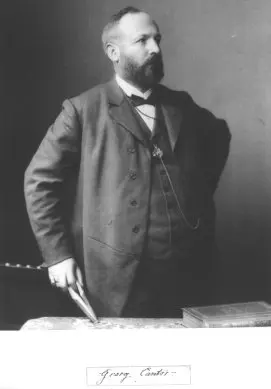
- Cantor and his definition: Wikipedia, “Set (mathematics)” (Cantor, 1845–1918; his “definite and separate objects of our intuition or our thought”; a set does not change if elements are repeated or put in another order; Zermelo’s braces, 1908), read November 2026.
- The symbol ∈: Wikipedia, “Element (mathematics)” (Peano, Arithmetices principia, 1889, “Signum ∈ significat est”; from epsilon, the first letter of ἐστί), read November 2026.
- SAARC: Wikipedia, “South Asian Association for Regional Cooperation” (eight members; founded 8 December 1985 in Dhaka; secretariat in Kathmandu; Thailand neither a member nor an observer), read November 2026.
- Nepal’s flag: Wikipedia, “Flag of Nepal” (crimson red, with a blue border and white emblems), read November 2026.
- Voters’ list and voting age: Wikipedia, “Elections in Nepal” (the Election Commission prepares the voters’ list; the voting age is 18), read November 2026.
- SQL: Wikipedia, “Where (SQL)” (a WHERE clause keeps only the rows that meet a condition), read November 2026.
A companion to your textbook, not a replacement for it: study from the book your school uses, and where the two differ, follow your teacher. Found a mistake? Please tell us.