
Your mother’s potted plant is drooping. Is it thirsty? Is the afternoon sun too strong? Did someone pour soapy water into it? You could guess, or you could find out. Finding out, in a careful and fair way, is what science is.
This unit gives you two tools every scientist uses. The first is the fair test: change one thing, watch one thing, and keep everything else the same. The second is a trick with units that lets you catch a wrong formula before it fools you.
What a scientific study is
A scientific study looks at things in nature in a planned and organized way. It doesn’t trust opinions or guesses; it trusts evidence, things that can be observed and measured. Out of this evidence come scientific facts, theories and models.
Every event in nature has causes. The plant wilts because of something. A factor that is connected with an event, directly or indirectly, and can change, is called a variable.
1.1 Variables of scientific research
Cause and effect
When something happens, we want to know why. Take the wilting plant. Maybe it lacks water; maybe the sun is too hot. To find out, we can move it into the shade, or water it, and watch what happens.
- The cause (lack of water, too much sun) is what makes something happen.
- The effect (wilting) is what happens.
The effect depends on the cause, and how much it depends matters. A stem stays stiff when it is full of water and goes limp as the water runs out. If we know how the size of the cause is linked to the size of the effect, we can predict: “If I forget to water it for two hot days, it will wilt.” Then we can act before it happens.
Finding these links, and in the end understanding how nature works, is the job of a scientist. And the way to find them is the experiment.
Activity 1.1: a rubber-band catapult
No rubber band at hand? Try the experiment here first.
What makes something a variable
In the catapult, you changed one quantity (the extension) and watched how another quantity (the distance) changed. Both are physical quantities, things you can measure, and both had a different value each time. That is why they are called variables: the quantities that change, or could change, in an experiment.
Other things could have changed too: the thickness of the rubber band, or the size of the paper bullet. So they are variables of this experiment as well, even if we chose not to change them.
To write about variables quickly, we give each one a symbol. If e is the extension and x is the distance, the result of the experiment can be written as
which is read “x is proportional to e”, and means: the more you stretch, the farther it flies.
Three kinds of variables
Variables are sorted into three kinds: independent, dependent and controlled. A simple way to remember them:
| Kind | In plain words | In the catapult |
|---|---|---|
| Independent variable | what I change | the extension of the rubber band |
| Dependent variable | what I observe (measure) | the distance the bullet flies |
| Controlled variables | what I keep the same | the thickness of the band, the size of the bullet |
a. Independent variable
The experimenter is free to choose its value: you decide to stretch the band 4 cm, then 6 cm. It is the cause you are testing. Its value does not depend on anything else in the experiment, which is why it is called independent.
In a plant-growth experiment, the amount of fertilizer, sunlight or water could each be the independent variable.
b. Dependent variable
You can’t decide how far the bullet will fly. You can only let go and measure it, because the distance depends on how much you stretched the band. A variable whose value depends on another variable, and that the experimenter cannot set directly, is the dependent variable. It is the effect.
If you study how sunlight affects a plant, the amount of sunlight is the independent variable, and the height or growth of the plant is the dependent variable.
c. Controlled variables
Most experiments have more than two things that could change, and each of them could affect the result. Suppose you used a thick band for the 4 cm shot and a thin one for the 6 cm shot. The bullet went farther the second time. Was it the stretch, or the band? You can’t tell. The result is worthless.
So every variable except the independent and dependent ones must be kept the same, or controlled, all through the experiment. That makes the results valid, reliable and accurate. Controlled variables are what make a test fair.
Seedling: V. Rattan, A Popular California Flora (1888), public domain
In the light-and-plants experiment of Figure 1.2, the plants should all be the same size at the start, and get the same air, water and manure, in the same kind of pot and soil. Those are the controlled variables.
Or suppose you study how the surface area of limestone affects how fast it reacts with acid (powder versus lumps). The surface area is the independent variable and the rate of reaction is the dependent variable. The concentration and amount of acid, and the mass of limestone, must stay the same: they are the controlled variables.
More examples
| What is being studied | Independent variable (what I change) | Dependent variable (what I observe) | Controlled variables (what I keep the same) |
|---|---|---|---|
| How turning a tap’s knob affects the flow of water | how far the knob is turned (degrees) | water flowing out per minute (liters) | the water pressure |
| How electricity makes a solenoid magnetic | the electric current (amperes) | the number of pins the electromagnet picks up | the number of turns in the solenoid, the size of the pins |
| How heat affects how much sugar dissolves | the temperature of the water (°C) | the mass of sugar that dissolves completely (grams) | the amount of water (always 100 g) |
| How exercise affects the heartbeat right away | how long you exercise (minutes) | the number of heartbeats | the type of exercise, the time between stopping and counting |
Now you try. Each of these is a real experiment.
Sita puts ice cubes of the same size in cups of water at 20 °C, 40 °C and 60 °C, and times how long each takes to melt. What is the dependent variable?
Pick an answer to see why.
Ramesh wants to know whether a heavier ball bounces higher. He drops a tennis ball, a cricket ball and a football. What is wrong with his test?
Pick an answer to see why.
Rules for variables
- An experiment should have only one independent variable. Change two things at once and you can’t tell which one caused the effect.
- It should have only one dependent variable: the one thing you measure.
- All other variables are controlled.
- In an equation, the dependent variable is usually written on the left, and the independent variable on the right. That is why they are sometimes called the left and right variables. In , the distance depends on the time ; the speed is kept the same. So is dependent, is independent, and is controlled.
- On a graph, the independent variable goes along the horizontal x-axis, and the dependent variable up the vertical y-axis. So they are also called the x-variable and the y-variable. A graph shows how a change in the independent variable brings a change in the dependent one. (The catapult’s graph above is drawn this way.)
1.2 Types of units
Every physical quantity is measured in a unit: length in meters, time in seconds. Units come in two types:
- Fundamental (base) units
- Derived units
Fundamental units
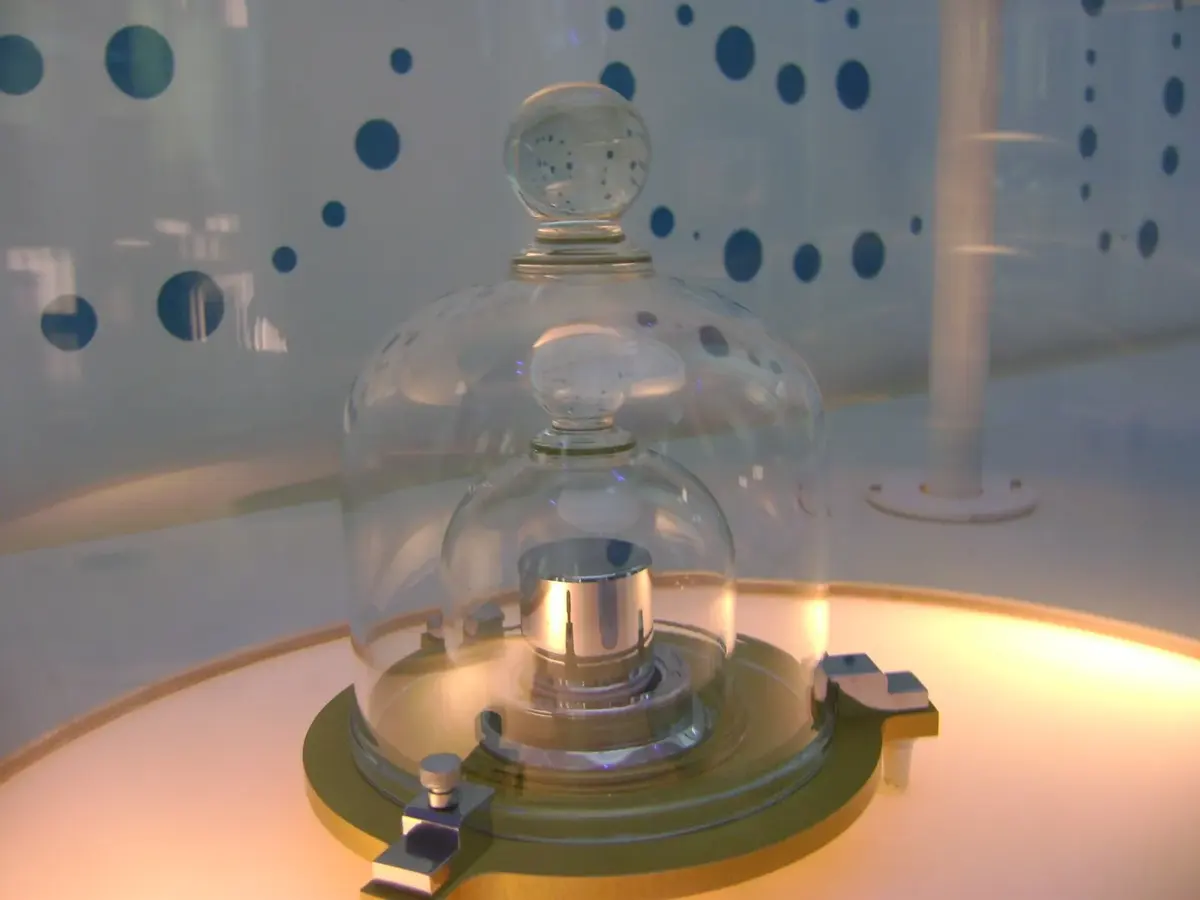
A fundamental unit stands on its own. It does not depend on any other unit and can’t be broken into simpler units. The meter (length), the kilogram (mass) and the second (time) are fundamental units.
The SI system (the International System of Units, used by scientists everywhere) has seven fundamental units:
| Physical quantity | SI unit | Symbol |
|---|---|---|
| length | meter | m |
| mass | kilogram | kg |
| time | second | s |
| temperature | kelvin | K |
| luminous intensity (brightness of light) | candela | cd |
| electric current | ampere | A |
| amount of substance | mole | mol |
Derived units
A derived unit does not exist on its own. It is made by combining two or more fundamental units.
The unit of density is kg/m³ (kilograms per cubic meter): it is made of the kilogram and the meter. The unit of force is kg m/s², made of three fundamental units, the kilogram, meter and second. Saying “kilogram meter per second squared” every time is tiring, so this combination has a short name of its own: the newton (N).
In the same way, the unit of pressure, kg m⁻¹ s⁻², is called the pascal (Pa). Many derived units have special names like this. Some don’t: the unit of density is just kg m⁻³.
| Quantity | Formula | Units according to the formula | Derived unit | Special name |
|---|---|---|---|---|
| area | length × breadth | meter × meter | m² | |
| volume | length × breadth × height | meter × meter × meter | m³ | |
| density | mass ÷ volume | kilogram ÷ metre³ | kg/m³ | |
| velocity | displacement ÷ time | meter ÷ second | m/s | |
| acceleration | change in velocity ÷ time | meter ÷ (second × second) | m/s² | |
| force | mass × acceleration | kilogram × meter ÷ (second × second) | kg m/s² | newton (N) |
| pressure | force ÷ area | (kg m/s²) ÷ metre² | kg m⁻¹ s⁻² | pascal (Pa) |
| work, energy | force × distance | (kg m/s²) × meter | kg m² s⁻² | joule (J) |
| power | work ÷ time | (kg m²/s²) ÷ second | kg m² s⁻³ | watt (W) |
| frequency | 1 ÷ time | 1 ÷ second | s⁻¹ | hertz (Hz) |
Finding the fundamental units in a derived unit
Start from the formula that defines the quantity, and put in the unit of each part.
| Fundamental unit | Derived unit |
|---|---|
| does not depend on other units | depends on fundamental units |
| there are only seven | there are many, all made from the seven |
Checking equations with units
Here is the second tool, and it is a powerful one. Scientific study gives us formulas and equations. Units can tell us whether an equation could be right, and the rule is simple:
In a correct equation, both sides have the same units.
An example
Is correct? (distance = speed × time)
- Left side: is a distance, in m.
- Right side: is m s⁻¹ × s = m.
Both sides are meters, so the equation is valid.
Someone else says . Check:
- Left side: m.
- Right side: m s⁻¹ ÷ s = m s⁻².
A distance can’t equal something measured in m s⁻². The equation is wrong.
Adding and subtracting
You can only add or subtract quantities with the same units. Two speeds can be added: is fine, as both are in m s⁻¹. You can’t add 5 meters to 3 seconds; the answer would mean nothing.
- is possible: is in m, and is m s⁻² × s² = m.
- is not possible: is in m, but is m s⁻² × s = m s⁻¹, a speed.
So unit analysis is used to check whether an equation could be correct, to find how physical quantities are related, and to convert between different systems of units.
Exercise
1. Choose the correct option
a. Which of these is a fundamental unit?
Pick an answer to see why.
b. Which physical quantity has the unit m s⁻¹?
Pick an answer to see why.
c. Which of these is a derived unit?
Pick an answer to see why.
d. Which of these is the newton?
Pick an answer to see why.
2. Give reasons
The joule is a derived unit of work.
Answer
Some variables should be controlled while doing an experiment.
Answer
is not a valid relation.
Answer
3. Differentiate between
Independent variable and dependent variable
Answer
Fundamental unit and derived unit
Answer
4. Answer these questions
What is a unit?
Answer
Write the SI units of mass, temperature, energy and density.
Answer
How is the validity of an equation checked? Give an example.
Answer
Which fundamental units make up the unit of pressure?
Answer
Find the fundamental units in:
- i.newton (N)
- ii.watt (W)
- iii.joule (J)
- iv.pascal (Pa)
Answer
Niva claimed that another formula for power is , and that a formula for pressure is . Check both by their units.
Hint
Answer
Describe the independent, dependent and controlled variables, with an example of each.
Answer
Karma connected a dry cell to a bulb with a few pieces of wire, and the bulb lit. He wondered how the thickness of the wire affects how long the dry cell lasts. Name the independent, dependent and controlled variables.
Answer
Chandani wanted to find out how substances mixed into soil affect plant growth. She sieved a bucket of soil from a field and shared it equally among 12 pots of the same size. She mixed two spoons of lime into each of three pots, two spoons of urea into the next three, two spoons of table salt into the next three, and two spoons of compost into the last three. She planted similar seeds of the same plant in every pot, kept them all in a sunny place in the house, and watered all of them every day. Once the plants grew, she measured the height of each one daily.
- i.Name the independent, dependent and controlled variables in Chandani’s experiment.
- ii.Why did she use 3 pots for each substance?
Answer
Subodh wanted to find out how the color of an object affects how much heat it holds. He painted four conical flasks with enamel: black, white, green and red. He filled them with water, closed each one tightly with a cork, and kept them in the sun. After some time he measured the temperature of the water in each flask with a thermometer. Name the independent and dependent variables. Which variables should Subodh control?
Answer
Manisha wanted to test her dog’s eating habits. She decided to study how the amount of food and the time of giving food affect how fast the dog eats. What is wrong with her experiment, and how can she fix it?
Answer
Show that the unit of electrical resistance, the ohm (Ω), is kg m² s⁻³ A⁻².
Hint
Answer
Quiz yourself: Scientific Learning, Grades 5–10 →
Practice every question in the book, and keep track of the ones you miss →
A companion to your textbook, not a replacement for it: study from the book your school uses, and where the two differ, follow your teacher. Found a mistake? Please tell us.