
In 1991 the American economist Herbert Simon asked his readers to imagine a visitor from Mars, coming down toward the Earth with a telescope that shows how people work together. Firms show up as solid green patches. Each time one firm buys from another or sells to it, a red line joins them. Inside the green, faint blue lines run from bosses to the people they direct. Now and then a green patch splits in two, or swallows another, as when two firms merge. Over the United States or the Soviet Union, over a Chinese city or western Europe, most of what the visitor saw would be green, because nearly everyone below worked for an organization. Its report home, Simon thought, would speak of “large green areas interconnected by red lines”, not “a network of red lines connecting green spots”. It might wonder why we call this a market economy.
The last two chapters showed what markets do well. A crowd of buyers and sellers, with nobody in charge, finds a price, and the price tells everyone how much to make and how much to buy. Yet inside a factory, a bank or a hospital, prices disappear. If markets are so clever, why does anyone have a boss?
The plain answer is that using a market costs something. Every deal means finding someone, agreeing a price, checking that the work was done, and sorting out what went wrong. For a sack of sugar bought once a week, that is easy. For work that has to be done many times a day, in ways nobody can write down in advance, it is easier to agree once, a wage for the month in return for doing what’s needed, and let one person decide the rest. A firm is a group of people who have made that kind of agreement. Inside it, orders do the job that prices do outside.
Anshu’s tea shop shows how it happens. Business has grown, and in the afternoon rush the dirty glasses pile up faster than she can pour. She could pay someone by the glass each time, bargain over the rate every afternoon and check every glass. Instead she takes on Sujan, a young man from a village up the road (made up, like her), for a monthly wage. She doesn’t list his tasks. Today he washes glasses, tomorrow he carries the gas cylinder up from the road, and when a customer wants biscuits he runs next door for them. The shop has become a firm, a very small one. Anshu gives the orders, and it is the shop, not each glass, that deals with the market.
Why there are firms at all
The puzzle was first put clearly by a student. In 1931 Ronald Coase, twenty years old and studying commerce in London, sat in the seminar of a professor who taught that a competitive economy coordinated by prices would make what people valued most, with no planning needed. Coase was convinced, and troubled. Every firm had managers, and their whole job was to coordinate. Why were they needed, if prices did it all? Lenin had said that Russia’s economy would be run as one big factory, and economists in the West said such planning could never work. Yet the West was full of factories, some of them enormous, each run by a plan of its own.
A traveling scholarship took Coase to the United States for a year, where he went round factories and businesses asking why industries were organized so differently. By the summer of 1932 he had his answer. As he put it much later, “there were costs of using the pricing mechanism. What the prices are has to be discovered. There are negotiations to be undertaken, contracts have to be drawn up, inspections have to be made, arrangements have to be made to settle disputes, and so on.” Economists now call these transaction costs. Where they are high, it pays to stop trading and start directing, and a firm appears. Coase gave the idea in a lecture in Dundee, in Scotland, in October 1932, when he was twenty-one. He published it in 1937 as “The Nature of the Firm”, and in 1991 he was given the Nobel prize in economics.
The same idea says where a firm should stop. Directing costs something too. Bosses make mistakes, and the bigger a firm, the more there is to watch. A firm survives, Coase argued, only while it coordinates more cheaply than the market would, and more cheaply than another firm could. So Anshu hires a helper but doesn’t grow her own sugarcane, and she buys her gas from Nepal Oil Corporation instead of importing it herself. An older economist, Dennis Robertson, had described firms as “islands of conscious power in this ocean of unconscious co-operation like lumps of butter coagulating in a pail of buttermilk.” Coase’s answer explains how much butter there is.
Simon added that his Martian would see something different over the villages of central Africa, or of rural India and China. There the green patches would be far smaller, and much of the land would be covered by little black dots, families and villages making most of what they needed, only partly drawn into markets. Nepal would look like that too. Its economic census of 2018 counted every shop, workshop, school, hotel and factory with a fixed place, though not unregistered farms or government offices: 923,356 of them, with about 3.2 million people working in them, between three and four to each. Nine in ten were owned by one person, and half weren’t registered with any office at all. From above, Nepal’s green would mostly be specks.
Dividing the work
A boss is worth having for another reason. Once people work together, the work can be split up, and that is where most of the gain comes from. Adam Smith made the point in the first chapter of The Wealth of Nations, in 1776, with the humblest thing he could think of, a pin.
A man with no training, Smith wrote, “could scarce, perhaps, with his utmost industry, make one pin in a day, and certainly could not make twenty.” But in a pin workshop, “one man draws out the wire, another straights it, a third cuts it, a fourth points it, a fifth grinds it at the top for receiving the head”, and so on through about eighteen separate steps. Smith had seen a small workshop where ten men, some doing two or three steps each, could make about twelve pounds of pins a day, more than 48,000 pins, or 4,800 for each man. Working alone, each might not have made twenty. The workshop’s production was the same kind of thing, pins, but its productivity, what each worker made in a day, was hundreds of times greater. Splitting a job into parts like this is called the division of labor, श्रम विभाजन, and a person or place that sticks to one part is specializing, विशिष्टीकरण.
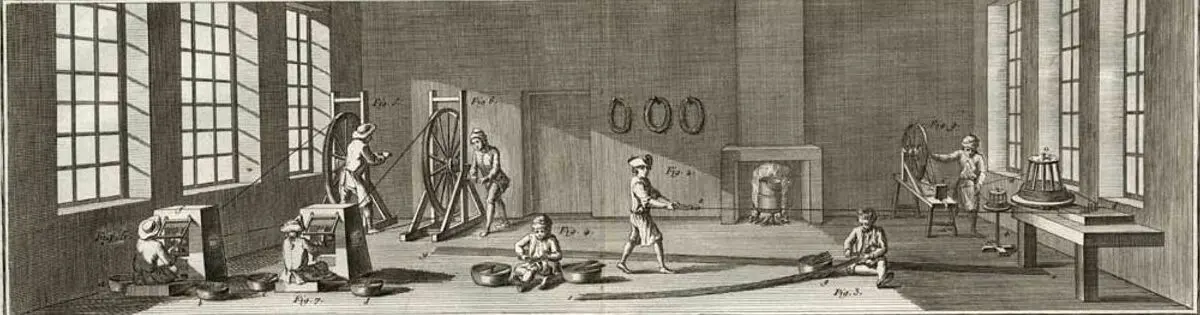
Smith gave three reasons. A person who does one thing all day gets very good at it. He had met smiths who could make nails when they had to, two or three hundred a day, “and those, too, very bad ones”, and boys who had done nothing but make nails who could each turn out more than 2,300. Less time is lost moving from one job to another, with different tools in a different place. And a worker who thinks about one small task all day is likely to find a quicker way to do it, so many of the machines in the workshops had first been invented by the workers themselves.
But a job can only be split as finely as there are buyers for the parts. The division of labor, as Smith put it, is limited by the extent of the market. A porter, someone who carries loads for a living, could find enough work only in a big town. In the lonely Highlands of Scotland every farmer had to be his own butcher, baker and brewer. Anshu’s town has enough customers to keep one helper busy. A big restaurant in Kathmandu can have one person making only tea, another rolling only momos and a third washing only plates.
Work is divided in three ways. A single job is split into steps, like the pins. A society splits into trades, so the farmer, the tailor, the teacher and the driver each do one kind of work and buy the rest; economists group them into three sectors, taking from nature (farming, forestry, mining), making things (factories, building), and services (shops, schools, transport). And places specialize: the tea in Anshu’s glass comes from the gardens in the east, where it grows well, and the rest of the country buys it. Countries specialize too, which is the subject of a later chapter.
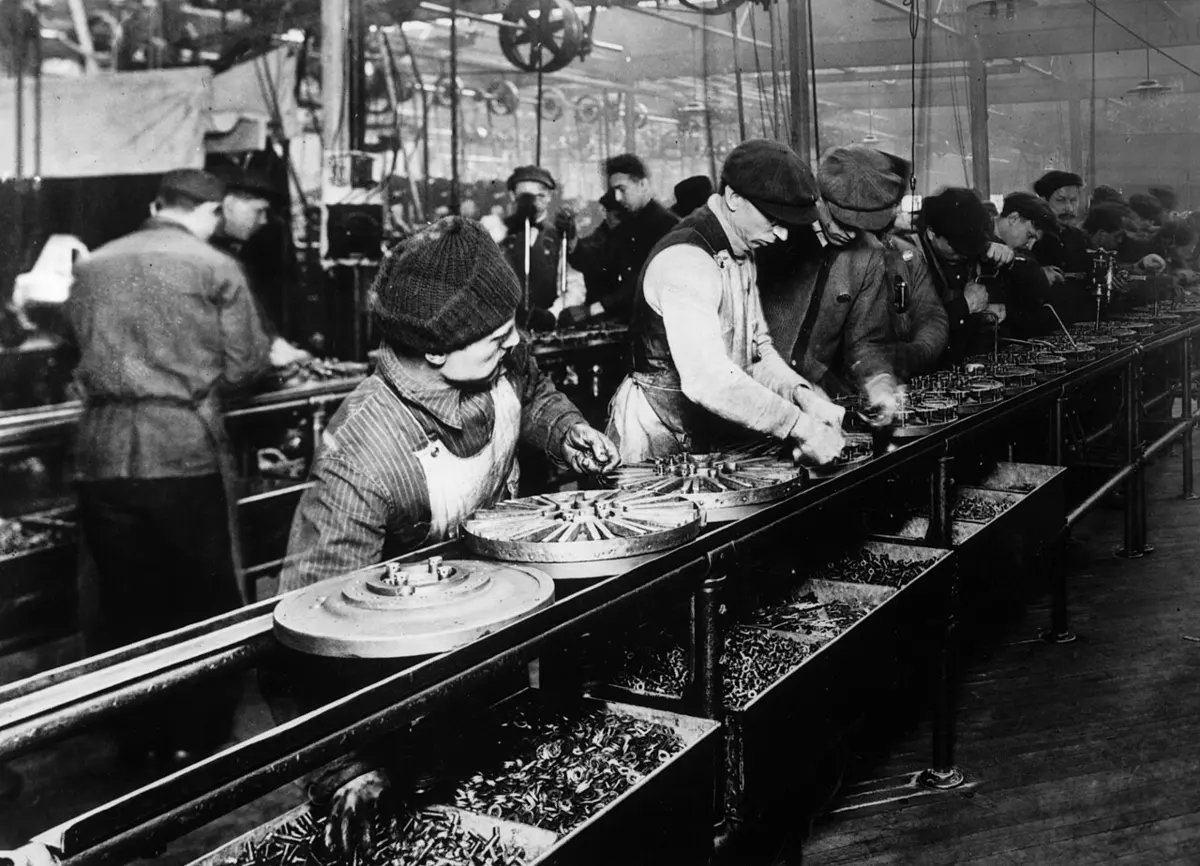
The gains have a price, and the workers usually pay it. In 1913 the Ford Motor Company in the United States set its cars moving past the workers on a line, pulled at first by a rope. Each man now did one or two tasks instead of helping to build a whole car, and the Model T was built in about an hour and a half. The workers found it boring and disliked the line’s strict timing, and they began leaving for other companies. Ford’s answer was the five-dollar day, more than double what a worker had been paid.
Smith had seen this coming. Near the end of the same book that opens with the pin factory, he warned that a man who spends his whole life on “a few simple operations” loses the habit of thinking, and “generally becomes as stupid and ignorant as it is possible for a human creature to become.” His remedy was a little school in every district, its teacher paid partly by the public, where children could learn to read, write and do sums for a fee even a laborer could afford. There are other costs. A worker who knows only one step is stranded when a machine takes it over. And the more finely the work is divided, the more everyone depends on everyone else. When one step in the chain stops, from a closed road to a missing part, the whole line stops with it.
What it takes to make anything
Look again at Anshu’s shop and four kinds of things are going into each glass of tea. There is the room and the ground under it. There is the work of her hands and Sujan’s. There are the burner, the pans, the glasses and the benches. And there is Anshu herself, who brought all of it together and who loses if it fails. Economists call these four the factors of production, उत्पादनका साधन: land, labor, capital and enterprise. Each is paid in its own way, rent for land, wages for labor, interest for capital and profit for enterprise, and why each is paid what it is waits for a later chapter. What matters here is what makes each one different.
Land, भूमि, means much more than ground. It is everything nature provides: the soil, the water, the forests, the stone and the minerals underneath, the river that turns a turbine. No amount of work can make more of it in total, and a plot can’t be moved to where it would be more useful. That is why it varies so much in price. A few square meters on a busy road in Kathmandu earn far more than a terrace far up a hill path, though the hill soil may be better. Land can be improved, by terracing or irrigation, or worn out and washed away, but its total stays more or less what nature gave.
Labor, श्रम, is human effort, “whether with the hand or the head”, as the English economist Alfred Marshall put it: Sujan carrying gas, Anshu working out what to charge, a teacher, a pilot, a programmer. Land and capital do nothing by themselves; labor is the active factor, the one that sets the others working. Two more things set it apart. A day’s work can’t be stored. If Sujan is ill on Tuesday, Tuesday’s work is gone for good, as a sack of sugar never is. And the worker comes with the work. “The worker sells his work,” Marshall wrote, “but he himself remains his own property.” A person has to be present where the work is done, so where it is, how safe it is and whom he works beside matter to him in a way they never matter to a sack of sugar. What a worker can do depends on her schooling, skill and health, so a country can make its labor worth more by investing in its people. Nepal’s school books count work as labor when it is done for pay. A great deal of work, cooking, caring and fetching water at home, is done for none, and a later chapter comes back to it.
Capital, पुँजी, is anything people have made in order to make something else: the burner and the pans, a building, a truck, a road, a machine, a computer. In everyday speech capital means money, and money is how most capital is bought, but an economist counts the burner, not the cash it cost. Capital needs saving, because to build or buy it someone has to give up spending today. And it wears out. The glasses break and the burner rusts, so part of what a business earns has to go toward replacing them. Adding to a country’s stock of capital is called capital formation, पुँजी निर्माण.
The fourth factor has two names in Nepal’s books: enterprise, उद्यम, in Grade 9, and organization, सङ्गठन, in Grade 11. Older economists counted only three factors, and Marshall thought it best “sometimes to reckon Organization apart as a distinct agent of production.” It is the work of deciding what to make, how and for whom, bringing land, labor and capital together, trying new ways of doing things, and carrying the risk. Anshu agrees the rent, Sujan’s wage and the interest on her loan before she sells a glass, and she has to pay them whatever happens. What is left after all of them is her profit, and it may turn out to be a loss. The person who takes that chance is called an entrepreneur, उद्यमी.
Who owns a firm
Firms come in a few kinds, and one question separates them more than any other: if the business fails and can’t pay its debts, who has to pay?
Anshu’s shop belongs to one person. That is a sole proprietorship, एकल स्वामित्व, the simplest kind, and the most common by far: it was nine in ten of the places the economic census counted. She makes every decision and keeps every rupee of profit. But if the shop runs up debts it can’t pay, she has to pay them herself, out of her savings, her jewelry, even her house. Her liability, as the law calls it, is unlimited. And the shop can grow only as fast as one person can save and borrow. Small firms can stay close to their customers and change quickly; big ones can buy in bulk, use costly machines and borrow more easily, which is why some kinds of work go to each.
Suppose Anshu and a friend decide to open a momo counter together, each putting in money and work and sharing the profit as they agree. That is a partnership, साझेदारी. Two people can raise more money than one and share the work. But if the business can’t pay its debts, the partners have to pay them from their own property, just as Anshu would alone.
A company, कम्पनी (in Nepal’s books a joint stock company, संयुक्त पुँजी कम्पनी), is different in one way that changed the world. The law treats it as a person in its own right, which can own things, sign agreements, borrow and be taken to court. Its owners hold shares, and if it fails, the most each of them can lose is what they paid for their shares. Their houses are safe. This is limited liability, and it is what lets thousands of strangers put their money into one business without each of them risking everything they own. In Nepal a private company, with “Private Limited” after its name, may have at most 101 shareholders and can’t sell shares to the public. A public company, with “Limited” after its name, needs at least seven and can sell shares to anyone; once listed, its shares are bought and sold on the Nepal Stock Exchange. Its accounts must be published every year, because its owners are many. They elect a board, the board hires managers, and the people who own the firm are no longer the people who run it.
Some firms are owned by the government, wholly or partly. These are public enterprises, सार्वजनिक संस्थान, set up to make things people need at a fair price, or to work where private firms wouldn’t go. The Nepal Electricity Authority is one. So is Nepal Oil Corporation, which supplies the gas under Anshu’s pan. Their aim is meant to be people’s welfare more than profit, though how well they manage it, and how much a government should own at all, are part of the old argument about markets and plans.
The last kind is owned by the people who use it. A cooperative, सहकारी, might be farmers who sell their milk together, or neighbors who pool their savings and lend to each other. Under Nepal’s law it needs at least thirty founding members, or fifteen for workers or young people running a business on their own labor or skills, and one hundred for a savings and credit cooperative in a big city. Each member has one vote however many shares he holds, and a member’s liability is limited to his shares. By March 2026 Nepal had about 32,000 registered cooperatives. How savings and credit cooperatives are watched over, and what happens to members’ money when one fails, is a story about banks that comes in a later chapter.
| Owned by | If it can’t pay its debts | |
|---|---|---|
| Sole proprietorship | One person | She pays, from all she has |
| Partnership | Two or more partners | They pay, from all they have |
| Company | Shareholders, through a board | They lose only what their shares cost |
| Public enterprise | The government | It does; the state decides its fate |
| Cooperative | Members, one vote each | They lose only their shares |
How to register one in Nepal is set out in Starting in Nepal.
So a firm is an island of orders in a sea of prices. It exists because using a market costs something, and it grows only while giving orders costs less. Inside it, work can be divided into steps, which makes people far more productive and their work narrower, as far as the market is large enough. Everything it makes takes land, labor, capital and the enterprise that brings them together. And who owns it decides who pays when it fails. With Sujan hired, Anshu has a new question: what each glass costs her to make, and how many she should make.
Found a mistake? Please tell us.