
Picture a tomato grower selling his crates at Kalimati, Kathmandu’s wholesale market for fruit and vegetables. If he asks Rs. 10 a kilo more than everyone around him, he will go home with his crates still full, and one who asks Rs. 10 less gives money away for nothing, since buyers would have paid the going price anyway. He decides how many tomatoes to grow and when to pick them. He doesn’t decide what they sell for. The Nepal Oil Corporation does decide. Every couple of weeks it reviews the price of petrol and diesel, one price for every pump in the country, and the drivers who fill up pay it.
Adam Smith saw the difference. “The price of monopoly,” he wrote, “is upon every occasion the highest which can be got. The natural price, or the price of free competition, on the contrary, is the lowest which can be taken.” Most real sellers sit somewhere between the tomato grower and the oil corporation, and where they sit depends on three things: how many sellers there are, how alike their goods are, and how easy it is for a newcomer to set up beside them. Many sellers of the same thing, free to come and go, leave each of them no power over the price at all. One seller with no rival can choose the price, though not what buyers will do about it.
Nepal’s books start with what a market is. It needs buyers and sellers, something to trade, a price, buyers who want the thing and can pay for it, and a way for the two sides to meet, whether a square in a bazaar or a phone. Some markets are local, like a weekly हाट (haat, a village market). Some cover the country, like rice, or cement from the factories in Udayapur, Arghakhanchi and Hetauda. Cardamom, ginger and tea are sold across the world. Economists sort markets in another way too, by how much competition there is in them, their बजार संरचना (market structure).
Many sellers, no power
The tomato market is close to what economists call perfect competition, पूर्ण प्रतिस्पर्धा. There are so many buyers and sellers that none of them is big enough to move the price. They all sell the same thing, so a buyer doesn’t care whose tomato it is. Everyone knows the going price. Workers, land and money can move into the trade and out of it, firms can start and stop freely, and the government leaves the price alone. No market has all of these exactly, and Nepal’s books call perfect competition imaginary, काल्पनिक. Wheat, rice and vegetables come close, and so do the tea shops of a busy bazaar.
In such a market the price is set by the whole trade, the industry, उद्योग, where the demand of all the buyers meets the supply of all the sellers. Each firm, फर्म, has to take it. Economists call it a price taker, मूल्य स्वीकारक. For one grower the demand for his tomatoes is a flat line at the going price: if tomatoes are going for Rs. 40 a kilo, he can sell a crate or a truckload at Rs. 40, and nothing at Rs. 41. Every extra kilo brings in exactly the price, so his average revenue and his marginal revenue are the same, and both are the price.
That leaves him one decision, how much to sell, and the rule for it is the one a shop uses for any output. Go on as long as one more unit brings in more than it costs. Stop where the marginal revenue equals the marginal cost, MR = MC. Nepal’s books call this the necessary condition, आवश्यक सर्त, and add a second one, the sufficient condition, पर्याप्त सर्त: at that point the marginal cost must be rising, cutting the marginal revenue line from below. The second matters because a firm’s marginal cost often falls before it rises. In Anshu’s tea shop, made up like everyone in it, an extra glass costs about Rs. 17.8 when she works alone, Rs. 16.4 once she has a helper, Rs. 18.8 as the room fills up, then far more. Stopping where that cost is still falling would be the worst choice, since the glasses just after cost even less to make. At the bazaar’s Rs. 25 a glass, the rising cost meets the price at about 280 glasses a day.
At 280 glasses, after rent, her own day and her helpers’ wages, Anshu keeps an economic profit of about Rs. 1,500 a day. In the short run, with the number of shops fixed, that can last. But nothing stops a newcomer from renting the room next door, buying a stove and selling the same tea, and Rs. 1,500 a day above what the work and the money could earn elsewhere is a reason to. As shops open, more tea is offered at every price, the going price falls, and every shop’s profit shrinks. New shops keep coming until there is no profit left to come for. That happens when the price has fallen to the lowest average cost, Rs. 19.6 a glass for Anshu’s shop, where she makes just enough to pay herself what she could earn elsewhere. Economists call that normal profit. If the price fell lower, shops would close and the price would climb back. In the long run, with firms free to come and go, the price settles at the bottom of the average cost.
There is a floor even in the short run. A shop that can’t cover its rent but can cover its milk, sugar and wages does better to stay open and lose a little than to close and lose the whole rent. Only when the price falls below its lowest average variable cost, Rs. 17 for Anshu, should it shut the door. In the long run, then, each glass sells for what it costs to make, Smith’s “lowest which can be taken”.
One seller
Now picture a tea house at a high pass on a trekking trail, the only one for a day’s walk either way (it is made up). Walkers arrive cold and tired, and the owner can charge what she likes. Here is the other end of the scale, एकाधिकार, monopoly, from the Greek for one seller. There is one seller, the good has no close substitute, and something keeps rivals out. The firm is the whole industry, so there is no going price to take: the owner is a price maker, मूल्य निर्धारक.
She can’t charge anything and still sell as much, though. The walkers’ demand still slopes down. Suppose that at Rs. 200 a glass they buy 10 glasses a day, and every Rs. 20 off sells 10 more:
| Price a glass | Glasses a day | Takings |
|---|---|---|
| Rs. 200 | 10 | Rs. 2,000 |
| Rs. 180 | 20 | Rs. 3,600 |
| Rs. 160 | 30 | Rs. 4,800 |
| Rs. 140 | 40 | Rs. 5,600 |
| Rs. 120 | 50 | Rs. 6,000 |
| Rs. 100 | 60 | Rs. 6,000 |
Her average revenue is the price, as for any seller, and it falls along the demand line. Her marginal revenue falls faster. Going from 30 glasses to 40 means cutting the price for all 40 walkers, not only the ten new ones, so her takings rise by Rs. 800, Rs. 80 for each extra glass, though each sells for Rs. 140. From 40 to 50 the extra glasses add only Rs. 40 each, and from 50 to 60 nothing at all. For a single seller marginal revenue always lies below the price.
Say each glass costs her Rs. 60 to make, with the tea, sugar, gas and the porter who carries them up. The rule is the same as the tomato grower’s: sell as long as an extra glass brings in more than it costs. Up to 40 glasses, each one adds more than Rs. 60 to her takings; after that, less. So she sells 40 glasses a day, and the price is what the walkers will pay for 40 glasses, Rs. 140, read off the demand line above that point. Over and above the cost of her glasses she makes Rs. 3,200 a day, and since no one can open beside her, the profit doesn’t get competed away.
If the pass had many tea houses, the price would be pushed down toward Rs. 60 and the walkers would drink about 80 glasses. Part of what they lose under the monopoly goes to the owner as her profit. Part goes to no one: 40 glasses that walkers would have paid more for than they cost to make are never made, because selling them would mean cutting the price on every other glass. That lost trade, worth Rs. 1,600 a day in the made-up numbers, is the economists’ main case against monopoly. Smith put it as the monopolist “keeping the market constantly understocked”.
What keeps rivals out takes a few forms. Sometimes it is the law: the Nepal Oil Corporation has had the whole import and distribution of petrol, and Nepal’s books give it, with the Nepal Electricity Authority, as the country’s examples of monopoly. Sometimes it is a resource: the diamond company De Beers long controlled most of the world’s diamond production. Sometimes it is a patent, which lets an inventor keep others from copying a new medicine or machine for a set number of years, twenty in the United States, in return for publishing how it works. And sometimes it is cost. Laying a second set of electricity lines or water pipes down every street would double the cost of the network for no more water or power, so one network serves everyone more cheaply than two. That is a natural monopoly. Nepal leaves its electricity wires almost entirely to one state body, but doesn’t let it name its own price: the Electricity Regulatory Commission fixes what the Electricity Authority may charge.
A seller with power over price can sometimes do better still by charging different buyers different prices for the same thing, as the tea house might if it could charge trekkers more than porters. Economists call it price discrimination, and it needs buyers who can’t easily resell to one another.
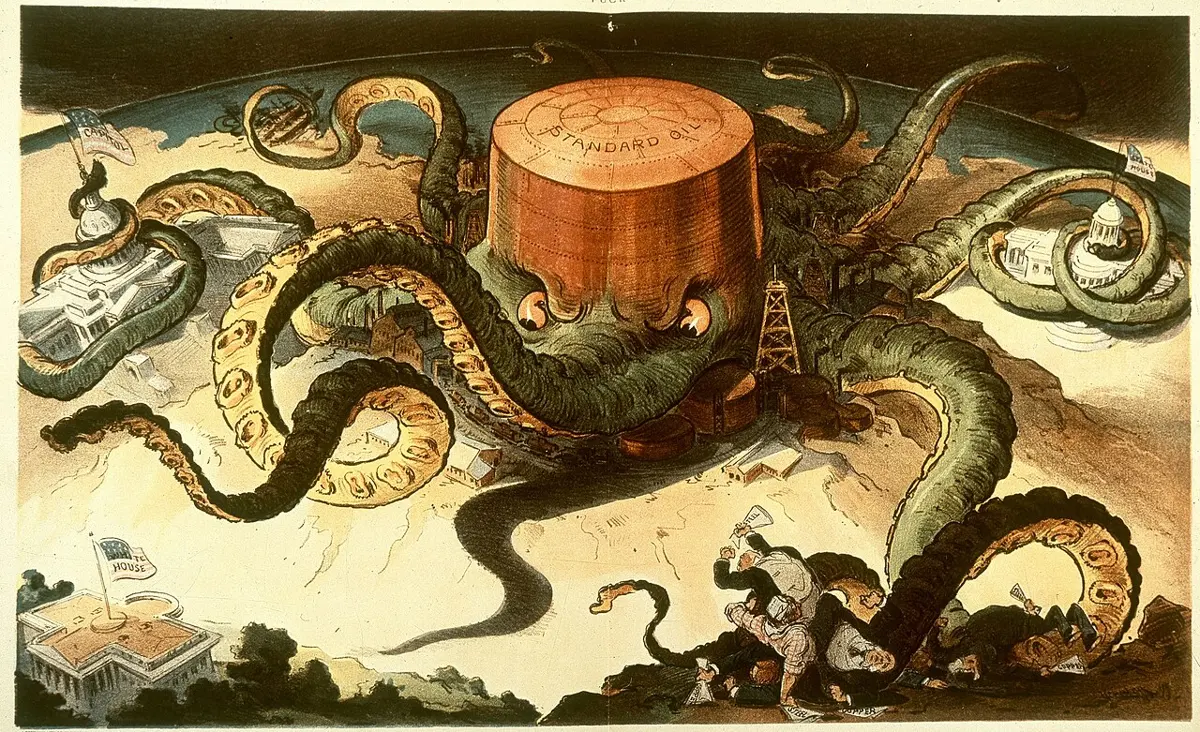
Many monopolies don’t last: high profits draw people to look for a way in, and new technology often finds one. Some have been broken up by law. John D. Rockefeller’s Standard Oil, founded in Cleveland, grew to dominate America’s oil business until the government sued it and the Supreme Court upheld an order to split it into 34 companies. Their descendants include two of the world’s largest oil firms, ExxonMobil and Chevron.
Between the two
Real markets mostly lie between the two ends, in two very different places. The first has many sellers, as in perfect competition, but goods that aren’t quite alike. Anshu’s tea isn’t quite the tea across the road. Hers comes with more ginger and a seat by the window, and some customers come for her in particular. That gives her a little power. When she once charged Rs. 30 a glass she didn’t lose every customer, as a tomato grower would; she sold 180 glasses instead of 200. Economists call this monopolistic competition, एकाधिकारात्मक प्रतिस्पर्धा. Two economists worked it out separately at about the same time, Edward Chamberlin at Harvard and Joan Robinson at Cambridge, and it fits restaurants, hair salons, clothes shops and brands of noodles, soap and shampoo.
Each seller is a small monopolist of its own version of the good, so it charges more than its marginal cost. But anyone can open another momo shop or launch another shampoo, and when some sellers make good profits, new ones come with versions of their own and take some of their customers. In the long run, profits are again worn away to normal. What is left are prices a little above cost, a great deal of advertising and packaging, since each seller works to make its version seem different, and variety, which buyers pay a little for.
The second place has a few big sellers, each watching the others. That is oligopoly, अल्पाधिकार, from the Greek for few. Cement, steel, airlines and banks are often like this. Nepal’s mobile phone service is the clearest case: of the companies licensed over the years, two are left, Nepal Telecom and Ncell, and by the regulator’s count each has about half of the country’s mobile connections. In an oligopoly, what one seller earns depends on what the others do, so before it sets a price it has to guess how they will answer.
The guessing is easiest to see with two sellers and one choice. Suppose the only two momo shops in a small town (made up) can each charge Rs. 150 a plate or Rs. 120. If both charge Rs. 150 they share the town’s customers and each makes Rs. 2,000 a day. If one cuts to Rs. 120 while the other holds, the cheap shop takes most of the customers and makes Rs. 2,600, and the dear one is left with Rs. 400. If both cut, they share the customers again, a few more of them at the lower price, and make Rs. 1,500 each. Whatever the other shop does, cutting pays more that day: Rs. 2,600 instead of Rs. 2,000 if it holds, Rs. 1,500 instead of Rs. 400 if it cuts. So both cut, and both end up worse off than if both had held. Game theorists call this the prisoner’s dilemma, after a story of two prisoners questioned apart, each better off betraying the other.
The two shops don’t meet once, though. They face each other every morning, and that changes the sums. A cut wins for a day, and then the rival cuts too, and both are stuck at Rs. 1,500. A shop that answers every cut with a cut of its own, and every hold with a hold, makes undercutting a poor bet and holding a good one. When Robert Axelrod held contests between computer programs written to play the dilemma over and over, the rule that scored highest, in two contests running, was “tit for tat”: hold the first time, then copy what the other side did last. Rules that often do better have been found since, but the lesson stuck. Rivals who expect to meet again can keep prices high without ever saying a word to each other.
They can also say the word. A group of firms that agree on prices or on how much each will sell is a cartel, and the best known is OPEC, the Organization of the Petroleum Exporting Countries, whose members agree to hold down how much oil they sell and so keep its price high. A cartel faces the same dilemma from inside. Each member gains by quietly selling more than its share at the agreed price, and no court will make it stop.
Agreements among companies are kept secret, because in most countries they are against the law. In the 1990s American investigators recorded the meetings of the world’s makers of lysine, a feed additive for pigs and chickens, as they fixed its price and divided the market among themselves. The price doubled. On one tape the president of the main American maker, Archer Daniels Midland, told an executive of a rival firm his company’s slogan: “Our competitors are our friends. Our customers are the enemy.” The company later agreed to plead guilty, for this cartel and a second one in citric acid, and to pay a fine of $100 million, then the largest criminal fine America’s competition law had brought. Executives went to prison. Smith had seen it coming: “People of the same trade seldom meet together, even for merriment and diversion, but the conversation ends in a conspiracy against the public, or in some contrivance to raise prices.”
The mirror image of a single seller is a single buyer, a monopsony, एक क्रेताधिकार. A sugar mill that is the only buyer of cane for miles around can pay farmers less than a crowd of mills competing for their cane would.
Keeping markets open
Since a monopoly or a cartel can charge more than competition allows, most countries have laws against them, and Nepal is one. Its constitution, in Article 51, sets the state the aim of ending black marketing, monopoly, artificial shortages and restrictions on competition, so as to make the economy competitive and protect consumers. The Competition Promotion and Market Protection Act, 2063, forbids producers or sellers of the same goods to agree to fix prices, limit how much they make, divide places or customers among themselves, rig tenders, or run a syndicate, सिन्डिकेट, in transport or distribution, so that only members may carry goods or passengers on a route. It sets fines, and a board to look into cases.
Firms also grow by joining together. When two rivals in the same trade merge, economists call it a horizontal merger, and it worries regulators most, since it leaves fewer sellers. A vertical merger joins firms at different steps of the same chain, as a tea company buying a tea estate would. A conglomerate merger joins firms in unrelated trades. Most mergers harm no one, and many let the joined firm work more cheaply. Nepal’s Act goes after the few that don’t: a firm may not merge with a rival making the same goods, or buy half or more of it, in order to keep a monopoly, and a merger that leaves the joined firm with more than 40 percent of the country’s output counts as made for that purpose.
A law works only as well as it is used. In 2018 a newspaper reported that the board had been idle for almost a decade, and that syndicates and cartels flourished. That spring the bus companies on the Araniko Highway, the road from Kathmandu to the Chinese border, protested when a newcomer was given a permit to run beside them, and the cabinet decided that the transport committees through which such groups had held their routes would no longer be renewed. Seven years on, another newspaper reported that the board still wasn’t working. Telecom shows the other side of the problem. The government has said Nepal needs a third mobile company, but licenses are costly, and the airwaves a newcomer would need are scarce.
Keeping markets open isn’t only a job for the law. It means fewer licenses that only a few can get, buyers who know what others charge, and, where a second network makes no sense, a regulator who sets the price in place of the competition that can’t exist.
So the power a seller has comes from its market. Where many sellers offer the same thing and anyone can join them, none has any power: each takes the price, sells up to where the extra cost meets it, and in the long run earns just enough to stay. One seller with rivals kept out sells less, at a higher price, and some trade that would have suited everyone never happens. Most firms live in between, among many sellers of slightly different goods, or among a few big ones that would do best by agreeing and are each tempted to break the agreement. Anshu’s tea now has a price. The money it brings in still has to be shared among the people who own the room, lend the money, do the work and take the risk.
Found a mistake? Please tell us.