
In a museum in Madrid, the Reina Sofía, a painting nearly eight meters wide fills one wall of a room. It is painted in grays, black and white, and it is about a town being bombed. Pablo Picasso painted it in Paris in five weeks, from 1 May to 4 June 1937, after German planes of the Condor Legion bombed the Basque town of Guernica. It is one of the most famous pictures of the last hundred years. This book can’t show it to you.
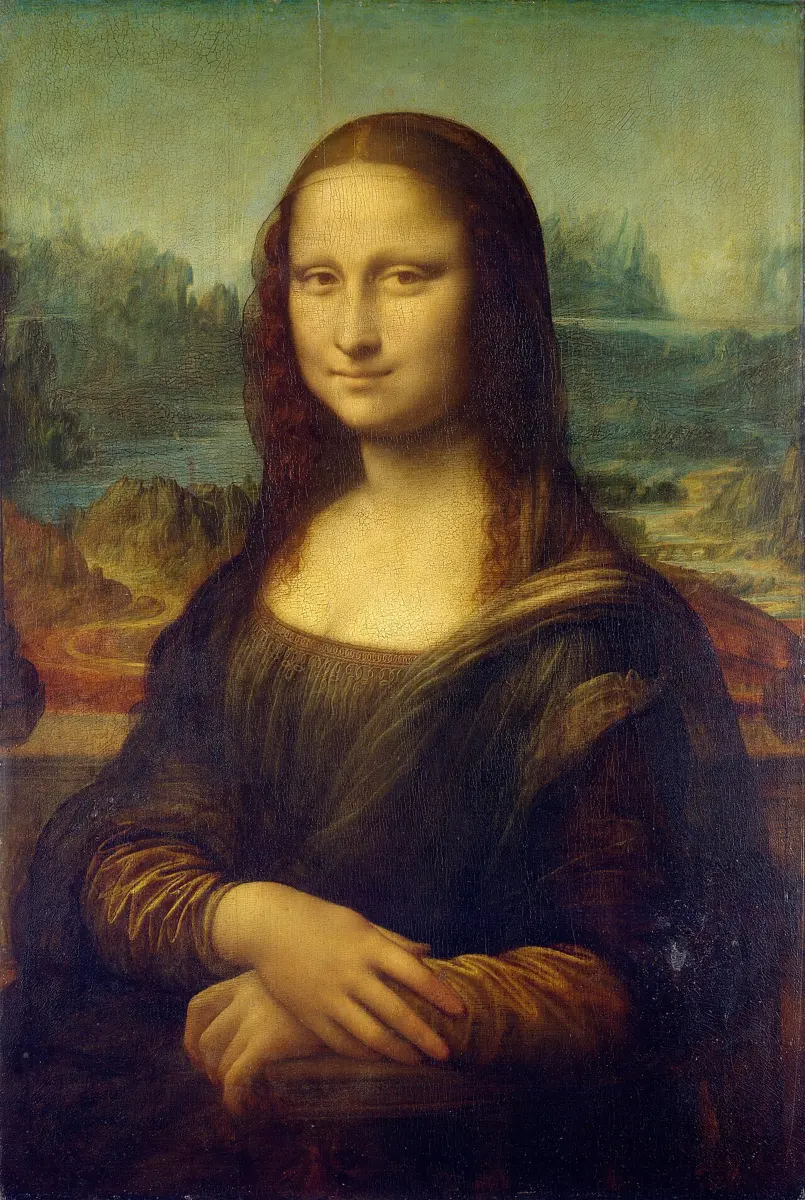
It can show you the Mona Lisa, which is four hundred years older, and it will, further down. The difference between the two isn’t fame or quality or which museum owns them. It is that Leonardo died in 1519 and Picasso died in 1973, and a painter’s pictures belong to the painter, and then to the painter’s heirs, for a fixed number of years after the painter dies. Almost every artist in this chapter died after 1950 or is still alive, so their work appears here as words, as our own drawings of how it was made, and as links to the museums that own it and show it. At the end comes the question of who owns a picture, and for how long.
Paint on the floor
In the years after the Second World War a group of painters in New York, later called the Abstract Expressionists, gave up painting things altogether. The best known was Jackson Pollock, born in 1912. In the late 1940s he stopped painting on an easel. He tacked a big canvas to the floor of his studio and walked round it, pouring and dripping paint onto it straight from the can, or flicking it from sticks, trowels and knives, sometimes adding sand or broken glass. “On the floor I am more at ease,” he wrote in 1947. “I feel nearer, more a part of the painting, since this way I can walk around it, work from the four sides and be literally ‘in’ the painting.” The results are tangles of lines, one layer over another, with no top or bottom and no single thing to look at. Tate’s Summertime: Number 9A, from 1948, is one. Pollock was killed in a car crash in 1956, at forty-four.
Mark Rothko, born in 1903, went the other way: fewer marks, not more. His mature paintings are large soft-edged rectangles of color, one above another, floating on a colored ground. In the late 1950s he was asked to paint a set of murals for the Four Seasons, a restaurant in the Seagram Building in New York. He painted them, and then withdrew: the worldly setting of a restaurant, as Tate puts it, was not where he wanted them. In 1969 he gave nine of them to Tate in London, largely out of admiration for Turner, whose storms of light are in Three Hundred Years of Paint, hoping they would hang near Turner’s pictures. They arrived in 1970, the year he died. Tate shows them in a room of their own in dim light, as “objects of contemplation, demanding the viewer’s complete absorption”.

Not everyone gave up painting things. Francis Bacon, a painter in London born in 1909, painted people, and his most famous picture began with an old one. In 1650 the Spanish painter Diego Velázquez, in Rome, painted Pope Innocent X, seated in his chair, looking at the painter with hard, clever eyes. Three centuries later Bacon painted the pope again, several times, and in the best known, Study after Velázquez’s Portrait of Pope Innocent X (1953, now in the Des Moines Art Center in Iowa), the seated pope is screaming. It has been called the screaming pope ever since. The Francis Bacon estate’s page tells the story of the series. Velázquez’s picture is shown here because it is old enough to belong to everyone; Bacon’s, which is not, has to be imagined beside it.
Soup, stone and oak trees
In July 1962 a small gallery in Los Angeles, the Ferus Gallery, hung thirty-two paintings by a New York artist named Andy Warhol. They were all the same: a can of Campbell’s soup, one for each of the thirty-two flavors the company sold, painted flat and straight on. The gallery’s owner, Irving Blum, set them on narrow shelves along the walls, like a supermarket aisle. A critic wrote that Warhol was either “a soft-headed fool or a hard-headed charlatan”, and a gallery down the street put real Campbell’s cans in its window, two for 33 cents. Blum sold five of the paintings, then had second thoughts, bought them back and kept the set for himself, paying Warhol $1,000 for all thirty-two over ten months.
The soup cans were painted by hand: Warhol projected the can’s picture onto the canvas, traced it and filled it in, and stamped the little fleur-de-lys round the label’s edge. Soon he found a faster way, the one his pictures of Marilyn Monroe and other famous faces are made with. It is the silkscreen. He sent a photograph to a professional printer with instructions to crop it and raise its contrast, which flattens the face into black shapes; the printer put the image onto a screen of fine mesh “like a photographic negative”, so that the mesh stays open only where ink should go. Then, as the US Supreme Court later described it, Warhol would “place the screen face down on the canvas, pour ink onto the back of the mesh, and use a squeegee to pull the ink through the weave”. The same screen could print the same face again and again, in any color. The drawing shows how.
That was the point. Pop art, as it was called, took its pictures from shop shelves, newspapers and films, things everybody had seen, and made them the way factories make things, many alike. Whether that was a joke about art, a celebration of shopping or a sad picture of a world where everything is for sale, people still argue. The market decided one thing: in May 2022 a 1964 silkscreen of Marilyn Monroe, Shot Sage Blue Marilyn, sold at Christie’s in New York for $195 million, the most ever paid at auction for a work by an American artist.
In England, meanwhile, a sculptor was making people lying in the landscape. Henry Moore, born in Castleford in Yorkshire in 1898, carved and cast figures lying down, in stone and in bronze, such as a woman in Green Hornton stone in 1938, now at Tate. He studied bones, he said, for “the inside structure that nature uses for both lightness and strength”, and pebbles and rocks because they “show nature’s way of working stone”. He wanted his work outdoors: he would “rather have a piece of my sculpture put in a landscape” than in any building. Tate’s account of his sculptures and the Henry Moore Foundation, which keeps his house and studios, show them.
The German artist Joseph Beuys, born in Kleve in 1921, went further from the gallery still. For the great Kassel exhibition documenta in 1982 he had 7,000 basalt stones dumped in a heap in front of the city’s main museum, the Fridericianum, much to the annoyance of the people who lived there, and the people of Kassel began planting oak trees across the city, each with one of the stones beside it. As trees were planted, the heap shrank. The work was called 7000 Oaks, and it was finished only at the next documenta, in 1987, a year after Beuys died, when his son planted the last tree beside the first one. They stand there still, with the rest of the trees across the city. Beuys called this “social sculpture”: the shaping of a society by the people in it, which he thought was art too. Everyone, he said, is an artist.
Everywhere at once
New York was never the only place. In 1954, in Osaka, the painter Yoshihara Jirō, who paid for it, gathered younger artists into the Gutai group, from a Japanese word meaning “concrete” or “embodiment”. In 1955 Shiraga Kazuo threw himself into a heap of mud and rolled in it, Challenge to the Mud; the next year he was painting with his feet. Murakami Saburō ran at screens of stretched paper and burst through them, Laceration of Paper. The making of the work, the artist’s body in action, was the work. Tate’s page on Gutai has more; the group broke up in 1972.
In Brazil, Lygia Clark made sculptures that were meant to be handled. Her Bichos, from 1960, are sheets of aluminium joined by hinges, which the viewer folds into new shapes; she called each one “an almost-body”, and said the hinge reminded her of a backbone. The Sainsbury Centre in Norwich has them. In Nigeria, the Ghanaian sculptor El Anatsui, born in 1944 and until 2011 a professor at the University of Nigeria at Nsukka, has since the late 1990s been joining thousands of flattened metal bottle tops with wire, with the help of dozens of assistants, into great hangings like metal cloth. In 2023 he filled the vast Turbine Hall of Tate Modern in London with the largest of them, Behind the Red Moon, about the Atlantic slave trade. In 2010 the Chinese artist Ai Weiwei covered the same hall’s floor with about a hundred million sunflower seeds made of porcelain, each one shaped and painted by hand by hundreds of craftspeople in Jingdezhen, the porcelain city of China, Korea and Japan. Visitors were meant to walk on them, until the dust they raised stopped it.
Nepal’s own modern art, from Lain Singh Bangdel’s first exhibition in Kathmandu in 1962 to the Kathmandu Triennale, is the subject of Modern Nepali Art. One date belongs here. In 2022 Nepal had a pavilion of its own for the first time at the Venice Biennale, the international exhibition held in Venice every two years: Tales of Muted Spirits – Dispersed Threads – Twisted Shangri-La, by Tsherin Sherpa, known for his thangka painting, with metal sculptures, woolen carpets and thangka paintings made with artists from across Nepal, curated by Sheelasha Rajbhandari and Hit Man Gurung.
Who owns a picture
When an artist makes a picture, the law gives the artist rights over it that are separate from owning the canvas. Nepal’s are in the Copyright Act, 2059 (2002). A work is protected from the moment it is made, with no need to register it (section 5): a painting, a sculpture, a woodcarving, a photograph, a building’s design, a book, a song (section 2). The author alone may copy it, translate it, adapt it, sell copies, show it in public or broadcast it (section 7), and has two rights that can’t be sold: to be named as its author, and to stop it being distorted or mutilated (section 8). Ideas aren’t protected, only the way they are expressed, and some things belong to no one: news, methods, principles, court judgments, folk songs, folk tales, proverbs and general data (section 4). A small part of a published work may be quoted, with its source and author named, and used in teaching (sections 17 and 18). That is why this book can quote a sentence of Pollock’s but not reproduce his painting.
The rights don’t last forever. Under section 14 they last for the author’s life and fifty years after, counted in Bikram Sambat years (section 41); for a photograph or a work of applied art, twenty-five years from when it was made. When the time runs out, the work passes into the public domain: it belongs to everyone, and anyone may copy it, print it, change it or sell copies. Almost every country follows the same pattern because of the Berne Convention, a treaty first signed in 1886, which Nepal joined in 2006. It says a work must be protected without any formality, that the author keeps the moral rights, and that the term must be at least the author’s life and fifty years, starting on 1 January after the death. A country may give longer, and many do; Spain, for one, gives seventy years.
So the answer to “can I print this?” depends on where you are. Picasso died in 1973. Under Nepal’s rule his fifty years have run out. In Spain, where it hangs, today’s law gives seventy years, but Spain’s earlier law of 1879 gave eighty, and the law of 1996 keeps the old term for authors who died before 7 December 1987. Picasso’s work is protected there until the end of 2053. A book on a website is read everywhere, and this one takes its pictures from Wikimedia Commons, which accepts a work only if it is free both in the United States and in the country it comes from. Leonardo worked on the Mona Lisa from 1503 until about the time he died, in 1519, so it passed that test centuries ago. A careful photograph of a flat old painting adds no new authorship, Commons holds, so the photograph is free too.
The drawing works out the dates for five painters. Each bar starts at the year of death; its dark part is fifty years, Nepal’s term and the least the Berne Convention allows, and the paler part runs on to seventy. Pollock’s, Rothko’s and Picasso’s fifty years are over; Warhol’s are not, and Bangdel, who died in 2002, is protected in Nepal until about 2053.
Copying and borrowing are not always easy to tell apart, and artists have always borrowed. In 1981 a photographer, Lynn Goldsmith, took portraits of the young musician Prince for Newsweek. In 1984 she licensed one to Vanity Fair as an “artist reference for an illustration”, for one use, for $400 and a credit, and the magazine hired Warhol, who made a purple silkscreen from it; from the same photograph came sixteen Prince pictures in all. In 2016, after Prince died, the Warhol Foundation licensed another of them, Orange Prince, to the magazine’s owner for a cover, for $10,000. The quarrel went to court, and on 18 May 2023 the US Supreme Court decided, seven to two, that this use was not fair: Warhol’s picture and her photograph were doing the same job, a portrait of Prince on a magazine, for money. The judges didn’t say Warhol’s pictures weren’t art. They said that being art doesn’t by itself make a copy fair. In the same year the US Copyright Office refused to register a picture made with the image generator Midjourney, from at least 624 typed prompts, which had won a prize at the 2022 Colorado State Fair, because human authorship is “a bedrock requirement” and the parts made by the machine weren’t set aside; what machines make, and what it means for artists, is in Made by Machines.
Is any of it any good? The people who saw it first often thought not: a critic called Warhol a fool or a charlatan, and sixty years later one of his Marilyns sold for $195 million. A price says what someone will pay, not what a picture does. The surer way to judge is to look hard and ask the questions asked of every older work here: what it is made of, how it was made, who made it and who paid, and what it was for.
After 1950 art spread in every direction at once: paint poured on the floor and color floating in dim rooms, a pope screaming, soup cans and film stars printed like goods in a factory, stones and oak trees in a German city, an artist wrestling mud in Osaka, sculptures to fold in your hands in Brazil, bottle tops woven in Nigeria, a Nepali pavilion in Venice. Hardly any of it can be shown here, because the people who made it died recently or are alive, and the law gives each of them, and their heirs, the right to decide who copies their work, for their lifetime and fifty years in Nepal and longer in many countries. When the time is up, the work belongs to everyone; until then, the museums show it.
Found a mistake? Please tell us.