
The Metropolitan Museum of Art in New York keeps, off display, a lump of dried clay small enough to close your hand around. It is about five thousand years old, and it probably comes from Uruk, a city in the south of what is now Iraq. Someone pressed round holes into it while the clay was still soft and scratched little pictures beside them with a pointed stick. Before any of that, they rolled a cylinder seal across its faces, leaving a tiny scene of a man leading two dogs on a leash among wild boars in a reed marsh.
It isn’t a poem, a prayer or a king’s boast. The round holes are numbers, and the museum’s best reading is that the tablet records barley handed out by a large temple. It is, in other words, an account. Somebody received grain, somebody gave it, and somebody wanted that written down where it couldn’t be forgotten or argued about later.
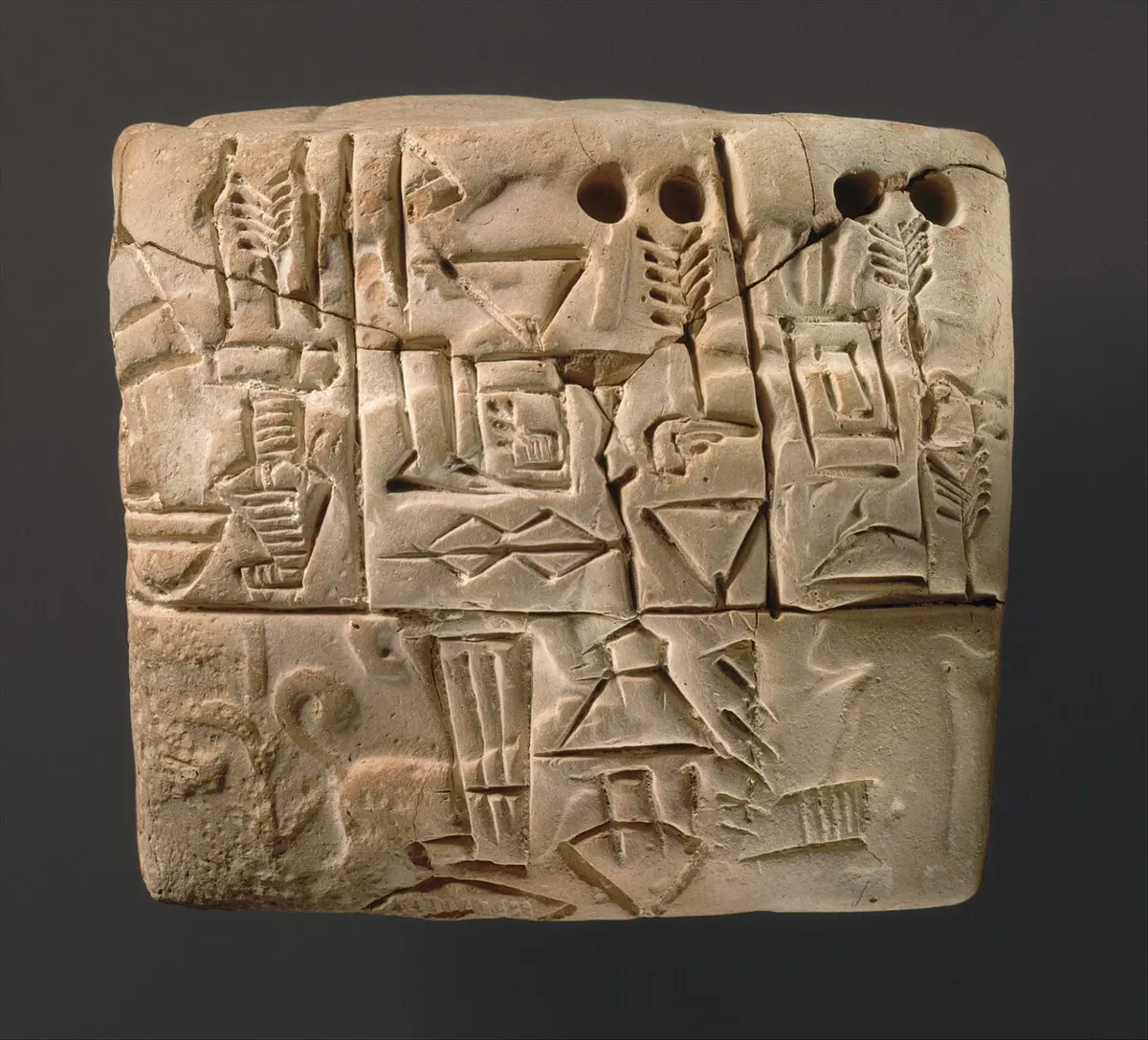
This one isn’t unusual. Archaeologists digging at Uruk found nearly five thousand tablets and pieces of tablets from the time when writing was new, all of them in the city’s old rubbish heaps. Of the nearly 4,900 texts known from the later of those early periods, at Uruk and at Jemdet Nasr to the north, 4,167 are accounts, counts and measures of barley, animals, cloth and the like. Most of the rest are lists of signs and words. The oldest writing anyone has found, give or take whatever Egypt was doing at about the same time, is mostly bookkeeping.
Accounts may even have made writing. For thousands of years before these tablets, people in the Near East made small clay shapes, cones, balls and discs, and in Uruk’s time some of them were sealed inside hollow clay balls like a receipt in an envelope, with marks pressed on the outside. Then came flat tablets carrying nothing but number marks, and only after them tablets with picture signs. Denise Schmandt-Besserat, an archaeologist who has spent her life on these tokens, thinks each shape stood for one thing, a cone for a small measure of barley, a disc for a sheep, and that pressing a token’s mark into clay instead of keeping the token was the invention of writing. Others think she goes too far: simple shapes are easy to make in clay, and they find too few tokens that match the first written signs to show that one grew out of the other. What both sides accept is the order, counters first, then numbers on clay, then signs for things, and what the earliest tablets are about.
Accounts are older than coins, too. Uruk’s scribes counted in measures of barley and heads of sheep. The first coins weren’t struck until the 600s BCE, in Lydia, a kingdom in what is now western Turkey, well over two thousand years later. People were writing down who owed what long before there were rupees, or any coins at all, to count it in.
So the question this chapter asks is an old one. Why do people bother?
Four jobs
A set of accounts does four jobs. It remembers, it lets someone check, it helps someone decide, and it shows someone else what happened. Almost everything in accounting, however complicated it looks, is one of those four.
The first is the plainest. Memory is short and generous to its owner. A temple handing out barley to many people can’t carry in anyone’s head who got how much last month. Neither can a shop that sells on credit, a cooperative holding its members’ savings, or a family trying to work out where this month’s money went. Try a small test of it: list ten things your household paid for or was paid in a month. Without something written down, it is harder than it sounds. A written account doesn’t forget, doesn’t round things in its own favor, and is still there when the person who wrote it has moved away or died.
The second job is checking. A record that only its writer can see is a diary. A record someone else can look at is a check on everyone involved. If the money and the records are kept by different people, or if the records can be compared with the cash in the drawer or the goods on the shelf, a mistake shows up, and so does a theft.
The English potter Josiah Wedgwood found this out in 1772, as the historian who studied his firm’s papers tells it. He worked out, under fourteen headings, what each of thirty-one of his products cost to make, most of them vases. At first his figures wouldn’t agree with the year’s actual results. Then he found that his head clerk had been hiding sales. Wedgwood dismissed him, and after that, his estimates and his results agreed well enough. Two sets of numbers that ought to have matched didn’t, and the gap between them was a theft.
The third job is deciding. Knowing what each of his wares cost him was useful to Wedgwood for more than catching a clerk: a historian of his firm thinks it carried the firm through the severe slump that hit later that same year. Every business faces the same questions on a smaller scale. Is the shop making money or slowly losing it? Which goods sell, and which sit on the shelf for a year? Can it afford a second helper, or a scooter for deliveries? Should it borrow? A person who guesses can be lucky. A person with accounts can see.
That is also why accountants care so much about profit. The word means simply what is left of the money a business earned after paying what it cost to earn it, and knowing it answers several questions at once: whether the business is succeeding at all, how much the owner can safely take out to live on, how much tax is owed, and whether a bank should lend to it.
The fourth job is showing someone else, and it may be the most important. A shopkeeper who keeps only to herself can run her shop on memory and luck. As soon as anyone else has a stake in it, a partner, a bank, a supplier who sends goods before being paid, the government that taxes its income, they need to see what happened, and they need to be able to trust what they see. Accounts are how a business explains itself to people who weren’t there.
Nepal’s own old papers hold such records. A Newari manuscript photographed for the British Library’s Endangered Archives Programme is titled, in its catalog, Bisket Jatra Kharcha Tippani: a note of the expenses of Bisket Jatra, Bhaktapur’s New Year festival. It was first written in Nepal Samvat 797, which is 1676 or 1677 in the Western calendar, added to in later years, and it is still kept in Nepal, in the Gyankar Vajracharya collection. The catalog doesn’t say who wrote it, but the use of such a note is plain: when money for something belongs to many people, a written note of what was spent lets them see where it went.

Another comes from the far west. Among old papers from Doti, photographed for the same archive, is a single sheet of लोक्ता (lokta) paper about a meter long, cataloged as a खर्चको बही, a “book of expenses”, for the year 1987 of the Vikram Samvat, about 1930 (one line of the catalog says 1989, about 1932). It is still kept in Doti. बही is still the Nepali word for an account book. Neither paper is grand: one counts what a festival cost, the other a year’s spending by whoever kept it, which is what most account books are.
Keeping the books, and making sense of them
The work divides into two parts, and Nepali has a word for each.
The first part is writing down what happened. In English it is called bookkeeping, from the books that accounts were kept in for centuries, and in Nepali लेखा अभिलेखन. Each event that changes a business’s money is a transaction, कारोबार: a sale, a purchase, a payment of rent, a loan received. The bookkeeper’s job is to notice each one and record it, in money, as it happens, with a paper behind it, a bill or a receipt, to show it really took place.
Not everything that happens is a transaction. Accountants have a saying for it: all transactions are events, but not all events are transactions. If a shop gets a thorough cleaning, that is an event, and nobody writes “the shop is cleaner” in the books. But the broom that was bought and the wage paid to the person who swept are transactions, because each has a money value and changes what the shop has. A visit from an important guest, a staff meeting or a festival greeting doesn’t go in the books either. Only what can be measured in money goes in.
The second part is making sense of it all. In Nepali it is लेखाविधि, and in English it is accounting proper. Thousands of recorded transactions are just a long list, and a list doesn’t say whether a business is doing well. So the records are sorted: everything about cash in one place, everything about each customer in another, all the rent together, all the sales together. Then each heap is added up. Then the totals are set out in a few short statements, called the financial statements: what the business earned and spent over the year, and what it has and owes on the last day. Then someone reads those statements and asks what they mean: is profit rising or falling, are debts growing faster than sales? And last, the results are handed to the people who need them.
These make six steps, usually drawn in a circle: identify a transaction, record it, classify it, summarize it, interpret the result, and present it. It is a circle because the work never stops. Accounts are kept for a fixed stretch of time, usually a year. Nepal’s financial year, which the government’s offices keep their accounts by, runs from the first of साउन (Saun) to the last day of असार (Asar), and the morning after one year’s books are closed, the next year’s are open.
The two parts usually belong to two kinds of people. The bookkeeper does the steady daily work of recording, and in a big office this is given to junior staff. The accountant, लेखापाल, is the one who sorts, sums, interprets and reports, and who checks the bookkeeper’s work. In a small shop the owner does both, often at the same table in the same evening. But the difference matters even there, because recording is a habit and interpreting is a judgment. A shop can keep perfect records and still have nobody who knows what they say.
There is also a set of rules underneath both parts, things every accountant takes for granted: that the business is counted apart from its owner, that it will go on trading next year, that things are recorded at what they cost. Those rules have their own chapter later. For now it is enough to know that they exist, and that they are the reason two accountants given the same receipts will produce much the same books.
Who reads them
Accounts are written to be read, and not only businesses keep them: so do households, doctors and lawyers, temples, libraries, the Red Cross and every office of the government. Different readers come to them with different questions.
The owner wants to know whether it is all worth it: is the business making money, is her own share in it growing, how much can she take out this month without hurting it? A manager in a bigger business wants detail: which branch is doing well, which costs are climbing, whether last month’s new product is selling. These two read the accounts from inside, and they can ask for any figure they like.
Everyone else reads from outside, and each has a sharper question. A bank deciding on a loan wants to know whether the business can pay it back, and whether there is enough behind it if things go wrong. A supplier who hands over goods today and gets paid next month wants to know the same thing on a smaller scale: will this customer pay? Employees want to know whether wages are safe and the business will last. People who buy shares in a company want to know what their share is earning and whether it is worth holding.
Then there is the government. It taxes a business’s income, its sales and what it brings in from abroad, and the right tax can only be worked out from true records of all of them. Government offices keep accounts of their own, of public money, which the people they serve have every right to see. And when an auditor comes to check any of these books, the records are what there is to check: with no accounts, there is nothing to audit.
And there are the smallest readers of all. Picture a school’s eco club that sells plants once a year to pay for a trip. Its treasurer, Kriti, keeps a notebook of what came in and what went out, with the receipts tucked inside, and at the year’s last meeting she reads it out. Kriti is made up, but every club, cooperative, temple committee and guthi works this way. The members don’t need a profit figure. They need to know their money was used for what they agreed, and the treasurer needs to be able to show it was. Accounts protect the honest person who keeps them as much as they expose a dishonest one.
The list of readers grows as a business does. A small shop’s books may be read by nobody but its owner. A large company today has thousands of owners who have never met, lenders in other countries and tax offices in several, and they all read the same published statements. That is why so much of accounting is about rules and checks: the more strangers rely on a set of books, the more it matters that the books follow a method everyone understands, and that someone from outside has looked at them.
What accounts can and can’t say
Accounts have limits, and they are worth hearing early. Accounts record only what can be put in money, so a loyal customer, a skilled worker or a good name with the neighbors never appears in them, however much they are worth. They record what has already happened, not what will. They keep each thing at what it cost when it was bought, so after years of rising prices, the figures can drift a long way from what anything would fetch today. Putting a value on some things is hard in the first place. And keeping accounts well takes training, which a small business may not have. This book ends on those limits, because they are where accounts stop and judgment has to take over.
Within its limits, though, a good set of accounts is one of the quietest tools of trust there is. It lets a temple keep track of its barley, a town see what its festival cost, a potter find a thief and weather a slump, a club’s members know their money was spent as they agreed, and a stranger lend to a business they have never seen. All of it rests on the same plain habit the clerks of Uruk had: when something of value changes hands, write it down, in a way someone else can check.
From here the book keeps one shop’s books through its first year: Yasmin’s hardware and paint shop, which is made up, like every figure from it.
Found a mistake? Please tell us.