
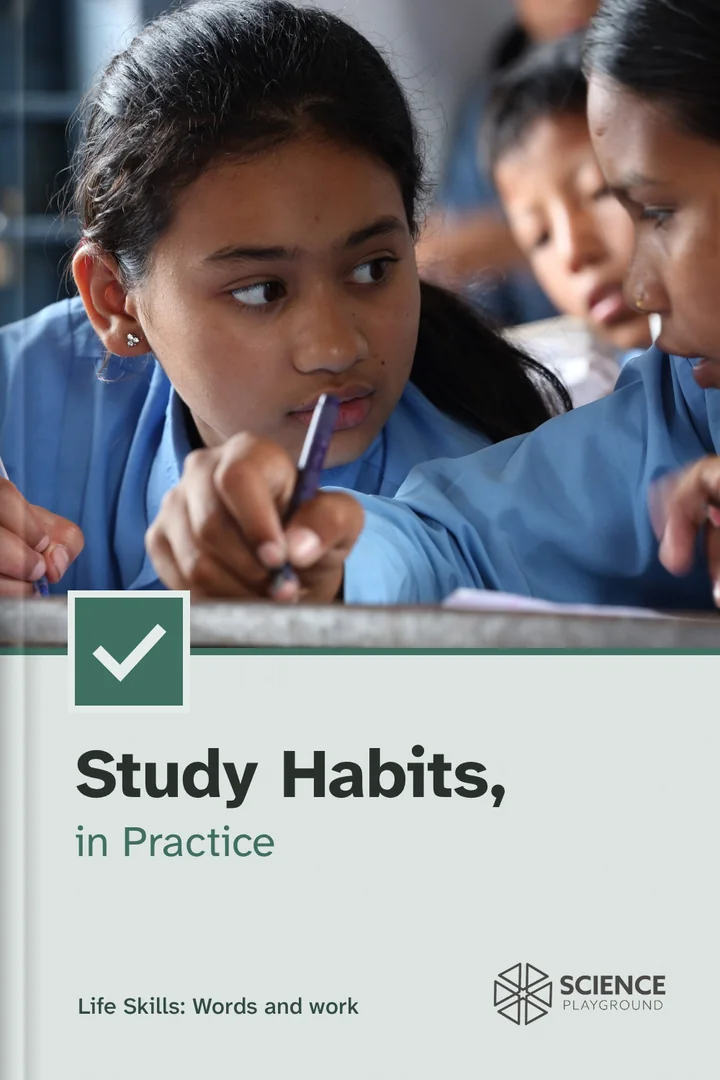
Study Habits, in Practice
Small habits that research shows work, each one you can try tonight. Pick one, try it, and tick it off.
43 habits. Open one, try it, and tick it off.
Setting up: focus and rest
- Plan two short sessions a week per subject
On Sunday, draw a table. Two short sessions per subject, on different days, each saying what you’ll test yourself on.
Not tested on its own - Set a goal for each session
Not “study Science”, but “Exercise 3, questions 1 to 5, then check the answers.” Write it down before you start.
Some evidence - Make a “when …, then I will …” plan
Not “I’ll study more”, but “When I get home from school, then I’ll do ten maths questions before tea.”
Moderate evidence - Start with just two minutes
Putting off the essay? Promise yourself two minutes: open the copy, write the first line. Then decide whether to go on.
Not tested on its own - Put the phone in another room
A phone you can reach is a phone you will check. Give it to someone until you finish.
Some evidence - Do one thing at a time
No chat, no video in the corner. Study, then message. Students who did both learned less.
Some evidence - Study in a quiet spot, and sometimes in another
A quiet spot for most of your study; once you know a unit, revise it somewhere else too. In the exam, picture where you learned it.
Some evidence - If you play music while reading, make it without words
Songs with words and a TV talking next door pull at your reading. Silence, or music without words.
Moderate evidence - Take a short break on a timer, and move in it
About 25 minutes of study, then a 5-minute break away from the desk. Set a timer for both.
Some evidence - Move for an hour every day
About an hour a day of moving enough to breathe harder: walking to school, football, dancing. It can come in pieces.
Some evidence - Keep your bedtime on school nights
Teenagers need 8 to 10 hours. If something has to give, cut screen time, not sleep.
Strong evidence
Reading a unit
- Try the questions before you study the unit
Before a new unit, guess the answers to its questions. Wrong guesses are fine; you’ll read more carefully.
Some evidence - Preview a unit for three minutes first
Skim the headings, diagrams and end questions before you read. Then you know what to look for.
Not tested on its own - Turn each heading into a question
“Electric resistance” becomes “What is resistance, and what changes it?” Read to answer it, then answer it with the book shut.
Strong evidence - Skim what you know, slow down for what’s new
A good reader isn’t fast everywhere. Skim the familiar; slow down for definitions, equations and diagrams.
Strong evidence - Go back when a sentence doesn’t make sense
Your eyes jump back all the time. That is how good readers fix a misreading, not a habit to stop.
Strong evidence - Skip the speed-reading apps
Apps that flash words faster only make you understand less. Measure your speed together with how much you understood.
Strong evidence - Read a lot, and learn the words
Every word you know flies by; every word you don’t stops you. Read for fun, and learn each subject’s words.
Strong evidence
In class
- Take class notes in your own words
Don’t copy every word. Write the main points short, in your own words, with space to fill in tonight.
Some evidence - Turn today’s notes into questions the same evening
Tonight, write a question beside each main point in your notes, then cover the notes and answer.
Strong evidence
After class: practice
- Test yourself instead of rereading
Close the book, write down what you remember, then check. It beats reading the chapter again.
Strong evidence - Write formulas from memory before you use them
Start practice with a blank page: write the formulas you need from memory, then check them against the book.
Not tested on its own - Don’t stop at the highlighter
Highlighting feels like studying, but helps little on its own. Turn what you marked into questions.
Strong evidence - Write the answer before you flip the card
Flash cards work when you recall the answer first. Keep the ones you miss coming back.
Strong evidence - Study with a friend: both answer every question
When you quiz each other, both of you write an answer before anyone says it aloud.
Some evidence - Explain it out loud, step by step
Explain each step to a friend, a younger sister or an empty chair. Where you get stuck is what to study.
Moderate evidence - Ask “why?” of every new fact
Write “why?” in the margin of each new fact, and try to answer before you read on.
Moderate evidence - Learn each new term with two examples
For every new term, find two examples in the book and say what makes each one fit.
Moderate evidence - Study a worked example, then cover more of it
Study one solved problem, then cover its last step and do it yourself, then two steps, then the whole thing.
Moderate evidence - Turn the text into a drawing, then draw it from memory
Draw what the paragraph says, labels and all. Tomorrow, draw it again with the book shut.
Moderate evidence - Spread it out: two short sessions beat one long one
An hour on Monday and an hour on Thursday beat two hours the night before.
Strong evidence - Mix topics when you practice
Shuffle questions from different exercises, so you learn to pick the method, as in the exam.
Moderate evidence - Go back to old units every week
Once a week, fifteen minutes of questions from units you finished long ago.
Strong evidence
Tests and exams
- Plan how you’ll prepare for each test
Before a test, spend ten minutes choosing how you’ll prepare. The evidence is split, so keep it short and pick methods that work.
Some evidence - When a test comes back, find the right answer to every lost mark
Don’t stop at the score. Write the right answer to every question you lost marks on.
Moderate evidence - Keep a mistakes list
Every question you get wrong goes in one notebook. That notebook is next week’s study.
Strong evidence - Do whole practice papers against the clock
From three weeks out, sit full papers in exam time, then mark them honestly, point by point.
Strong evidence - Sleep before the exam, not instead of it
The night before, a short session on your mistakes and your usual bedtime beat staying up.
Strong evidence - Say “not yet”, then try a different way
When something is hard, say “not yet”, and then change how you’re trying. The words alone do little.
Some evidence - Read the whole paper, then answer what you know
Read every question first. Bank the sure marks, write clear separate points, and check at the end.
Not tested on its own - Give each mark about two minutes
SEE Science gives 180 minutes for 75 marks. Plan on 2 minutes a mark, and half an hour is left to read and check.
Not tested on its own - Check an answer by putting it back in
Put your answer back into the question. If it doesn’t fit, you’ve caught your own mistake.
Not tested on its own - Change an answer when you find a better reason
Your first answer isn’t magic. If you check and find a reason it’s wrong, change it.
Strong evidence
General information, not professional advice. No page can fit every situation. You use it at your own risk: see our terms. Spotted a mistake, or know something better? Tell us.
Cover photo: AusAID/Jim Holmes, CC BY 2.0
