
The Nepali word for psychology is मनोविज्ञान, and it explains itself: the विज्ञान, the science, of the मन. The English word takes more digging. It was put together in Latin about five hundred years ago from two Greek words, psyche and logos. Logos is a word, a reason, an account. Psyche began, it seems, as breath, then came to mean life, the soul, the self that feels and thinks. Aristotle also used it for a butterfly.
So both languages name the subject after something inside you. That is where the trouble starts. Everyone has a mind, everyone has watched it working all their life, and everyone feels they know it well. This chapter is about why that feeling isn’t enough, and what psychologists have done instead.
What psychology is
Psychology is the scientific study of the mind and behavior. That is how the American Psychological Association puts it, and most textbooks agree. The mind means everything going on inside you: seeing, remembering, wanting, deciding, feeling afraid or ashamed or pleased. Behavior means what you can be seen to do, from blinking to joining a crowd.
The catch is that nobody can see a mind. Not your best friend’s, and, in an odd way, not quite your own. So psychologists study it through what can be measured: what people do, what their bodies do (a heartbeat, a pupil widening, a brain at work on a scan), and what people say about themselves, which is useful but slippery. From these they work back, carefully, to what must be going on inside.
That rules out some things psychology is often taken for. It isn’t mind-reading. A psychologist can’t look at you and know what you’re thinking. It isn’t a set of tests that sort people into types, either, though tests are among its tools. And it isn’t common sense dressed up in long words, though that is the commonest complaint about it.
The complaint is easy to make, because almost anything about people sounds obvious once you hear it. In 1949 an American sociologist showed how easy. He was reviewing a huge survey of American soldiers in the Second World War, and he listed some of its findings. Better-educated men showed more signs of nervous strain than less-educated ones; of course, he wrote, everyone knows that thinkers are highly strung. Men from farms kept their spirits up better than city men; naturally, they were used to hardship. Soldiers from the hot American South coped better with the heat of the Pacific islands; well, obviously.
Then he gave the game away. Every one of these was the opposite of what the survey had found. The less-educated men showed more strain. Southerners coped with the tropics no better than Northerners. And if he had given the true results first, he pointed out, readers would have found those obvious too. Common sense can explain anything after the fact, which is exactly why it can’t tell you, beforehand, which of two opposite things is true. Finding that out is the job.
Why looking inward isn’t enough
You might think there is one shortcut. You can’t see into anyone else’s mind, but you are inside your own. Why not just ask people why they did what they did?
Two American psychologists stumbled on a reason in the 1970s. In a shop, posing as a consumer survey, they asked passersby to judge the quality of four pairs of nylon stockings laid out in a row. The four pairs were identical. Even so, people chose the pair on the right far more often than the pair on the left, by almost four to one. Asked why they had chosen, not one of the 52 mentioned where the pair lay. When the researchers asked directly whether the position might have mattered, almost all said no, most of them, the researchers wrote, with a worried glance, as if they’d misunderstood the question or were dealing with a madman.
People weren’t lying. They gave honest reasons. They just weren’t the real ones. The two psychologists argued that when we explain our own choices, we often aren’t looking inward at all. We’re doing what we’d do for anyone else: offering the reason that seems likely. This was one small study, found by accident, and what exactly it shows has been argued over ever since. But it wasn’t alone for long.
In Sweden, a group of researchers have spent the years since 2005 catching people out in a stranger way. In one study they stopped 160 people in a park and asked them to mark, on a clipboard, how much they agreed with statements about right and wrong, such as whether the government should be allowed to read people’s email. Then the people read some of their answers aloud and explained them. What they didn’t know was that a sticky patch on the clipboard had swapped some statements for their opposites, leaving each mark where it was. So the page now said they believed the reverse of what they had said. Many didn’t notice. Sixty-nine percent accepted at least one reversed answer as their own, and 53% went on to argue, clearly and firmly, for the opposite of their first view. The same team has found this choice blindness, as they call it, with faces in photographs and with jam and tea. Teams in Chile and Germany have seen it too, and found it slipperier than it first looked. People catch more swaps when the experimenter seems unreliable, and in one small German study people could point out afterwards most of the swaps they had let pass, and their pupils had widened when the swaps happened. So some people may notice and keep quiet. What holds up is that people often accept an answer that isn’t theirs, and defend it; how often they truly fail to notice is still argued. It is warning enough: the reasons you give for a choice can be built after it, and feel just as real.
None of this means your inner life is make-believe. You really do feel pain, and know it. What you can’t do so well is see the machinery: why you chose, what moved you, where a feeling came from. Your view of your own mind is a view from inside one room of a large building.
Even where the mind is in the body is easy to get wrong from inside. Aristotle, the Greek philosopher who wrote a whole book about the psyche, taught that the seat of thought and feeling was the heart, and that the brain was there to cool the blood. His successors in Alexandria showed that the brain was what mattered, but his idea lasted, in some form, for two thousand years. It feels right. When you’re frightened or in love, the action seems to be in your chest.
Nepali knows that feeling well. Nepali speakers often place the मन, as researchers working in Nepal heard it, around the heart. But Nepali also divides the inner life in a way English doesn’t quite.
The मन is where wanting and liking happen. मलाई जान मन लाग्छ, I feel like going: something has struck the मन. फुटबल मन पर्छ? Do you like football: is it on top of the मन? Worry is words playing in the मन, मनमा कुरा खेल्ने; sadness is the मन hurting, मन दुख्यो; a painful memory is a wound of the मन, मनको घाउ. It is the heart-mind, as one team of researchers translated it. It isn’t simply the मुटु, the organ in your chest that pumps the blood, though in some sayings the मुटु aches too. The मन only lives nearby.
The दिमाग is something else, the brain-mind. It thinks, controls, keeps you behaving as people expect. When you can’t concentrate, your दिमाग has been eaten, दिमाग खायो. When you’re irritated and your head feels hot, your दिमाग has heated up, दिमाग तात्यो. And the दिमाग isn’t the गिदी, the soft gray brain inside the skull. The दिमाग is what the गिदी does.
The researchers who studied these words in Nepal found five parts of a person in everyday Nepali: the मन, the दिमाग, the जिउ or body, the सातो or spirit, which a bad fright can knock out of you, and इज्जत, your standing among other people. Other languages of Nepal have their own versions. Among the Yolmo, a people of Nepal who speak a Tibeto-Burman language, the heart-mind is the sem, and the brain is said to stand above it and keep it in check.
English has its own split, between the head and the heart, but covers both with one word, mind. Nepali keeps them apart and gives each its own kind of trouble, which matters, as this book shows near the end, for who feels able to ask for help.
What these words are is a theory: an account of the inner life that a whole people built up and still uses every day. Every language has one. Psychology begins from such theories too, and then tries to test them.
Old answers to the same questions
People were thinking hard about the mind long before anyone called it a science.
In Greece, Plato, writing in the voice of his teacher Socrates, noticed that a mind can argue with itself. A thirsty man wants to drink, yet decides not to. Something in him wants, something else forbids. Plato concluded that the soul must have parts: reason, which judges; spirit, which gets angry and proud; and appetite, which wants. Socrates himself, at his trial, had said that a life without examining it is not worth living. Aristotle went the other way from parts. To him the psyche was simply what makes a living body alive, so plants had one too, and animals, and people, each with more powers than the last.
In India, thinkers asked many of the same questions. The Upanishads taught that beneath the changing mind lies a lasting self, the आत्मा (ātmā). The Bhagavad Gita describes three गुण (guṇa), strands of nature that nothing on earth is free of, people included: सत्त्व (sattva), pure and bright, which binds a person to happiness and knowledge; रजस् (rajas), passion born of craving, which binds a person to action; and तमस् (tamas), darkness born of ignorance, which binds through carelessness, laziness and sleep. Ayurveda tied character to the body through its three दोष (doṣa), much as Greek doctors did through their four bodily fluids, or humors. The melancholy person, in Greek, was the one with too much black bile. Neither has stood up to testing: the humors were disproved, and no दोष has been found in the body.
The Buddha disagreed with the Upanishads about the lasting self. On his account there is no fixed self behind experience at all, only a stream of physical and mental events, each giving rise to the next, which we mistake for one unchanging “me”. Later Buddhist scholars drew up long, careful lists of the kinds of mental event. And the Buddha taught a way of watching the mind from inside, the root of what English now calls mindfulness, a training in self-awareness: sitting still and noticing, breath by breath, what the body, the feelings and the mind are doing, without grabbing at them. “Breathing in heavily they know: ‘I’m breathing in heavily,’” runs one old instruction. Other teachings practiced spreading compassion, करुणा (karuṇā), outward until it reached the whole world. In 1979, at a hospital in Massachusetts, an American scientist turned this watching into a ten-week course for patients whose long-lasting pain ordinary treatment hadn’t helped. His first report, on 51 of them, had no group to compare them with, so it couldn’t show that the course was what helped. Whether courses like it help, and whom, needs better experiments, and the book takes it up later.
All of this was careful, long and often wise. What it mostly wasn’t was tested. You can’t settle by argument whether a soul has three parts, or check with a ruler how much रजस् a person has. The new step, in the nineteenth century, was to bring the mind into a laboratory.
A science of something you can’t see
In 1879, at the University of Leipzig in Germany, Wilhelm Wundt set up a laboratory for psychology, usually counted as the first. He was a physiologist who wanted to find the building blocks of conscious experience, and he did it partly with clocks. His instruments could time how long a person took to respond to a sound or a light, to a thousandth of a second.
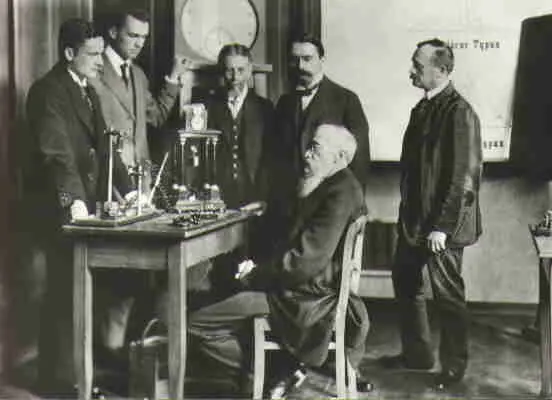
His other method was trained looking inward. Wundt’s observers learned to report on their own experience as objectively as they could, under controlled conditions. It was a serious attempt to make introspection scientific. It also ran into trouble: different observers, looking carefully at their own minds, often disagreed, and nobody could settle who was right, because nobody else could look.
In America, William James wrote The Principles of Psychology in 1890. Its first line called psychology “the Science of Mental Life”. James was less interested in the mind’s building blocks than in what it was for, how thinking and feeling help a living thing get by in the world.
Then, in 1913, John Watson lost patience with the whole business. Psychology, he announced, should be “a purely objective experimental branch of natural science”, aiming at the prediction and control of behavior, and introspection formed “no essential part of its methods”. Forget consciousness, he said; study what people and animals do. His behaviorism made the subject rigorous, with objective methods and experiments. It also set aside thoughts and feelings, since nobody can see them.
Meanwhile the Austrian neurologist Sigmund Freud had been listening to his patients and came to the opposite conclusion from Watson’s about where to look. Much of what moves us, Freud argued, is out of sight in the unconscious, and comes out in dreams, slips of the tongue, and the troubles that brought people to him. He wrote in 1917 that his work had dealt human pride a heavy blow: it showed that “the Ego is not master in its own house”. Freud’s theories were built from his own interpretations of his patients, and most of his particular ideas have not found support in later research. His broad point, that a great deal of mental life happens outside awareness, has. The stockings say the same thing, by a different road.
Others widened the field again. The Swiss scientist Jean Piaget argued that children don’t simply know less than adults: they think differently, in ways that change as they grow. In the middle of the century Abraham Maslow and Carl Rogers objected to Freud’s gloom and to behaviorism’s way of reducing people to simple causes, and stressed instead the good that people can grow into; Rogers built a way of counseling around listening to a person with warmth, honesty and understanding. From the 1950s, with computers in the air, psychologists came back to the mind itself, to memory, attention and language, now studied with experiments rather than with trained introspection. And in 1998, as president of the American Psychological Association, Martin Seligman, who had made his name studying helplessness, pressed for a “positive psychology”, a science of what helps people thrive and not only of what makes them suffer.
It is tempting to read this as a line of people getting it wrong until someone got it right. It is better read as one question asked again and again: how do you study a mind, when the only one you can see into is your own, and even that view is partial? Each answer left something behind: Watson’s demand that claims rest on what anyone can observe is now how the whole subject works.
How sure, and who was asked
What makes all this a science isn’t white coats or long words. It is that its claims are put where they can turn out wrong: tested by observation, in ways other people can repeat, and given up when they fail. Common sense never has to lose. A science does, and psychology has lost some famous findings. Several stories you may have heard, about obedience, prisons and willpower, look different now from how they were first told, and this book tells them both ways.
So two questions run through every chapter that follows. How well has the finding held up when others tried it again? And who was it tested on? A great deal of psychology was worked out on American and European university students. Some of it holds for people everywhere, some of it doesn’t, and for much of it nobody in Nepal has looked.
The subject itself has grown wide, and is often split in two: pure psychology, which tries to understand, and applied psychology, which puts that understanding to use. On the first side, experimental psychologists test memory, thinking and the senses in the laboratory, developmental psychologists study how people change as they grow, social psychologists how people behave with and around others, health psychologists how the mind bears on illness and getting well, and abnormal psychology studies mental illness itself. On the second, clinical and counseling psychologists help people in distress. Educational psychologists work on how students learn, organizational and industrial psychologists on how people are chosen and trained for work and how they do it, and sports psychologists on how players train and keep their nerve. In law, psychologists ask how far a witness’s memory can be trusted. Psychometry, the making of fair tests of ability and character, is a field of its own. Nepal’s own curriculum adds where it expects the subject to be used and to grow: in mental health and schools; in the Public Service Commission, which chooses the country’s civil servants by examination; in work with young people who have broken the law; in rural development, where so much depends on whether people take up a new way of farming or of staying healthy; and in tourism and hospitality, which run on understanding what guests want. The researchers who studied the मन and the दिमाग met psychosocial counselors at work in Jumla. You don’t need to become a psychologist to use any of this. It is enough to know a little better how your own mind works, and how far to trust it.
So psychology is the patient work of finding out about minds from the outside, because the inside view, though it is the only one any of us gets for free, leaves out most of what is going on. The Nepali names for the inner life, मन and दिमाग, are an old theory worth taking seriously. The Greek, Hindu and Buddhist thinkers asked the right questions. What the last century and a half added was a way of checking the answers, and the honesty, when it works, to say which ones failed.
Found a mistake? Please tell us.