
On 8 November 2016, India’s prime minister announced that the country’s 500 and 1,000 rupee notes would stop being money. Those two notes made up 86% of all the cash in India. People there had about fifty days to take them to a bank and swap them for new ones, and they did: by the time the counting was finished, 99.3% of the old notes had come back.
Nepal was not part of that deal. Indian money had always crossed the open border in pockets and wallets, and before the ban a Nepali could legally carry up to 25,000 Indian rupees in those big notes. Workers in India sent them home. Families near the border kept them for shopping on the other side. The same day Nepal Rastra Bank, Nepal’s central bank, told banks and money changers to stop handling them, and asked India for a way to exchange them. Banks in Nepal turned out to hold 78.5 million Indian rupees’ worth. By February 2022 only about 8.5 million had been exchanged, and the central bank said it was still holding the other 70 million, with no reply from India. Reports in early 2026 said the notes were still sitting there. How much more sat in homes nobody knows. One estimate from business people in 2017 ran as high as ten billion rupees.
In July 2017 a news agency’s report told of a father in Nepal whose son worked in a restaurant in Delhi and had sent home 8,000 rupees in the old notes. “My savings are worth no more than waste papers,” he said. The paper was exactly what it had been a year before, the same size, the same color, the same printing. Something else had gone, and that something is what this chapter is about.
Paper that everyone takes
A banknote is a piece of printed paper. It buys a plate of momo because the person selling momo is sure that the person selling flour will take it too, and the flour seller is sure the farmer will, and so on round the whole country. Money works because everyone expects everyone else to accept it. Take that expectation away, as India did with two of its notes overnight, and what is left is printed paper. How people came to trust coins, then paper, then numbers on a phone is a long story of its own, and Economics, for the Curious tells it. For one person with money in a pocket, the question that matters is plainer: what will this buy?
The answer is not fixed. Sabina, who is 15 and made up, gets pocket money from her mother Anshu’s tea shop. When Anshu was 15, around the year 2000, food in Nepal cost about a sixth of what it costs today. Anshu is made up too, but that sixth isn’t: it is what Nepal’s own measure of prices says. Nobody kept a record of one plate’s price, so take a made-up one: if a plate that sells for Rs. 150 now had kept pace with food in general, it cost about Rs. 26 then. To Sabina that sounds like a joke. To Anshu it sounds like Tuesday.
Prices that creep up
Prices in general going up over the years is called inflation. People in Nepal call it महँगी (dearness), and the textbooks call it मुद्रास्फीति. It doesn’t mean every price rises. Some fall: in 2023/24 cooking oil and ghee were about 11% cheaper than the year before, and in 2017/18 lentils and beans fell by almost a quarter. Inflation is the average, the way the whole of what a household buys gets dearer.
Somebody has to measure that average, and in Nepal it is Nepal Rastra Bank. Its staff go to markets and write down prices: 525 things, in 87 market places spread over all 77 districts. Some prices are checked every week, some every month. The list reads like a family’s year. It has rice and lentils, cooking oil and sugar, rent for a room, a school bus fee, bus fares for trips under and over 50 kilometers, a cup of tea, a plate of buff momo, and the charge for putting a new screen on a mobile phone. Each thing counts according to how much households really spend on it, which the bank takes from a national survey of thousands of families. Food and drink make up about a third. The bank then turns all those prices into one number, the consumer price index. When the index is 6% higher than a year ago, inflation is 6%.
People have been writing down prices in Nepal for a long time. The Gorkhapatra newspaper began printing the retail prices of a few goods in 1902, and the central bank has collected them since it opened in 1956. Its index, with each item weighted by what families spend, goes back to 1973/74. That long line is what lets us take food prices back to 2000, and you can take it back further yourself.
The line rises slowly at first and then steeply, and the curve itself says something. Between 1973/74 and 2025/26 prices in Nepal rose about fifty times. A rupee in 1973/74 bought roughly what fifty rupees buy now. Yet the average rise over those 52 years was under 8% a year. Nobody living through it saw prices jump fifty times. They saw them go up a little each year, and a little more the next, and each year’s rise was added on top of the last one’s. At 8% a year prices double in about nine years, and then double again from there. Small steps, taken for long enough, end up somewhere far away. You’ll meet this same arithmetic, working the other way, when money earns interest in a bank.
The rise has not been even. In the 1970s and 1980s prices often went up 10% or more in a year. In 1991/92 they rose 21%. Since about 2016 the yearly rise has mostly been between 3% and 8%. Some of the reasons lie far from any Nepali market. India is Nepal’s biggest trading partner, with about two thirds of its trade. The border is open, and the Nepali rupee is fixed to the Indian one. So when prices rise in India, they soon rise here. Nepal Rastra Bank’s own study found that each 1% of inflation in India has tended to bring about 0.7% to Nepal.
A little inflation every year is thought normal. The central bank doesn’t try to stop prices rising altogether. It aims to keep the rise steady and not too fast, and each year it names a figure it hopes to stay near. What it fears is the other end, and the standard example of that is Germany in 1923. The government had paid for the First World War largely by borrowing, and in 1923 it printed money in enormous amounts to pay its bills. On 3 January 1923 a kilogram of rye bread in Berlin cost 163 marks. On 19 November the same kilogram cost 233 billion marks. The note in the photo was printed for 100 billion marks on 26 October that year. Less than a month later it couldn’t buy half a kilo of bread.
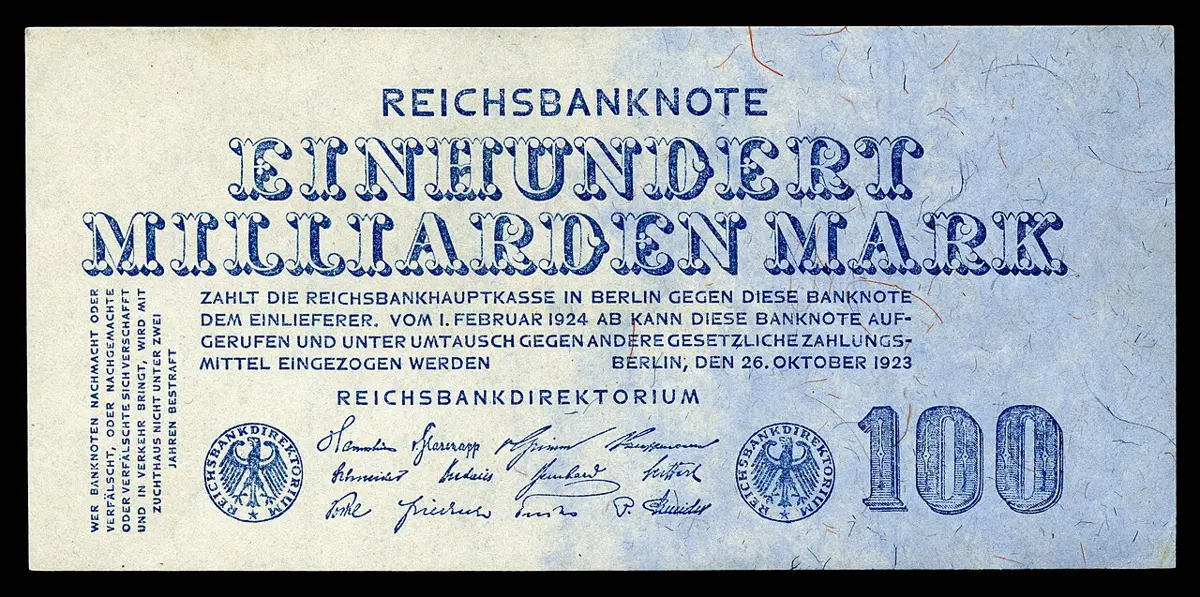
How much, and how much it buys
All this leaves money with two sizes. One is the number written on it, or in your account. The other is what that number can buy. Economists call the first nominal and the second real, and the gap between them is the whole point of this chapter. A rupee is always a rupee. What a rupee is worth keeps changing.
The difference shows up wherever money is counted over time. Take pay. Nepal Rastra Bank keeps an index of wages and salaries too. In 2024/25 pay rose about 2.9%, while prices rose about 4.1%. Workers took home more rupees and could buy less with them, so their real pay fell. In 2025/26, by the bank’s first, provisional figures, pay rose about 5.8% and prices about 3.1%, and real pay rose. A raise is only a raise once you know what happened to prices.
Or take money kept at home. Cash under a mattress, in a tin or behind the picture of a god keeps its nominal value perfectly: put Rs. 10,000 away and you’ll find Rs. 10,000 when you look. But by Nepal’s own index, Rs. 10,000 put away in 2015/16 would buy in 2025/26 only what about Rs. 6,200 bought when it was hidden. Nobody stole the missing Rs. 3,800. Prices simply moved on while the money sat still. That is why cash at home quietly shrinks, even in a quiet decade, and why families who have watched it happen look for something whose price rises along with everything else. Gold, land and a few goats have all been answers to that problem. Each has its own risks, and a later chapter looks at them.
Inflation also shifts money between people without anyone handing anything over. Someone who has lent money is paid back later in rupees that buy less, so the lender loses and the borrower gains. In Germany in 1923 the people hurt worst were those living on savings, a fixed pension or a fixed rent. Farmers who had borrowed against their land paid off the whole debt with money that had become almost worthless. Ordinary inflation does the same thing slowly. It’s one reason nobody lends for long without charging interest, the price of waiting for money.
What this book is about
The father with the useless notes did nothing foolish. He kept money his son had earned, in a currency that had always been good, and a decision made in another country changed it. Most money trouble is less sudden than that, and most of it can be seen coming by someone who knows what to look for. That knowing has a name, financial literacy, वित्तीय साक्षरता. Nepal Rastra Bank describes it as the knowledge, skill, attitude and behavior a person needs to make informed decisions about money. It has two halves: understanding how money works, and acting on that understanding in ordinary life.
Nepal’s school course on finance, वित्त तथा बैङ्किङ, lists the basic parts as money (मुद्रा), income, spending, saving and investing, with securities (धितोपत्र), such as shares, and remittance (विप्रेषण), money sent home from abroad. Each is a way money moves through a life. Income (आम्दानी) is what comes in: pocket money, a wage, profit from a shop, rent. Spending (खर्च) is what goes out, on needs and on wants. Saving (बचत) is what you don’t spend now so that you can spend it later. Investing (लगानी) is putting savings into something that should earn more, a share in a business, a piece of land, and accepting some risk that it won’t. Behind every one of them sits the question this chapter started with: what will this money buy, and when?
This book follows those threads through one life, Sabina’s, from pocket money to old age. It explains how each thing works and why it exists, and leaves the choices to you. It isn’t financial advice, and it never says what to buy.
So the thing to keep from this chapter is that money has two sizes. The number on the note stays put, and what it buys drifts, nearly always down, a few percent a year. In Nepal that drift has made prices fifty times higher since 1973/74, without any year that felt like a disaster. Any sum of money, a wage, a savings account, a loan, a price your grandmother remembers, means little until you ask what it buys and when. The next chapter takes that question one step further. If money now and money later are not the same thing, then how should a person who earns at 30 pay for being 70?
Try this
- Ask a parent or grandparent what a plate of momo, a cup of tea and a bus ride cost when they were your age. Work out how many times dearer each is now, and compare with the widget for that year.
- Find Nepal Rastra Bank’s latest Current Macroeconomic and Financial Situation report on its website, and the line near the start that gives consumer price inflation. Is it higher or lower than the bank’s target in the box below?
- If someone in your family got a raise this year, take the inflation figure away from it. That’s roughly how much their real pay changed.
Found a mistake? Please tell us.