
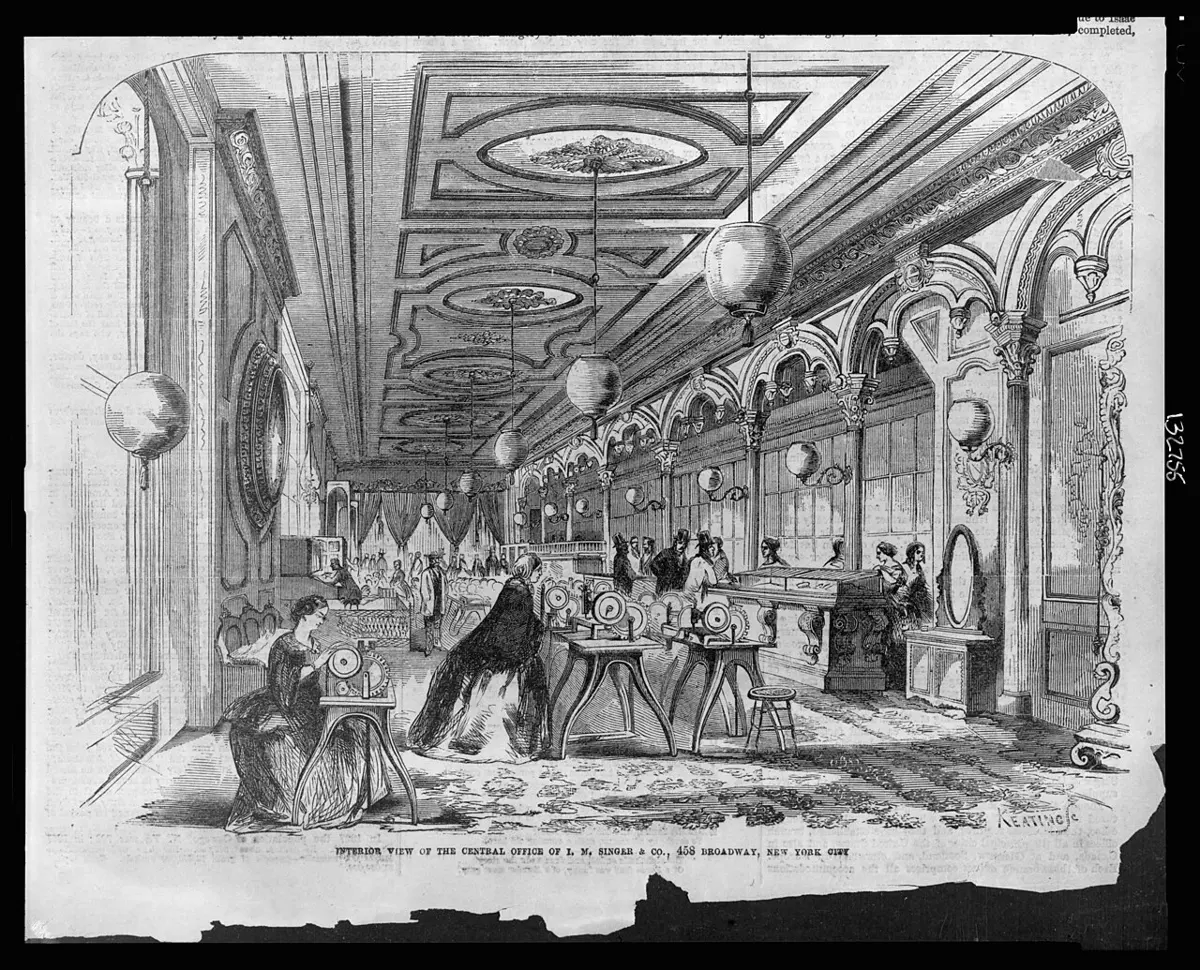
In the 1850s a sewing machine cost a great deal, and most American families earned little. It cut the time needed to sew a shirt from about fourteen hours to one, but few households could pay for one at once. Isaac Singer’s company in New York had machines to sell, and Singer’s partner, a lawyer named Edward Clark, suggested a way round that. In 1856 the firm’s own paper, the Gazette, put the idea as a question: “Why not rent a sewing machine to the housewife and apply the rental fee to the purchase price of the machine?”
Paying by installments wasn’t new. Debts had been settled in parts for centuries, and one account says Singer’s plan was inspired by the piano showrooms near its office. What the company did was carry the idea to a machine for the home, and sell it hard. Its sales tripled within a year, and by the 1890s its agents were notorious for “dollar down, dollar a week”. A machine that let a tailor or a family sew faster could earn part of its own payments, the kind of loan Chapter 14 called a good trade.
Today the equal payment has a name in Nepal that everyone uses in English: the EMI, the equated monthly installment. A motorbike, a phone, a house, a laptop for college: each can be had now and paid for in equal parts, month by month. The word “equated” is the clue to this chapter. The payments are made equal on purpose, but what each one does changes from the first to the last.
Three payments, worked by hand
Take a made-up loan of Rs. 30,000 at 1% a month, repaid in three equal payments. The bank works out the payment first, Rs. 10,200.66, and then each month does the same two steps. It charges a month’s interest on whatever is still owed, and whatever is left of the payment repays the loan.
In the first month the whole Rs. 30,000 is owed, so the interest is Rs. 300. The other Rs. 9,900.66 of the payment repays the loan, leaving Rs. 20,099.34. In the second month the interest is 1% of that, Rs. 200.99, so Rs. 9,999.67 repays the loan and Rs. 10,099.67 is left. In the third month the interest is Rs. 101, and the payment clears what remains. The last payment is a paisa more than the others, Rs. 10,200.67, because every sum was rounded to the paisa along the way.
That is all a loan schedule is, the repayment table that finance books call an amortization schedule. Every line has the same three columns: the interest on what was owed, the part that repays the loan, and what is still owed after it. The payments stay the same while the interest shrinks, because the debt it is charged on shrinks, and so each month a little more goes to the loan. Here the shift is small: 3% of the first payment was interest and 1% of the last.
Why the payment is that size
How did the bank know to ask Rs. 10,200.66? It ran Chapter 9’s regular saving backward.
Chapter 9 put a payment P aside at the end of each period for n periods, at a rate r for each period, and asked how much it grew to. A loan asks the opposite question. How much is a row of equal future payments worth today? Chapter 10 called this a payment’s present value. One payment of P made a month from now is worth P ÷ (1 + r) today, one made two months from now P ÷ (1 + r)², and so on. Adding n of them gives the present value of the whole row:
For the payments to be fair to both sides, this must equal the loan. Turned round, that gives the payment the bank asks:
This is the EMI formula. r is the monthly rate, the yearly rate divided by 12, and n is the number of months. For Rs. 30,000 at 1% for three months it gives Rs. 10,200.66, to the paisa. Grade 10 Math, Unit 2 works the growth of money this formula runs backward.
The same equation answers three different questions, depending on which of its parts is unknown. Given the loan, the rate and the months, it gives the payment. Given the payment someone can afford, it gives how long the loan will take: Rs. 1 lakh at 1% a month, repaid at Rs. 10,000 a month, needs 10.6 months, so ten full payments and a smaller eleventh. And given the loan, the payment and the months, it gives the rate, though not by rearranging. A rate has to be found by trying one, seeing whether the payments come out too big or too small, and adjusting, as a spreadsheet’s rate function does. That last use turns out to matter most, because it reveals what a deal really costs.
Chapter 9’s payments came at the end of each period, an ordinary annuity. When each payment is made at the start instead, an annuity due, the first one is paid the day the loan is made, and every payment is worth a month more. Rs. 1 lakh at 12% a year for 12 months costs Rs. 8,884.88 a month paid at each month’s end, but Rs. 8,796.91 paid at each month’s start. The EMI formula above is the first kind. A rent, or a deal in which the first installment is paid at the counter, is the second.
Mostly interest, at first
On a short loan the shift from interest to loan hardly shows. On a long one it is the whole story.
Take a made-up home loan of Rs. 30 lakh at 7% a year for 20 years. The EMI is Rs. 23,259. In the first month the bank charges 7% ÷ 12 on the whole Rs. 30 lakh, which is Rs. 17,500, so three-quarters of the first payment is interest and only Rs. 5,759 repays the loan. The loan part doesn’t overtake the interest until the 122nd payment, just over ten years in. After half the term, the borrower has paid Rs. 27.9 lakh, and still owes Rs. 20 lakh, two-thirds of what was borrowed. In all, the 240 payments come to Rs. 55.8 lakh, of which Rs. 25.8 lakh is interest.
This is not a trick. Each month’s interest is just the month’s price of the money still held, at the agreed rate, and early on most of the money is still held. But it surprises nearly everyone who first reads a schedule, and it explains two things borrowers notice. Selling a house a few years into its loan leaves most of the loan still to pay. And extra money paid early cuts the most interest, as a later section shows.
A longer term makes the EMI smaller and the loan dearer. The same Rs. 30 lakh at the same 7%:
| Term | EMI | Interest in all |
|---|---|---|
| 10 years | Rs. 34,833 | Rs. 11.8 lakh |
| 20 years | Rs. 23,259 | Rs. 25.8 lakh |
| 30 years | Rs. 19,959 | Rs. 41.9 lakh |
Going from 20 years to 30 cuts the EMI by about Rs. 3,300 a month and adds Rs. 16 lakh of interest. Over 30 years the interest is more than the house loan itself. The longer term can still be the right choice. It may be the only EMI a household’s income can carry, and Nepal Rastra Bank lets home loan payments take at most 70% of a borrower’s income, so an EMI of Rs. 23,259 needs an income of at least about Rs. 33,200 a month. But the lower monthly figure is not a lower price.
Flat and reducing
There are two ways to turn a rate into installments, and they can sound the same.
The way above is on the reducing balance: each month’s interest is charged on what is still owed. The other is a flat rate. The interest is worked out once on the whole loan for the whole term, added to it, and the total is divided into equal parts. Rs. 1 lakh for a year at a flat 12% means Rs. 12,000 of interest, and twelve payments of Rs. 9,333. On the reducing balance, at 1% a month, the same loan costs Rs. 6,619 of interest, with an EMI of Rs. 8,885.
A flat rate charges interest on money the borrower has already paid back. By the last month only a twelfth of the loan, about Rs. 8,300, is still to be repaid, yet the flat payment carries a full Rs. 1,000 of interest, as if the whole Rs. 1 lakh were still out. Working backward from the payments, as the last section did, shows what the flat 12% really is: about 1.79% a month on the reducing balance, or 21.5% a year, close to double.
That doubling has been known for a long time. In 1972, in a debate in Britain’s House of Lords on a report about consumer credit, Baroness Phillips told of a reporter who had gone to buy a washing machine in London and been quoted a “service charge” of 7½%, which worked out at a true rate of 14.7% a year. Lord Davies of Leek offered a rule of thumb: “one would be roughly right if one always doubled the flat rate.” Lord Redesdale, replying, confirmed it with figures: a flat 6½% over six months was really 11.06%, and over three years about 12%. The report they were debating had recommended that lenders show the true yearly rate.
In Nepal, Nepal Rastra Bank’s directives of 2067 BS (2010) told banks and finance companies not to fix flat interest rates on their loans. Its current directive on interest rates doesn’t repeat that line, but it makes them publish every rate as a yearly percentage. A shop’s installment plan or a private lender’s is another matter. Where a rate is quoted for installments and isn’t from a bank, the first question is whether it is flat.
The “0%” installment
Phones in Nepal are sold on schemes advertised as 0% EMI, usually through a bank’s credit card or a finance company. A buyer pays part of the price at the start, often a large part, and the rest over three months to two years, with no interest named. Not every condition is in the advertisement, and the cost is often in the conditions.
The cost can be in a processing fee, in a higher price than a cash buyer pays, or in a cash discount the installment buyer doesn’t get. India’s central bank wrote to its banks about exactly this in 2013. In the zero percent schemes on credit cards, it said, the interest is often camouflaged and passed on as a processing fee, and “the very concept of zero percent interest is non-existent”. Any discount the maker or the shop gives, it said, should lower the amount the buyer borrows, not be hidden in the rate.
The equation from earlier shows the real price. Take a made-up phone costing Rs. 30,000 in cash, or Rs. 2,900 a month for a year with a fee of Rs. 1,000 at the start: Rs. 35,800 in all. Since the fee is paid on the day, the buyer is really borrowing Rs. 29,000 and repaying it in twelve payments of Rs. 2,900. The rate that makes those payments worth Rs. 29,000 today is about 2.9% a month, 35% a year. A “0%” plan with no fee at all, Rs. 2,500 a month for a year on a phone a shop would sell for Rs. 27,000 in cash, still costs about 20% a year. The test is simple: compare the total paid with the cash price, on the same day, at the same shop.
Credit cards
A credit card is a loan with no fixed EMI at all. The bank sets a limit, the holder borrows whenever they pay with the card, and each month a statement shows what is owed, with a minimum payment that keeps the card in good standing. Nepal had about 344,000 credit cards in mid-October 2026, against 13.8 million debit cards.
In Nepal only the commercial banks and the national-level development banks and finance companies may issue credit cards, and Nepal Rastra Bank’s rules on payments say what the card’s agreement must spell out: the limit, the billing period, the date by which it must be paid, the interest and penalty charged if it isn’t paid by then or only the minimum is paid, and how those are worked out, with an example. Cash can be drawn on a card only up to a tenth of its limit. One Nepali bank’s card charges 2% a month, 24% a year, with a fee of Rs. 1,000 a year, a late fee of Rs. 750, and for drawing cash, Rs. 100 to Rs. 200 plus 2% of the amount, before any interest.
The rules don’t set how the interest is charged, which each bank’s agreement says. In the United States, where the government’s consumer finance agency explains it, most cards give a grace period: a holder who pays the whole statement by its due date pays no interest at all. A holder who pays only part of it pays interest on the rest, and can lose the grace period, so that new purchases cost interest from the day they are made. A Nepali card’s own agreement is the one to read.
The minimum payment is where a card’s cost hides. Take a made-up balance of Rs. 20,000 at 2% a month, with a minimum of 5% of the balance or Rs. 500, whichever is more, and nothing new spent. Paying the minimum each month clears it in four years, with Rs. 9,344 of interest. Paying Rs. 1,000 a month clears it in a little over two years, with Rs. 5,797. American card statements must show how long paying only the minimum would take, and the monthly payment that would clear the balance in three years.
Paying early
Because the interest is charged on what is still owed, any extra rupee paid toward the loan stops costing interest from that day on. Nepal Rastra Bank lets a borrower pay off a loan of up to Rs. 50 lakh early without a fee.
Go back to the Rs. 30 lakh home loan at 7%. After five years, Rs. 25.9 lakh is still owed. Suppose the borrower pays an extra Rs. 2 lakh then. Keeping the same EMI, the loan ends 22 months sooner, and the rest of it costs Rs. 3.3 lakh less interest. Keeping the same end date instead, the EMI falls from Rs. 23,259 to Rs. 21,461. The first way saves more interest; the second leaves more money each month.
A loan at a rate that moves adds one more unknown. When the rate rises, either the EMI rises or more payments are needed to clear the same debt. Nepal Rastra Bank now asks for personal loans of more than a year to be at a fixed rate unless the borrower asks for one that moves, as Chapter 14 described.
An EMI is the same payment made month after month, but it does a different job each time. It is sized so that the row of payments is worth exactly the loan today, which is why the same equation can find the payment, the months or the rate. Each payment first pays the month’s interest on what is still owed, so a long loan is mostly interest at first, and a longer term means a smaller payment but a bigger total. A flat rate is close to double its name, and “0%” is a claim to test against the cash price. The question that cuts through every scheme is the one Singer’s customers could have asked too: how much in all, against how much today?
Try this
- Use the Loan Board for Rs. 30,000 at 12% a year for 3 months, and check its schedule against the three payments worked by hand.
- On the Loan Board, set Rs. 30 lakh at 7% and find the first payment in which more goes to the loan than to interest at 10, 20 and 30 years.
- The next time an installment price is advertised, add up the EMI: the monthly payment times the months, plus any fee or down payment. Compare the total with the price for cash on the same day.
- In a spreadsheet, the function PMT(rate, months, −loan) gives the EMI. Use it for Rs. 1 lakh at 1% a month for 12 months, then RATE(12, −9333.33, 100000) to find what a flat 12% really costs a month.
Found a mistake? Please tell us.