
It is the last period on a Friday in a Bhaktapur school, and the maths teacher writes a game on the board. “Give me an even number, and I’ll write it as two prime numbers added together.” Kriti says 28: “5 + 23.” Aayush says 100: “3 + 97.” Someone tries 98, and the class takes a minute to find 19 + 79.
Then Kriti asks the real question. “Does it work for every even number? Even one with fifty digits?”
The teacher puts the chalk down. “Nobody knows. Not me, not anyone. People have tried for nearly three hundred years.”
Play the game yourself first. Pick an even number, then tap the primes up to half of it, one by one, and see which ones leave a prime behind.
Guess first. Has anyone ever found an even number bigger than 2 that can’t be written as two primes added?
Pick an answer to see why.
Try it: count the ways
Some numbers split in only one way: 4 = 2 + 2, 6 = 3 + 3, 8 = 3 + 5, 12 = 5 + 7. Others have several. Here is every way for the even numbers up to 40, counting 3 + 7 and 7 + 3 as the same way:
| Even number | 4 | 6 | 8 | 10 | 12 | 14 | 16 | 18 | 20 | 22 | 24 | 26 | 28 | 30 | 32 | 34 | 36 | 38 | 40 |
|---|---|---|---|---|---|---|---|---|---|---|---|---|---|---|---|---|---|---|---|
| Ways | 1 | 1 | 1 | 2 | 1 | 2 | 2 | 2 | 2 | 3 | 3 | 3 | 2 | 3 | 2 | 4 | 4 | 2 | 3 |
Look at the table, then use the widget below to look much further.
- a.Does the number of ways grow steadily, or does it jump about?
- b.30 has 3 ways but 32 has only 2; 36 has 4 but 38 has 2. What do 30 and 36 have in common?
- c.Up to 10,000, does the smallest number of ways stay near 1, or does it climb?
Why multiples of 3 have twice the ways
Take 1,000, which isn’t a multiple of 3. Try a prime p from 5 upward. Every prime from 5 on leaves 1 or 2 when divided by 3. If p leaves the same remainder as 1,000 (which leaves 1), then 1{,}000 − p leaves 0: it is a multiple of 3, so it can’t be prime. That kills about half the primes before you even look: of the 93 primes from 5 to 500, 45 give a multiple of 3.
Now take 1,002, a multiple of 3. Then 1{,}002 − p is a multiple of 3 only if p is, and no prime from 5 on is. None of the 93 primes is ruled out this way. So a multiple of 3 has about twice as many chances, and gets about twice as many ways. The same thing happens, more weakly, with 5 and 7: 210 = 2 × 3 × 5 × 7 has 19 ways, while 212 has only 6.
Which even number would you expect to have the most ways to split into two primes?
Pick an answer to see why.
Goldbach’s conjecture
On 7 June 1742, Christian Goldbach, a mathematician in the service of the Russian government, wrote to his friend Leonhard Euler about numbers made by adding primes. In that letter and Euler’s reply, the claim took the shape we know:
A conjecture is a statement that mathematicians think is true but nobody has proved. Once proved, it becomes a theorem. Euler answered on 30 June 1742, in German: “That every even number is a sum of two primes I hold to be a completely certain theorem, although I cannot prove it.” (Our translation.) In those days 1 counted as a prime, so his letters say things a little differently, but this is the modern form.
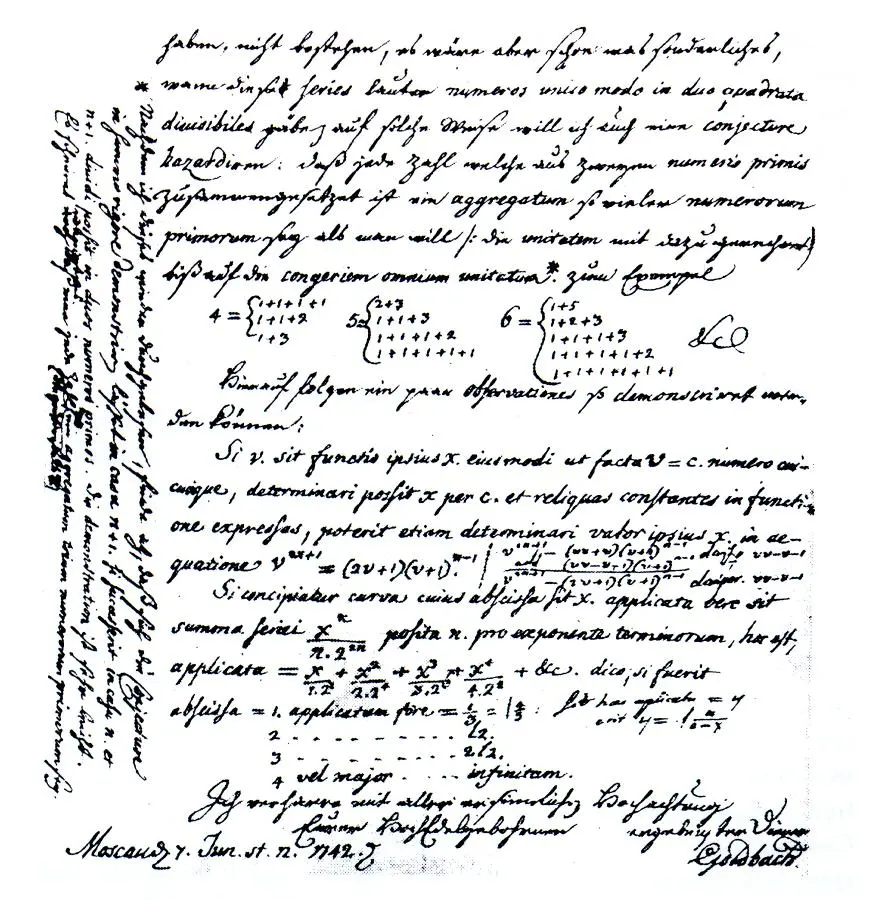
How sure can anyone be?
The evidence from computers. In April 2012, a search led by Tomás Oliveira e Silva at the University of Aveiro, in Portugal, run in the spare time of many computers, finished checking every even number up to 4 × 10¹⁸. Every one splits. None of them needs a smaller part bigger than the prime 9,781.
The evidence from counting. Near a number n, about one number in every is prime, where is the natural logarithm of topic 3, about 2.3 for every factor of 10 in n. (Near 10,000, about one number in 9.2.) To split n you have about n/2 pairs to try, and if each part were prime by chance, a pair would be two primes about once in every tries. So you’d expect roughly
ways. For 10,000 that gives about 59. The true count, 127, is higher, because the formula forgets what you just saw: both parts are odd, and multiples of 3 and 5 aren’t ruled out at random. But the formula gets the main thing right: the ways grow without limit. Near 4 × 10¹⁸ it predicts about a thousand million million ways. For a number to have none, every one of those chances would have to fail at once.
The estimate that was always too high, until it wasn’t
Here is a sharper warning, about counting primes themselves. In 1792 or 1793, aged 15 or 16, Carl Friedrich Gauss thought about how many primes there are up to x. The estimate that grew from it adds up the chance of being prime for every number t up to x (smoothly, as calculus adds). That sum is written . It is remarkably good:
| Up to | Primes there are | Gauss’s estimate, li | Too high by |
|---|---|---|---|
| 1,000 | 168 | 177.6 | 9.6 |
| 1,000,000 | 78,498 | 78,627.5 | 129.5 |
| 10⁹ | 50,847,534 | 50,849,235.0 | 1,701.0 |
| 10¹⁸ | 24,739,954,287,740,860 | 24,739,954,309,690,415.0 | 21,949,555.0 |
Every count anyone has ever done finds the estimate too high. So surely it always is? In 1914 John Littlewood proved it is not: somewhere, the count of primes overtakes Gauss’s estimate, and then they swap places infinitely often. A crossing has been proved near 1.4 × 10³¹⁶, a number with 317 digits, far beyond any computer’s count; none comes before 10¹⁹, and exactly where the first is, nobody knows. (That was the first job of Skewes’s number, in topic 5.) A pattern can hold for every number anyone can check and still be false.
Which of these would settle Goldbach’s conjecture?
Pick an answer to see why.
Why it is so hard
Primes are defined by multiplying: a prime isn’t a product of smaller numbers. Goldbach asks about adding them, and knowing how a number breaks into factors tells you almost nothing about the factors of its neighbors. The tools for crossing between the two worlds are still too weak.
What has been proved
Mathematicians have proved things that come close:
- Three primes for odd numbers. Goldbach’s other guess in the 1742 letter, written in its margin, in modern form: every odd number greater than 5 is the sum of three primes (35 = 2 + 2 + 31, 99 = 3 + 7 + 89, 2,025 = 3 + 5 + 2,017). Ivan Vinogradov proved it in 1937 for all odd numbers beyond some huge size; Harald Helfgott proved it for all of them in 2013 (accepted for publication in 2015, and still being revised chapter by chapter).
- A prime plus almost a prime. In 1973 Chen Jingrun proved that every large enough even number is a prime plus a number that is either prime or the product of two primes: 2,026 = 5 + 2,021, and 2,021 = 43 × 47.
- Almost every even number. In 1937 and 1938 Nikolai Chudakov, Johannes van der Corput and Theodor Estermann proved that exceptions, if there are any, become rarer and rarer: as you go further out, the share of even numbers that can’t be split shrinks towards zero. In 1975 Hugh Montgomery and Robert Vaughan proved that they are rarer still.
Twin primes: how close can primes be?
Primes come close together surprisingly often: 11 and 13, 17 and 19, 29 and 31, 101 and 103. Two primes that differ by 2 are twin primes. (Apart from 2 and 3, they can’t be closer: of two numbers 1 apart, one is even, and the only even prime is 2.)
Here is how many twin pairs there are, counted by our program up to 10⁸ and by others beyond:
| Up to | 100 | 1,000 | 10,000 | 100,000 | 10⁶ | 10⁷ | 10⁸ | 10¹⁸ |
|---|---|---|---|---|---|---|---|---|
| Twin pairs | 8 | 35 | 205 | 1,224 | 8,169 | 58,980 | 440,312 | 808,675,888,577,436 |
They thin out, but they keep coming. The largest twin pair known (as of October 2026) is 2,996,863,034,895 × 2¹²⁹⁰⁰⁰⁰ ± 1, two numbers of 388,342 digits found in September 2016 by the volunteers of the PrimeGrid project. G. H. Hardy and John Littlewood guessed a formula for how many there should be; up to 10⁸ it predicts about 440,368, against the true 440,312.
It is one of the best-known open questions in mathematics: the counting evidence says twins never stop, and nobody has proved it.
A gap that stays small
Before 2013 nobody could prove even that the gaps between neighboring primes stay below some fixed size infinitely often. Then, in April 2013, a university lecturer, Yitang Zhang, proved it: there are infinitely many pairs of primes less than 70 million apart. Seventy million is not two, but it is a fixed number, and that was the breakthrough. Within weeks, mathematicians around the world, working together online in Terence Tao’s Polymath project, began cutting it down. In November 2013 James Maynard, with a new and simpler method, reached 600. By 2014 the Polymath project, using Maynard’s ideas, had 246.
In Figure 10.2, from 70 million to 246 the bound fell by a factor of about 285,000; from 246 to 2 it needs a factor of only 123. But the best these methods give, even assuming a stronger unproved guess about how primes spread, is 6. And “246” means only that at least one of the gaps 2, 4, 6, …, 246 happens infinitely often. Nobody knows which.
Landau’s four problems
In 1912, at the International Congress of Mathematicians, the German mathematician Edmund Landau listed four questions about primes that he called “unattackable at the present state of mathematics”. Two you have met. As of 2026, all four are still open.
- Goldbach’s conjecture: every even number greater than 2 is a sum of two primes.
- Twin primes: infinitely many pairs of primes differ by 2.
- Legendre’s conjecture: between any two square numbers next to each other there is always a prime.
- Primes one more than a square: there are infinitely many primes of the form .
A prime between every two squares?
Between 1 and 4 there are 2 and 3; between 4 and 9, 5 and 7; between 9 and 16, 11 and 13; between 16 and 25, 17, 19 and 23. Adrien-Marie Legendre guessed, in his book on number theory (1808), that this never fails.
The counts grow: for every n from 1,000 to 9,999 there are at least 127 primes between and , and the conjecture has been checked up to n of about 4.5 × 10⁹. What is proved, Bertrand’s postulate (Chebyshev, 1852), promises a prime between any number and its double: from 10,000, somewhere in a stretch of 10,000 numbers. Legendre asks for one in a stretch of only 201, from 10,000 to 10,201. Between two big enough cubes next to each other a prime has been proved, but squares are still too close together for the proofs.
Primes one more than a square
is prime for n = 1, 2, 4, 6, 10, 14, 16, 20, …: the primes 2, 5, 17, 37, 101, 197, 257, 401. Among n up to 100 there are 19 such primes; up to 10,000, 841. They grow rarer, but nobody can prove they don’t stop. The nearest result: in 1978 Henryk Iwaniec proved that infinitely many numbers are a prime or the product of two primes, close in spirit to Chen’s theorem.
For which of these n can be prime?
Pick an answer to see why.
The biggest open problem: the Riemann hypothesis
Gauss’s estimate missed by 9.6 at 1,000 and by about 22 million at 10¹⁸. That is tiny next to the counts, and smaller even than , the square root: at 10¹⁸, is 10⁹, and the miss is about 2 % of it.
In 1859 Bernhard Riemann linked the count of primes to a single function and the places where it is zero, and guessed that all those places, apart from some easy ones, lie on one straight line. His guess, the Riemann hypothesis, comes down to this: Gauss’s estimate is never wrong by much more than . If it is true, the miss is always less than once x passes 2,657 (Lowell Schoenfeld, 1976); at 10¹⁸ that allows about 1.6 billion, and the real miss is 22 million. The two go together: if the miss always stayed that small, the hypothesis would be true. So it says that the primes, scattered as they look, are spread as evenly as they possibly could be (in 1901 Helge von Koch showed that it gives what mathematicians call the best possible bound on the miss).
In 1900 David Hilbert put it, together with Goldbach and the twin primes, in his famous list of 23 problems for the new century. In 2000 the Clay Mathematics Institute named it one of seven Millennium Prize Problems, with US$1 million for a proof. Of the seven, only one has been solved; the Riemann hypothesis hasn’t.
Where this is used
Most of these questions have no use outside mathematics yet. But one practical cousin was answered recently, in South Asia.
Questions
★ Which of these is not a way to write 50 as two primes added?
Pick an answer to see why.
Find every way to write 68 as two primes added. Why do you think 68 has so few compared with 66 or 70?
Hint
Answer
Show that if Goldbach’s conjecture is true, then every odd number greater than 5 is the sum of three primes.
Hint
Answer
★★ For which prime p are p, p + 2 and p + 4 all prime?
Pick an answer to see why.
Check Legendre’s conjecture between 30² and 31². How many primes are there? Is the stretch from 31² to 32² any different?
Hint
Answer
Show that for n greater than 2, can be prime only if n ends in 0, 4 or 6. Check the list 4, 6, 10, 14, 16, 20, 24, 26, 36, 40.
Hint
Answer
Where to go next
- Is There a Biggest Prime Number? (Grades 6–8) Euclid’s proof that the primes never end, and how they thin out.
- Is a Pattern That Works Ten Times Always True? (Grades 6–8) Goldbach’s other guess failing at 5,777, and patterns that break late.
- What Is the Biggest Number Anyone Has Used? Skewes’s number, where the count of primes and Gauss’s estimate cross.
- How Can Two Strangers Agree on a Secret in Public? Big primes at work, keeping your messages private.
- Can You Prove √2 Is Not a Fraction? What a proof is, and why checking cases is never one.
- Computing, Going Further, Grades 9–12: Will This Simple Rule Ever Stop? Another question a child can ask and no one can answer, the Collatz problem, explored by program. (Coming soon.)
Where these facts come from
- Goldbach’s letter of 7 June 1742 and its marginal guess, Euler’s reply of 30 June 1742 (the German quoted, translated by us), 1 then counted as prime, the modern statements, the heuristic , Oliveira e Silva’s check to 4 × 10¹⁸, Chen’s theorem (1973), Chudakov, van der Corput and Estermann’s “almost all” (1937–1938), Montgomery and Vaughan (1975), Helfgott (2013): Wikipedia, “Goldbach’s conjecture”, read October 2026.
- The check reaching 4 × 10¹⁸ in April 2012 on the spare time of many computers, the minimal partition 3,325,581,707,333,960,528 = 9,781 + a 19-digit prime (the smallest number up to there needing a smaller part as big as 9,781): T. Oliveira e Silva, “Goldbach conjecture verification”, University of Aveiro, read October 2026. No peer-reviewed extension past 4 × 10¹⁸ was found (October 2026).
- Vinogradov (1937), Helfgott’s proof (2013), accepted in the Annals of Mathematics Studies in 2015 and under revision since: Wikipedia, “Goldbach’s weak conjecture”, read October 2026.
- Goldbach (1690–1764), tutor at the Russian court in Moscow, his correspondence with Euler: Wikipedia, “Christian Goldbach”, read October 2026.
- Goldbach’s letter of 18 November 1752 (a prime plus twice a square) and Stern’s 1856 counterexamples 5,777 and 5,993: ProofWiki, “Goldbach’s Lesser Conjecture/Historical Note”, read October 2026; the exceptions listed in OEIS A060003, read October 2026.
- Gauss’s li, Littlewood (1914), a proved crossing near 1.397 × 10³¹⁶ (not known to be the first), no crossing below 10¹⁹ (Büthe, 2015): Wikipedia, “Skewes’s number”, read October 2026. The counts of primes up to 10²⁹ in the table: Wikipedia, “Prime-counting function”, read October 2026 (those up to 10⁸ also counted by our program; li computed by it).
- Twin primes, de Polignac (1849), Zhang’s 70 million (April 2013), Tao’s Polymath proposal, 246 within a year, Maynard’s method, the conditional 12 and 6, the largest known pair (388,342 digits, September 2016), the Hardy–Littlewood constant: Wikipedia, “Twin prime”, read October 2026. The 808,675,888,577,436 pairs below 10¹⁸: OEIS A007508, read October 2026. The largest pair still first on the Prime Pages’ list of the largest known twin primes, read 31 October 2026.
- Polymath8a’s 4,680 (20 July 2013), Maynard’s 600 (November 2013), the 2026 claims (an AI-found 240 on 28 August, Stadlmann’s 240 posted 31 August 2026, then 236, 212 and 186, all with AI) and “as of September 2026, none … peer-reviewed, leaving the established bound at 246”: Wikipedia, “Prime gap”, read October 2026; Stadlmann’s abstract on arXiv:2608.31126 and the conditional status of the 186 claim in its repository’s README, read October 2026. The Polymath project’s records table, 246 without assumptions, 6 on the generalized Elliott–Halberstam conjecture: Polymath wiki, “Bounded gaps between primes”, read October 2026 through the Wayback Machine; Polymath8a and 8b: Wikipedia, “Polymath Project”, read October 2026.
- James Maynard’s bound of 600 and his Fields Medal (2022): Wikipedia, “James Maynard (mathematician)”, read October 2026.
- Yitang Zhang’s life (born 1955 in Shanghai, the Cultural Revolution, Peking and Purdue, work as an accountant, delivery worker, in a motel and a Subway shop, lecturer at New Hampshire from 1999, the 2013 paper, the MacArthur Fellowship, UC Santa Barbara from 2015): Wikipedia, “Yitang Zhang”, read October 2026.
- Landau’s four problems (1912), “unattackable at the present state of mathematics”, all open as of 2026, Iwaniec’s theorem on : Wikipedia, “Landau’s problems”, read October 2026.
- Legendre’s conjecture (1808), checked to , Ingham’s cubes: Wikipedia, “Legendre’s conjecture”, read October 2026. Bertrand and Chebyshev: as in the Grades 6–8 topic on primes.
- Riemann’s 1859 paper, Hilbert’s eighth problem, von Koch’s best possible bound (1901) and Schoenfeld’s form of it for , the error controlled by where the zeros lie, Goldbach’s comet named for its shape (in the Goldbach article): Wikipedia, “Riemann hypothesis”, read October 2026. The seven Millennium Prize Problems (24 May 2000, US$1 million each, only the Poincaré conjecture solved): Clay Mathematics Institute, “Millennium Prize Problems”, read October 2026.
- Gauss considering how primes thin out at 15 or 16, “in the year 1792 or 1793”: Wikipedia, “Prime number theorem”, read October 2026.
- Gary L. Miller’s test (1976), certain if the generalized Riemann hypothesis holds, and the probabilistic test in libraries such as OpenSSL: Wikipedia, “Miller–Rabin primality test”, read October 2026.
- The AKS test (Agrawal, Kayal and Saxena, IIT Kanpur, 6 August 2002, “PRIMES is in P”; Miller’s test depending on the generalized Riemann hypothesis; slower in practice): Wikipedia, “AKS primality test”; Kayal’s and Saxena’s B.Tech degrees in 2002, the 2006 Gödel and Fulkerson Prizes: Wikipedia, “Neeraj Kayal” and “Nitin Saxena”, read October 2026.
- Every count, list and number computed on this page (the ways for every even number to 20,000 and the comet’s lows, 1,000 against 1,002 and the 45 of 93 primes, the twin counts to 10⁸ and the Hardy–Littlewood estimate, Legendre’s counts, , li, the gap ratios, the twin record’s digits, the questions’ answers) was computed by a script (
checks/textbooks/math-further-9-12/10/tmp/answers.py).