
The power line from the national grid comes up the valley as far as the substation at Besi, beside the river, and stops there. Seven villages on the hillside above are still waiting for it. Your aunt, an engineer helping the rural municipality, spreads out a map of the fourteen routes a line could follow: Besi to Pipalbot along the trail, 4 km; Pipalbot up to Deurali, 5 km; Thulo Gaun across the stream to Simle, only 2 km; and so on.
Every kilometer of line means poles, wire and porters to carry them, so the plan with the least line is the one to build. A village has power once a line joins it to Besi, directly or through other villages. Which routes should get a line? Try it before reading on.
Guess first. What is the least cable that gives all seven villages power?
Pick an answer to see why.
Fewer villages first
Start with three villages, each pair joined by a possible route of 3, 4 or 6 km. There are three ways to join them with two routes: 3 + 4 = 7 km, 3 + 6 = 9 km and 4 + 6 = 10 km. The best leaves out the longest route. Two things in this tiny case are true for any number of villages.
The least network never has a loop. If some lines in a plan form a loop, take any one of them out: every village is still joined, since power can go round the other way, and the plan is shorter. So the best plan has no loop. A network that joins every place and has no loops is called a spanning tree: a tree because, like a real tree’s branches, its lines never grow back together. The one with the least total length is the minimum spanning tree.
With n places, a tree has exactly n − 1 lines. With no lines, every place is a group on its own: n groups. A line that closes no loop joins two places in different groups (otherwise it would close a loop), so it merges two groups into one. To get from n groups to one takes exactly n − 1 such lines. Besi and the seven villages are 8 places, so every plan with no loop has 7 lines; the puzzle is only which 7.
A district wants to join 20 health posts with a fiber network, with no loops. How many fiber links will it lay?
Pick an answer to see why.
Shortest first
Here is a rule that seems too simple to work. List the routes from the shortest to the longest. Go down the list and, for each route:
- lay a line along it, unless it would close a loop;
- if it would close a loop, cross it out.
Stop when you have laid n − 1 lines. Try it on the hillside.
On the hillside, the routes of 2, 3, 4 and 5 km are laid. Besi to Deurali (6 km) is crossed out: Besi and Deurali are joined already, through Pipalbot. Pipalbot to Sano Gaun (7 km) joins the two groups grown so far. The 8 and 9 km routes are crossed out, Sano Gaun to Chisapani (10 km) is laid, and the 11, 12 and 13 km routes each close a loop. Thulo Gaun to Lekhgaun (14 km) is the seventh line: 2 + 3 + 4 + 5 + 7 + 10 + 14 = 45 km.
This rule is called Kruskal’s algorithm, after the American mathematician Joseph Kruskal, who published it in 1956. It is a greedy rule: at every step it takes what looks best right now and never goes back. Greedy rules are often wrong. Imagine notes of 25, 20, 10 and 5 rupees: pay Rs 40 by always taking the biggest note that fits, and you get 25 + 10 + 5, three notes, when two 20s would do. So why should shortest first be any better?
Why greedy is exactly right
The proof rests on one fact. Divide the villages into two groups, any way you like. Some line of any plan must cross from one group to the other, or they would never be joined. Among all the routes crossing the divide, take the shortest; call it e.
The cut rule. Some cheapest network uses the route e.
Here is why. Take any cheapest network. If it doesn’t use e, add e to it, as on the left of Figure 26.1: with one line too many, it now has a loop through e. Walk round that loop starting along e: you cross the divide on e, and must cross back before you return, so the loop crosses the divide again, along another line, f. Take f out. The loop is broken in one place, so everything is still joined, with n − 1 lines again: a spanning tree. Its length has changed by e − f, and e was the shortest route across the divide, so e − f is zero or less. So the new network is cheapest too, and it uses e.
Now watch shortest first. Each line it lays joins two separate groups. Take one of them as one side of a divide, everything else as the other. A shorter route across this divide came earlier in the list, when its ends were in different groups too (groups only ever merge), so it would have been laid, and would now be inside a group, not crossing. So the line being laid is the shortest route across this divide, and the cut rule says some cheapest network contains it. And the swap never disturbs an earlier line: those lie inside groups, so none of them can be the f taken out. So the lines laid so far always belong to one cheapest network, and when the seventh is laid, they are it.
The crossed-out routes have their own rule, the loop rule: the longest route in any loop is never needed (if it is strictly the longest, no cheapest network uses it). Each route that shortest first crosses out closes a loop of lines laid before it, all shorter, so it is the longest in its loop.
On the hillside, why is the 6 km route from Besi to Deurali crossed out, even though it is the fifth shortest?
Pick an answer to see why.
Grow from the substation
A second rule is closer to how a line crew thinks. Start at Besi, the only place with power. Then, again and again, lay the shortest route that runs from a place with power to a place without it, until every village has power.
The lines go in a different order this time: 4 km to Pipalbot, 5 km to Deurali, 7 km to Sano Gaun, then 3 km to Thulo Gaun and 2 km to Simle, then 10 km to Chisapani and 14 km to Lekhgaun. But they are the same seven lines, the same 45 km. The cut rule explains why: take “with power” and “without” as the two sides of the divide, and each step lays the shortest route across it.
This is Prim’s algorithm, or more fairly the Jarník–Prim algorithm: the Czech mathematician Vojtěch Jarník found it in 1930, and Robert Prim found it again at Bell Laboratories in the United States in 1957. Edsger Dijkstra, whose method for shortest routes is in What Is the Quickest Way Across the Map?, found it a third time in 1959, in the same short paper as his shortest routes.
Where the rule breaks
Least cable, or shortest way from Besi?
Suppose you want instead each village as close as possible to Besi along the line. Then you give each its shortest route from Besi, as Dijkstra’s method finds it. Deurali would get its own 6 km line straight from Besi, instead of being reached through Pipalbot (4 + 5 = 9 km), and Chisapani would hang off Pipalbot by the 12 km route, 16 km from Besi instead of the 21 km it is in the 45 km network. This network uses 48 km. Least cable and shortest distances are different goals. Office computer networks, which must also avoid loops, make the second choice: the Spanning Tree Protocol keeps each switch’s cheapest path to one chosen “root” switch (see Trees in Grade 10 Computing).
A new pole in the middle
So far a line could only branch at a village. What if the plan may put up a new pole anywhere, for three lines to meet? Take three villages at the corners of a triangle whose sides are all 10 km. Without a junction, the best is two sides, 20 km. With a junction at the middle, three lines of about 5.77 km each make about 17.32 km: 13.4% less line, for one extra pole.
The shortest total comes where the three lines meet at 120°, 120° and 120°. To see why, drill three holes in a table top at the villages, tie three strings together in a knot, thread one string down through each hole and hang the same weight on each. The weights sink as low as they can, so they leave as little string as possible on the table: the knot comes to rest where the three strings on top are shortest in total. There each string pulls the knot towards its village equally hard, and three equal pulls cancel only when they are 120° apart (drawn nose to tail, they must close up into a triangle with equal sides, and walking round it you turn 120° at each corner). The junction is then the point whose distances to the three villages add up to the least: the Fermat point of the triangle. Pierre de Fermat set it as a challenge to Evangelista Torricelli, who found it where the circles round three equilateral triangles drawn on its sides meet; his pupil Vincenzo Viviani published the solution in 1659.
It doesn’t always help. In the triangle with a wide angle (about 143° at Chaur), the best junction is Chaur itself (on the table, the knot is pulled right into Chaur’s hole): the plain network of two sides. The rule: if one angle of the triangle is 120° or more, the junction belongs at that village, and a junction saves nothing.
A network that may add junctions is a Steiner tree, and the junctions are Steiner points. With many villages, the junctions always meet in threes at 120°, and at most n − 2 of them are ever needed. But where to put them has no known fast method: it belongs to the family of hard problems in Algorithms for Hard Problems (Grade 12 Computing). The equilateral triangle’s 13.4% is believed to be the most that junctions can ever save on a flat map, compared with the minimum spanning tree: that is the Gilbert–Pollak conjecture. A proof announced in 1990 was later found to have a gap, and as of 2026 it is still not proved.
The best junction for three villages makes angles of 120°, 120° and 120°. Which triangle of villages can a junction not improve?
Pick an answer to see why.
Where this is used
Questions
★ A village network has 12 villages and 15 lines, and every village has power. What can you be sure of?
Pick an answer to see why.
On the hillside, a planner proposes this plan: Besi–Pipalbot, Besi–Deurali, Pipalbot–Sano Gaun, Sano Gaun–Thulo Gaun, Thulo Gaun–Simle, Pipalbot–Chisapani and Thulo Gaun–Lekhgaun. Does every village get power, how long is it, and which single swap would shorten it most?
Hint
Answer
A lineman must walk along every line of the 45 km network, to check it, starting and ending at Besi. What is the shortest walk he can make? Explain why he can’t do better.
Hint
Answer
Four villages stand at the corners of a square field whose sides are 10 km. Compare three plans: the minimum spanning tree; lines from one pole at the center of the square; and two poles on the line through the middle of the square, each joined to the two nearest corners and to each other, with every angle at the poles 120°.
Hint
Answer
★★★ Suppose one route on the hillside carried a subsidy so large that its cost counts as negative. Does shortest first still find the cheapest network?
Pick an answer to see why.
Where to go next
- What Is the Quickest Way Across the Map? The quickest route from one place, by nearest first.
- How Does a Map App Find the Quickest Route? (Grades 9–12) Searching towards the goal.
- Can You Cross Every Bridge Just Once? Walking every line of a network just once.
- Why Do Flights to America Fly Near the North Pole? Shortest lines on the round Earth.
- Graphs, Maps, Routes and Networks (Grade 10 Computing) Networks in Python, and the trees inside every search; and Grade 12’s Algorithms for Hard Problems, greedy rules that fail.
- How Do Games Build a New Maze Every Time? (Computing, Going Further 9–12) Mazes as random spanning trees.
Where these facts come from
- The minimum spanning tree: a spanning tree has n − 1 lines; one cheapest tree when all lengths differ; the cut and cycle rules and their swap proofs; Borůvka’s 1926 algorithm for Moravia’s electricity network, Jarník’s 1930 algorithm found again by Prim (1957) and Dijkstra (1959); uses in network design, clustering, taxonomy and the traveling salesman problem: Wikipedia, “Minimum spanning tree”, read October 2026.
- Borůvka asked in 1925 by an employee of the Western Moravian Power Plant Company to design the cheapest network joining towns in western Moravia; his two 1926 papers (mathematical, and for engineers); his matrix formulation, before graph theory’s terms existed; Jarník’s letter and 1930 paper; the German summary reaching Princeton and Kruskal’s recollection of the “very flimsy” typewritten carbon copy (Kruskal 1997, quoted there); Prim’s remark about “an obscure Czech paper”; Borůvka’s technical paper describing the same method as Prim’s: Helena Durnová, “Otakar Borůvka (1899–1995) and the Minimum Spanning Tree”, in Mathematik im Wandel (Franzbecker, 2006), pp. 264–274, read October 2026.
- Borůvka’s friend Jindřich Saxel of the West Moravian Power Company (who suggested the problem “during World War I”, where Durnová has 1925), the paper’s title, his dates (1899–1995), born in Moravia and died in Brno: Wikipedia, “Otakar Borůvka”, read October 2026.
- Kruskal’s 1956 paper in the Proceedings of the American Mathematical Society, the rule and its proof: Wikipedia, “Kruskal’s algorithm”; Jarník 1930, Prim 1957 in the Bell System Technical Journal, Dijkstra 1959: Wikipedia, “Prim’s algorithm”; Prim at Bell Laboratories, born 1921: Wikipedia, “Robert C. Prim”, all read October 2026.
- spanning trees, Borchardt 1860, Cayley 1889: Wikipedia, “Cayley’s formula”, read October 2026.
- The Spanning Tree Protocol (Radia Perlman, Digital Equipment Corporation, 1985; least-cost paths to a root bridge): Wikipedia, “Spanning Tree Protocol”, read October 2026.
- Steiner trees: Steiner points of three lines at 120°, at most n − 2 of them, NP-hard for many points, the Steiner ratio and the Gilbert–Pollak conjecture (2/√3; a 1990 claimed proof; “still open”, after Ivanov and Tuzhilin 2012), Jarník and Kössler 1934: Wikipedia, “Steiner tree problem”; the Fermat point, its 120° angles, the vertex case for an angle of 120° or more, Fermat’s challenge to Torricelli and Viviani’s publication in 1659: Wikipedia, “Fermat point”, both read October 2026.
- Soap films between two plates giving Steiner trees with 120° junctions, and films that settle into networks that are not the shortest: P. Dutta, S. P. Khastgir and A. Roy (IIT Kharagpur), “Steiner trees and spanning trees in six-pin soap films”, arXiv:0806.1340, read October 2026.
- Networker, the Sustainable Engineering Lab’s tool for planning distribution networks, whose example network is a minimum spanning tree when every place has enough budget: SEL-Columbia/networker on GitHub (its README; last changed 2016), read October 2026.
- Single-linkage clustering as essentially Kruskal’s algorithm, Gower and Ross (1969), friends-of-friends for galaxy clusters: Wikipedia, “Single-linkage clustering”; mazes as random spanning trees, randomized Kruskal’s: Wikipedia, “Maze generation algorithm”; Christofides’ 1976 algorithm, its minimum spanning tree first step, the 3/2 guarantee with the triangle inequality, and the tree as a lower bound for the round: Wikipedia, “Christofides algorithm”, all read October 2026.
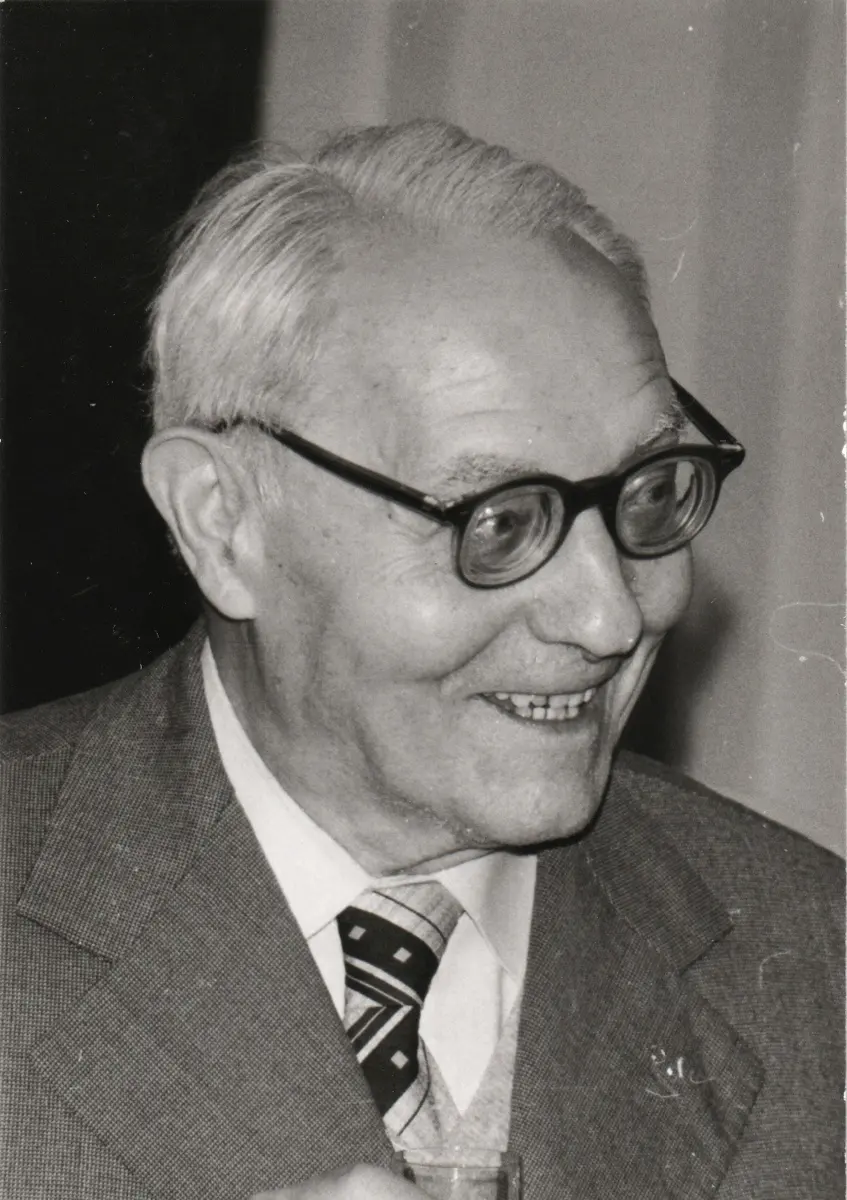
- The portrait of Borůvka, 24 September 1981: its Wikimedia Commons page, read October 2026.
- Every number in the topic (the hillside’s 783 spanning trees from 45 to 80 km, its one 45 km network and the next best 46 km, the order shortest first lays and crosses out its lines, growing from Besi, the 48 km network of shortest ways from Besi and its distances, the three-village and five-town examples, , the lineman’s 90 km, the longest-first 80 km) was computed in
checks/textbooks/math-further-9-12/26/tmp/village_numbers.py, and the junctions (the equilateral triangle’s 17.32 km and 13.4%, the widget’s two triangles, the square’s 30, 28.28 and 27.32 km) injunction_numbers.pybeside it.
