
Exam practice
Every question from the end of every unit, with hints and answers to open. After you check an answer, mark how you did, and come back to the ones you didn’t get.
23 questions
Unit 4 · Classification of Living Beings
Exercise (Vertebrates)
2. Fill in the blanks
Animals with a backbone are called ______.
Answer
Animals with a backbone are called vertebrates.
A fish swims in water with the help of its ______.
Answer
A fish swims in water with the help of its fins.
A frog’s webbed feet help it to ______.
Answer
A frog’s webbed feet help it to swim.
A snake ______ on the ground.
Answer
A snake crawls on the ground. (“Gills” is not needed.)
A monkey ______ its baby.
Answer
A monkey breastfeeds its baby.
3. Match the body covering with the animal
| Body covering | Animal |
|---|---|
| A. soft, moist skin | a.crab |
| B. scales | b.frog |
| C. hair | c.tortoise |
| D. dry, hard scales | d.danphe |
| E. feathers | e.rohu fish |
| f.cat |
Answer
- A. soft, moist skin: b. frog
- B. scales: e. rohu fish
- C. hair: f. cat
- D. dry, hard scales: c. tortoise
- E. feathers: d. danphe
The crab is left over. It has no backbone. Its body is covered with a hard shell.
5. Answer these questions
What do birds use their feet for?
Answer
For walking, running and hopping; for perching on branches; for catching and holding prey (an eagle); for scratching for food (a hen); and for swimming (a duck’s webbed feet).
When does a frog breathe with gills, with its skin and with its lungs?
Answer
- Gills: when it is a young tadpole in the water.
- Skin: when the grown frog is in water, and its moist skin helps on land too.
- Lungs: when the grown frog is on land.
How do the different parts of a bird’s body help it fly?
Answer
- Wings push down on the air and lift the bird.
- Feathers make the wings wide and smooth, and keep the body warm and light.
- A streamlined, boat-shaped body lets air flow past easily.
- Light, hollow bones and air sacs make the body light.
- A beak instead of heavy teeth and jaws keeps the head light.
- The tail helps it steer and slow down.
Draw a fish and a bird, showing their main features. Name the parts.
Answer
Your drawings should look something like these.
Most reptiles have two pairs of legs, but a snake has none. Why is a snake put in the reptile group?
Answer
Because it has all the other features of a reptile:
- its body is covered with dry, hard scales;
- it breathes with lungs;
- it lays eggs on land, with a tough shell;
- it has a backbone, a head, a trunk and a tail.
Having no legs is not enough to move it to another group. (Scientists have found tiny leftover hip bones in pythons. Long ago, the snakes’ ancestors had legs.)
Name the group of animals with these features.
- i.They lay eggs on land, breathe with lungs, and are covered with dry, hard scales.
- ii.Their body is covered with hair; they give birth to babies and breastfeed them.
- iii.Their body has scales and fins; they breathe with gills.
- iv.They have two pairs of legs and soft, moist skin; they breathe with lungs and skin.
- v.They have a boat-shaped body and light bones, and breathe with lungs.
Answer
- i.Reptiles
- ii.Mammals
- iii.Fish (Pisces)
- iv.Amphibians
- v.Birds (Aves)
Exercise (Plants)
2. Fill in the table
| Part of the plant | Monocot plant | Dicot plant |
|---|---|---|
| Root | ||
| Stem | ||
| Leaf | ||
| Seed |
Answer
| Part of the plant | Monocot plant | Dicot plant |
|---|---|---|
| Root | fibrous roots | tap root |
| Stem | hollow | solid stem |
| Leaf | parallel veins | reticulate veins |
| Seed | monocotyledonous (one cotyledon) | dicotyledonous (two cotyledons) |
3. Match the parts of a flower with their names
| Part | Name |
|---|---|
| a.the colorful, attractive part | A. gynoecium |
| b.the place where the four parts of the flower are joined | B. calyx |
| c.the male part | C. petiole |
| d.the green part of the flower | D. thalamus |
| e.the female part | E. androecium |
| F. corolla |
Answer
- a. the colorful, attractive part: F. corolla
- b. the place where the four parts are joined: D. thalamus
- c. the male part: E. androecium
- d. the green part: B. calyx
- e. the female part: A. gynoecium
The petiole is left over. It is part of a leaf, not a flower.
4. Name the parts of the leaf
Look at the leaf, and name each part from its description.
- the broad part of the leaf
- the part of the leaf joined to the stem
- the part of the leaf between the leaf base and the lamina
- the thick vein from the base to the tip of the leaf
Answer
- lamina
- leaf base
- petiole
- midrib
7. Answer these questions
Draw a fibrous root and a tap root. Write any two differences between them.
Answer
- A tap root has one thick main root growing straight down, with thinner roots branching from it. Fibrous roots are many thin roots from the bottom of the stem, all about the same thickness.
- Tap roots are found in dicots, like mustard and gram. Fibrous roots are found in monocots, like onion and maize.
Why is a gram plant called a dicot? Give any two reasons.
Answer
Any two:
- Its seed has two cotyledons: a soaked gram splits into two halves.
- Its leaves have a net of veins.
- It has a tap root.
- Its stem is solid.
Write the differences between a maize plant and a soybean plant, by their roots, leaves, stems and seeds.
Answer
Maize is a monocot; soybean is a dicot.
- Roots: maize has fibrous roots; soybean has a tap root.
- Leaves: maize leaves have parallel veins; soybean leaves have a net of veins.
- Stem: a maize stem has clear nodes and no branches; a soybean stem branches, and its nodes are not so clear.
- Seeds: a maize seed has one cotyledon; a soybean seed has two.
Look at the sugarcane stems in the photo.
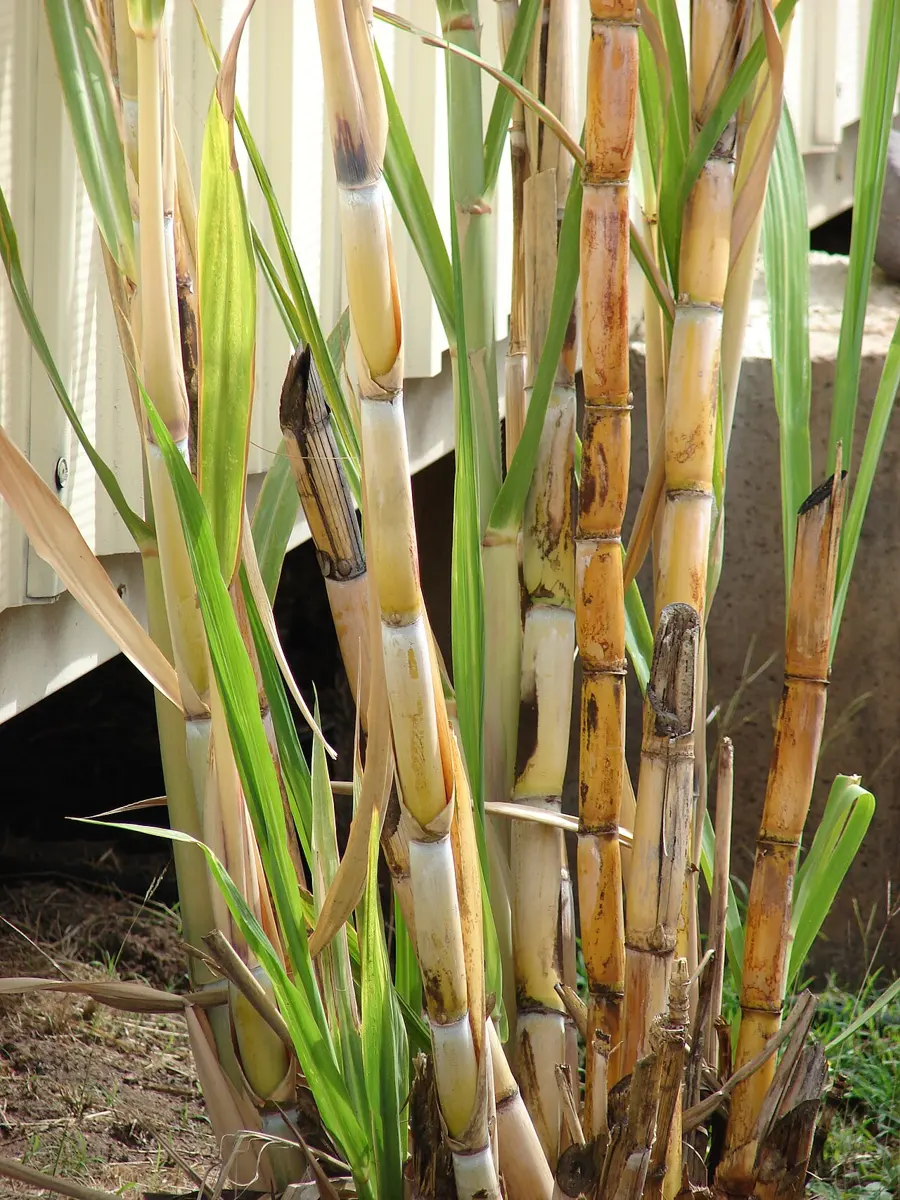
- i.Which part of the sugarcane is this?
- ii.From the photo, how can you tell a monocot from a dicot?
- iii.Draw the veins of a sugarcane leaf. What kind of veins are they?
Answer
- i.The stem.
- ii.The stem has clear nodes, like rings, with internodes between them. Monocots have clear nodes; in dicots, the nodes are not so clear. Its long, narrow leaves have parallel veins, another monocot clue. So sugarcane is a monocot.
- iii.Draw a long, narrow leaf, with a thick midrib and many fine lines running side by side from the base to the tip. They are parallel veins.
Why is a leaf called a plant’s kitchen?
Answer
Because the leaf is where the plant makes its food. Its green chlorophyll catches sunlight. With that light, the leaf makes food from water (from the roots) and carbon dioxide (from the air). Then the food goes to every part of the plant, just as food from the kitchen goes to the whole family.
What makes flowers attract insects?
Answer
- Their bright colors (the petals).
- Their sweet smell.
- The sweet juice, nectar, and the pollen, which insects eat.
Can petals make food? Give a reason.
Answer
No. Most petals are not green. They have no chlorophyll, so they can’t make food from sunlight. A plant makes its food mainly in its green leaves.
Look at the flower and answer the questions.
- i.Name the parts A and E.
- ii.In which process does the yellow powder in part B take part?
- iii.Why is it useful for part C to be colorful?
- iv.What happens if part B of the flower is damaged?
- v.When does part D protect the flower?
Answer
- i.A is the gynoecium, the female part. E is the pedicel, the flower’s stalk.
- ii.The yellow powder is pollen. It takes part in pollination, which leads to seeds.
- iii.C is the corolla. Its color attracts insects and birds. They carry pollen from flower to flower.
- iv.B is the androecium. If it is damaged, the flower can’t make pollen. That flower can’t pollinate others.
- v.D is the calyx. Its sepals protect the flower when it is still a bud.