
Exam practice
Every question from the end of every unit, with hints and answers to open. After you check an answer, mark how you did, and come back to the ones you didn’t get.
16 questions
Unit 24 · Animalia
Printable PDFs
- Study notes 5 pages
- Worksheet: Body plans, sponges to annelids 5 pages Answer key
- Worksheet: Arthropods to chordates 5 pages Answer key
B. Answer the following questions
Compare and contrast Hydra and Sycon.
Answer
Alike: both are aquatic, many-celled, diploblastic animals with a central cavity, no coelom, no respiratory, circulatory or excretory system, and both reproduce asexually by budding and regeneration as well as sexually.
Different:
| Hydra | Sycon |
|---|---|
| phylum Coelenterata, class Hydrozoa | phylum Porifera, class Calcarea |
| fresh water | sea water |
| tissue grade | cellular grade |
| radially symmetrical | radially symmetrical (many sponges asymmetrical) |
| cavity is the coelenteron (gastrovascular cavity), lined by gastrodermis | cavity is the spongocoel, lined by choanocytes |
| one opening, the mouth, ringed by tentacles | many small ostia and one osculum; no mouth or tentacles |
| nematocysts (stinging cells) | no stinging cells; a skeleton of calcareous spicules |
| digestion extracellular and intracellular | digestion intracellular only |
| a nerve net | no nerve cells |
| can glide and somersault | fixed (sessile) |
| larva: planula (in most coelenterates; Hydra develops directly) | larva: amphiblastula |
Mention any six unique features of the phylum Porifera. Classify this phylum, with examples.
Answer
Unique features:
- a.The most primitive multicellular animals, at the cellular grade of organization (no tissues).
- b.A body perforated by many pores: small ostia and a large osculum.
- c.A water canal system, through which water flows for food, oxygen and removal of waste.
- d.The internal cavity, the spongocoel, lined by flagellated collar cells, choanocytes.
- e.A skeleton of calcareous or siliceous spicules or spongin fibers.
- f.Adults sessile, fixed to the substratum; a free-swimming amphiblastula or parenchymula larva.
Classification (by the skeleton):
- a.Calcarea: calcareous spicules (monaxon, triradiate, tetraxon); small, in shallow seas. Sycon, Leucosolenia, Grantia.
- b.Hexactinellida (Hyalospongiae): six-rayed (triaxon) siliceous spicules; glass sponges of the deep sea. Euplectella, Hyalonema.
- c.Demospongiae: spongin fibers, with or without siliceous spicules that are never six-rayed; the largest class, including freshwater sponges. Euspongia, Spongilla, Cliona.
In which phylum does metagenesis occur? Also mention any six unique features of this phylum.
Answer
Metagenesis, the alternation of an asexual polyp generation with a sexual medusa generation, occurs in the phylum Coelenterata (Cnidaria), for example in Obelia.
Unique features:
- a.The first animals with the tissue grade of organization; diploblastic, with mesoglea between the two layers.
- b.Nematocysts (stinging cells) for catching prey and defense.
- c.A single internal cavity, the coelenteron (gastrovascular cavity), with one opening, the mouth: an incomplete gut.
- d.Polymorphism: polyp and medusa forms.
- e.Radial (or biradial) symmetry, with tentacles round the mouth.
- f.A diffuse nerve net, with no brain.
- g.A free-swimming planula larva; some build coral reefs.
In the biology laboratory, a student observes Ascaris of both sexes. How can the student tell the male from the female?
Answer
Ascaris shows clear sexual dimorphism:
| Male Ascaris | Female Ascaris |
|---|---|
| smaller: about 15–30 cm long | larger: about 20–35 cm long |
| thinner | thicker |
| the hind end is curved (bent like a hook) towards the ventral side | the hind end is straight |
| a cloacal aperture near the tail, with two penial spicules (copulatory spicules) sticking out of it | no spicules; a separate anus near the tail |
| genital papillae round the cloacal opening | a female genital pore (vulva) on the ventral side about a third of the way from the front |
What are mouthparts? What is a cephalothorax? Write any four peculiar features of Arthropoda.
Answer
Mouthparts are the jointed appendages around an arthropod’s mouth that take in food: in an insect, the labrum (upper lip), a pair of mandibles, a pair of maxillae and the labium (lower lip). They are modified for the animal’s food: for biting and chewing (cockroach), piercing and sucking (mosquito), sponging (housefly) or siphoning (butterfly).
A cephalothorax is the single body region formed when the head and thorax are fused, as in prawns, crabs and spiders, with the abdomen behind it.
Peculiar features of Arthropoda:
- a.Jointed appendages (the name means “jointed feet”).
- b.An exoskeleton of chitin, shed by molting (ecdysis) as the animal grows.
- c.A body divided into head, thorax and abdomen (or cephalothorax and abdomen), metamerically segmented.
- d.An open circulatory system, with a hemocoel and a dorsal heart.
- e.Compound eyes made of ommatidia.
- f.The largest phylum, more than four-fifths of all known animals.
Classify the phylum Mollusca, with two characters and examples of each class.
Answer
- a.Monoplacophora: a single limpet-like shell; internal organs repeated (gills, kidneys, muscles). Neopilina.
- b.Amphineura: a shell of eight plates (or none); a small head without eyes or tentacles. Chiton, Neomenia.
- c.Scaphopoda: a tusk-shaped shell open at both ends; no eyes or gills, a conical digging foot. Dentalium, Cadulus.
- d.Gastropoda: a single, spirally coiled shell; an asymmetrical body (torsion), a distinct head with tentacles and a flat creeping foot. Pila, Helix, Limax.
- e.Pelecypoda (Bivalvia): a shell of two valves; no head or radula, a hatchet-shaped foot. Unio, Pecten, pearl oyster.
- f.Cephalopoda: all marine; a head with large eyes and arms with suckers round the mouth; shell external, internal or absent. Sepia, Loligo, Octopus, Nautilus.
What are the three main features of the phylum Chordata?
Answer
At some stage of life every chordate has:
- a.a notochord: a flexible, supporting rod in the mid-dorsal line, below the nerve cord and above the gut (replaced by the vertebral column in vertebrates);
- b.a dorsal, hollow (tubular) nerve cord above the notochord (the brain and spinal cord in vertebrates);
- c.paired pharyngeal gill slits in the wall of the pharynx (for life in fishes and protochordates, only in the embryo of land vertebrates).
(A post-anal tail is often added as a fourth.)
Why is the hagfish not a true fish? Give reasons.
Answer
The hagfish is a cyclostome (division Agnatha), not a member of the superclass Pisces, which belongs to the jawed vertebrates (Gnathostomata). Unlike true fishes:
- a.it has no jaws: its mouth is a round sucking opening;
- b.it has no paired fins, only an unpaired tail fin;
- c.its skin is slimy and has no scales;
- d.it has a single nostril, and gills opening by round pores, not slits under an operculum;
- e.its skeleton is cartilaginous, with only a poorly developed vertebral column.
It is fish-shaped and lives in water, but it is a jawless vertebrate.
Complete the table.
| Phylum | Coelom type | Alimentary canal | Segmentation | Excretory organ |
|---|---|---|---|---|
| Platyhelminthes | pseudosegmentation | |||
| Annelida | complete | nephridia | ||
| Nemathelminthes |
Answer
| Phylum | Coelom type | Alimentary canal | Segmentation | Excretory organ |
|---|---|---|---|---|
| Platyhelminthes | acoelomate (no coelom) | incomplete (no anus), absent in tapeworms | pseudosegmentation (tapeworms; most are unsegmented) | flame cells (protonephridia) |
| Annelida | true coelom (schizocoel) | complete | metameric (true) segmentation | nephridia |
| Nemathelminthes | pseudocoelom | complete | unsegmented | renette cells (H-shaped excretory canals) |
Write any four differences between a spider and a prawn.
Answer
| Spider | Prawn |
|---|---|
| subphylum Chelicerata, class Arachnida | subphylum Mandibulata, class Crustacea |
| lives on land | lives in water |
| no antennae | two pairs of antennae |
| chelicerae (fangs) and pedipalps; no mandibles | mandibles and two pairs of maxillae |
| four pairs of walking legs | five pairs of walking legs, and swimmerets |
| no appendages on the abdomen (except spinnerets) | a pair of appendages on each abdominal segment |
| breathes by book lungs and tracheae | breathes by gills |
| only simple eyes | compound eyes on stalks |
| excretion by Malpighian tubules and coxal glands | excretion by green glands |
What are the unique features of Aves?
Answer
- a.A body covered with feathers.
- b.The forelimbs modified into wings.
- c.Jaws forming a toothless beak.
- d.A single skin gland, the preen (uropygial) gland.
- e.Pneumatic (hollow, air-filled) bones, and a keeled sternum for the flight muscles.
- f.Lungs joined to air sacs; the voice from the syrinx.
- g.A four-chambered heart; homeothermic.
- h.Uricotelic, with no urinary bladder.
- i.Only the left ovary works in the female.
- j.Large yolky eggs in a calcareous shell; all oviparous.
Echinoderms are unique animals among the invertebrates. Justify the statement.
Answer
- a.They are all marine, and benthic.
- b.The adults are radially symmetrical (in fives), though their larvae are bilateral and they come from bilateral ancestors: no other group changes symmetry like this.
- c.They have a water vascular system, found in no other animals, which works the tube feet used in moving, feeding and breathing.
- d.They have an endoskeleton of calcareous ossicles in the skin, with spines (“spiny skin”); other invertebrates have an exoskeleton or none.
- e.Many have tiny pincers, pedicellariae.
- f.They have no head, brain, heart or excretory system.
- g.They are deuterostomes and enterocoelomates, like the chordates: the invertebrates closest to us.
- h.They have great powers of regeneration.
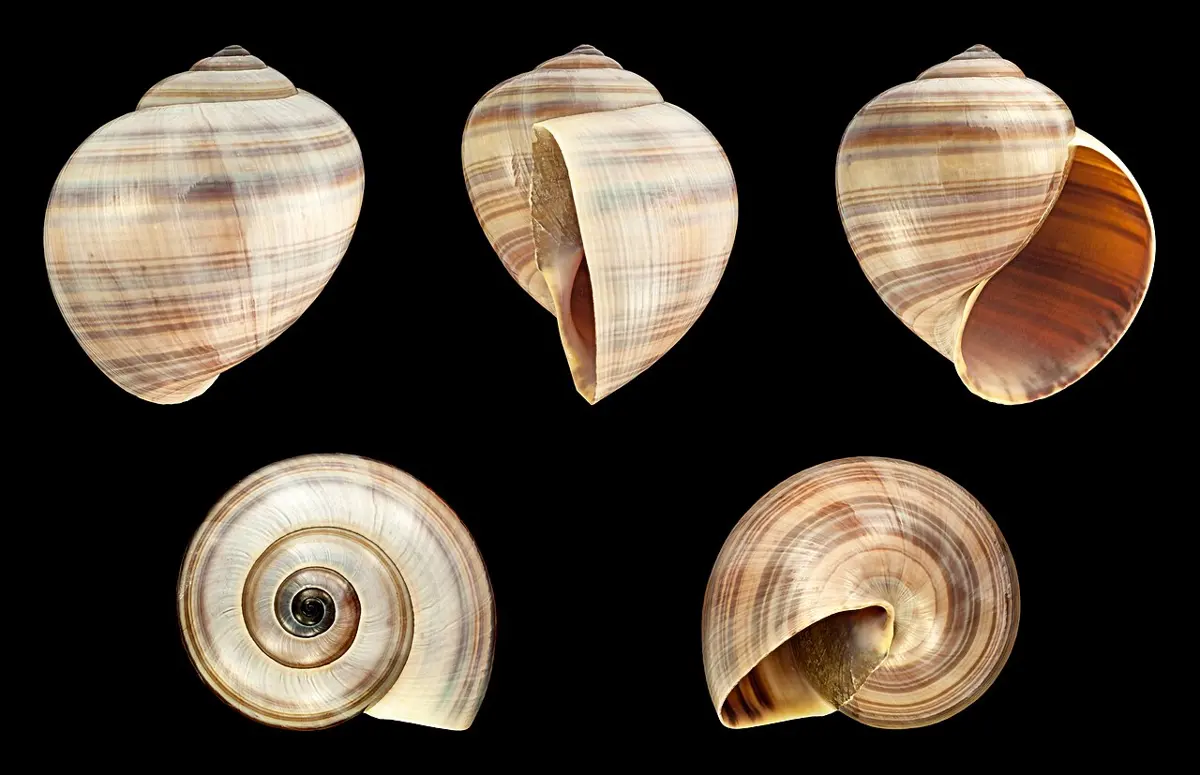
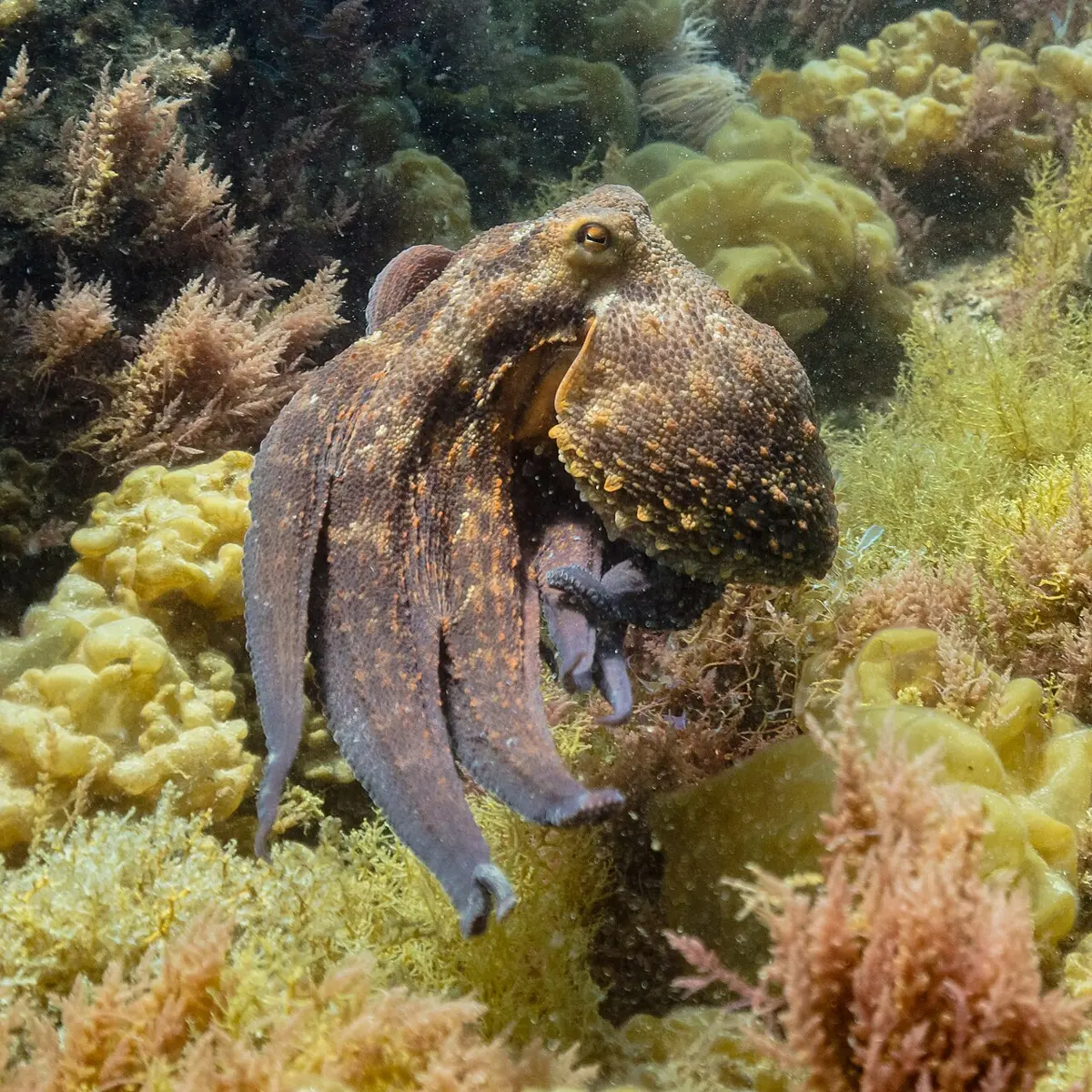
Identify the animals A and B and write any three differences between them.
Answer
A is the shell of an apple snail, Pila (class Gastropoda; the one in the photo is Pila ampullacea, a close relative of Nepal’s Pila globosa). B is an Octopus (class Cephalopoda). Both are mollusks.
| Pila (A) | Octopus (B) |
|---|---|
| in fresh water and rice fields; amphibious | marine only |
| a large, spirally coiled external shell with an operculum | no shell |
| body asymmetrical (torsion) | body bilaterally symmetrical |
| creeps on a broad, flat muscular foot | the foot is modified into eight arms with suckers and a siphon; swims by jet propulsion |
| small eyes on tentacles | large, well-developed eyes |
| an open circulatory system | a closed circulatory system |
| breathes by a gill and a pulmonary sac | breathes by gills |
How do you tell a millipede from a centipede?
Answer
| Millipede (Julus) | Centipede (Scolopendra) |
|---|---|
| body round (cylindrical) in section | body flattened dorso-ventrally |
| two pairs of legs on most body segments (each ring is two segments fused) | one pair of legs on each segment |
| short legs under the body; slow | long legs out to the sides; fast |
| no poison claws | the first pair of trunk legs are poison claws (forcipules) |
| short antennae | long antennae |
| genital opening near the front (third segment) | genital opening at the hind end |
| herbivore or detritivore (rotting leaves) | carnivore, a predator |
| defends itself by rolling up and giving off bad-smelling chemicals | defends itself by biting |
Mention any five characters of Osteichthyes and of Chondrichthyes.
Answer
| Osteichthyes (bony fishes) | Chondrichthyes (cartilaginous fishes) |
|---|---|
| fresh water, the sea and brackish water | mostly marine |
| a skeleton mostly of bone | a skeleton of cartilage |
| homocercal tail (equal lobes) | heterocercal tail (upper lobe larger) |
| mouth terminal | mouth ventral |
| cycloid, ctenoid or ganoid scales | tiny tooth-like placoid scales |
| four pairs of gills, covered by an operculum | 5–7 pairs of gill slits, uncovered |
| usually a swim bladder | no swim bladder |
| fertilization external; no claspers; mostly oviparous | fertilization internal; males have claspers; many ovoviviparous |
| e.g. rohu (Labeo), carp, seahorse | e.g. dogfish (Scoliodon), stingray (Trygon), Torpedo |
What are the differences between a pigeon and a bat?
Answer
Both fly, with wings made from their forelimbs, but the pigeon is a bird (class Aves) and the bat a mammal (class Mammalia).
| Pigeon | Bat |
|---|---|
| body covered with feathers | body covered with hair (fur) |
| the wing is a forelimb carrying flight feathers; the fingers are reduced and fused | the wing is a skin membrane (patagium) stretched over very long fingers |
| toothless beak | jaws with teeth |
| no external ear (pinna); one ear ossicle | an external ear (pinna), often large; three ear ossicles |
| no sweat glands; only a preen gland | sweat, sebaceous and mammary glands |
| no diaphragm; lungs with air sacs | a diaphragm; no air sacs |
| red blood cells nucleated | red blood cells without a nucleus |
| uricotelic; no urinary bladder | ureotelic; a urinary bladder |
| lays eggs (oviparous) | gives birth to young and feeds them milk (viviparous) |
| active by day; finds its way by sight | most fly at night; many find their way by echolocation |