
Imagine a town square in winter, ankle-deep in orange pulp, where thousands of people throw oranges at each other for three days and call it a celebration. Now imagine families around the world sitting down to a feast to say thank you for the harvest: turkey in the United States, rice cakes steamed on pine needles in Korea, palm nut soup in Ghana.
This unit reads both: a traveler’s story of the Battle of the Oranges in Italy, and a tour of harvest festivals around the world. Along the way you will learn to report a question (“She asked me whether I had seen it”), which the SEE tests every year, to find the stressed syllable in a word, and to write two things the SEE asks for: an essay about a festival and a news story from notes.
Getting started
The unit opens with four festivals celebrated in Nepal. Here is what each picture shows, and something you could say about it.
| Picture | The festival | Something to say |
|---|---|---|
| People laughing, their faces and clothes covered in bright powder | Holi, the festival of colors, on the full moon of Fagun | People throw colored powder and water at each other; it welcomes spring and celebrates the victory of good over evil. |
| Men embracing outside a great mosque with domes and minarets | Eid, which ends Ramadan, the Muslim month of fasting | After a month of fasting from dawn to sunset, families pray together, hug, share sweet dishes and give to the poor. |
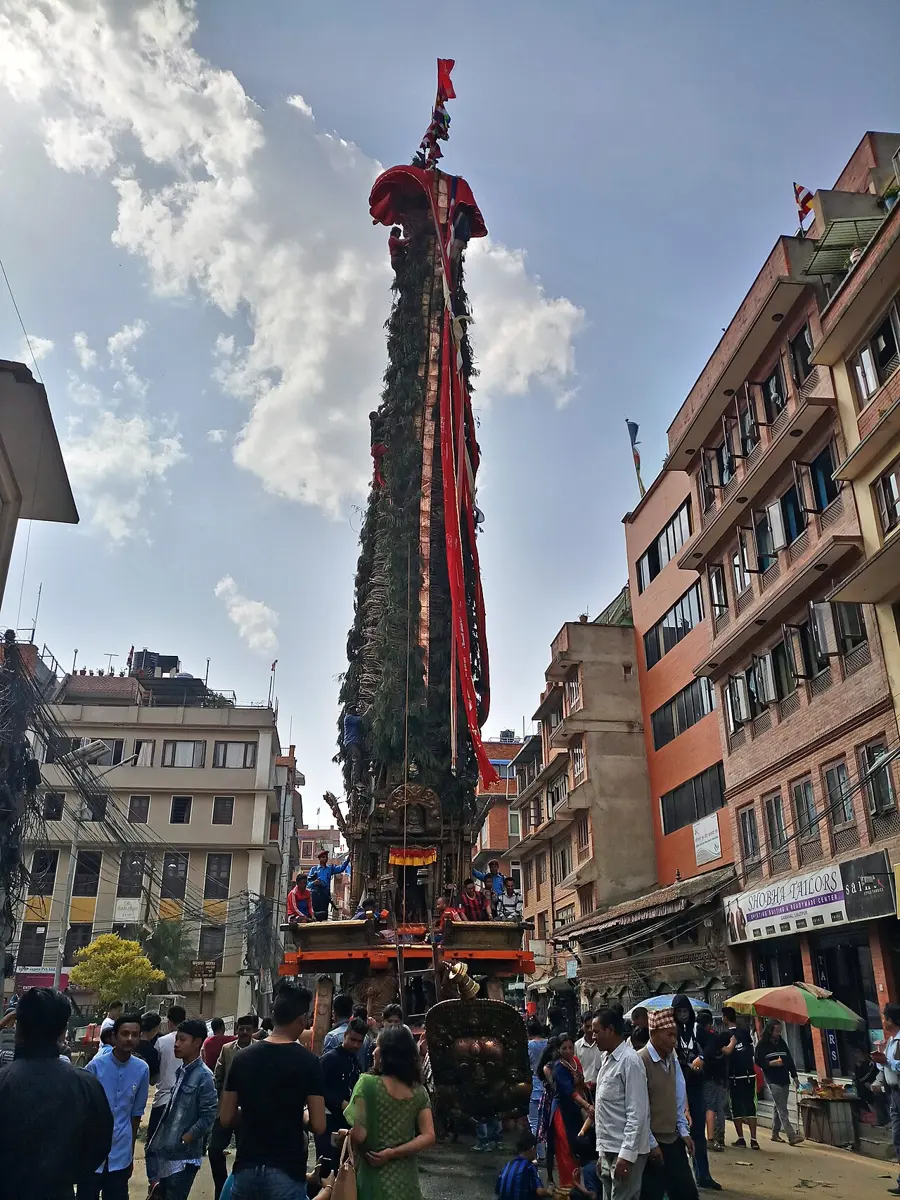
| A very tall chariot topped with green branches, pulled by a crowd | Rato Machhindranath Jatra in Lalitpur | The god of rain is pulled through the streets of Patan in a towering chariot before the monsoon, praying for good rain and harvest. |
| A three-roofed chariot in a crowded square of old brick buildings | Biska (Bisket) Jatra in Bhaktapur | Bhairav’s chariot is pulled to and fro in a tug-of-war between the two halves of the town, around the Nepali New Year. |
Reading I: Battle of the Oranges
Before you read
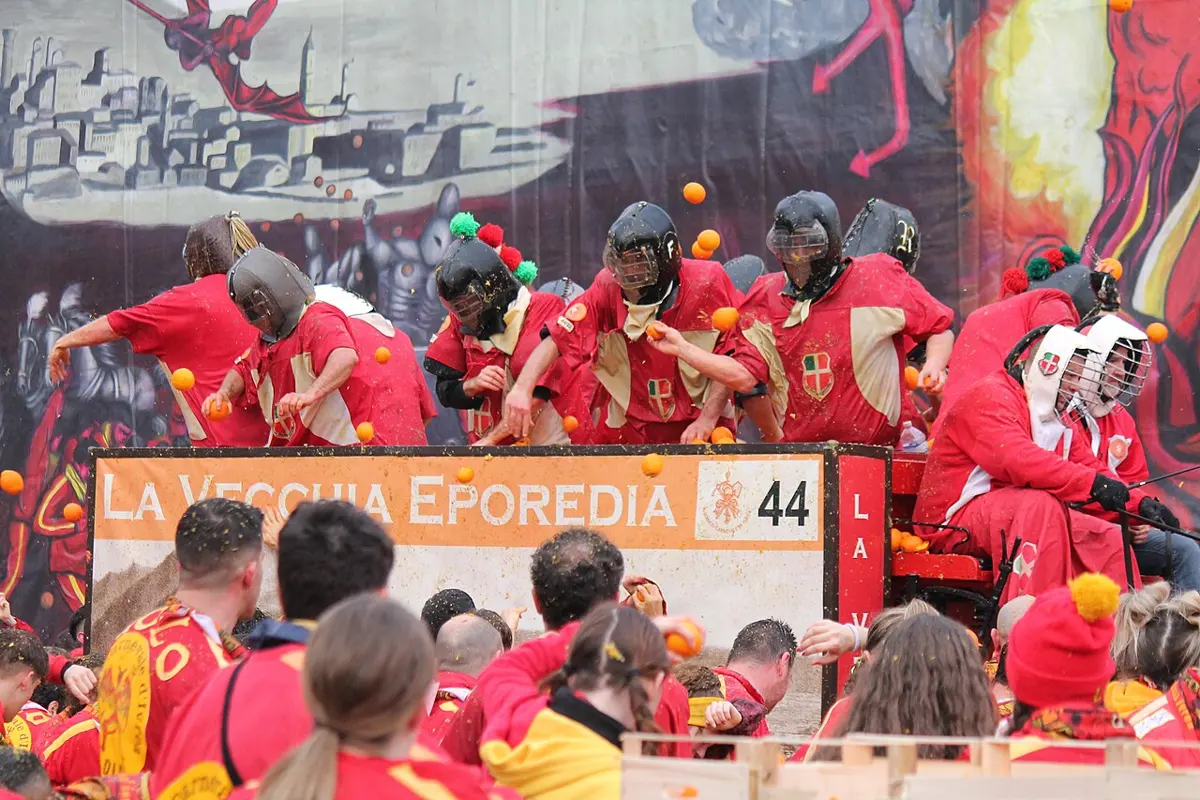
What is the man in the picture doing?
A model answer
Which is your favorite festival? Tell the class about it.
A model answer
What kind of text it is
The text is a first-person travel story: a visitor (her name, Margherita, is under the text) tells what happened to her at a festival in Italy. Three things give it life, and you can use them in your own writing:
- It is told in the present tense, as if it were happening now (“I am hit in the chest”), so you feel you are there.
- It mixes action (oranges flying, carts charging) with facts about the festival (the red hat, the teams).
- It lets the people speak for themselves: Silvia and Massi say in their own words why they love it.
The story, part by part
1. Hit!
The story starts in the middle of the action. The writer sees a flash of orange, an orange hits her in the chest, the breath goes out of her, and she slips and falls, bottom first, into a pile of squashed fruit. Her first thought is whether her red hat is still on. It is.
2. Why the red hat matters
She explains. During the carnival, notices are stuck up all over Ivrea, a town in northern Italy, telling everyone, and visitors above all, to wear a red hat. Anyone without one may be treated as a fair target for “gentle and moderate” orange-throwing. (The polite words are a joke: nothing about it is gentle.)
The hat is the berretto frigio, a soft, sock-shaped red cap sold on every corner. It is the symbol of the carnival and of freedom: in ancient Rome a cap like it was worn by slaves who had been set free, and in the Middle Ages by poor farmers who rose up against the lords who owned their land.
3. Blood?
She gets up and is hit again, on the forehead. Her head jerks back, she wipes her face and sees red. She is sure she will need stitches; maybe she is concussed! Then she remembers: blood oranges, a kind of orange with deep red flesh and juice. It isn’t blood at all. The joke is on her, and on the reader.
4. The battle
Shaking from the fright and then the relief, she moves to the back of the square. She explains that this is the first of three days of battles, so everyone is fresh and excited after waiting a whole year.
- Nine teams of aranceri (orange-throwers) on foot, in team uniforms, throw oranges hard at the people riding in horse-drawn carts.
- The riders wear padded costumes and leather helmets that look like something from a science-fiction show (Doctor Who is a British TV series).
- After an hour the square is a thick, sweet-and-sour smelling mud of orange pulp and horse dung.
- The throwers on foot run to the crates of oranges stacked at the sides, fill their bags and baggy shirts, and charge at each cart as it comes.
- The horses stop for a few minutes while oranges burst all over, then the cart moves on and the throwers chase it, hurling their last oranges.
- They wear no protection. Juice runs down their faces; some have broken noses or hold an aching cheek, arm or rib. But they hold their heads high and shout their team’s war cries.
5. Silvia: “it’s good for you”
Silvia, holding half an orange on her swollen right eye like an ice pack, says this is the moment she waits for all year, and she will be happy to have a black eye tomorrow. Sipping a hot spiced wine, she explains why: for her, the carnival is good for the mind. For three days she can let out all the frustration that has built up during the year, and afterwards she feels fresh. Accidents happen, she admits, but she says the writer should try it.
6. Massi: “forget the nets”
The writer admits she is curious. But she is wearing a hat, and the public are not supposed to throw, though some hat-wearers still throw an orange now and then. To prevent trouble, volunteers tell the public to stay behind protective nets.
Massi, a thrower of the Morte team (morte means “death” in Italian, which is why a huge skull is on his uniform), laughs at the nets: to live the carnival, you have to be in the middle of the battle. The writer asks if he isn’t afraid of getting hurt. He says that next to the thrill you get, a black eye is a small price to pay. Then, as a cart comes, he invites her to throw away her hat and join him.
She is tempted, but she declines. The story ends there: the writer stays a watcher, and leaves the reader to decide whether Massi is brave or mad.
Why does the writer think, for a moment, that she is bleeding?
Pick an answer to see why.
Why do visitors wear the red hat?
Pick an answer to see why.
Words from the story
Words linked here open in English Vocabulary, where you can see an example and practice them in the word game. The meanings are the ones the words have in this story.
| Word | Meaning here |
|---|---|
| flash | a sudden, very short sight of something |
| mush | a soft, wet, squashed mass |
| plastered (on the walls) | stuck up all over |
| symbol | a thing that stands for an idea (the red hat stands for freedom) |
| riot | to fight in the streets against people in power |
| feudal lord | in the Middle Ages, a lord who owned the land poor farmers worked on |
| jerk | to move with one sudden, sharp movement |
| concussion | a brain injury from a blow to the head, which can make you lose consciousness for a short time |
| succession | one thing quickly after another (“a quick succession of shock and relief”) |
| retreat | to move back, away from danger |
| hurl | to throw hard |
| opponent | the person or side you fight or play against |
| clad (in) | dressed (in) |
| sludge | thick, soft mud or a mud-like mixture |
| pulp | the soft part inside fruits and vegetables |
| crate | a large box for carrying fruit or bottles |
| bombard | to attack again and again with many things |
| clutch | to hold tightly |
| sip | to drink in very small mouthfuls |
| mulled (wine) | heated with sugar and spices |
| gigantic | very large |
| tempted | wanting to do something, though you know you perhaps shouldn’t |
| decline | to say no to an offer, politely |
A. Match the words with their meanings
Match the words with their meanings.
- a.mush
- b.jerk
- c.concussion
- d.hurl
- e.pulp
- f.clutch
- g.sip
- i.to throw something violently in a particular direction
- ii.to hold something tightly
- iii.a soft thick mass or mixture
- iv.to drink something, taking a very small amount each time
- v.to make something move with a sudden short sharp movement
- vi.a temporary loss of consciousness
- vii.the soft part inside fruits and vegetables
Answer
B. True or false?
The tourists are informed to wear a red hat through public notices.
Pick an answer to see why.
The aranceri seem dressed in Doctor Who-like costumes.
Pick an answer to see why.
When a cart approaches, the aranceri run away from the square.
Pick an answer to see why.
The narrator feels bored during the festival.
Pick an answer to see why.
The volunteers encourage the visitors to join the battle.
Pick an answer to see why.
The narrator accepts Massi’s offer.
Pick an answer to see why.
C. Answer the questions
What does the red hat symbolize?
Answer
How does the narrator feel when she wipes her face?
Answer
What does the square look like after an hour of the battle of the oranges?
Answer
How do the aranceri chase the cart?
Answer
Does Silvia enjoy this carnival? Why?
Answer
Why does Massi say, “Forget the nets”?
Answer
D. A strange festival
Strange festivals are celebrated in many parts of the world. Collect some information about any one of them and share it in the class.
A model answer
Pronunciation: syllables and stress
A syllable is a beat of a word, with one vowel sound at its heart: ex-plode has two, cel-e-bra-tion four. In a word of two or more syllables, one is stressed: said a little louder, longer and higher than the others. Clap the beats as you say each word, and the stressed one is the one you clap hardest.
| Word | Syllables | Stressed syllable | Said as |
|---|---|---|---|
| retreat | two | second | re-TREAT |
| concussion | three | second | con-CUS-sion |
| opponent | three | second | op-PO-nent |
| succession | three | second | suc-CES-sion |
| explode | two | second | ex-PLODE |
| celebration | four | third | cel-e-BRA-tion |
| consciousness | three | first | CON-scious-ness |
| liberty | three | first | LIB-er-ty |
The rules of word stress are in Word stress, at the end of the unit.
Speaking: reporting questions
A. A question and its report
In the story, the writer asks Massi, “Aren’t you afraid of getting hurt?” Reported, it becomes:
The reporter asked Massi if he was not afraid of getting hurt.
Four things changed: the reporting verb is asked; if joins the question on; the words go back into statement order (he was, not was he), with the person and tense changed as in any reported speech; and there is no question mark. Grammar I explains each step.
B. Questions about Chandi Naach
In a picture that comes with this task, a girl asks an older man about Chandi Naach, the dance of the Kirat people (Rai, Limbu, Yakkha and Sunuwar) at the Ubhauli and Udhauli festivals, when people dance in a circle to the beat of the dhol and jhyamta, copying the movements of farming, birds and animals.
Work in pairs: one asks, the other reports. Report the girl’s six questions, beginning “She asked him…”.
- a.“Have you ever seen Chandi Naach?”
- b.“Can you remember how you enjoyed the festival in your youth?”
- c.“Is there any ritual to perform it?”
- d.“Do you invite a priest for the ritual?”
- e.“How did you dance?”
- f.“What activity did you appreciate?”
Answer
Grammar I: Reported speech, questions
Unit 1 reported statements. Questions follow the same rules for person, tense, and time and place words, with three more changes.
1. A reporting verb for asking
Use asked, wanted to know, inquired or wondered, never said.
- asked takes the listener straight after it, or none: She asked me if… / She asked if…
- wanted to know and wondered take no listener straight after them: He wanted to know if… (or wanted to know from me if…)
- inquired takes of before the listener: Usha inquired of Anju how long…
2. If or whether for a yes/no question; the question word for the rest
A yes/no question (it starts with a helping verb: Are, Is, Do, Did, Have, Can, Will…) is joined with if or whether:
- “Are you working tonight?” → Agaman asked Timothy if he was working that night.
A wh-question (what, where, when, why, who, which, how, how long, how many…) keeps its question word as the joiner:
- “Where will you stay tonight?” → I asked him where he would stay that night.
3. Statement order, no do/does/did, no question mark
A reported question is not a question any more: it is a statement about a question. So:
- The subject comes before the verb: “Is this the road…?” → … if this was the road…
- Do, does and did disappear, and the main verb takes the tense: “What did you have?” → … what I had had. “Do you live in Patan?” → … if I lived in Patan.
- The sentence ends with a full stop.
The changes, in one table
| Direct question | Reported question (after asked) |
|---|---|
| “Are you hungry?” | She asked me if I was hungry. |
| “Do you like momo?” | He asked me if I liked momo. |
| “Did you see the jatra?” | She asked me whether I had seen the jatra. |
| “Have you been to Paris?” | He asked me if I had been to Paris. |
| “Can you swim?” | She asked me if I could swim. |
| “Where do you live?” | He asked me where I lived. |
| “Why did you go out last night?” | She asked me why I had gone out the night before. |
| “What are you going to do this weekend?” | He asked me what I was going to do that weekend. |
| “Who broke the window?” | She asked who had broken the window. |
The last one is different: when who or what is the subject of the question, the question is already in statement order, so only the tense moves back.
“Is the museum open on Saturday?” the tourist asked. Which is correct?
Pick an answer to see why.
“Where did you buy this hat?” Silvia asked me. In reported speech:
Pick an answer to see why.
Massi asks the visitor, “Will you come with me?” In reported speech:
Pick an answer to see why.
A. Report the questions, from the beginnings given
Change the following questions into indirect speech. The beginning of each sentence is given.
- a.“Are you working tonight?” Agaman asked Timothy ………
- b.“Is this the road to the station?” A stranger wanted to know from me ………
- c.“Did you do your homework?” My friend inquired of her ………
- d.“Have you been to Paris?” The tourist was asked ………
- e.“How long have you been working in this company?” Usha inquired of Anju ………
- f.“What flavor ice cream did you have at the party?” My mother asked me ………
- g.“Have you studied reported speech before?” The teacher wanted to know ………
- h.“Where will you stay tonight?” I asked him ………
- i.“How many players were shown a yellow card by the referee?” Sumangal asked his friend ………
- j.“What effect did the medicine have on the patient?” Sarita wanted to know from Sommaya ………
Answer
B. Report the questions
Change the following questions into reported speech.
- a.Kritika asked me, “Why did you go out last night?”
- b.“Who was that beautiful woman, Usha?” said Sunita.
- c.“How is your mother?” said Gaurab to Yang Dolma.
- d.My friend wanted to know, “What are you going to do at the weekend?”
- e.“Where will you live after graduation?” said my teacher.
- f.Anusha said to Melisha, “What were you doing when I saw you?”
- g.I said to the pilgrim, “How was the journey?”
- h.“How often do you go to the cinema?” said Krishna.
- i.“Do you live in Patan?” said the principal.
- j.Niraj said to Luniva, “Did Phadindra arrive on time?”
Hint
Answer
Writing I: An essay on a festival
Write an essay describing a festival which is celebrated in your community. Include its brief history, the people involved, its major activities, its religious or social importance, its duration, and its drawbacks, if any.
Hint
A model essay
How to write an essay
An essay is a piece of writing on one topic, set out in paragraphs. In the SEE, the free writing task may be an essay (about 200 words, 8 marks). Plan before you write:
- Title: short and clear (“Bisket Jatra: Bhaktapur Welcomes the New Year”).
- Introduction: what the festival is, when and where it is held, and how long it lasts.
- Body: one paragraph for each point the task names (history; people and activities; importance; drawbacks). Begin each paragraph with a sentence that says what it is about.
- Conclusion: your own view, and a hope or a suggestion.
Use the present simple for what happens every year (people pull, the pole is raised) and the past for history (the kings started, the prince killed).
Reading II: Thanksgiving around the world
Before you read
What kind of text it is
The text is an informative article in short sections, one for each country, under a heading. Each section answers the same questions: when the festival is, why it began, and what people eat and do. That makes it easy to scan for one fact (Exercise B asks you to).
The article, country by country
Introduction
Festivals are not only for fun: they show a people’s heritage, culture and traditions. Many countries hold a festival to give thanks for the harvest, with plenty of food and time with family and friends. Thanksgiving may seem purely American, but other countries keep the same tradition in their own ways.
1. Thanksgiving, United States
- When: the fourth Thursday of November; a national holiday.
- Why: it commemorates (remembers with a celebration) the feast the Pilgrims, English settlers, held after their first harvest in 1621. About 90 Native Americans and 53 Pilgrims attended. It was celebrated intermittently (on and off) after that.
- What: a family dinner is at the center of it: Americans eat more on Thanksgiving Day than on any other day of the year, even Christmas. Roast turkey is a must, about 45 million of them every year, with mashed potatoes, sweet potatoes, sweet corn and autumn vegetables, all foods first grown in the Americas.
- Parades, from a small town’s marching band to Macy’s Thanksgiving Day Parade in New York, which is called the world’s largest, with floats and giant balloons of cartoon characters and shows.
2. Chuseok, South Korea
- Also called Hangawi, or the Harvest Moon Festival; one of Korea’s most popular holidays.
- When: the 15th day of the eighth month of the lunar calendar (the full moon in September or early October).
- Why: to celebrate the autumn harvest and honor one’s ancestors. Koreans travel back to their family’s hometown, as many Nepalis go home for Dashain.
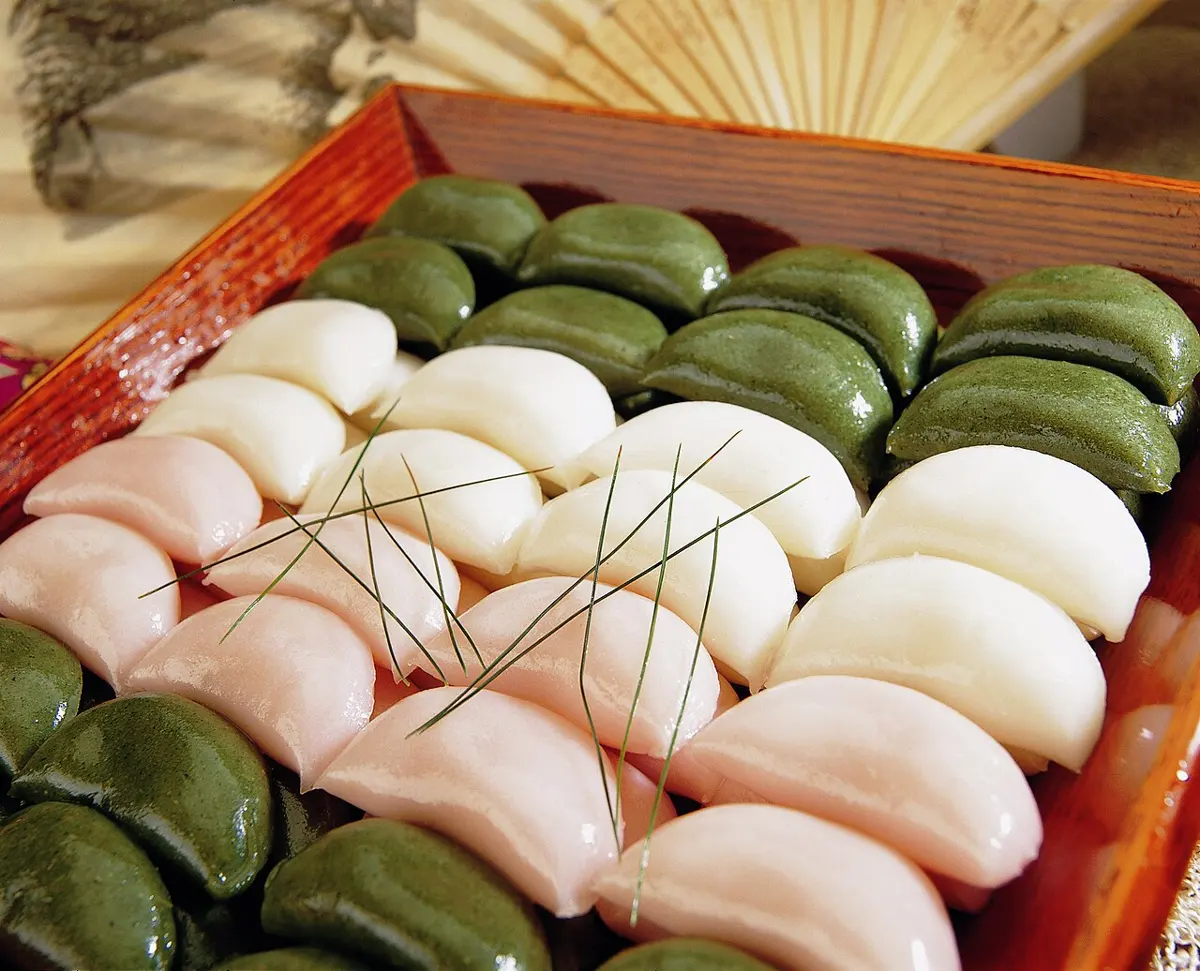
- What: the day begins with a ceremony offering food and wine to the ancestors, then a meal of fish and newly harvested vegetables and grains. The special food is songpyeon, a crescent-shaped rice cake steamed on a bed of pine needles. Later, families visit their relatives’ graves. There are gifts and games: tug-of-war, archery and ssireum, Korean wrestling; dancing, music, and hanbok, the traditional clothes.
3. Dia de Ação de Graças, Brazil
- A fairly new festival, celebrated with gusto (great enjoyment).
- How it began: a former president of Brazil, Eurico Gaspar Dutra, was so taken with Thanksgiving when he visited the United States that he started it at home in 1949.
- What: it begins with a church service (a mass) to give thanks for a rich harvest; then a lively carnival, and revelers head to the beach. Roast turkey is still the main dish, with a few exotic twists: cranberries don’t grow in Brazil, so the sauce for the bird is made from jabuticaba, the “Brazilian grape”.
4. Thanksgiving, Liberia
- A lively, spicy celebration, started in the 19th century by freed slaves from America who settled in Liberia, in West Africa. It gives thanks for freedom, celebrating the good things in life while remembering a painful past.
- What: after church, families eat roast chicken, green bean casserole and mashed cassava, all well spiced, then dance and sing into the evening.
5. Crop Over, Barbados
- Barbados’s biggest party, lasting 12 weeks, from May to August, ending in a huge final parade, the Grand Kadooment.
- Why: it began as a celebration of the end of the sugar cane harvest, from the 1780s, when Barbados was one of the world’s largest producers of sugar.
- What: carnivals fill the season, and calypso bands and dancers compete in ever bigger, more colorful (flamboyant) shows.
6. Homowo, Ghana
- Homowo means “to hoot (jeer) at hunger”. It celebrates the end of a long famine long ago.
- What: a feast, of course: palm nut soup with fish and kpokpoi, a dish of steamed, unleavened corn dough mixed with palm oil.
- When: from May, when millet is sown, through August and September. Before the feast, drumming and singing are banned, so that the crops can grow in peace. It ends with a night of singing, dancing and wild (frantic) drumming, defying hunger.
7. Mehregan, Iran
- An ancient festival, at least from the 4th century BC, held on the 196th day of the Iranian year (in early October).
- Why: a good harvest, and Mehr (Mithra), the old Persian divinity of friendship, promises and light.
- What: new clothes, community blessings, and a feast on a table decorated with marjoram (a sweet herb): sherbet drinks, rich dinners, and in some villages a sheep roasted slowly all day. People line their eyes with kohl for good luck and throw marjoram, lotus and sugar plum seeds over each other.
Which festival in the article began as a thank-you for freedom, not only for food?
Pick an answer to see why.
Why were drumming and singing banned before Homowo?
Pick an answer to see why.
Words from the article
| Word | Meaning here |
|---|---|
| intermittently | on and off, not every time |
| commemorate | to remember an important event or person with a celebration |
| lunar (calendar) | going by the moon |
| typically | usually; as is normal for that kind |
| crescent | the curved shape of the new moon, wide in the middle and pointed at both ends |
| celebrant | a person who takes part in a celebration |
| gusto | great enjoyment |
| abundant | more than enough; plentiful |
| vibrant | full of life and energy |
| reveler (British reveller) | a person having fun in a noisy way, with others |
| exotic | from another country, and seeming exciting and unusual |
| cassava | a starchy root eaten like potatoes in Africa and South America |
| douse | to pour a lot of liquid (or spice) over |
| top off | to end something in a special way |
| culminate | to end in a high point |
| finale | the last and most exciting part of a show |
| pervade | to spread through all of something |
| calypso | a kind of lively Caribbean song |
| flamboyant | brightly colored and showy, so that people notice |
| famine | a time when a whole region has too little food |
| frantic | fast, wild and not well organized |
| defiance | standing up boldly against something |
A. Find the words
Find the words in the text that have these meanings.
- a.in a way occurring at irregular intervals; not continuous or steady
- b.to remind people of an important event or person from the past
- c.in a way that shows the usual qualities or features of a particular type of person or thing
- d.a curved shape that is wide in the middle and pointed at each end
- e.full of life and energy
- f.a person who is having fun in a noisy way, usually with a group of other people
- g.from or in another country; seeming exciting and unusual
- h.to spread through and be easy to notice
- i.brightly colored and likely to attract attention
- j.done quickly and with a lot of activity, but not very well organized
Answer
B. Which country?
The following describe activities during Thanksgiving around the world. Write the name of the country where each is celebrated.
- a.Families gather for a feast in the evening accompanied by dancing and singing.
- b.People wear new clothes and get community blessings.
- c.Palm nut soup, fish and traditional kpokpoi are served.
- d.People return to their hometowns to celebrate the festival.
- e.Celebrants go to the beach in a noisy way.
- f.Parades are taken out in the streets.
- g.Food and wine are offered to the forefathers.
Answer
C. Answer the questions
What is the main feature of American Thanksgiving?
Answer
What do parades include in Thanksgiving in America?
Answer
When and why is Chuseok celebrated in Korea?
Answer
How did Thanksgiving begin in Brazil?
Answer
Who started Thanksgiving in Liberia? Why was it started?
Answer
What is Thanksgiving celebrated for in Barbados?
Answer
Why is Homowo marked in Ghana?
Answer
D. Thanks for the harvest at home
How do people express their gratitude for food and harvest in your community? Share with your friends.
A model answer
Listening: special days
The textbook’s listening task has five people talking about special days. CDC’s own recording is below: read the questions in B and C first, then listen, as many times as you need.
A. Before you listen
B and C. The textbook’s audio: answers
Do the speakers like or dislike each day?
- April Fool’s Day
- Earth Day
- Mother’s Day
- Father’s Day
- New Year’s Eve
Answer
Write True or False.
Speaker 1: a. One of his co-workers played tricks on everyone. b. He had a wonderful time.
Speaker 2: a. The book club planted flowers. b. He didn’t go anywhere on Earth Day.
Speaker 3: a. Her mother did not enjoy them making a mess in the kitchen. b. The kids served their mother breakfast in bed.
Speaker 4: a. He had a party with his friends. b. He went to a big family dinner.
Speaker 5: a. She went to a great party. b. The neighbors had a noisy party.
Answer
Practice listening alone
Grammar II: Reported questions in use
A. Choose the correct answers
Sujita asked her mother ……… .
Pick an answer to see why.
She replied that she had never had caviar when I said to her, “……… caviar?”
Pick an answer to see why.
The salesperson said to him, “What ……… for you?”
Pick an answer to see why.
The tourist inquired of me ……… to Banepa.
Pick an answer to see why.
The little girl asked us what time ……… to come back.
Pick an answer to see why.
The head teacher asked her ……… the exam form the week before.
Pick an answer to see why.
Renuka asked me ……… her.
Pick an answer to see why.
B. From the report back to the questions
Here the work goes the other way. Nihar Chaudhary interviewed her Social Studies teacher, Mr. Sudeep Prasad Joshi, about Ihi, also called Bel Bibaha, a Newar ceremony, and wrote a report. What did he tell her?
- Ihi is a ceremony in which Newar girls before their teens, usually between five and nine, are married to Suvarna Kumar, a golden image standing for the god Vishnu.
- It is done so that the girl will grow up healthy and able to have children. It is also said to have begun as a protection against Sati: a girl married to Vishnu, who never dies, could never be called a widow.
- A bel (wood apple) fruit is given as the witness of the marriage, which is why it is called Bel Bibaha. The bel was chosen because it does not rot easily, and so it is thought of as divine.
- The ritual takes two days in a row, which tires the girls and their parents, and the participants may not eat certain foods, especially salty ones.
Read Nihar’s report (summarized above) and write the direct questions she must have asked.
Hint
Answer
Writing II: A news story
Write a news story using the following clues.
Vitamin A Capsules Given to Children
- health assistants give vitamin A capsules, October 19–20
- children from six months to five years
- deworming tablets to children between 1 and 5 years
- announced by the Department of Health Services
- vitamin A program running since 2050 BS, deworming since 2056 BS
Hint
A model news story
How to write a news story
A news story reports something that has just happened, for readers who want the facts fast. Its shape is an upside-down triangle: the most important facts first, the details after.
- Headline: short, in the present tense or passive, no full stop (“Vitamin A Capsules Given to Children”).
- Dateline: the place and date (Kathmandu, October 20).
- Lead (the first paragraph): answers who, what, when, where (and why or how) in one or two sentences.
- Body: more details in order of importance; who said or announced it (according to…, officials said…).
- End: what happens next, or a quote.
Write it in the third person, in the past tense for what happened, and keep your own opinion out.
Project work
Word stress
Stress is the extra force given to one syllable of a word (or one word of a sentence). English uses it to tell words apart: a PRES-ent (a gift) and to pre-SENT (to give). These rules help you guess where the stress falls in a word you have never heard; each has exceptions, so check a dictionary when you can.
| Rule | Examples |
|---|---|
| 1.A word of one syllable is stressed on that syllable, when said on its own. | do, pot, song, read |
| 2.Most two-syllable nouns and adjectives stress the first syllable. | FA-ther, HAP-py, TA-ble, a PRES-ent |
| 3.Most two-syllable verbs stress the second syllable. | cor-RECT, pre-SENT, be-LIEVE, ex-PLODE |
| 4.Most three-syllable nouns and adjectives stress the first syllable, but not those ending in -eer, -ee or -ese, which stress the end. | POL-i-tics, GEN-er-al, EX-cel-lent; en-gi-NEER, Nep-a-LESE |
| 5.Many three-syllable verbs stress the first syllable, but many others stress the second, especially those with a prefix. | OR-gan-ize, DEC-o-rate, SIG-ni-fy; re-MEM-ber, con-TIN-ue, de-TER-mine |
| 6.Words ending in -cy, -ty, -phy, -gy stress the third syllable from the end. | de-MOC-ra-cy, un-CER-tain-ty, pho-TOG-ra-phy, bi-OL-o-gy |
| 7.Compound nouns stress the first part. | HAIR-brush, CLASS-room, BREAK-fast, FOOT-ball |
| 8.Words ending in -tion, -sion, -ic stress the syllable just before the ending. | cel-e-BRA-tion, con-CUS-sion, sci-en-TIF-ic |
Where is the stress in photography?
Pick an answer to see why.
“They will record the festival songs.” Here record is said:
Pick an answer to see why.
Exercise
SEE-style practice on this unit. Try each one as in the exam, then open the answer.
Change these questions into indirect speech.
- a.“Where do you keep the oranges?” the visitor asked Massi.
- b.“Is Chuseok a holiday in Korea?” Rina asked her teacher.
- c.Bina said to me, “Did you watch the chariot festival yesterday?”
- d.“How many people came to the jatra?” the reporter asked the police.
- e.The teacher said to us, “Can you name three harvest festivals?”
- f.“Who brought the sel roti?” my grandmother asked.
Answer
Choose the correct answer for each numbered blank.
On the first day of Bisket Jatra, a visitor from Japan stopped me and asked (a) ……… (where, what, that, if) the crowd was going. I told her that they (b) ……… (are pulling, were pulling, pull, will pull) Bhairav’s chariot to Taumadhi. She asked me whether I (c) ……… (have, has, had, having) ever pulled the chariot myself, and (d) ……… (why, if, that, what) people pulled in two directions. Then she wanted to know (e) ……… (can she, if she could, she can, could she) take photos. Finally she asked me (f) ……… (what time did the pole fall, what time the pole fell, what time the pole would fall, what time will the pole fall) on New Year’s Eve.
Answer
Read the passage and write True or False.
Every year in Bhadra, the people of Kathmandu pull the chariot of the Living Goddess, Kumari, through the old city during Indra Jatra. The festival lasts eight days. Masked dancers act out stories of the gods, and a tall wooden pole is raised outside the old palace on the first day. The festival marks the end of the monsoon and gives thanks to Indra, the god of rain.
- a.Indra Jatra is a festival of Lalitpur.
- b.The Kumari is pulled in a chariot.
- c.The festival lasts about a week.
- d.The pole is raised at the end of the festival.
- e.The festival thanks the god of rain.
Answer
Write a news story for a national daily, using these clues: a tree-planting campaign — Eco Club of a school in your district — Saturday — 300 saplings planted along the river bank — students, teachers and the ward chairperson — plan to look after them for two years.
A model news story
Write an essay of about 200 words on “The festival I like most”.
Hint
Practice every question in the book, and keep track of the ones you miss →
A companion to your textbook, not a replacement for it: study from the book your school uses, and where the two differ, follow your teacher. Found a mistake? Please tell us.