
First, find the right country. It should be well ruled and righteous, with plenty of food and no unrest. There, build a hut with a small door, no cracks or holes, neither too high nor too low, its floor thickly smeared with cow dung, a well and a verandah outside, a wall all round. Live in it free from worry. Don’t overeat, don’t chatter, don’t wear yourself out, and keep away from crowds. Only then does the practice begin.
That is how the most famous handbook of physical yoga sets out its teaching. It is the हठप्रदीपिका (Haṭhapradīpikā), “the light on haṭha”, widely printed under a longer name, the हठयोगप्रदीपिका, and it was put together by a yogi called स्वात्माराम (Svātmārāma) in about 1400. It is short, four chapters of verses, and it became the book that every later writer on हठ योग, the yoga of force, turned to. It is the book most people mean when they speak of the old texts of physical yoga.
What it teaches is a ladder, and it says so in its very first verse: the science of हठ is a splendid stairway for anyone who wants to climb to the royal terrace. The terrace is राजयोग (rājayoga), “royal yoga”, the stilled mind that Patanjali had described. The rungs are four, given in one verse: first the postures, then the many kinds of holding the breath, then the bodily techniques called seals, and last a deep concentration on a sound heard inside. The body is worked on so that the mind can come to rest. And along the way, the book promises, come health, a long life, strange powers and, at the very top, freedom from death itself.
A book made of other books
स्वात्माराम did not invent his yoga. He gathered it. Most of the हठप्रदीपिका is made of verses taken from earlier works, some on हठ and some on other kinds of yoga, written between the twelfth and fifteenth centuries, which he fitted together into one course. He tells us where his teaching came from: from Matsyendranath and Gorakhnath, through their favor, and he lists nearly thirty perfected yogis of their line who, he says, “used the power of हठयोग to smash the rod of death” and are roaming the worlds still. About himself the book says little else.
It was copied and copied. Scholars know of at least two hundred and fifty manuscripts, in collections across India and the world, and the oldest that carries a date was written within a century of the author. It has been translated hundreds of times. Yet every printed version rested on a handful of manuscripts from one part of India until a team at Oxford and Marburg recently published an edition made from more than two hundred of them, with a new English translation. Most of what this chapter quotes from the book is from that edition.
The book is practical from the start. Before any pose, it tells the yogi what to eat: wheat, rice and barley, milk and ghee, butter, sugar and honey, mung beans, a few vegetables, rainwater. It tells him what to avoid: food that is sour, salty, pungent or reheated, mustard and sesame, garlic and asafoetida, fish, meat and alcohol. The stomach should be left a quarter empty. Six things ruin yoga, it says: overeating, overexertion, idle chatter, breaking one’s vows, too much company and sensuality. Six make it succeed, among them zeal, courage and contentment. And then, a little surprisingly for a book so strict, it adds that anyone can succeed by practice: young, old, very old, even sick or weak.
The postures
The first rung is आसन (āsana), the posture, and here a modern reader is in for a surprise. The हठप्रदीपिका describes only fifteen.
It explains why it can be so brief. Shiva, it says, taught eighty-four postures, and from them it takes the four best: the adept’s pose, the lotus, the lion and the auspicious pose, all of them ways of sitting. Of these, one stands above all, सिद्धासन (siddhāsana), the adept’s pose, a cross-legged seat with one heel pressed firmly under the body. It is the single most important of all postures, the book says, and twelve years of it, with a careful diet and meditation, bring the yogi to the end of yoga. “What is the point of the many tiring postures,” it asks, “when there is सिद्धासन?”
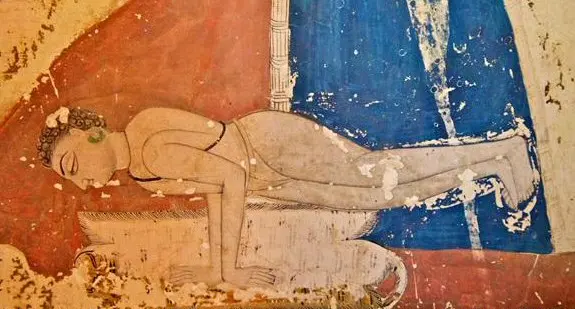
The other eleven are a mixed group. There are a few more seats, a twist named after Matsyendranath, a forward bend in which the yogi sits with his legs straight out and his forehead on his knees, a pose in which he holds his toes and draws them back like a bowstring, and a balance on the hands with the body held straight in the air like a stick, the peacock. Each comes with a promise. The forward bend sends the breath into the central channel, kindles the digestive fire and makes the belly thin. The peacock quickly cures all illnesses, those of the belly first, burns up bad food or too much food, and lets a yogi digest strong poison. The last of these eleven, lying on the ground on one’s back like a corpse, removes the tiredness the others cause and calms the mind.
That short list is one of the most useful things to know about these books. Their yoga was mainly sitting still, breathing and pressing, not a long sequence of stretches. The long lists came later. A text of the seventeenth century, the हठरत्नावली (Haṭharatnāvalī), names eighty-four postures; manuscripts of the eighteenth century describe ninety, a hundred and ten, a hundred and twelve, most of them not seated but bending, twisting or balancing, some done with ropes, though hardly any of the standing poses common today. How those grew into the poses on a modern yoga mat is a story of the twentieth century, told later in this book, in Yoga on the Mat.
Cleaning the body
Between the postures and the breath, the हठप्रदीपिका sets the षट्कर्म (ṣaṭkarma), the six cleansings. They are not for everyone, it says. A person with too much fat and phlegm should do them first; anyone whose humors are in balance should not. The words are Ayurveda’s, the दोष of Three Doshas, and the idea is a physician’s: clear out the excess, and the rest goes smoothly.
The six are plain enough to describe without teaching them. In धौती (dhautī), a long wet strip of cloth, four fingers wide, is slowly swallowed and drawn out again. In वस्ति (vasti), the yogi squats in water up to the navel with a small tube in the anus and draws the water in, to flush the bowel. In नेती (netī), a thread is passed up through the nose and out of the mouth. In त्राटक (trāṭaka), he stares at a small point without blinking until tears come. In नौली (naulī), he rolls the muscles of the belly round and round, “with the speed of a rapid whirlpool”. And in कपालभाति (kapālabhāti), “the skull bellows”, he breathes in and out very fast, like a blacksmith’s bellows. Each, again, has its promise: the cloth drives out coughs, wheezing and skin disease and twenty diseases of phlegm, the thread gives “divine sight”. The book also records a debate. Some teachers, it says, held that breath control alone dries up every impurity, and needed none of this.
Later books went much further. The घेरण्ड संहिता (Gheraṇḍa Saṃhitā), the other manual most often printed, opens with its cleansings, and divides them into many kinds: washings of the teeth, the tongue, the ears and the throat, the stomach filled with air or with water and emptied, and stranger ones. One asks the yogi to stand in water up to the navel, draw out his intestines, wash them and put them back. An early English translator, who had seen his own teacher do many of these practices, called that one “a little dangerous”; a scholar of these texts today counts it among the practices nobody can actually do.
Seals and locks
The third rung is the strangest to a modern reader, and to the books themselves the most precious. A मुद्रा (mudrā), “seal”, is a whole-body technique, and a बन्ध (bandha), “lock”, is one kind of seal, a squeezing of one part of the body to hold something in. The हठप्रदीपिका teaches ten. It calls them a secret to be guarded like a casket of gems, and says they destroy old age and death and give the eight great powers, such as becoming as small as an atom.
Three are locks. The root lock squeezes the base of the body, to force the downward breath to turn and rise. The “flying up” lock draws the belly back and up. The throat lock presses the chin to the chest, so that, in the book’s picture, the nectar dripping from the head does not fall into the fire of the belly and burn. Others go further. In the “inverted” position the yogi keeps his head down and his feet up, a short while on the first day and longer each day after, and is promised that in six months his gray hair and wrinkles will vanish. In खेचरी (khecarī), “moving in the sky”, the tongue is lengthened little by little, by “cutting, moving and milking” it, until it can be turned back into the hollow above the palate; there, the book says, it drinks the nectar, and the yogi knows no disease, death, sleep, hunger or thirst. Another seal, वज्रोली (vajrolī), was meant to keep a man’s seed from being lost, because these books held it to be life itself: “death arises through the loss of semen, and life from retaining it.”
Read as a whole, the seals show what the हठप्रदीपिका is really for. Postures steady the body, breath control quiets it, and the seals are meant to turn its forces round, to send the breath up the central channel, to wake the coiled power at the base of the spine and to stop the slow drip of life that makes people age. Health is a promise along the way. The goal is a mind so still that, in the book’s closing verses, the breath does not move in or out, up or down, and the yogi is free.
The other manuals
The हठप्रदीपिका had company. Earlier there was the शिवसंहिता (Śivasaṃhitā), and before it the books it drew on. Later came the long scholarly compilations of the sixteenth to eighteenth centuries, and the घेरण्ड संहिता.
The घेरण्ड संहिता is written as a conversation. A man named Chanda Kapali comes to the hut of the sage Gheranda and asks to be taught the yoga of the body, and Gheranda answers him lesson by lesson. Its picture of the body is one of its best lines: the body is like an unbaked clay pot thrown into water, soon dissolved, so bake it hard in the fire of yoga. It divides the path into seven limbs, each with its gift: cleansing purifies, posture strengthens, seals steady, drawing in the senses calms, breath control lightens, meditation brings perception of the self and समाधि (samādhi), the deepest absorption, brings freedom. It says there are as many postures as there are kinds of living creatures, 8,400,000, that Shiva chose eighty-four of them as the best, and that thirty-two are useful to people in this world. It teaches twenty-five seals. CDC’s Grade 10 yoga book calls Gheranda a teacher of the sixteenth or seventeenth century, while saying that neither his life nor his exact time is clear; historians who have studied the manuscripts place the book itself in the seventeenth or eighteenth century, long after the हठप्रदीपिका.
Promises and warnings
The manuals promise a great deal. Correct practice destroys all diseases. The yogi grows lean and bright, his eyes shine, he hears the inner sound clearly. He becomes “sixteen years old” again, floats on water, digests poison, gains powers and cheats death. These are the books’ own claims, made in the language of their time, and the book you are reading doesn’t test them here; whether yoga helps with any illness is a question for modern trials, the subject of this book’s last part.
They also warn, often and sensibly. Learn from a teacher, never from the book alone. Begin slowly; the inverted pose a little more each day. Eat enough, or the fire the practice kindles will burn up the body. In the first stage, keep away from fire, women and long roads. Keep it secret, because a technique told to everyone loses its power. The breath, above all, is to be handled with care; how carefully, and why, is the subject of Breath.
Some of what the books teach carries risks that are written down today. The United States’ National Center for Complementary and Integrative Health advises people new to yoga to avoid headstands, shoulder stands, forceful breathing and the lotus position, which is one of the हठप्रदीपिका’s four best. For rinsing the nose with salt water, a common practice today, the United States’ drug regulator warns that tap water is not safe, because some of the tiny organisms in it can survive in the nose and, in rare cases, cause fatal infections; it should be distilled, sterile, or boiled and cooled. And the books themselves contain practices nobody can do, and breath-holds far longer than any ever verified in modern tests. That is a reason to read them as history, not as a manual for your own body.
So the हठ manuals are handbooks of a yoga worked through the body, to still the mind. The हठप्रदीपिका, put together by स्वात्माराम in about 1400 from earlier books, climbs a ladder of four rungs: a few postures, mostly seated, the holding of the breath, the seals and locks, and concentration on an inner sound. On the way it adds six cleansings for those who need them. The घेरण्ड संहिता, a much later book, sets out seven limbs and many more cleansings, postures and seals, and later books listed more than a hundred postures. They promised health, youth, powers and freedom from death, and they warned their readers to go slowly, with a teacher.
Found a mistake? Please tell us.